
Knowledge · Tackle
Fishing trousers: Tough, dry and tick-proof
Fishing trousers have more to put up with at the water than leisure trousers: wet grass, kneeling in bank mud, thorns, wind on the boat and hours on a cold seat. This page covers which type suits what, how layers keep you warm in winter and what the trousers do against ticks.
What acts on your trousers at the bank
Wet at the water rarely comes only from above: dew on the bankside grass, damp ground when you kneel, rain on the bivvy chair. Which places suffer most is described by the Blinker magazine for waders: knees and seat, and the inner sides of the legs where the fabric rubs as you walk. Thorns and barbed wire make small holes there. With fishing trousers it is the same places, because you kneel and sit on them.
The second load is cold, and when you sit and wait it often comes from below. The Berufsgenossenschaft der Bauwirtschaft (BG BAU) advises people working outdoors to avoid contact with cold surfaces and, when standing for long, to put mats under their feet against ground cold. For the same reason a seat pad belongs to a sit-and-wait session, because cold ground draws a lot of heat from the body.
Fabrics: cotton, merino and membrane
Jeans are made of cotton. An article in Rute & Rolle gives up this material entirely for fishing in the cold: it does warm, but holds moisture and dries very slowly. If you move and sweat, you end up standing at the water clammy. Synthetic fibres or merino wool are better.
Why sweat matters so much is explained by BG BAU. If it collects in the layers of clothing, cold bridges form. As soon as you move less, the moisture evaporates there and the body loses a lot of heat. Merino wool and similar fabrics carry sweat away from the skin to the outside.
Membrane and water column
Breathable weatherproof trousers work with a membrane, a thin layer between layers of fabric. The principle can be shown well with waders: the membrane lets no liquid water through, but lets part of the water vapour out from the inside. It works best when it is warmer and more humid inside than outside. It cannot prevent sweating entirely.
When buying you will come across the figure water column. It states the water pressure the fabric is meant to withstand; 10.000 mm stands, in calculation, for the pressure that ten metres of water exert. Blinker puts the laboratory value into perspective: whether trousers stay waterproof depends just as much on the seams, the protection of the membrane and the fit. Dirt, sweat and skin grease reduce the function of the outer fabric. So membrane trousers too are washed according to the care label and dried inside and out after fishing.
Types for bank, boat and winter
What counts in the choice is cut, lining and fabric, not the model.
| Design | Use | What to look for |
|---|---|---|
| Rain or over trousers | showers, wet grass, spray | room for the layers underneath |
| Thermal trousers | cold days, long sit | lining, moisture carried outwards |
| Bib trousers, overalls | winter, boat, ice | back and kidneys covered |
| light summer trousers | heat, tall grass | long, light-coloured, densely woven |
Over trousers: They are the outer layer. BG BAU advises choosing outer clothing big enough that the inner layers fit well beneath it. When trying them on, you wear the underwear layers you will use later, squat down and kneel. If the fabric pulls tight over knees and seat, the trousers are too small.
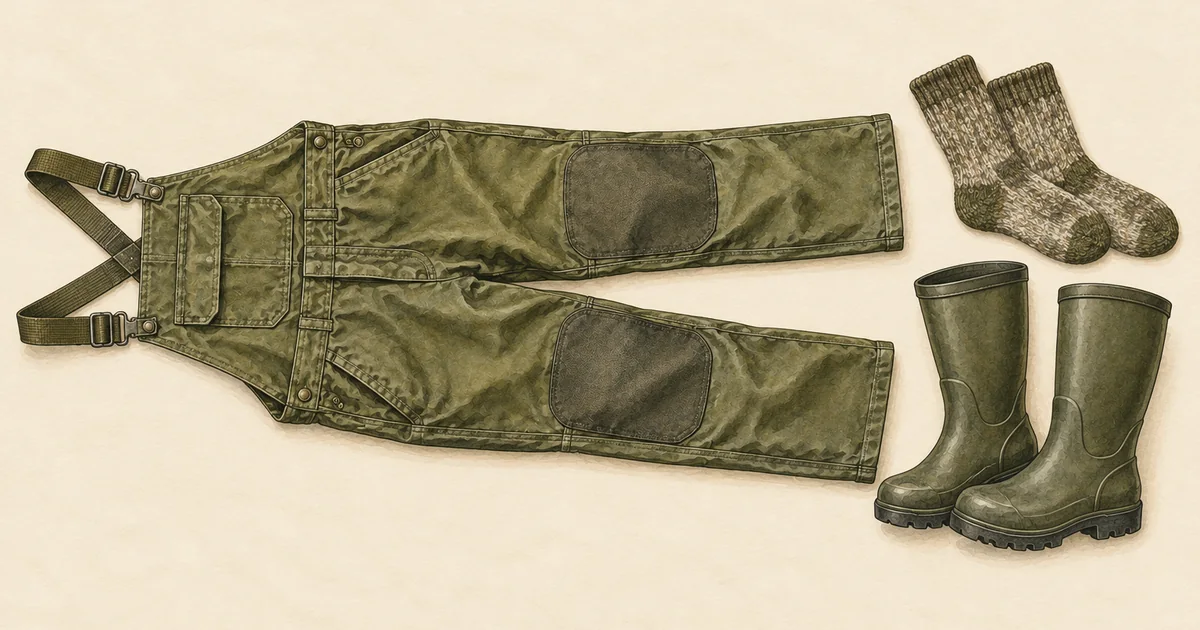
Thermal and bib trousers: Thermal trousers are lined. Breathable thermal clothing keeps you warm and at the same time carries moisture outwards. Bib trousers and overalls solve a problem of waistband trousers: when you sit and bend, the waistband slips and the lower back is bare. BG BAU advises looking for a cut in winter clothing that covers back and kidneys well.
Summer trousers: According to the Federal Office for Radiation Protection (BfS), clothing is the best sun protection outdoors. How much UV radiation a fabric blocks depends mainly on the type of weave and density, the more densely woven the better. For clothing with stated UV protection, what counts according to the BfS is above all the test standard given: only UV Standard 801 also measures on wet, stretched fabric.
On the boat
On the water you lack the wind shelter of the bank. The brochure „Sicherheit auf dem Wasser“ from the Federal Ministry of Transport, the BSH and the Waterways Administration warns that wind alone can cause hypothermia at air temperatures below 15 °C. It advises taking warm trousers, socks, a pullover and underwear, if possible in duplicate. Waterproof and windproof over trousers, which BG BAU names as weather protection, keep off spray and the wet bench. For a fall into the water the brochure names dry suits or neoprene suits as protection against hypothermia. Rain trousers do not count among them, and no trousers replace the life jacket.
Layers in winter
Against cold, BG BAU recommends the layering principle with three layers. On the inside is the base layer, which regulates the climate at the skin and carries moisture away. In the middle the warming layer insulates, and on the outside the weather protection keeps wind and wet out.
Blinker transfers that to fishing in January: merino wool on the skin, a breathable insulating layer above it, a thickly lined overall on the outside. How strongly clothing insulates is stated in clo. BG BAU gives 0,6 clo for summer clothing and 2 clo for a ski outfit, so a good three times as much.
According to BG BAU, trouser legs and shoes should overlap well, and fastenings should be operable with cold fingers, large zips rather than buttons. So the over trousers belong over the boot shaft, otherwise rainwater runs into the shoe. The warming layer can stay in the rucksack on the way to the spot, because anyone who already sweats heavily on the way there cools faster later. How to set yourself up at the ice hole is under Ice fishing, suitable footwear under Fishing shoes.
Ticks: trouser leg into the sock
According to the Robert Koch Institute (RKI), ticks usually wait below a metre in height, often only 10 to 50 cm above the ground, on grass, bushes or dead wood. The RKI names closed clothing with sturdy shoes, long trousers and long sleeves as a certain protection in tall grass. If you tuck your trouser legs into your socks, the tick has to climb up the outside of the fabric, and on light-coloured clothing it is easier to spot.
Important for trousers: ticks like to bite where clothing fits tightly, according to the RKI also at the hip under the waistband. They often search for a spot for a long time, up to an hour or longer. After fishing it is therefore worth looking under the waistband and into the backs of the knees. Repellents work on the skin only for a limited time; the RKI advises applying them to clothing as well, if they leave no stains there.
Health: The information on ticks follows the RKI and is no substitute for medical advice. How to remove a tick and when to see a doctor is under Sun, heat and ticks.
Fishing trousers or waders
Fishing trousers are made for bank and boat. If you stand in the water, you need waders: they reach to the hip or chest and have either neoprene feet over which wading boots go, or boots fixed on. Neoprene insulates through many small, closed gas cells and suits cold water and sessions with little movement. What to watch when wading is under Bank and waders.
Common mistakes
- Jeans in wet and cold. Cotton holds water and dries slowly.
- Buying over trousers too tight. With no room for the warming layer the fabric pulls over knees and seat. Constant tension strains seams, bonding and laminate.
- Walking to the spot warmly dressed. If you sweat on the way, you freeze later sitting. Close up the layers only at the water.
- Shorts in tall bankside grass. Ticks often wait at calf height, and bare skin is their first contact.
- Never washing the membrane trousers. Dirt and skin grease impair the function. How to wash is on the care label.
Frequently asked questions
Are jeans enough for fishing?
On dry, mild days, yes. In wet and cold, practised anglers advise against cotton because it holds water and dries slowly. Rain trousers over the top help against rain, but not against sweat from the inside.
What water column should rain trousers have?
The sources of this page give no fixed figure for fishing trousers. The water column describes the water pressure the fabric withstands in the laboratory. Whether the trousers stay waterproof at the bank depends just as much on seams, membrane protection and fit.
Bib trousers or waistband trousers for winter?
For long sitting in the cold, bib trousers or an overall are better, because back and kidneys stay covered even when bending. For January days a thickly lined overall comes into question as the outer layer.
Related
- Waders: when you stand in the water instead of on the bank
- Fishing shoes: footwear that overlaps the trouser leg
- Sun, heat and ticks: UV index, drinking and removing a tick
- Ice fishing: gear and rules at the ice hole
- Boat and life jacket: what you check before casting off
- Weather at the water: check wind and temperature before setting off
- Line calculator: working out breaking strain and backing for the reel
Sources
- Robert Koch-Institut: Fragen zu Zecken, Zeckenstich, Infektion (Wartehöhe, Kleidung, Socken, Stichstellen, Abwehrmittel)
- BG BAU, BauPortal 4/2022: Schutz vor Gefährdungen durch Kälte (Zwiebelprinzip, Kältebrücken, Merino, Nierenregion, Passform, Verschlüsse, Clo, Bodenkälte)
- BG BAU: Persönliche Schutzausrüstung im Herbst und Winter (wasser- und winddichte Wetterschutzkleidung)
- BMVI, BSH und WSV: Sicherheit auf dem Wasser (PDF) (Wind unter 15 °C, Ersatzkleidung, Schutzanzüge)
- Bundesamt für Strahlenschutz: UV-Schutz durch Kleidung (Gewebedichte, Prüfstandard)
- Blinker: Wathose kaufen (Membran, Wassersäule, Knie und Gesäß, Anprobe, Pflege, Bauformen)
- Blinker: Angeln im Januar (Schichten im Januar), Blinker: 10 Tipps zum Angeln im Winter (Thermokleidung) und Blinker: 10 Tipps für warme Füße beim Angeln (Sitzunterlage)
- Rute & Rolle: Schicht für Schicht (Baumwolle, Kunstfaser, Merino)
Text AI-assisted, drawing AI-generated. Sources opened and checked in October 2026; no graphics taken from the sources.
All figures are rough guides with no guarantee. The notes on ticks and cold are no substitute for medical advice.