
Knowledge · Tackle
Lantern and tent lamp: Light at your swim without glare
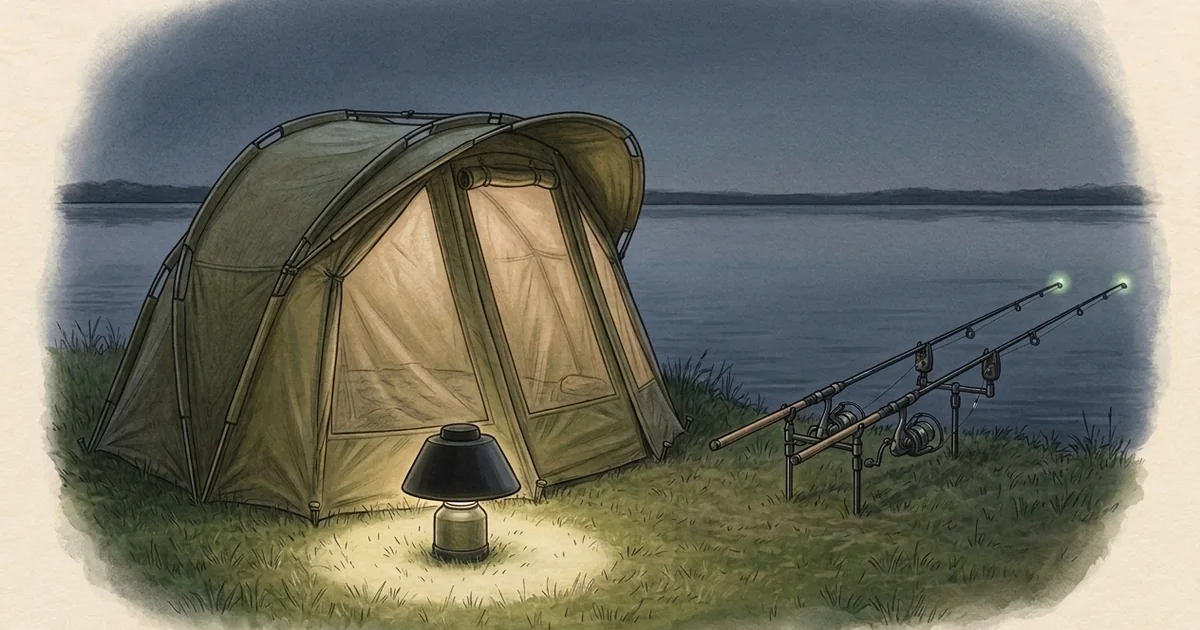
A camping lamp does not shine where you are looking but across your whole night swim: into the tent, onto the cooking area, along the guy lines. It is good if it gives a warm, dim light, points downwards and leaves the water dark. A flame has no place in a tent.
Four lights, four jobs
The head torch follows your gaze and stays in charge of knots, bait and landing net. Anything that should light up one spot is handled by a swim lamp. Three types are common:
- LED lantern: shines in all directions, can be stood up or hung and belongs at the cooking and eating area. A shade or a covered top section directs the light downwards instead of into your neighbours‘ eyes.
- Tent lamp: small and flat, with a hook, loop or magnet for the tent roof, usually with several settings. Inside the tent the lowest setting is almost always enough, as the space is small.
- String lights: many weak points instead of one bright source. On the porch or the guy lines they show where lines and pegs are, without dazzling. Some strings run on button cells.
You do not need a lamp for the rods: glow sticks on the tip or float show the bite.
| If you … | you take | watch out for |
|---|---|---|
| are reading or getting changed in the tent | Tent lamp | lowest setting, warm white |
| are cooking or eating | LED lantern with shade | place it low, light on the ground |
| are tying knots or changing bait | Head torch | red light or low setting, not onto the water |
| walk to the car at night | Head torch | high setting only on the path |
| want to find your tent and guy lines again | String lights | low brightness, on the guy lines |
| want to keep an eye on bites | Glow stick, bite indicator | do not shine on the rod tips |
| want to warm up | no lamp | gas and paraffin stay outside |
Lumens, runtime, beam distance: the FL1 ratings
On many packs, next to the figures, you will see FL1 or ANSI FL1. This voluntary US standard sets out how measurements are taken so that ratings are comparable. According to its freely readable extract, the 2009 version, then published by the industry association NEMA, applied to torches, spotlights and head torches with directed light; it did not mention lanterns. Today the US trade association PLATO looks after the standard as an accredited standards developer. Its version FL 1-2025, published in February 2026, explicitly also covers “area lights”, i.e. lights for a whole area. The text of the standard is only available for a fee; the measurement rules below come from PLATO’s explanations of the new version.
- Lumens and beam distance: Luminous flux in lumens is all the light emitted, determined in the laboratory with an integrating sphere. Like beam distance and peak beam intensity, it is measured between 30 seconds and two minutes after switching on. So the figure describes the start, not the third hour.
- Runtime: It starts with the value after 30 seconds and ends when the lamp delivers only 10 per cent of it. How bright the lamp shines in the meantime is not contained in this one figure.
- Turbo and boost: The 2025 version measures short high-output modes separately, between the first and the tenth second. Their runtime already ends when brightness falls to 90 per cent of the maximum. According to PLATO, such a mode must always be listed with its runtime and together with the other modes in the table, and it may not be called “HIGH”.
- Water and dust: Protection is given as an IP rating to DIN EN 60529. A table from the German Social Accident Insurance (DGUV) assigns IPX6 to powerful water jets, IPX7 to temporary immersion and IPX8 to continuous immersion down to a stated depth. According to PLATO, for IPX8 FL 1-2025 requires at least 30 minutes at the depth stated by the manufacturer, under harsher conditions than in the IPX7 test. The dust protection levels IP5X and IP6X are new.
Fig. 2 shows why two lamps with the same number of hours can feel different: one stays bright for a long time and then suddenly goes dark, the other fades early. Both reach 10 per cent at the same time, and the pack shows the same figure.
Worked example: If a lamp is rated under FL1 at 300 lumens and 10 hours (assumed values), you get 300 lm after 30 seconds and still 30 lm after ten hours. For comparison, the Swiss consumer magazine K-Tipp considers less than 100 lumens sufficient for evening walks with a head torch. So at the end of its runtime the lamp is well below that. If the runtime for each setting is printed on the pack, what counts for the tent lamp is the figure for the low setting.
Warm, dim light: insects, fish, neighbours
According to the German Environment Agency (UBA), many nocturnal insects are attracted above all to UV light and to the adjacent violet and blue parts of visible light. The higher the Kelvin value, the greater the blue content; lamps up to about 3.300 K count as warm white. In field trials described in a 2013 volume from the Bundesamt für Naturschutz (BfN), cold white LEDs attracted considerably more insects than warm white ones. An example from the water in the same volume: a single street lamp near a stream drew in as many caddisflies in one night as hatched along 200 metres of bank in the same time.
At around 650 to 780 nanometres, red lies at the other end of the spectrum, far from UV, violet and blue. By this classification, red light attracts fewer insects; however, the sources checked give no measurements of their own for red lamps. For your eyes, red has a second advantage: Blinker recommends it for tying knots, because the eye is less sensitive to it and the light is still enough. That way your eyes stay adjusted to the dark.
Light has an effect in the water too. The Leibniz Institute of Freshwater Ecology and Inland Fisheries (IGB) writes that even light levels below full-moon brightness, i.e. below 0,3 lux, can change animals’ bodies via the hormone melatonin. The BfN volume says of fish that even weak light partly inhibits the production of melatonin. So don’t sweep the beam across the surface of the water. What anglers report about light on the water when fishing for zander or eel is covered under Head torch; the sources checked give no measurements on this.
Then the neighbours: the UBA advises mounting lamps so that nobody looks into them constantly from close range, as this reduces glare. A lantern at eye level shines right across to the far bank; placed low and with a shade, it lights the ground. From the recommendations of the Federal/State Working Group on Immission Control, summarised by the UBA, and the advice of the Bavarian State Office for the Environment for gardens, comes a short list that also suits the fishing spot:
- Direct light only where you need it, and downwards rather than sideways.
- Warm white instead of cold white, at low brightness.
- Only switch it on for as long as necessary. While waiting for a bite, the lantern stays off.
- No bright, far-reaching lamps in the open countryside.
Power: batteries, rechargeables, power bank
If a device gives you the choice, rechargeable batteries are a better choice than disposable ones, according to the UBA. Nickel-metal hydride rechargeables deliver about 1,2 instead of 1,5 volts, and normal cells lose around a quarter of their charge a month on their own, while low self-discharge cells lose only about 4 per cent. For a lamp that sits in the box for weeks, that matters. If the battery is built in, the whole device often dies with it; the UBA therefore recommends looking for easily replaceable batteries when buying.
Do not charge lithium batteries in lamps, power banks and power stations at night in the tent. The UBA advises staying nearby while charging and not charging while you sleep. The Berlin Fire Brigade recommends a place with a smoke alarm where nothing flammable is lying around. Between sleeping bag and clothing that is hardly possible, so charge during the day under supervision. How much a power bank delivers, how a power station and solar panel go together and what cold does to batteries is covered under Rechargeable batteries and power banks.
Some string lights and LED tea lights run on button cells. The German Federal Institute for Risk Assessment (BfR) warns that if a small child swallows a button cell, it can get stuck in the oesophagus and cause severe chemical burns there. Even cells that seem flat should be kept out of children’s reach. On a family fishing day, the string therefore stays on the tent with the battery compartment closed.
Gas and paraffin lanterns: not in the tent
Gas lanterns and paraffin lamps give warm light and a little heat. That is exactly what makes them dangerous in a tent. When gas or oil burns, it produces carbon monoxide (CO), according to the Feuerwehr Dortmund fire service. The gas is invisible, odourless and tasteless, and the first signs are headache and dizziness. According to the Berliner Feuerwehr, CO can become life-threatening within a few minutes, depending on the amount. An ordinary smoke alarm does not help here, the BfR stresses: only dedicated CO alarms warn you of CO.
The Feuerwehr Dortmund advises using only appliances intended for heating in enclosed spaces there, and explicitly names patio heaters, camping stoves and barbecues as unsuitable. For night anglers, the British magazine Angling Times puts it just as clearly: no gas or charcoal appliances in a bivvy or tent. A gas lantern is one of them. On top of that comes the open flame: the Berliner Feuerwehr generally recommends electric lights instead of candles and never leaving a flame unattended. In a tent you sleep in, that is impossible. What applies to the stove is covered under Camping stove and Fishing tent.
Liquid fuel brings its own risk. For paraffin-based lamp oil, the BfR warned back in 2011 that a small sip or sucking on the wick can be enough to cause life-threatening lung damage. The Swiss Bundesamt für Gesundheit (BAG) describes the danger in the same way today: if swallowed or vomited oil gets into the lungs, severe inflammation can follow. So keep the bottle tightly closed and stored out of children’s reach; the BAG recommends the original bottle.
Even outdoors, a flame is not allowed everywhere. In Bavaria, Art. 17 para. 2 no. 1 of the forest act (Waldgesetz, version valid from 1 April 2026) prohibits lighting or using an open light in the forest and less than 100 metres from it. The article does not define what counts as an open light, and other states have their own rules. The Bavarian implementing regulation for the fisheries act lists in § 15 para. 1 no. 1 (version valid from 1 June 2025), among the prohibited fishing methods, “fishing using electric light sources”. The wording does not say what that means for a lantern at your swim; the fisheries authority (Fischereibehörde) can clarify. More under Fire on the bank.
In an emergency: If CO poisoning is suspected, the Feuerwehr Dortmund advises going outside immediately and calling the emergency number 112. If a child has swallowed a button cell, the BfR says the child should be examined in hospital straight away. After a sip of lamp oil, do not induce vomiting; go to a doctor or hospital immediately and take the bottle with you, again according to the BfR; the BAG also explicitly warns against inducing vomiting. This information does not replace medical advice.
Setting up light for the night
- Charge batteries while it is still light and pack spare cells. No charging in the tent at night.
- Fix the tent lamp to the ceiling and set it to the lowest level before it gets dark.
- Place the lantern for the cooking and eating area low or hang it under a shade, so that the light falls on the ground and not on the water.
- Run string lights along the guy lines and the path to the water so you do not trip at night.
- Fit glow sticks to the rod tips and do not shine the lantern on the tips.
- Once the rods are out, switch off the lantern: only the tent lamp stays on, dimmed, and the head torch lies within reach.
- In the morning, collect the glow sticks, empty cells and string lights and take them with you, as described under Leaving your fishing spot clean.
Common mistakes
- Lantern at eye level without a shade: it dazzles you and your neighbours and shines across the water.
- Cool white light all night: it attracts far more insects than warm white.
- Reading the runtime as full brightness: the number of hours on the pack ends at a tenth of the starting value.
- Charging a power bank in your sleeping bag: charge lithium batteries under supervision, not while you sleep.
- Gas lantern in the tent for warmth: you will not notice CO, and a smoke alarm does not warn you of it.
Frequently asked questions
How bright does a tent lamp need to be?
The sources checked do not give a fixed figure. As a guide: according to K-Tipp, less than 100 lumens is enough for an evening walk with a head torch. In a small tent you need less than on a dark path; a well-adjustable low setting matters more.
Can the gas lantern stand in front of the tent?
Whether open light is allowed at your water is governed by state law, such as the forest act (Waldgesetz) in Bavaria, and by the water rules (Gewässerordnung). Following the advice of the Berliner Feuerwehr, never leave a flame unattended. The entrance and porch count as part of the tent, as described for the Camping stove, so the gas lantern has no place there either.
What does IPX7 on a lamp mean?
According to the DGUV table for DIN EN 60529, IPX7 stands for temporary immersion and IPX8 for continuous immersion down to a stated depth. If the lamp falls off the jetty, it is better off with IPX7 than with IPX6, which only stands for powerful water jets. Under FL 1-2025, the manufacturer states how deep and for how long an IPX8 lamp may be submerged.
Related
- Head torch: red light, night vision and light on the bank
- Glow sticks: seeing bites without a lamp
- Batteries and power banks: capacity, power station, solar and safe charging
- Camping stove: why the stove stays outside the tent too
- Night fishing: routine and choosing a swim for the night by the water
- Fire on the bank: what the states and forest fire levels regulate
- Night session packing list: what to take for the night
- Line calculator: breaking strain and backing before it gets dark
Sources
- Umweltbundesamt: UMID 1/2020, LED & Co (Insekten, LAI-Empfehlungen, Farbtemperatur, Blendung), Batterien und Akkus richtig nutzen (Spannung, Selbstentladung, Austausch) und Lithium-Batterien und Lithium-Ionen-Akkus (nicht im Schlaf laden)
- Bundesamt für Naturschutz: BfN-Skripten 336, Schutz der Nacht (2013; LED-Farben, Köcherfliegen, Fische)
- Leibniz-Institut für Gewässerökologie und Binnenfischerei: Lichtverschmutzung (Wirkung unter 0,3 Lux)
- Bayerisches Landesamt für Umwelt: Nachtleben im Garten (Licht nach unten, warmweiß)
- Bundesinstitut für Risikobewertung: Knopfzellen in Lichterketten, Gesundheitsrisiken durch Kohlenmonoxid und Lampenöle (Presseinformation 2011)
- Schweizerisches Bundesamt für Gesundheit: Lampenöl (Lunge, kein Erbrechen auslösen, Aufbewahrung)
- Feuerwehr Dortmund: Kohlenstoffmonoxid (Anzeichen, Notruf, keine Campinggeräte zum Heizen)
- Berliner Feuerwehr: Warnmelder, Lithium-Ionen-Akkus und Vorweihnachtszeit
- Angling Times: Winter fishing warning (keine Gas- oder Kohlegeräte im Bivvy)
- Blinker: 10 Mythen über das Nachtangeln (Rotlicht zum Knotenbinden)
- K-Tipp: Welche Stirnlampe eignet sich zum Joggen? (Lumen für Abendspaziergänge)
- Freistaat Bayern: Bayerisches Waldgesetz, Art. 17 (offenes Licht im und am Wald) und AVBayFiG, § 15 (elektrische Lichtquellen beim Fischen)
- National Electrical Manufacturers Association: ANSI/NEMA FL 1-2009, frei zugänglicher Auszug (Archivkopie) (Geltungsbereich, Messgrößen der Norm)
- Deutsche Gesetzliche Unfallversicherung: DGUV Information 203-005, Anhang 2: Schutzarten nach DIN EN 60529 (Bedeutung von IPX6, IPX7, IPX8)
- Portable Lights American Trade Organization (PLATO): ANSI/PLATO FL 1-2025: Getting the Testing Right (Messzeitpunkte, Leuchtdauer bis 10 Prozent, Turbo-Stufen, IPX8, Staubschutz), How to Mark and Message Your Products Correctly (Angabe von Turbo-Stufen, freiwillige Norm) und Publication of Revised ANSI/PLATO FL 1 2025 Standard (Erscheinen, erweiterter Geltungsbereich)
Text AI-assisted, drawing AI-generated. Sources opened and checked in November 2026; no graphics taken from the sources.
All information is for guidance only and without guarantee. What your lamp can do is stated in its instructions; whether light and flames are allowed at your water is governed by state law, your fishing permit (Erlaubnisschein) and the water rules.