
Knowledge · Tackle
Batteries and power banks: Power for long sessions
On a long session at the water, your phone, head torch and bite alarm all need power, and many of these devices now have permanently built-in rechargeable batteries. This page explains what the figures on a power bank mean, how to charge and store lithium batteries safely at the water, what cold and damp do to them and where old batteries should go.
Who draws power at the swim
According to Blinker, head torches often no longer have replaceable batteries but a built-in rechargeable one, and so do phones and many bite alarms. According to the Federal Environment Agency (Umweltbundesamt, UBA), a built-in battery is very likely to be a lithium-ion one. A power bank is such a battery in its own casing that recharges other devices by cable. According to Britain’s Angling Times, most night anglers now own one.
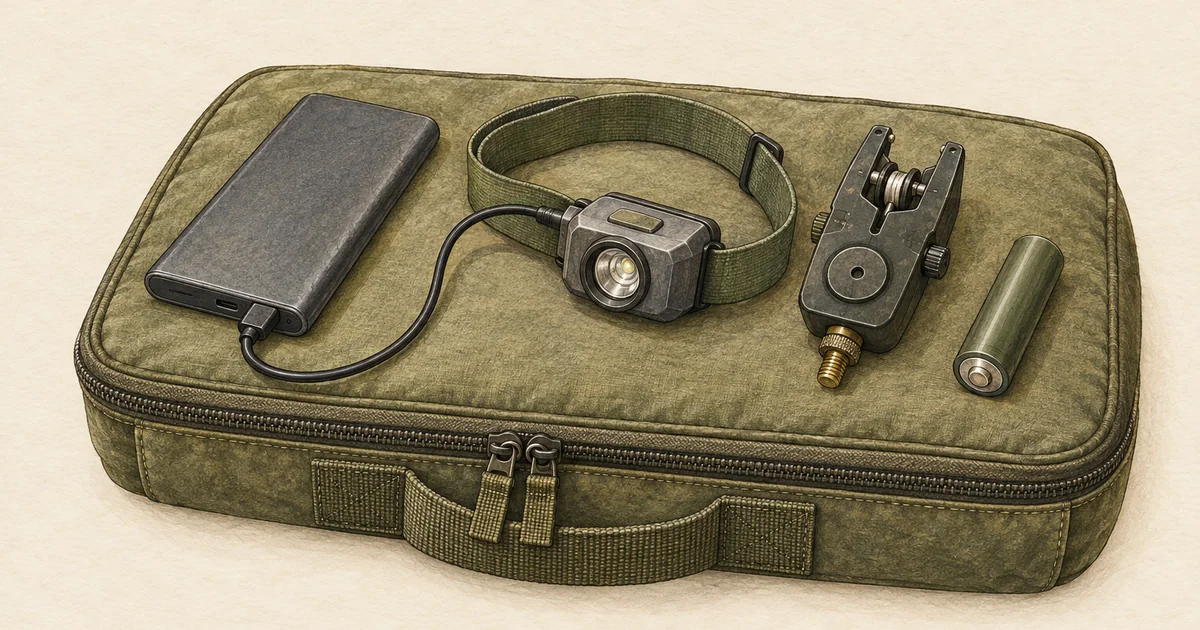
- Phone: weather forecast, camera and emergency call in one, see also night fishing.
- Head torch: everyday charging tips can be found under head torch.
- Bite alarm: unit and radio receiver, see Bite indicators.
- Fish finder and bait boat: a flat fish finder battery can end a day on the boat at midday. More under fish finder and bait boat.
What is written on the power bank
The casing usually shows two figures. The capacity in milliampere-hours (mAh) says how much charge is stored. The amount of energy in watt-hours (Wh) is capacity times voltage and is therefore the more accurate figure. If only mAh is printed, you calculate with the cell voltage, usually 3,7 volts according to Blinker: 10.000 mAh is 10 Ah, times 3,7 V gives 37 Wh.
Less of this reaches your phone. Energy is lost when converting from 3,7 to 5 volts and as heat, and a remainder stays in the battery to protect the cells. As a rule of thumb, Blinker therefore reckons with about 70 per cent of the printed capacity, so a 10.000 mAh power bank delivers roughly 7.000 mAh.
| Specification | Meaning | Matters for |
|---|---|---|
| mAh | stored charge | comparison at the same voltage |
| Wh | energy, Ah times volts | limits on aircraft |
| 5 V output | usual connection | lamp, phone, headphones |
| 9 to 20 V output | on larger power banks | devices such as laptops |
| IP67 | protection rating: dust-tight, conditionally waterproof | splashes at the bank |
Charging and storing according to advice from the fire brigade and the authorities
Lithium batteries are safe when handled properly, writes the UBA, but the risk is particularly high during charging. The Berlin fire brigade names falls, heat, overcharging, deep discharge and ageing among the triggers; inside, a chain reaction can then run from cell to cell.
- The right charger: Only the intended charger and cable (UBA); unplug after charging. Overcharging can, according to the Federal Institute for Materials Research and Testing (Bundesanstalt für Materialforschung und -prüfung, BAM), trigger a dangerous reaction.
- Stay awake: The UBA and the fire brigade advise against charging while you sleep, because you would notice a danger too late. In the tent, the phone stays on the power bank only while you are awake.
- Nothing flammable nearby: Charge in a place with a smoke detector and nothing flammable close by (UBA, fire brigade). A sleeping bag is the wrong place for it.
- Keep the way clear: The fire brigade advises against storing or charging batteries in escape and rescue routes. In a tent, that is the entrance.
- Avoid knocks: Impacts can, according to the BAM, start a fire; a padded bag protects the battery while you carry it.
- No tinkering: Do not open batteries and do not build your own battery packs (BAM, fire brigade). With foreign cells, a battery is no longer safety-tested, according to the BAM.
The UBA also advises against storing or charging batteries outdoors or in damp rooms. That is not entirely possible on a session, so you charge at home, where a smoke detector hangs, and at the water only top up what is necessary. For the winter break, the UBA passes on the manufacturers‘ recommendation of about 40 to 50 per cent charge, stored at 10 to 25 °C and recharged after six months at the latest.
Cold, heat and damp
In the cold, the performance of the batteries in phone, head torch and bite alarm drops noticeably; in winter you notice it first. The UBA names sub-zero temperatures, especially below minus 20 °C, and heat above plus 50 °C as reasons why service life falls sharply. Even above 40 °C it harms a lithium-ion battery, even when it is just lying there. As an example, the UBA gives a power bank in a hot car, and the BAM advises not to leave your phone in the car. At the swim, the power bank therefore belongs in the shade, not on the sunny bedchair.
If lithium comes into contact with water, the battery can be damaged, writes the UBA. So store batteries dry and not in the fridge, where condensation threatens. What a casing can withstand is shown by its protection rating: IP67 stands for dust-tight and at least conditionally waterproof.
Recognising damaged batteries
Swollen, deformed, leaking, outgassed or with a greasy film at the terminals: such batteries are defective according to the UBA and must neither be used further nor opened. The BAM names a further sign. If a battery gets so hot that you cannot touch it even though it is not charging, or gas escapes, it is dangerous. Escaping substances can be a strong irritant according to the UBA, so only touch leaking batteries with gloves on.
If a battery smokes: The BAM advises placing small, deformed or smoking lithium batteries, where possible, in a container with a great deal of water, and warns of the toxic gases. The Berlin fire brigade: extinguish small incipient fires with plenty of water, but only if this can be done safely, watch for flying burning parts, warn others and call 112. This text is no substitute for medical advice.
Flying to a fishing holiday
A loose power bank counts as a spare lithium battery on an aircraft. According to the Federal Aviation Office (Luftfahrt-Bundesamt, LBA), it is forbidden in checked baggage and may only go in hand luggage. Each lithium-ion battery may have 100 Wh at most, up to 160 Wh with the airline’s approval, but then no more than two spare batteries per person. 100 Wh divided by 3,7 volts is about 27 Ah, so roughly 27.000 mAh.
Devices with a built-in lithium battery should also go in hand luggage. In a suitcase they must, according to the LBA, be switched off completely, without standby, and protected against being switched on and against damage. Airlines can be stricter, so ask them beforehand. For shipping, note that lithium batteries are dangerous goods according to the BAM, with their own regulations and labelling obligations.
Handing in old batteries: battery law as a guide
Since 7 October 2025, the Battery Law Implementation Act (Batterierecht-Durchführungsgesetz, BattDG) has applied; it replaced the old Battery Act (Batteriegesetz). Under § 6 BattDG, end users hand in used batteries separately from residual waste, and used device batteries exclusively via collection points affiliated with the producer responsibility organisations. Under § 14, every retailer takes back used device batteries of the type it sells or has sold free of charge, in the shop or right next to it, in quantities usual for a household.
If the battery is built firmly into the device, for example in the head torch, the Electrical and Electronic Equipment Act (Elektro- und Elektronikgerätegesetz) applies: the old device goes separately from residual waste to a collection point, and batteries it does not enclose are removed beforehand without destroying them (§ 10 ElektroG). The UBA advises:
- Tape over the terminals of lithium batteries so that no short circuit occurs.
- Bring damaged batteries in a screw-top jar and tell the staff about the damage.
- Never into residual waste, the yellow bin, bulky waste or scrap metal, otherwise, according to the fire brigade, fires threaten in refuse vehicles and sorting plants.
- For large batteries, ask the recycling centre (Wertstoffhof) beforehand whether it will take them free of charge.
Note, as of October 2026: BattDG and ElektroG, both last amended on 25 November 2025. Which collection point in your municipality accepts which batteries is something the local waste disposal service can tell you.
Phone by the water: case and mount
By the water, your mobile is often the only phone you have for an emergency call. The DLRG points out that you can try 112 even without reception on your own network; the phone then looks for another network. For sea kayak trips, the Deutsche Gesellschaft zur Rettung Schiffbrüchiger (DGzRS) lists in its planning checklist a mobile phone packed waterproof or a handheld VHF radio, and its equipment list includes waterproof cases for phones and a power bank. At sea, however, the phone does not replace the radio. A DGzRS sea rescuer warns that reception on the open sea ends after just a few kilometres, and according to the DGzRS only VHF radio ensures contact with rescuers and ships in an emergency. More on this under Marine radio and emergency calls and Fishing kayak.
Many phones are themselves protected against water, which you can tell from the IP code. According to Stiftung Warentest, its second digit stands for protection against water, and an 8 means continuous immersion. Stiftung Warentest names two catches: the rating applies to the new device, and water resistance can decline over time. And testing is done with tap water; salt water can attack seals. If you fish on the coast or from a boat, put even a waterproof phone in a case as well. How to test the case before using it for the first time is covered under Catch photo equipment.
From a boat, cameras and phones get splashed more often, according to Blinker, and in the worst case they stop working. Blinker’s solution is a transparent, tightly closing box from the household department, in which the devices lie together, protected from rain and salt water. In a case or box, what was said above about heat still applies: do not leave them in blazing sun.
Mount: If you fish alone, screw the camera onto a bankstick, the ground spike for the rod rest. According to Blinker, rod rests have a 3/8 inch English thread, whereas cameras have a 1/4 inch thread; a small adapter connects the two. How this works with the phone in a holder and a remote shutter release is shown on the page Catch photo. On a bike ride to the water, a handlebar mount holds the phone for navigation, writes Blinker; more under Fishing by bike.
Solar panel and power station for long sessions
A power station is a large battery in a housing with a carrying handle. According to Stiftung Warentest, the clear feature that distinguishes it from a power bank is at least one Schuko mains socket with 230 volts. The devices in the Stiftung’s test also had USB ports and a 12-volt socket like in a car, which can run a cool box, for example. Two figures count: the watt-hours (Wh) tell you how much energy is stored, the watts (W) how fast it can be delivered to a device. The Stiftung calculates like this: if a device draws 500 W, a 500 Wh power station lasts about one hour, not counting conversion losses. The usable amount is always less than printed, because the electronics themselves use power.
In 2023 the Stiftung tested devices with 400 to 644 Wh. That is many times the 100 Wh per lithium-ion battery that the LBA allows in air baggage, or 160 Wh with the airline’s approval. For a flight to a fishing holiday, plan with a power bank in your hand luggage instead; the LBA and the airline give the details.
Worked example for two nights
The values are assumed; yours are on the battery or in the manual. The calculation uses the same 3,7 volt cell voltage as above and Blinker’s 70 per cent approach.
- Phone with 4.000 mAh: 4 Ah times 3,7 V gives around 15 Wh per full charge.
- Head torch with 2.000 mAh: 2 Ah times 3,7 V gives just over 7 Wh.
- Two nights, charging each fully once: 2 times (15 + 7) Wh makes 44 Wh.
- Allowing for losses: 44 Wh divided by 0,7 gives around 63 Wh on the label.
- Result: a power bank with 20.000 mAh, i.e. 74 Wh, is enough for this.
That matches Stiftung Warentest’s assessment that a smaller power bank is enough for charging a phone. A power station is only worth it when a device needs the mains socket or the 12-volt socket.
Solar panel: charge by day, use at night
For longer trips away from mains power, Blinker names a solar module that fills a power bank during the day as a good solution; you then charge your phone from it even after sunset. Folding modules pack small and still offer a large surface. The small solar cell on the housing of some outdoor power banks, on the other hand, supplies rather little power according to Blinker. For a power station, according to Stiftung Warentest, you need a sufficiently large module and time, and the panel should be turned towards the sun again and again during the day. How well a power station copes with changing light under clouds also depends on its voltage regulation, according to the Stiftung; many devices use a technique called MPPT (Maximum Power Point Tracking) for this.
The panel belongs in the sun, the battery does not. The Institut für Schadenverhütung und Schadenforschung (IFS), run by the public insurers, advises against storing batteries in direct sunlight and gives 60 °C as the upper limit set by well-known manufacturers. The UBA considers anything above 40 °C harmful, see above. With a long cable, the power bank or power station lies in the shade while the panel stands in the sun (Fig. 2).
Fire safety on a night session
A power station contains many cells. If one of them goes into thermal runaway, i.e. releases its energy suddenly and uncontrollably, it usually takes the neighbouring cells with it, according to the IFS. Such battery packs can burn for minutes to hours and reignite after hours or days. According to the IFS, the fire risk is greatest during charging. For a night by the water, this means:
- Do not charge while you sleep: if your phone is connected to the power station at night, it charges while you are asleep. The UBA and the fire brigade advise against this, see above.
- A firm, dry spot: away from the sleeping bag, the tent wall and the entrance. The fire brigade advises charging with nothing flammable nearby and keeping escape routes clear.
- No long periods of frost: after a long time in frost, according to the IFS, there is a risk of permanent capacity loss and of fire the next time it is charged. The IFS advises against storing batteries in an unheated garage in winter; a cold car boot is no better a place to store them.
- After a fall or a dunking: according to the BAM, impacts can cause a fire. For flooded solar storage batteries in houses, the IFS describes fires that broke out a few days later as they dried out; the Bundesverband Energiespeichersysteme advises against putting such batteries back into operation yourself. If your power station has been in the water, ask the manufacturer before using it again.
- Type: if the device says lithium iron phosphate (LiFePO4), the fire risk is somewhat lower according to the IFS, but it is still there. The points above apply all the same.
Common mistakes
- Phone and power bank in the sleeping bag at night. The UBA and the fire brigade advise against charging while asleep or next to anything flammable.
- The power bank stays in the car. The UBA names the spot behind the windscreen as an unfavourable place.
- Carrying on using a swollen battery. It is defective and, with the terminals taped, goes to a collection point.
- Packing the power bank in the suitcase. Loose spare batteries are forbidden in checked baggage according to the LBA.
- Throwing old batteries into the residual waste bin. The BattDG requires them to be returned separately.
- Putting the power station in the sun next to the solar panel. The IFS advises against storing batteries in direct sunlight; only the panel belongs in the light.
Frequently asked questions
May I charge my phone from the power bank overnight?
The UBA and the Berlin fire brigade advise against charging while you sleep. Charge in the evening while you are awake, and then put the power bank away from the sleeping bag and bedchair.
How many watt-hours does my power bank have?
Convert the mAh to Ah and multiply by 3,7 volts. 20.000 mAh gives 74 Wh this way, below the limit of 100 Wh that the LBA names.
What should I do with a swollen battery?
Do not use it further and do not open it. The UBA advises taping the terminals, taking the battery sealed to a collection point in a shop or to the recycling centre (Wertstoffhof) and speaking to the staff.
Do I need a power station for a night session?
For a phone and a head torch, usually not. According to Stiftung Warentest, a smaller power bank is enough just for charging a phone, and the worked example above comes to around 63 Wh for two nights. A power station is only worth it for devices running on 230 or 12 volts, such as a cool box.
Related
- Head torch: red light and everyday charging tips
- Bite indicators: electronic, with radio or as a bell
- Fishing tent: pitching at the bank and why the stove stays outside
- Fish finder and bait boat: electronics on and under the water
- Night fishing: setting up the swim in daylight, lighting and state rules
- Travel rod: multi-piece rod for airline luggage
- Catch photo: phone on the bankstick, remote shutter release and working quickly
- Line calculator: breaking strain after the knot and backing for the session rod
Sources
- Umweltbundesamt: Lithium-Batterien und Lithium-Ionen-Akkus (Laden, Lagern, Temperaturen, Nässe, Schäden, Rückgabe) und Batterien und Akkus richtig nutzen und fachgerecht entsorgen (40 °C, Nachladen, Müllarten)
- Bundesanstalt für Materialforschung und -prüfung: Sicherer Umgang mit Lithium-Batterien (Überladung, Stöße, Warnzeichen, rauchender Akku, Versand)
- Berliner Feuerwehr: Lithium-Ionen-Akkus (Ursachen, Laden, Rettungswege, Brandfall)
- Luftfahrt-Bundesamt: Elektronische Geräte mit Lithium-Batterien (Handgepäck, 100 und 160 Wh, Vergleich mit Powerstations)
- Bundesministerium der Justiz: BattDG (Inkrafttreten), § 6 und § 14 BattDG (Rückgabe, Rücknahme), § 10 ElektroG (Altgeräte)
- Blinker: Strom am Wasser (mAh und Wh, nutzbare Kapazität, IP67, Kälte, Solarmodul), Immer in der Tacklebox (Winter) und Das Echolot: oft, aber nicht immer (Echolot-Akku), Wasserdichte Klick-Box für die Kamera (Spritzwasser im Boot), So gelingen Angelfotos (Gewinde am Rutenhalter) und Bikepacking: Angeln, Rad und Campen (Lenkerhalterung)
- Angling Times: Winter fishing warning (Powerbanks bei Nachtanglern)
- DLRG: Notruf richtig absetzen (112 ohne Empfang)
- Deutsche Gesellschaft zur Rettung Schiffbrüchiger: Seekajak (wasserfest verpacktes Handy, Gehäuse für Telefone), Angeln (Handyempfang auf See) und Was tun im Seenotfall (UKW-Funk vor Handy)
- Stiftung Warentest: IP-Schutzarten verstehen (zweite Ziffer, Neuzustand, Leitungs- und Salzwasser) und Powerstations im Test (Wh und W, Steckdosen, Laden per Solarmodul, MPPT; nur Begriffe, keine Testergebnisse)
- IFS, Institut für Schadenverhütung und Schadenforschung (öffentliche Versicherer): Lithium-Ionen-Akkus (Akkupacks, Laden, Sonne, 60 °C, Frost, LiFePO4) und PV-Speicher unter Wasser (Brand nach Überflutung, Rat des Bundesverbands Energiespeichersysteme)
Text AI-assisted, drawing AI-generated. Sources opened and checked in October and November 2026, no graphics taken from the sources.
All figures are rough guides without guarantee. What your battery can take is stated in the device’s instructions; collection points and airlines may have requirements of their own.