
Knowledge · Tackle
Bait boat: Baiting and laying the rig by remote control
A bait boat is a remote-controlled model boat that carries feed and the hook rig to a spot you can hardly reach from the bank. Whether you may use one is decided by the water rules and the fishing permit (Erlaubnisschein), and there it is often banned or restricted to certain times.
Construction: hopper, hatch, release
A bait boat is usually a converted model boat that carries boilies to the baiting spot. Inside the boat sits a feed hopper; Fig. 1 shows a twin-hull design. Over the spot you open it by remote control, and the load sinks to the bottom. The boat can also take the rig along: a release holds it during the trip and lets it go at the spot. Anglers also lay the carp rig this way. Via the line, the rig stays connected to the rod on the bank.
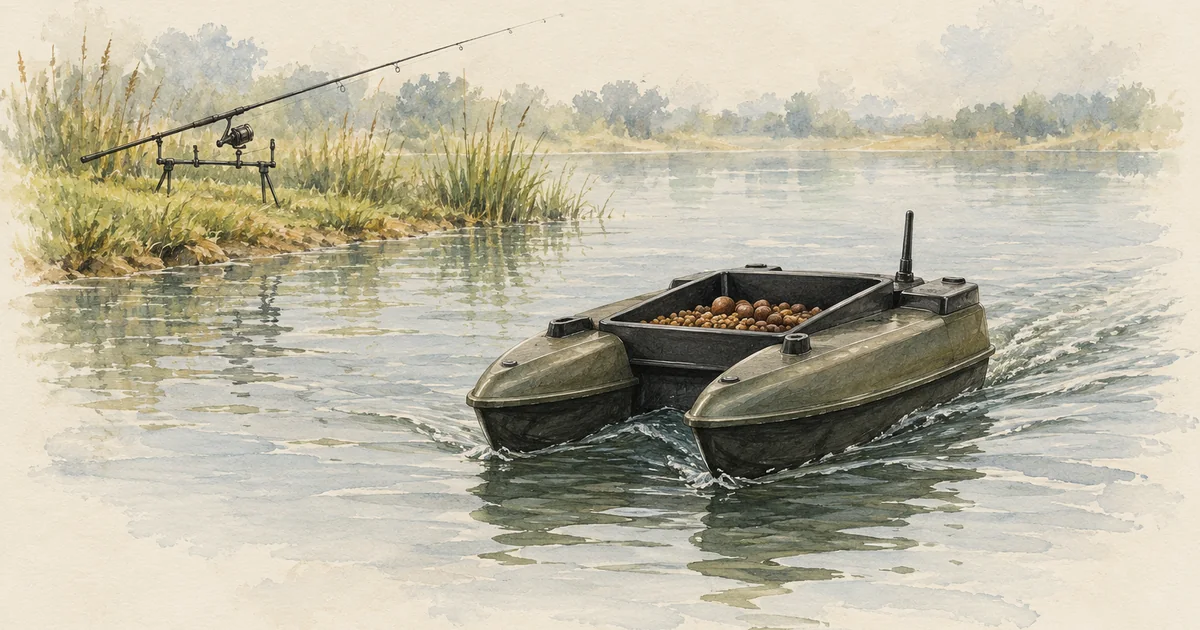
Some boats carry a fish finder with which you search the bottom for structure, others an underwater camera that shows fish activity and also whether the bait was eaten.
What anglers use the boat for
The main reason is distance: Fisch & Fang considers targeted topping-up with a rod beyond 100 m hardly feasible. According to Blinker, many carp anglers on the European continent run their rig out instead of casting it, even to a drop-off 70 m away. The rod is then used mainly for playing the fish, that is, the fight with the hooked fish. What this means for length and action is covered under carp rod.
A second argument comes from a column in Angling Times: if you cast under overhanging trees, sooner or later you get caught in the branches, and tackle left there endangers animals. He therefore prefers to place the rig with the boat in such spots. But he also stresses that you still have to know where feed and rig belong. How to find drop-offs, plateaus and gaps in the weed is explained under carp fishing.
Procedure: placing bait and rig
The specialist sources describe no fixed routine, but the individual steps can be pieced together from them. Fig. 2 shows them in the order in which they come up at the water:
- Choose the spot: The boat does not make the decision for you. The Angling Times column stresses that you still need to know where bait and rig belong. A fish finder, a camera or marker work with a lead are suitable for that.
- Heading out: The rig hangs in the release, and the line runs to the rod on the bank. Blinker describes how the carp rig can be placed conveniently with the boat this way.
- Releasing: Over the spot, you open the hatch. How the bait then lies depends on hatch, augers and portions, see below.
- Checking: With a camera on the boat you see whether the fish accept the bait, and can top up or give less.
Pile or carpet: how the feed lies
The hatch releases the hopper all at once. Fisch & Fang names it a drawback of the bait boat that the whole load lands as a thick pile on the bottom, which is rarely wanted. There are boats with feed augers, that is, rotating screw conveyors, which spread the feed over a large area above the weed. It lies wider with such a spreader or in several small portions at neighbouring spots. How throwing sticks and catapults spread feed is explained on the pages throwing stick and bait catapult.
Which daily amounts associations allow, and from when a water gains phosphorus in its balance, is given with figures under the throwing tube. The Arbeitskreis Angeln of the Deutscher Angelfischerverband considers moderate baiting ecologically harmless and rejects blanket bans. For sensitive or nutrient-poor waters it proposes daily upper limits set individually for each water (as of November 2025). A camera on the boat helps you keep to moderation.
What water rules say
Whether a bait boat may be used is governed by state law, the water rules of the manager and your fishing permit. Six examples show how different this turns out, retrieved in November 2026:
| Water manager (Bewirtschafter) | Rule on bait boats, extract from the wording | Issued by |
|---|---|---|
| Landesanglerverband Brandenburg, No. 3.3 | “Baiting using technical aids with their own propulsion (bait boats, drones and the like) is prohibited.” | 2019 |
| Fischereiverein Hannover, No. 3.2 | “The use of remote-controlled bait boats is only permitted outside the breeding and stocking season (01.04. – 15.07.).” On ponds in the Südliche Leineaue landscape protection area it is prohibited all year round. | 2026 |
| Landesverband Sächsischer Angler, Annex 1.2 | On opencast mining lakes under mining supervision: “any use of boats, including remote-controlled models for baiting, is prohibited”, unless a permit has been granted | 2024 |
| Sportangler-Vereinigung Hamburg, § 6 | “Likewise prohibited is the use of drones, bait boats and the use of live sonar technology” | January 2026 |
| Bezirksfischereiverband Ostfriesland, No. 2.6 | “Placing bait by means of technical aids (boats, bait boats, drones etc.) is prohibited.” | Resolution 2023 |
| Landesfischereiverband Westfalen und Lippe | “No boats, model boats (e.g. bait boats) or flotation aids (e.g. belly boats) may be used when fishing in the association’s waters.” | undated |
The wording matters. The Brandenburg rules speak of baiting. Whether running out a rig without feed also falls under that, the text does not say; clarify it with the association. At the Fischereiverein Hannover, the same rules forbid using watercraft of any kind or floating out baits. The Saxon rules list bait boats in the section on boat use. A symbol in the water directory shows where any use of boats is expressly not permitted. On opencast-mine lakes under mining supervision, boat use depends on a general ruling or a water-law permit.
In the Middle Franconian district fisheries regulation (amendment of 26 March 2026), § 5 contains a ban on fishing with devices or systems for the “real-time display of what is happening underwater”, naming live recordings by means of drones, cameras and the like. Bait boats are not mentioned in the text, and it does not decide whether a bait boat with a camera falls under it (Mittelfränkisches Amtsblatt Nr. 4/2026). Here too, the rule applies: if in doubt, ask the advisory service.
Blinker writes that bait boats are often banned and advises asking beforehand how the rules treat electronic bait boats where boats are prohibited.
Consideration for others at the water
The Fischereiverein Hannover ties its ban to the breeding and stocking season and exempts a landscape protection area entirely. Such periods and zones apply even when nobody is checking. The Bezirksfischereiverband für Ostfriesland also writes that fishing must not obstruct or endanger shipping and that bait and groundbait may only be placed within casting distance.
Some carp anglers deliberately do without a bait boat and fish finder at quiet, hard-to-reach bank spots. In their experience, carp withdraw from other swims precisely because of such disturbance. Others consider bait boats justified as long as they do not hinder other anglers. So do not run over other people’s lines and do not go into your neighbour’s swim. On bathing areas, the sources we checked make no statement; there, the rules of the water decide.
Battery, range and recovery
Bait boats run on batteries, whose performance Fisch & Fang often calls questionable. The specialist sources evaluated give no reliable range; according to the same article, DIY builders can adapt the battery capacity to their needs. A reserve for the return trip should therefore be planned. If a lithium-ion battery is in the boat, the Berlin fire brigade’s advice applies. It lists knocks or drops, heat, overcharging and deep discharge, and ageing among the causes of a failure. Its advice:
- Follow the manufacturer’s instructions on storage, charging and use.
- Charge in a place with a smoke detector and nothing flammable nearby, and not while sleeping.
- Do not use damaged, deformed or swollen batteries and do not build your own battery packs.
- Take old batteries to the municipal collection point or the take-back box in a shop, not into household waste.
More on transport and storage can be found under Batteries and power banks. If the boat gets caught in weed or stays out on the water with an empty battery, the specialist sources we checked name no recovery method. For your own safety: the DLRG warns, at still waters, of water plants that brush the body and can trigger panic, of muddy bottoms that make moving about considerably harder, and of water that often turns suddenly colder with depth. If you take a rowing boat for the recovery, you will find the life jacket and preparation under Boat and life jacket. Whether a boat may go on the water for this is again governed by the water rules.
Note: This page is no substitute for information from the association, the fisheries authority (Fischereibehörde) or the fire brigade. If a battery burns or gives off gas, alert the fire brigade on the emergency number 112.
Drones for taking baits out: aviation law and regulations
Instead of a boat, some anglers use a drone to fly the rig or some groundbait out and drop it over the spot. According to a Blinker article from 2021, this had become widespread mainly in South Africa and America, where rough water and reefs make casting difficult. The line stays on the reel, which the angler operates by hand. Environmentalists view this critically, because it lets fish be reached even in sanctuary zones that neither a cast nor a boat could reach before. This page does not make a recommendation. Anyone considering it has to deal with two sets of rules at once: aviation law and fisheries law.
Aviation law: dropping and operating category
A drone counts as an aircraft under § 1 of the Air Traffic Act (Luftverkehrsgesetz), according to the Digitale Plattform Unbemannte Luftfahrt (dipul) of the Federal Ministry of Transport. Implementing Regulation (EU) 2019/947 sorts operations into categories. In the “open” category, according to Article 3, the operator needs neither an operational authorisation nor an operational declaration beforehand. As one of its conditions, Article 4(1)(f) states: “during flight, the unmanned aircraft shall not carry dangerous goods and shall not drop any material.” If one of the conditions is not met, the operator must obtain an operational authorisation from the competent authority under Article 5(1). Under paragraph 5, a declaration by the operator is sufficient instead if the operation corresponds to one of the standard scenarios in the annex. The wording does not explicitly say whether placing a rig or groundbait counts as dropping material. Clarify that with the aviation authority.
For the “specific” category, dipul names a prior risk assessment and authorisation from the competent authority. The application is made to the aviation authority of the federal state in which you have your main residence. For Bavaria, Berlin, Brandenburg, Mecklenburg-Western Pomerania, North Rhine-Westphalia, Saarland, Saxony, Saxony-Anhalt and Thuringia, the Luftfahrt-Bundesamt is responsible according to dipul. dipul also points to the obligation to have liability insurance under § 43 of the Air Traffic Act (Luftverkehrsgesetz); you must carry the confirmation with you on every flight.
Geographical zones: waterways, protected areas, bathing beaches
What is colloquially called a no-fly zone is regulated as geographical zones by § 21h paragraph 3 of the Luftverkehrs-Ordnung (LuftVO). According to the wording, operation there is “permitted under the following conditions”. Three of these zones are often by the water:
- Federal waterways (No. 5): The zone covers the water and 100 metres either side of it. Among the conditions, the rule lists the express consent of the competent body, or a flight altitude that always stays below the lateral distance to the waterway, with a distance of more than 10 metres. For a crossing it requires a height of at least 100 metres, the shortest route and no overflying of ships, locks, weirs or moorings.
- Nature reserves, national parks and areas under § 7 paragraph 1 numbers 6 and 7 of the Federal Nature Conservation Act (Bundesnaturschutzgesetz) (No. 6): This means sites of Community importance and European bird protection areas, together known as Natura 2000 sites. Operation is permitted there if the competent nature conservation authority has expressly consented or state law provides otherwise. The third option does not apply in national parks and has four conditions, including “if the operation is not for the purposes of sport or leisure” and a flight altitude above 100 metres.
- Outdoor pools and bathing beaches (No. 8): Operation there is permitted outside opening or bathing hours.
dipul’s Map Tool shows where these zones are as an interactive map. The regulation requires the rules on protected areas and residential properties to be reviewed regularly, explicitly also with regard to disturbance and scaring effects on animals.
Fisheries law and water rules
In Bavaria, the implementing regulation to the Fisheries Act names drones explicitly. § 15 paragraph 1 number 1 AVBayFiG begins with “Prohibited is 1. fishing using” and also lists drones in the enumeration (version from 1 June 2025). The Bezirksfischereiverordnung Oberfranken 2026 prohibits in § 5 “the use of drones and devices for locating fish and fish stocks”. For the Large Brombachsee, the Fischereiverband Mittelfranken lists under “prohibited in principle” also “the use of drones and underwater drones when angling, for deploying rigs or feed”. The Anglerverband Niedersachsen writes in its water rules for the Mittellandkanal (as of 2026): “The use of drones is prohibited!” Three of the rule sets in the table above name drones in the same sentence as bait boats. In other federal states, state law applies, plus the water rules and the fishing permit (Erlaubnisschein).
The rules are found in four places, and each one has to fit on its own:
- Read the fishing permit (Erlaubnisschein) and the water rules for the water; if in doubt, ask the association.
- Check state fisheries law, and in Bavaria the Bezirksfischereiverordnung as well. The fisheries authority (Fischereibehörde) can give you information.
- Check in the dipul Map Tool whether the spot lies in a geographical zone, for example on a federal waterway or in a protected area.
- Clarify with the aviation authority whether dropping the rig needs an operational authorisation in the specific category, and keep your proof of insurance to hand.
Common mistakes
- Setting off without looking at the rules. On the waters of the Landesanglerverband Brandenburg, baiting with a bait boat is banned, and at the Fischereiverein Hannover temporarily or entirely. What applies at your water is stated in its rules and in the fishing permit (Erlaubnisschein).
- Opening the whole hopper at once. The load then lies as a pile on the bottom. Several small portions at neighbouring spots, or a boat with a spreader, distribute it better.
- Feeding too much because it is so easy. Keep to the daily quantity in the rules. A camera on the boat shows whether the feed is eaten at all.
- Charging the battery at night while asleep. The fire brigade advises against charging lithium batteries while sleeping.
- Not planning a reserve for the return trip. Battery performance is often described as questionable.
- Trusting the boat instead of the spot. Feed in the wrong place does not catch, even with the best boat.
Frequently asked questions
May I only run out the rig, without baiting?
That depends on the wording of your rules. The Landesanglerverband Brandenburg expressly bans baiting with the bait boat; on simply running out a rig, the text is silent. The Fischereiverein Hannover regulates the use of the bait boat as a whole. If in doubt, ask the association.
How far does a bait boat go?
The specialist sources evaluated here give no reliable range. Battery performance is often regarded as questionable. So plan a reserve for the return trip.
Is the bait boat unsporting?
Anglers argue about this. According to a column in Angling Times, many older anglers regard it as cheating; the author uses one himself.
What do I use when boats are banned?
For this case, Rute & Rolle describes the feed rocket, with which even small pieces of feed can be sent a long way. Boilies can also go out with the throwing stick, particles over a short distance with the bait catapult.
May I use a bait boat with a camera?
That is governed by the water rules and the local regulation. Middle Franconia prohibits fishing with devices for the real-time display of what is happening underwater, for example by drone or camera; the text does not mention bait boats. Other rules ban bait boats altogether.
Related
- Throwing stick for boilies: ranges, spread and feed quantities set by associations
- Bait catapult: spreading particles and feed balls accurately
- Carp fishing: choosing the spot, feed and gear on a session
- Hair rig: bait on the hair beside the hook
- Boilies: ingredients and sizes of the hookbait
- Fish finder: how it maps the bottom
- Rechargeable batteries and power banks: charging, storing, transporting
- Line calculator: checking the main line’s breaking strain for playing fish at distance
Sources
- Landesanglerverband Brandenburg: Gewässerordnung (Nr. 3.3, Anfüttern mit Futterbooten und Drohnen verboten)
- Fischereiverein Hannover: Gewässerordnung 2026 (PDF) (Nr. 3.2, Brut- und Setzzeit, Landschaftsschutzgebiet, Wasserfahrzeuge)
- Landesverband Sächsischer Angler: Gewässerordnung, Ausgabe 2024 (PDF) (Futterboote bei der Bootsbenutzung, Symbol im Gewässerverzeichnis, Tagebauseen nach Anlage 1.2)
- Deutscher Angelfischerverband, Arbeitskreis Angeln: Verwendung von Lockfutter (PDF) (moderates Anlocken, Tageshöchstgrenzen für sensible Gewässer)
- Berliner Feuerwehr: Lithium-Ionen-Akkus (Havarie, Laden, Entsorgung, Notruf)
- DLRG: Gefahren in stehenden Gewässern (Wasserpflanzen, Schlamm, Temperatur mit der Tiefe)
- Fisch & Fang: Karpfen auf große Entfernung (umgebautes Modellboot, Futter landet als Haufen, Akkuleistung, Beifüttern über 100 m) und Fisch & Fang: Aktiv sein, denn das Angeln muss man fühlen (Futterschnecken, Unterwasserkamera, Futterboote nur an wenigen Gewässern erlaubt)
- Blinker: Ist die Länge der Karpfenrute noch entscheidend? (Ausfahren, Kante in 70 m, Drill, Rücksicht, England), Blinker: Milde Umstände (Echolot am Futterboot, vorher erkundigen), Blinker: Karpfenangeln-Grundlagen (Montage mit dem Futterboot ablegen), Blinker: Karpfen-Spots im Verborgenen (Verzicht auf Futterboot an ruhigen Plätzen) und Blinker: Werfen mit Vertrauen (Futterboote oft verboten)
- Angling Times: Baiting-up tools? Bring ’em on, I say! (Kolumne: Montage mit dem Boot ablegen, Gerät in Ästen, Platzwahl, Streit um Fairness) und Rute & Rolle: Karpfen: Füttern mit der Spod-Rute (Futterrakete, wenn Boote fehlen oder verboten sind)
- Sportangler-Vereinigung Hamburg: Fischerei- und Gewässerordnung, Fassung Januar 2026 (PDF) (§ 6, Drohnen, Futterboote)
- Bezirksfischereiverband für Ostfriesland: Fischerei- und Gewässerordnung (Beschluss vom 23.02.2023, Nr. 2.6 technische Hilfsmittel, Schifffahrt, Wurfweite)
- Landesfischereiverband Westfalen und Lippe: Häufige Fragen (Modellboote in Verbandsgewässern)
- Regierung von Mittelfranken: Mittelfränkisches Amtsblatt Nr. 4/2026 (Änderung der Bezirksfischereiverordnung, § 5, Echtzeitdarstellung)
- EUR-Lex: Durchführungsverordnung (EU) 2019/947 über Vorschriften und Verfahren für den Betrieb unbemannter Luftfahrzeuge (Artikel 3, Kategorie „offen“ ohne vorherige Genehmigung; Artikel 4 Absatz 1 Buchstabe f, kein Abwurf; Artikel 5 Absatz 1 und 5, Betriebsgenehmigung oder Erklärung)
- Bundesministerium der Justiz: Luftverkehrs-Ordnung, § 21h (geografische Gebiete: Bundeswasserstraßen, Naturschutzgebiete, Badestrände, Überprüfung wegen Störwirkung auf Tiere)
- Bundesministerium der Justiz: Bundesnaturschutzgesetz, § 7 Begriffsbestimmungen (Gebiete nach Absatz 1 Nummer 6 bis 8, Natura 2000)
- dipul, Bundesministerium für Verkehr: Spezielle Kategorie (Risikobewertung, zuständige Behörde), dipul: Geografische Gebiete (Map Tool) und dipul: Mindestalter und Versicherungspflicht (Drohne als Luftfahrzeug, Haftpflichtversicherung)
- Bayern.Recht: AVBayFiG, § 15 Verbotene Fangarten, Fanggeräte und Fangvorrichtungen (Drohnen in der Verbotsliste, Fassung ab 1. Juni 2025)
- Bezirk Oberfranken: Bezirksfischereiverordnung Oberfranken 2026 (PDF) (§ 5, Drohnen und Ortungsgeräte)
- Fischereiverband Mittelfranken: Großer Brombachsee (Drohnen und Unterwasserdrohnen zum Ausbringen von Montagen oder Futter)
- Anglerverband Niedersachsen: Gewässerordnung Mittellandkanal, Stand 2026 (PDF) (Nutzung von Drohnen)
- Blinker: Drohnen-Fischen (Verbreitung in Südafrika und Amerika, Kritik von Umweltschützern) und Blinker: Südafrika verbietet Drohnen für Angler (Drohne an der handbedienten Rolle)
Text AI-assisted, drawings AI-generated. Sources opened and checked in November 2026, no graphics taken from the sources.
All information is a guide only, without guarantee. Whether and when you may use a bait boat or a drone is governed by state law, aviation law, the water rules and the fishing permit (Erlaubnisschein) for your water.