
Knowledge · Tackle
Headtorch and fishing lamp: Light for night fishing
A head torch leaves both hands free for knots, bait and landing net when you fish at night. Here you will find which lights help at the swim, why red light protects your night vision, why the beam does not belong on the water, and where state law or shipping rules have a say about light.
Three lights for the night swim
At the night swim you need light on your head for your hands, light at the tent for order, and a spare in case a lamp fails. The head torch, also called a headlamp, sits on a strap on your forehead and shines where you look. Blinker names the free hands as an advantage over a phone light and advises always packing a small headlamp in case darkness catches you out.
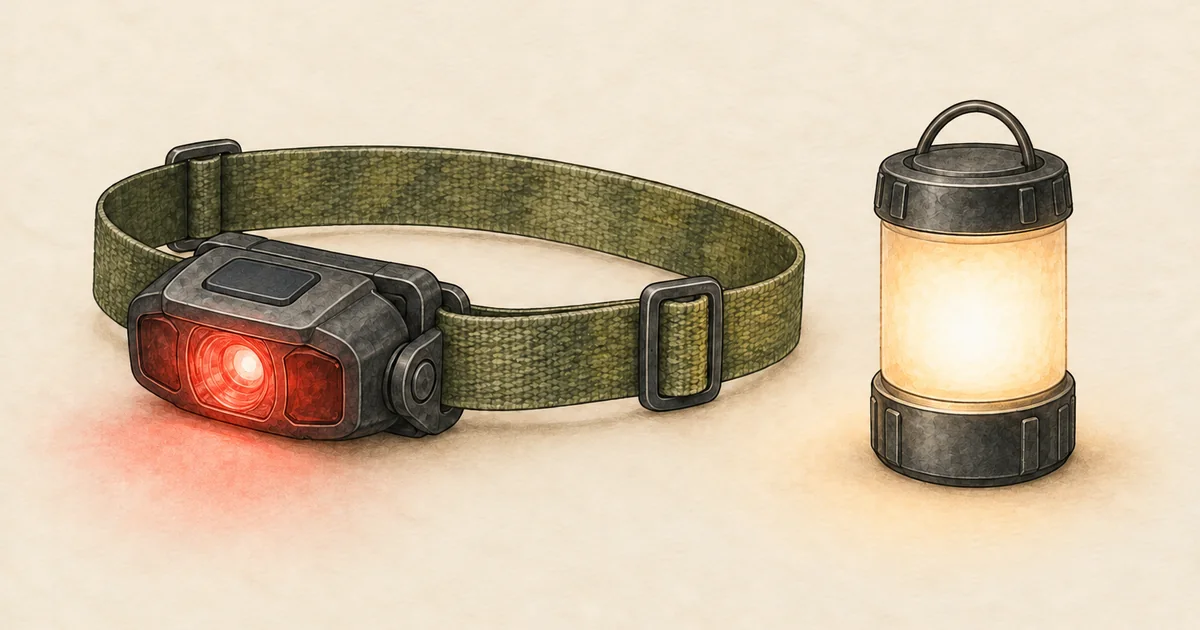
| Light | What for | How to use |
|---|---|---|
| Head torch, red light | knots, baiting, unhooking, netting | dim, aimed at the hands |
| Head torch, white light | the path, looking for gear on the ground | briefly, turned away from the water |
| Tent or swim lamp | tent, bedchair, bags | dimmed, shielded, off at night |
| Spare light | main lamp failing | second lamp, batteries, glow sticks |
Some headlamps can be dimmed. That saves the battery and gives a soft light in the tent. At night it is not the lamp that signals bites but a glow stick, bell or bite indicator.
Why red light protects your night vision
It takes about 30 minutes, according to the Lexikon der Biologie, for the eye to get used to darkness, whereas adaptation to brightness is much quicker. A bright flash of light can therefore rob you of some of your hard-won night vision. In the dark the rods of the retina do the seeing. According to the same lexicon their peak sensitivity is at about 505 nanometres in the blue-green, so red objects look darker in weak light than blue-green ones.
In practice that means the eye reacts less sensitively to red light, yet it is enough for tying knots (Blinker). The pupils stay wide, and after switching off your night vision is still there. If your lamp has no red mode, red tracing paper in front of the glass helps. Red light also helps when collecting dew worms at night, which shoot back into their burrows at footsteps or bright light. When eel, zander and wels catfish bite at night is explained under Night fishing.
The beam stays on land
Anglers report in several Blinker articles that light on the water drives fish away. When fishing for zander at night you never shine the head torch straight at the water, because that scares the predators. With eel, bright head torches and stamping on the bank are blamed for missing bites; red light scares less and is enough for baiting and netting. At quiet carp swims a weak head torch is better than a powerful floodlight. These are experiences from practice, not measurements.
Light on the bank also affects other animals. In an experiment by the Leibniz Institute of Freshwater Ecology and Inland Fisheries (IGB) in the Westhavelland, street lamps at the water attracted markedly more insects out of the water than on a dark control area. The IGB advises using light only where it is needed, shielding it and switching it off when nobody needs it. For the tent lamp that means: dimmed, pointed towards the land and off as soon as you lie down.
One habit helps: turn your head away from the water before you switch the lamp on, and start in red mode.
Do not dazzle your neighbours
The Federal Office for Radiation Protection (BfS) reports that in one study several LED torches fell into risk group 2 under the DIN EN 62471 standard, that is medium risk, without suitable warnings. According to the BfS the blink reflex cannot be relied on: in one study only a minority of test subjects closed their eyes reflexively in strong light. So address other anglers with your lamp lowered or switched off. The water regulations of the Landesanglerverband Brandenburg in any case require that you avoid hindering and disturbing one another while fishing.
Battery, cell and cold
Many devices at the water now have a built-in rechargeable battery. In winter the cold makes the batteries of phone, head torch and bite alarm run flat faster; a power bank helps. Some head torches carry their batteries in a separate case on the body, partly so that they do not lose power in the cold.
- Lithium-ion battery: The German Environment Agency (UBA) advises not letting it run completely flat and charging it at about 20 per cent charge at the latest. Above 40 °C it suffers, also when stored in a car in the sun.
- Spare lamp: For devices that sit unused for a long time, the UBA names nickel-metal-hydride batteries with low self-discharge. They are ready for use at once even after long storage; the agency gives rarely used torches as an example.
- Reserve: For eel fishing, a head torch comes with spare batteries, plus an emergency pack of glow sticks.
- Leaked batteries: According to the UBA, handle them only with gloves if possible. Spent batteries do not belong in household waste; more on that under glow sticks.
Reading lumens, runtime, beam distance and protection rating
The suffix FL1 after lumens or hours refers to a US measurement standard for torches and head torches. In its 2009 version, on which the US Forest Service relies, lumens are the total light emitted. The runtime runs from the starting value shortly after switching on until it drops to 10 per cent of that, the beam distance up to the point where 0,25 lux still arrive. So many hours does not mean many hours of full brightness. If the suffix is missing, the measuring method remains open.
The second digit in the IP code under DIN EN 60529 states the protection against water; an X stands for a digit that is not specified:
- IPX4: splashing water from any direction.
- IPX5, IPX6: water jets, tested with 12,5 or 100 litres per minute from 2,5 to 3 metres.
- IPX7: temporary immersion, 30 minutes at a depth of one metre.
- IPX8: continuous immersion by agreement between manufacturer and user, stricter than for 7.
Up to digit 6, a rating includes the lower ones. IP67 or IP68 on its own applies, under the standard, only to the conditions tested; water jets are covered only by a dual rating such as IPX6/IPX7. For equipment used unprotected outdoors, the employers’ liability insurance association BGN names at least IPX3, a benchmark for rain. For the boat, the transport ministry recommends splash-proof hand torches, that is digit 4. If the torch falls into the water on the bank, that is the case for digit 7.
Weight and fit on the head
The Forest Service specification applies to lamps on hard hats and allows, with headband and batteries, at most around 184 g (6,5 ounces) in one piece, or around 269 g (9,5 ounces) with a separate battery pack. The weight should be distributed so that the lamp sits balanced, and a connecting cable should be attached to the headband. When comparing, check whether a stated weight includes the headband and batteries.
Light, state law and water regulations
Fisheries law is state law. Whether you may fish at night at all is regulated by the state, the fishing permit (Erlaubnisschein) and the water regulations (Gewässerordnung); examples from four states are under night fishing. On light itself, here is an example from Bavaria: section 15 of the implementing regulation to the Fisheries Act (AVBayFiG) prohibits fishing using electric light sources. Whether a head torch for baiting falls under that, the wording does not say. Clarify this with your club or the fisheries authority (Fischereibehörde) before your first night.
Note, as of October 2026: The regulations mentioned are examples, not a complete overview. What counts is the current version in your state and your fishing permit and water regulations. For eye problems after being dazzled, this text is no substitute for medical advice.
Lights in the boat: navigation lights as a guide
In a boat, being seen matters too. On many federal waterways the Inland Waterways Traffic Regulations (BinSchStrO) apply; under the introductory regulation they do not cover, among others, the Rhine, the Moselle and sea shipping channels. Night is defined there as the time between sunset and sunrise (§ 1.01). A small craft that is neither under engine power nor under sail shows a white all-round ordinary light at night (§ 3.13 No. 5). When it is at rest, this light belongs on the fairway side (§ 3.20 No. 2). How bright an ordinary light has to be is set by a standard to which the regulation refers. § 3.07 also forbids dazzling with a light in a way that endangers or obstructs ships or traffic on land.
The Federal Ministry of Transport’s leaflet “Sicherheit auf dem Wasser” (as of February 2019) requires, for safety reasons, navigation lights approved for shipping and, on inland waters, an EU approval. As additional equipment it recommends splash-proof hand lamps with spare batteries. Which lights your boat needs on your water is something you settle with the boat hire firm or the responsible authority. Life jacket, weather and signing out are covered under Boat and life jacket.
Common mistakes
- Leaving the lamp on all night. It is better to put the rods out while it is still light and not to leave the head torch switched on all the time.
- Shining the light at the water or your neighbour when you turn round. A head torch follows every glance. Switch it off or to red before you turn.
- Only one light source with you. If it fails, you are left standing in the dark on the bank. A second lamp or spare batteries and a few glow sticks belong in your kit.
- Heading out on a winter night with a half-charged battery. Cold drains it faster, so set off fully charged and pack a power bank.
- Thinking only of the head torch in a boat. For navigation lights, the transport ministry’s leaflet names approved position lights. Find out what your boat needs before you set off.
Frequently asked questions
Is red light enough for unhooking?
Red light is also enough when you unhook or handle a fish. If you need to check something closely, switch to white briefly and turn away from the water as you do so. How unhooking itself works is explained under Landing and unhooking a fish.
May I fish in Bavaria with a head torch?
The AVBayFiG prohibits fishing using electric light sources. Whether a head torch used for baiting counts as one is not settled by the wording. Ask at your club or at the fisheries authority (Fischereibehörde).
Do I need my own light in a boat without an engine?
On federal waterways where the BinSchStrO applies, § 3.13 requires small craft that are neither under engine power nor under sail to show a white all-round light at night. Whether that applies to your boat is something to clarify with the responsible authority. Other waters have other rules; the authority or the hire firm can tell you.
Related
- Night fishing: biting times, a swim chosen in daylight and the rules of the states
- Glow sticks: light on the float and rod tip, disposal
- Bite indicators: hearing bites without switching on the lamp
- Boat and life jacket: life jacket, weather and signing out before you set off
- Life jacket: the jacket as part of your kit
- Landing and unhooking a fish: landing net, unhooking mat and removing the hook
- Line calculator: what the line still holds after the knot
Sources
- Spektrum, Lexikon der Biologie: Hell-Dunkel-Adaptation und Dämmerungssehen (Dauer der Dunkeladaptation, Empfindlichkeit der Stäbchen)
- Blinker: Überprüft: 10 Mythen über das Nachtangeln (Rotlicht für Knoten, Abhaken und Wurmsuche, Lampe nicht dauernd an), Aal: So fangen Sie Schlängler im Stillwasser (Kopflampe mit Rotlicht, Scheuchwirkung), Zanderangeln bei Nacht (nicht aufs Wasser leuchten), Karpfen-Spots im Verborgenen (schwache Lampe)
- Blinker: Immer in der Tacklebox: kleine Helfer (Stirnlampe im Gepäck, freie Hände, Akku und Kälte), Aalangeln: Mit diesen Tipps klappt’s (Ersatzbatterien), Angler-Werkzeug (Knicklichter für den Notfall)
- Leibniz-Institut für Gewässerökologie und Binnenfischerei: Fataler Insektenstaubsauger: Uferbeleuchtung (Versuch im Westhavelland) und Lichtverschmutzung (Licht abschirmen und ausschalten)
- Bundesamt für Strahlenschutz: Schutz bei sichtbarem Licht (LED-Taschenlampen in Risikogruppe 2, Lidschlussreflex)
- Umweltbundesamt: Batterien und Akkus richtig nutzen und fachgerecht entsorgen (Laden, Hitze, Akkus mit geringer Selbstentladung, ausgelaufene Batterien)
- Freistaat Bayern: Verordnung zur Ausführung des Bayerischen Fischereigesetzes (§ 15, elektrische Lichtquellen) und Landesanglerverband Brandenburg: Gewässerordnung (Nr. 1.7, gegenseitige Störung)
- Bundesministerium der Justiz, Binnenschifffahrtsstraßen-Ordnung: § 1.01, § 3.07, § 3.13, § 3.20 und Einführungsverordnung, § 1 (Begriffe, Blendung, Lichter von Kleinfahrzeugen, Geltungsbereich)
- BMVI, BSH, WSV: Sicherheit auf dem Wasser (PDF) (zugelassene Positionslichter, Handlampen mit Reservebatterien)
- US-Forstbehörde (USDA Forest Service): Specification 5100-451 (PDF) (Messwerte nach FL1, Gewicht)
- IEC 60529, Normtext (PDF) (Prüfbedingungen, Doppelangabe)
- BGN: DGUV Information 203-005, Anhang 2 und ASI 3.10, Schutzarten (Bezeichnungen, IPX3 im Freien)
- Wikipedia: Stirnlampe (Dimmen, Rotlicht und Pupillen, Batteriegehäuse am Körper, nur ergänzend)
Text AI-assisted, drawing AI-generated. Sources opened and checked in October 2026; no graphics taken from the sources.
All figures are guide values without guarantee. Which lights you may use on the bank and in the boat is decided by state law, your fishing permit (Erlaubnisschein), the water’s rules and the shipping law that applies to your water.