
Knowledge · Tackle
Fishing jacket and layering: Warm and dry at the water
A fishing jacket is the outer of three layers: it keeps out rain and wind, while the layers underneath keep you warm. At the water you often sit still for hours, and in between you walk and cast. So what matters is not only what beads off on the outside, but also where the sweat on the inside can go.
Three layers with three jobs
For outdoor work in winter, the German employers‘ liability insurance association for the construction industry (BG BAU) describes the layering principle like this: on the inside, one layer regulates the climate on the skin, above all moisture. In the middle sits the insulation, on the outside the weather protection. Above all, it matters that the warmth can be adjusted to the weather, your movement and how cold you feel. During a static session you hardly move; on the way to your swim and when spinning, on the other hand, you move a lot.
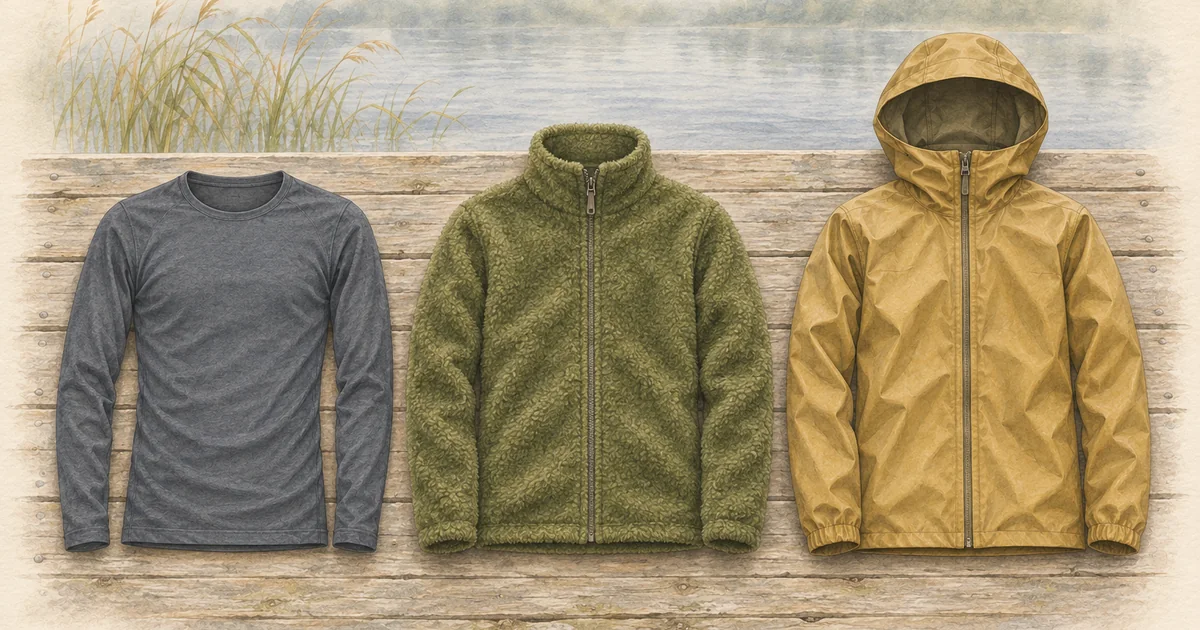
Base layer: merino or synthetic fibre
Functional underwear goes next to the skin. According to the BG BAU, merino wool and similar fabrics wick sweat away from the skin to the outside. An article in Rute & Rolle relies on synthetic fibre or merino for fishing and leaves out cotton; the reason is explained under Fishing trousers. A Blinker article on drysuits recommends functional underwear with a thicker fleece over it for the cold season, and light functional underwear for summer.
The reason is sweat. If it builds up in the layers, cold spots form, according to the BG BAU. In quiet phases, evaporative cooling develops there and draws a lot of heat from the body. At the water, that is the moment after the walk in, when you sit down.
Insulating layer: fleece and lining
The middle layer keeps you warm. For wading in winter, the magazine recommends several layers of fleece instead of ordinary winter clothing, because you can move better in them. Whether a down or a synthetic filling keeps you warmer when wet is not backed up with measurements by the sources checked for this page. According to the BG BAU, all that is certain is that clothing should stay as dry as possible and that wet items should be changeable.
Weather protection: the jacket itself
On the outside, the fishing jacket keeps out wind and rain. For the layers underneath to work, it must be roomy enough, as the BG BAU also stresses. How the membrane and water-repellent finish work is explained on the Wading jacket page.
Water column, EN 343 and Ret value
According to Blinker, the water column describes what water pressure a fabric is meant to withstand; 10.000 mm corresponds mathematically to the pressure of ten metres of water. It is measured in a hydrostatic pressure test. The European version was long called EN 20811; according to the British standards body BSI, it has been withdrawn since May 2018 and replaced by EN ISO 811. The figure applies to the fabric in the lab. According to Blinker, whether the jacket stays waterproof depends just as much on seams, membrane protection and fit. More under Rain gear.
The classes of EN 343
EN 343 is the European standard for protective clothing against rain, i.e. for weather protection clothing at work. It rates two things: water penetration, abbreviated WP, and water vapour resistance, abbreviated Ret. In the 2019 edition, according to the British testing institute SATRA, there are four classes for each, class 4 being the best. According to DIN, class 4 was only added with this edition; the Swiss accident insurer Suva still describes three classes on its website. Since May 2026 there has been the successor standard DIN EN ISO 24232, in which DIN has revised, among other things, the requirement for water penetration. Older labels still state EN 343, so check the standard and the edition.
The real difference from the water column on a swing tag: for class 1, fabric and seams are only tested when new, at a minimum of 8.000 pascals. From class 2, the fabric must first survive abrasion, repeated flexing, fuel and oil, and washing. After that, class 3 requires at least 13.000 Pa and class 4 at least 20.000 Pa, with class 4 also on washed seams.
Worked example: According to SATRA, 1.000 Pa corresponds to around 102 mm of water column. Class 1 therefore requires around 816 mm (8 × 10²) on new fabric, class 4 around 2.040 mm (20 × 102) after abrasion, flexing and washing. Next to 10.000 mm on a label that looks small, but a millimetre figure without a standard says nothing about used fabric and seams. All classes at a glance are shown in Rain gear.
Ret value: how easily sweat vapour gets out
Testing institutes measure breathability as water vapour resistance to DIN EN ISO 11092. The Hohenstein textile institute names measuring devices such as its skin model for this. The standard measures on a heated plate that imitates sweating; according to SATRA, EN 343 also refers to this method. Because Ret is a resistance, the rule is: the lower the figure, the more easily vapour gets out. For the best class 4, DIN gives a Ret below 10. With the EN 343 classes it is the other way round: there, the higher class is the more breathable one.
Two caveats belong here. The ISO 11092 standard itself says that its test conditions do not reflect any particular wearing situation and do not set comfort limits. And EN 343 contains an annex with recommendations on wearing time: Suva writes that, depending on the breathability class, the standard advises how long the clothing should be worn. For the weakest class 1, the BG BAU considers a limit on wearing time necessary for occupational safety. So with lots of walking and casting, the Ret class matters more than when sitting. Against the cold, according to the BG BAU, there is a further limit: rain protection clothing only down to −5 °C; below that, proper cold protection clothing is needed, see Thermal suit.
How to recognise a good fishing jacket
Length when seated. The BG BAU recommends choosing the size and cut so that the back and kidney area are well covered. During a static session, a short jacket rides up at the back as soon as you lean forward; a cut that is longer at the back prevents this, as in Fig. 1.
Hood and collar. A Blinker article on drysuits names the hood as windproof and waterproof protection for the head in the rain. The BG BAU calls for adequate protection for the neck and ears, but at the same time recommends openings at the neck and wrists through which the clothing can ventilate from the inside. A high collar that you can open does both.
Sleeve cuffs. According to the BG BAU, the sleeves should pull over or into the gloves and overlap with them. In the optional rain tower test of EN 343, testers check, according to SATRA, how much water creeps into the clothing via the sleeve ends. Suitable gloves are shown on the Fishing gloves page.
Pockets and fastenings. The same test looks for faults in the cut, such as pockets that fill with water. A flap over the opening keeps rain out. The BG BAU also recommends an easily reachable place for gloves you have taken off and fastenings that cold fingers can still manage, so large zips rather than buttons.
Trying it on in six steps
- Put on the layers you wear underneath at the water, at least a fleece.
- Sit on a chair and lean forward as if reaching for the rod. Your lower back stays covered.
- Make an overhead casting movement. The sleeves do not slide off your wrists.
- Put on gloves. The cuffs go over or into the glove, and you can still open the zip and pockets with them on.
- Pull the hood over your hat and close the collar. Neck and ears are covered, and the collar can be opened again for ventilation.
- Read the label: standard with edition, classes for water penetration and Ret, care instructions.
Head and neck: hat, neck scarf, sun hat and net
In winter, your head is part of your cold protection. The BG BAU says good protection for the head is important so that the whole body does not lose too much heat, and counts the nose, chin and outer ears among the areas particularly at risk from cold. A hat under the hood and a neck scarf cover this. If you pull the scarf over your mouth and nose in frost and wind, make sure it does not get soaked by your breath; the BG BAU warns about this with face masks too.
In summer, the job is reversed. According to the Federal Office for Radiation Protection (BfS), clothing and headwear are the best and simplest protection against UV radiation. The headwear should cover the ears and neck and shade the eyes, so a hat with a wide brim or a cap with a neck flap. At the water, UV exposure can be higher than the UV index indicates because of reflection. According to the BfS, how well a neck scarf protects depends mainly on the type of fabric and how densely it is woven. The UV Standard 801 also measures on wet, stretched fabric. More under Sun, heat and ticks.
Against mosquitoes, the German Environment Agency (UBA) recommends light-coloured, loose clothing outdoors, because mosquitoes prefer to fly at dark colours. A net over your hat transfers the idea of a mosquito net to your face; the authorities give no test values for this. More under Mosquito and tick protection.
Which layers for which weather
The table sums up the sources on this page for typical fishing days. It does not replace a look at the weather forecast for your water.
| Time | Skin and middle | Outside | Head and neck |
|---|---|---|---|
| Summer, sun | light functional underwear | long, light-coloured, tightly woven shirt; rain jacket in your rucksack | hat with a brim or a neck flap |
| Showers, lots of moving about when spinning | thin functional underwear, light fleece within reach | rain jacket with a high breathability class | Hood |
| Cold and windy, long static session | merino or synthetic fibre, fleece over it | lined jacket or overalls, long at the back | hat under the hood, neck scarf |
| Below −5 °C, ice fishing | as above, more layers | cold protection clothing instead of a rain jacket | hat, face protection that does not get soaked |
| Boat and open water | according to temperature, spare layer packed dry | windproof jacket, with the life jacket over it | head protection within reach |
For boats, the Federal Ministry of Transport’s brochure „Sicherheit auf dem Wasser“ names a windproof jacket, head protection and gloves as items that should be within reach. How the life jacket and weather clothing go together is shown in Life jacket and Boat and life jacket; at the ice hole, Ice fishing will help you further.
Cold, wind and hypothermia
Wind turns a cool day into a cold one. According to the German Weather Service (DWD), wind cools the skin more the faster it blows; in the cold, humidity only plays a role when the skin is wet with water or snow. On the water, according to the Federal Ministry of Transport, you can become hypothermic from wind alone even below 15 °C air temperature. For outdoor work, the BG BAU expects an increased risk to health from about −5 °C and describes as the most extreme case that the core body temperature drops and consciousness fades.
According to the German Red Cross (DRK), hypothermia occurs when the body loses more heat than it produces over a longer period. The DRK names shivering as an early sign. Then you dial 112, take the person somewhere warm, remove their wet clothing and wrap them in warm blankets. Rewarming is done slowly, without rubbing and without a hot-water bottle, and they get no alcohol. Alcohol only seems to warm you: according to the BG BAU, it opens the blood vessels in the skin, and the body loses a lot of heat as a result.
Safety: No jacket protects you if you fall into cold water. For that, the Federal Ministry of Transport names drysuits or wetsuits, see Thermal suit. In thunderstorms, Thunderstorms and weather applies. These notes do not replace medical advice or a first-aid course. In an emergency, dial 112.
Common mistakes
- A short jacket for a static session. When you sit and lean forward, your lower back is exposed, exactly where the BG BAU calls for coverage.
- Looking only at the millimetres. The water column measures the fabric. Seams, cuffs and pockets also decide whether you stay dry.
- Using the rain jacket as a winter jacket. According to the BG BAU, rain protection clothing is enough down to −5 °C; below that you need cold protection clothing.
- Zipped right up for the walk in. If you sweat, you cool down afterwards when you sit. Only close the collar and zip once you are at your swim.
- A nip against the cold. Alcohol only gives a feeling of warmth; the body loses heat in the process.
Frequently asked questions
What water column does a fishing jacket need?
The sources on this page give no fixed figure. A class to EN 343 tells you more than the millimetres, because from class 2 pre-treated fabric is also tested, and for class 4 washed seams as well.
Why do I sweat despite a breathable jacket?
According to Blinker, a membrane works best when it is noticeably warmer and more humid inside than outside, and even then it does not prevent sweating completely. Open the collar and zip when walking; the BG BAU explicitly names such openings as ventilation.
Is a rain jacket enough in winter?
Down to about −5 °C with warm layers underneath, says the BG BAU for weather protection clothing. Below that you need cold protection clothing, such as a lined suit.
Related
- Rain gear: reading the water column correctly
- Thermal suit and flotation suit: protection from the cold on boat and ice
- Fishing trousers: fabrics, bib-and-brace trousers and layers for your legs
- Fishing gloves: warm fingers that can still tie knots
- Wading jacket: short jacket, membrane and care
- Sun, heat and ticks: UV index and sun protection at the water
- Mosquito and tick protection: clothing and repellents
- Line calculator: working out breaking strength and knots
Sources
- BG BAU, BauPortal 4/2022: Schutz vor Gefährdungen durch Kälte (Schichten, Schnitt, Kopf, Kälte)
- BG BAU, Baustein E 606: Schutzkleidung (PDF)
- SATRA Technology Centre: The EN 343 protective clothing standard (Klassen, Mindestdrücke, Ret)
- DIN: Inhaltsverzeichnis DIN EN 343:2019-06 (PDF) (Gliederung der Norm), DIN: DIN EN 343:2019-06 (neue Klasse 4, Ret unter 10), DIN: DIN EN ISO 24232:2026-05 (Nachfolgenorm) und Suva: Warn- und Wetterschutzkleidung (Klassen, Tragedauer)
- BSI: BS EN ISO 811:2018, Hydrostatic pressure test und BSI: BS EN 20811:1992 (Prüfverfahren Wassersäule, Rückzug EN 20811) sowie ISO: ISO 11092:2026, Sweating guarded-hotplate test (Grenzen der Ret-Messung)
- Hohenstein: Komfort (Hautmodell)
- Blinker: Wathose kaufen (Wassersäule), Blinker: Angeln im Januar, Blinker: Waten im Winter und Blinker: Trockenanzüge
- Rute & Rolle: Schicht für Schicht
- Bundesministerium für Verkehr und digitale Infrastruktur: Sicherheit auf dem Wasser (PDF), Stand Februar 2019 (Wind, Unterkühlung, Schutz beim Sturz ins Wasser)
- Deutscher Wetterdienst: Wind-Chill-Effekt und Deutsches Rotes Kreuz: Erfrierungen und Unterkühlungen
- BfS: Tipps zum UV-Schutz und BfS: UV-Schutz durch Kleidung
- Umweltbundesamt: Stechmücken
Text AI-assisted, drawings AI-generated. Sources opened and checked in November 2026, no graphics taken from the sources.
All figures are guide values without guarantee. Which layers suit you depends on the weather, the fishing method and how cold you feel; in the case of cold injuries, this text does not replace medical advice.