
Knowledge · Tackle
Wading jacket: Short, watertight and with pockets
A wading jacket is the weather jacket for everyone who stands in the water while fishing. It keeps rain, wind and spray off your upper body and off the open top of the waders, and carries small items so that you can reach them in the water. This page explains what matters for length, cuffs and pockets and how jacket, belt and life jacket fit together.
Weather protection over the waders
Waders keep you dry from below, but they are open at the top. The hip band and the chest section can be pulled tight to the body with elastic, but that does not make the top fully sealed. A rain jacket worn over the waders therefore helps: it keeps the inside of the waders dry in rain or heavy spray.
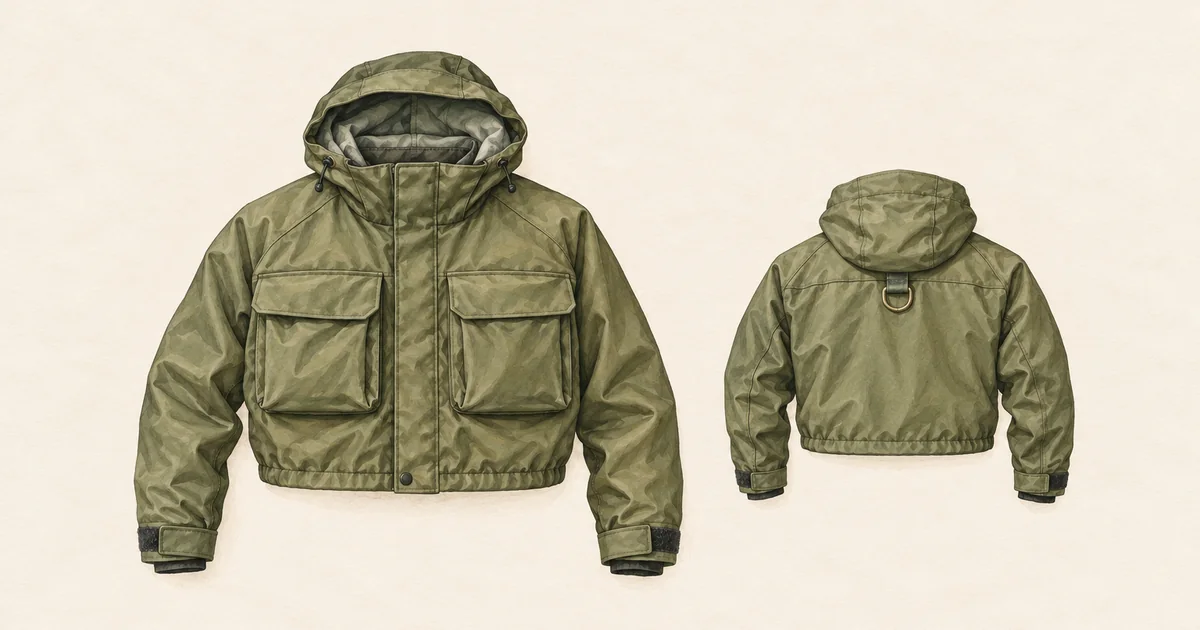
On the coast the jacket is part of the kit. When fly fishing on the coast, Blinker counts a wading jacket that also protects against wind and spray as part of the complete outfit. On the packing list for sea trout on the Baltic Sea it appears alongside warm underwear, waders, polarised glasses and a wading net, explicitly with a hood. More about the venue under Coast and surf fishing, about the target fish under Sea trout.
The hem ends above the water
When trying on, the lower hem counts above all. The sources checked for this page give no fixed length; the rule follows from the depth of the water: the hem must end above the line to which you wade. Anyone wading to the hip therefore needs a short jacket that stops at the waist. A long rain jacket hangs there with its hem in the water, and every wave pushes wetness under it, right at the waistband of the waders.
Try the jacket on with your arms raised, because the hem rides up when casting. You try the waders on with the clothing you will wear beneath them and squat as you do so. The same test suits the jacket over them.
Beneath the hem the wading belt sits on the waders. A short jacket leaves the belt free, so a net holder on the belt also stays within reach, as Rute & Rolle shows. More under Wading belt.
Cuffs, membrane and water repellency
At the sleeves the closure decides. If you reach below the surface to net or unhook a fish, water runs into a wide sleeve up to the elbow. Tight, adjustable cuffs at the wrist prevent that. Some wading clothing has neoprene cuffs. Clothing with neoprene does not belong in the tumble dryer, because booties and cuffs will not survive it.
Watertight and breathable wading clothing comes from a membrane, a thin layer in the fabric. Taking waders as an example: liquid water cannot get in from outside, while some of the moisture from inside escapes as vapour. This works best when it is warmer and more humid inside than outside. You cannot manage entirely without sweating, though.
On the outside a water-repellent finish, abbreviated DWR for Durable Water Repellent, makes water bead off the top fabric layer. That helps moisture escape outwards, and the clothing dries faster.
Pockets and a ring for the net
There is nowhere to put anything down in the water, so everything hangs on the body. Coastal fly anglers who want to save themselves changing the spool put a second reel with a different line in the pocket of the wading jacket or fishing vest. The Line calculator works out what breaking strain belongs on the second spool. The pockets therefore need to be big enough for a reel.
Chest pockets have an advantage when wading that follows from their position: they sit high and stay dry when pockets at hip height are already submerged.
For the landing net the wading jacket has a D-ring, a metal ring to hang it from. Rute & Rolle describes how one half of a two-part magnet sits there and the other on the net. The net then hangs on your back and comes free with one grab backwards. How magnet, belt holder and safety cord work together is explained under Wading net.
Underneath: layers instead of a winter jacket
The wading jacket is the outer shell; the layers beneath keep you warm. For winter spinning, several layers of fleece on the onion principle and thermal underwear beneath the waders work well. Ordinary winter clothing is impractical there because you can hardly move in it inside waders. So buy the jacket roomy enough for a fleece jumper to fit beneath it and for the sleeves not to become too short when casting.
Wading belt and life jacket
A jacket protects against weather, not against drowning. On its page about floods the DLRG warns about waders: if they fill up, inexperienced people can hardly get out of them, and in the worst case they pull the wearer under. According to the DLRG, even knee-deep current can sweep a person away. The British accident prevention society RoSPA advises a life jacket and a wading belt when wading, and considering a wading staff.
According to information sheet 212-004 of the Deutsche Gesetzliche Unfallversicherung (DGUV), an inflatable life jacket with an automatic mechanism inflates by itself as soon as its wearer falls into the water. They do not have to do anything. Heavy rain or high humidity do not trigger it, however.
When combining with other protective equipment, according to the DGUV nothing may hinder the inflated buoyancy chamber; as an example it names straps that can prevent inflation. Applied to wading, that means: the life jacket goes over the wading jacket, and straps from a rucksack or landing net do not belong over it. In addition, according to the DGUV, pockets of air in closed weather-protection clothing can work against a position that keeps an unconscious person afloat face up; in occupational safety it then requires jackets with 275 newtons of buoyancy. How to check the triggering is covered under Life jacket; the DGUV additionally names servicing by the manufacturer, usually every two years.
Safety: This page does not replace safety instruction or medical advice. In an emergency, dial 112. Basic rules for wading are covered under Bank and waders.
Care
Blinker explicitly counts wading jackets among wading clothing that needs care. You should not leave one wet in the boot of the car: fungi and bacteria grow in damp, and according to the article mould dissolves the seams. Wash it according to the sewn-in label and without fabric softener, which harms breathable wading clothing. Dirt, sun oil and insect repellent reduce the performance of the membrane; regular washing keeps its permeability to water vapour. After four to six washes the water-repellent finish is renewed from the outside, leaving neoprene parts out.
Common mistakes
- Wading deep in a long jacket. If the hem hangs in the water, wetness runs under the jacket as far as the top of the waders.
- Taking the jacket for a buoyancy aid. Clothing alone does not keep the head above water; according to the DGUV additional buoyancy is needed.
- Straps over the automatic jacket. Whatever constricts the buoyancy chamber can hinder inflation.
- Packing it away wet. Damp wading clothing goes mouldy, and mould dissolves the seams.
- A thick winter jacket under the waders. It robs you of freedom of movement; thin layers of fleece do not.
Frequently asked questions
Is an ordinary rain jacket enough for wading?
In shallow water it can be enough, as long as the hem stays above the waterline. The deeper you wade, the more it matters where the hem ends.
Does a wading jacket replace the life jacket?
No. The DGUV writes that clothing does not, as a rule, pull a person under water, but that additional buoyancy is needed to keep the head above the waterline. That is supplied by a buoyancy aid or life jacket, not by the jacket.
How often do I have to re-proof the jacket?
As a guide, four to six washes, after which the water-repellent finish is renewed from the outside. Without that beading effect, moisture soaks into the outer fabric layer.
Related
- Waders: material, fit and soles
- Wading belt: fit and effect in a fall
- Wading net: magnet, belt holder and safety cord
- Life jacket: solid or automatic, checking
- Bank and waders: current, wading staff and a secure stance
- Coast and surf fishing: the venue of many wading anglers
- Line calculator: breaking strain for the second spool
Sources
- Blinker: Erfolgreich angeln an der Küste (Watjacke gegen Wind und Spritzwasser) und Blinker: Das Silber der Meere, Meerforellenfischen auf Fehmarn (Watjacke mit Kapuze)
- Blinker: Fliegenfischen an der Küste, welche Schnur ist die richtige Wahl? (Ersatzrolle in der Tasche der Watjacke)
- Rute & Rolle: Kescher, Einnetzen! (Magnet am D-Ring der Watjacke, Kescherhalter am Gürtel)
- Blinker: Pflege der Wathose, darf die Hose in die Waschmaschine? (Pflege von Watbekleidung samt Jacken, Neopren-Manschetten)
- Blinker: Wathose kaufen, so finden Sie das richtige Modell (Membran, Anprobe, Watgürtel) und Blinker: Spinnangeln im Winter, die besten Tipps zum Watangeln (Schichten unter der Wathose)
- DLRG: Hochwasser (Wathosen, knietiefe Strömung) und RoSPA: Angling Safety Code (PDF) (Rettungsweste, Watgürtel, Watstock beim Waten)
- Deutsche Gesetzliche Unfallversicherung: DGUV Information 212-004, Rettungswesten und Schwimmhilfen (PDF) (Automatikweste, Kleidung und Auftrieb, Wartung)
- Wikipedia: Wathose (Regenjacke über der Wathose, nur ergänzend)
Text AI-assisted, drawing AI-generated. Sources opened and checked in October 2026; no graphics taken from the sources.
All figures are guide values without guarantee and do not replace safety instruction or medical advice. How deep you wade and which life jacket you wear is your decision, depending on the water, the current and the weather.