
Knowledge · Tackle
Rain gear for fishing: Reading the water column correctly
Whether your rain gear for fishing survives a day of steady rain is only partly written on the label. The water column (hydrostatic head) measures a piece of fabric in the lab, not the seams, the cuffs or a jacket after three winters on the bank. If you can read the ratings, you can tell when buying which figure says something about a wet day’s fishing.
Water column: what the millimetres mean
The water column states the water pressure a fabric is meant to withstand. Blinker turns the figure into a picture: 10.000 mm is as much pressure as a ten-metre column of water would put on the fabric.
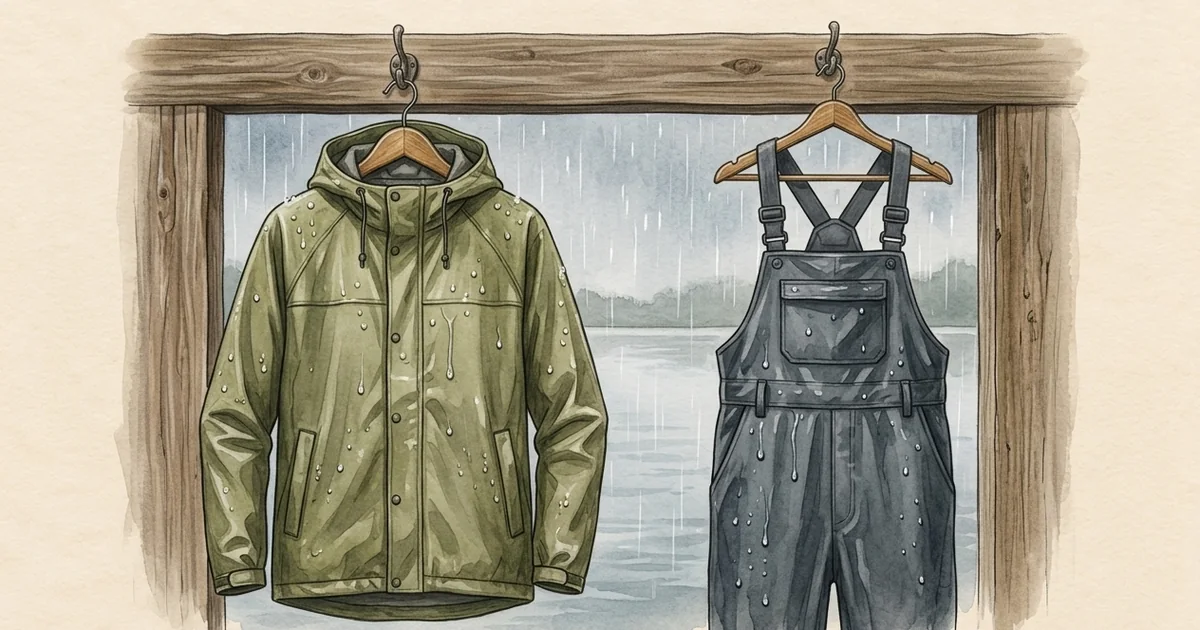
It is tested in a hydrostatic pressure test whose standard was long called EN 20811. According to the British standards body BSI, this version has been withdrawn since May 2018, and EN ISO 811 has applied since then. The test laboratory SATRA describes the procedure: water presses on the outside of the clamped sample, and the pressure rises gradually until the water penetrates the fabric.
Stiftung Warentest calls a fabric waterproof from 3.000 mm. That does not yet make a waterproof jacket. In a test by the Swiss consumer magazine Saldo, which the Stiftung reports on, most jackets stayed dry for only a few minutes in simulated continuous rain in the lab, including one with a very high water column on the label. After repeated washing, all of them stayed dry for less time than when new. The report names the seams above all as the weak point.
EN 343 and ISO 24232: the classes on the label
A reference to a standard tells you more. EN 343 is the European standard for protective clothing against rain, snowflakes, fog and ground moisture. According to DIN, water splashes and waves are not covered.
The label shows two properties with four classes each: water penetration resistance WP and water vapour resistance Ret, which stands for breathability. In each case, higher is better. For water penetration, what the fabric has been through before the measurement also counts:
- Class 1: fabric and seams when new, at least 8.000 Pa (pascals, the unit of pressure).
- Class 2: also 8.000 Pa, but after pre-treatments that imitate abrasion, repeated flexing, contact with fuel and oil, and washing.
- Class 3: 13.000 Pa after these pre-treatments.
- Class 4: 20.000 Pa after pre-treatment, and the seams likewise 20.000 Pa after cleaning.
The values come from EN 343:2019 as listed by SATRA; according to DIN, class 4 was added with this edition. Optionally, the finished jacket goes through a rain tower test to EN 14360. According to SATRA, it shows whether water creeps in at the sleeve cuffs or pockets fill up, in other words faults in the cut.
Worked example: SATRA equates 1.000 Pa with around 102 mm of water column. Classes 1 and 2 therefore require just over 800 mm (8 × 102 = 816 mm), class 3 around 1.330 mm (13 × 102 = 1.326 mm), class 4 just over 2.000 mm (20 × 102 = 2.040 mm). Next to labels showing 10.000 mm that looks small, but it applies to washed, abraded fabric and to the seams; a millimetre figure without a standard tells you nothing about either.
Since May 2026, DIN EN ISO 24232 has replaced DIN EN 343. Among the changes, DIN mentions a revised requirement for water penetration; the new figures are only in the paid-for standard text. Older labels still state EN 343.
| Rating | What it states | What it does not tell you |
|---|---|---|
| Water column in mm | pressure up to which the fabric stays waterproof in the lab | whether seams, zip and old fabric keep up |
| Class WP 1–4 | water penetration of fabric and seams, fabric from class 2 after pre-treatment | protection against spray and waves |
| Class Ret 1–4 | how easily water vapour escapes, class 4 the most easily | how much you sweat in a day |
| MVTR | amount of water vapour passing through the fabric | comparison when the test method differs |
| taped seams | seam tape over the stitch holes | how carefully it was taped |
Breathability: Ret and MVTR
On the way to your swim, when wading or when spinning you sweat; during a static session hardly at all. If the sweat vapour finds no way out, it condenses back into water, according to SATRA. The jacket then feels wet inside, even though no rain got through.
The lab measures the Ret value to ISO 11092 with a heated plate that imitates sweating; the Hohenstein testing institute also determines the breathability of outdoor clothing this way. The lower the resistance, the more easily vapour passes through: according to DIN, the best class 4 requires a Ret below 10. In the weakest class 1, the clothing holds back a lot of vapour; for occupational safety the BG BAU then requires the wearing time to be limited.
Some labels give the MVTR (Moisture Vapor Transmission Rate) instead, the amount of water vapour that passes through an area of fabric in a set time; here higher is better. There are several methods for this, and according to the standards organisation ASTM, a value from one method or under other test conditions cannot simply be carried over to another. So you only compare two MVTR figures if they come from the same test method.
A membrane works best when it is warmer and more humid inside than outside, writes Blinker; it cannot prevent sweating completely. The BG BAU recommends openings at the neck and wrists for ventilation and sets a lower limit for work clothing: weather protection clothing to EN 343 only down to −5 °C; below that you need cold protection clothing. For boat and ice, see Thermal suit.
Types: coating, membrane and laminate
Most fabrics for rain gear are woven and only become waterproof through an additional layer. SATRA names three ways:
- Coating: a waterproof layer is applied to the front or back of the fabric.
- Membrane: a very thin layer that keeps out liquid water and lets water vapour through.
- Laminate: the membrane is firmly bonded to protective fabric layers. According to Blinker, terms such as three-layer or five-layer describe the structure of this bond; more or tougher outer layers withstand more but weigh more.
The Verbraucherzentrale NRW recommends membranes that are not made of fluorinated plastics such as PTFE.
The seam decides
When sewing, the needle pierces the membrane, and every stitch leaves a hole. If the seam is not carefully taped afterwards, the rain finds its way inside there, writes Stiftung Warentest. In the jargon, sealed seams are called taped; the Hohenstein testing institute checks them as part of testing weather protection clothing to EN 343.
Water-repellent finish and PFAS
On the outside of the fabric there is a water-repellent finish, DWR for short, for Durable Water Repellent. It makes drops bead off. The membrane is what keeps water out; according to Blinker, the finish ensures that the outer fabric layer does not soak up water, that vapour escapes more easily and that the clothing dries faster.
For a long time, such finishes contained per- and polyfluorinated chemicals, formerly called PFCs, today mostly PFAS. The German Environment Agency (UBA) had 15 weatherproof outdoor jackets tested and reported in 2014 that they were present in every one. They get into the environment through washing and outgassing; sewage treatment plants do not break them down, so they reach rivers, seas and groundwater. The agency’s president at the time considered the weather protection of many textiles excessive and advised thinking before buying about how strongly an item really needs to repel water and dirt.
The Verbraucherzentrale NRW helps with reading the label: proofing agents marked “PFOA-free” usually still contain other fluorine compounds, and clothing advertised that way can contain them too. According to the UBA, PFOA itself has been on the list of the Stockholm Convention since 2019, among the substances that are to disappear worldwide. According to the Verbraucherzentrale, only clothing and products labelled fluorine-free, PFC-free or free of PFAS are completely free of fluorine.
Washing and reproofing
Sweat and dirt clog the membrane and coating; Blinker also mentions sun oil and insect repellent. Stiftung Warentest advises washing outdoor jackets at least after every season. But washing removes some of the water-repellent finish, which is why washing and reproofing belong together.
- Dry after fishing. Hang up jacket and trousers until they are dry inside and out. After a trip to the coast, rinse them with fresh water first: according to Blinker, salt can attack the membrane and builds up in seams and zips.
- Wash as the label says. Use a mild detergent, no fabric softener; Stiftung Warentest and Blinker both warn against it.
- Check the beading. If the outer fabric soaks up water instead of forming drops, the water-repellent finish is worn out. For wading clothing, Blinker gives four to six washes as a guide for when to reproof.
- Refresh without fluorine. According to Stiftung Warentest, sprays and wash-in products often contain fluorocarbons, so look for PFAS-free products. An article in Blinker recommends a spray applied from the outside for membrane clothing, because wash-in products also proof the inside.
- Activate as instructed. Some water-repellent finishes need heat, such as an iron on a low setting; others dry in the air. What your product needs is on the packaging, what the fabric can take is on the care label.
At the water: trousers over the boots, cuffs closed
Rain trousers belong over the boot shaft. The BG BAU requires trouser legs and footwear to overlap well; if the trouser leg is tucked into the boot, the trousers channel the water straight into the boot. As the outer layer, they must, on the advice of the BG BAU, be roomy enough for the layers underneath. Fabrics and cut: Fishing trousers, footwear: Fishing shoes.
When you sit, your weight presses the fabric at your bottom and thighs onto the wet seat for hours, plus friction with every movement. A dry fishing chair or a seat pad takes this spot out of play, and a fishing umbrella stops the rain from reaching your lap in the first place.
On the sleeves, the cuff is what matters, and it is precisely this weakness that the rain tower test reveals. When you cast with your arms raised, rain otherwise runs down your forearm into the jacket. For wading there are special short jackets, described under Wading jacket.
Safety: rain gear is weather protection, not rescue equipment. On a boat you are hit by spray, which EN 343 is not designed for; what else belongs on board is covered under Boat and life jacket. No jacket protects you from lightning: when to pack up is covered under Thunderstorms and weather.
Common mistakes
- Comparing only the millimetre figure. Without taped seams and a standard class, it says little about how long the jacket stays waterproof.
- Tucking the trousers into the boots. The water then runs down the inside of your leg into the boot.
- Washing with fabric softener, or not at all. Both cost breathability, and dirt and insect repellent damage the membrane.
- Taking “PFOA-free” to mean fluorine-free. According to the Verbraucherzentrale NRW, such products often still contain other fluorine compounds.
- Letting salt water dry on. After sea fishing, the clothing goes under fresh water before it goes into the wardrobe.
Frequently asked questions
What water column does a rain jacket for fishing need?
The sources checked give no fixed figure for fishing. Stiftung Warentest calls fabric waterproof from 3.000 mm; the highest class of EN 343 requires, once converted, just over 2.000 mm after pre-treatment and at the seams too. Taped seams and tight cuffs matter more than an even higher figure.
What do the two classes next to EN 343 mean?
One class stands for water penetration, the other for breathability (Ret), both from 1 to 4, and higher is better. From class 2 for water penetration, the fabric was abraded, flexed and washed before the measurement.
How often do I need to reproof my rain jacket?
As soon as drops no longer bead off. Stiftung Warentest advises washing at least after every season and then refreshing with a PFAS-free product; for wading clothing, Blinker gives four to six washes as a guide.
Does a rain jacket keep you warm in winter?
It keeps out wind and wet; the warmth has to come from the layers underneath. For work, the BG BAU uses weather protection clothing to EN 343 only down to −5 °C; below that you need cold protection clothing. How to build up the layers is covered under Fishing jacket.
Related
- Fishing jacket and layering: what goes under the rain jacket
- Fishing trousers: fabrics, designs and protection against ticks
- Fishing shoes and boots: footwear for the rain trousers to fall over
- Wading jacket: short weather protection over your waders
- Thermal suit and flotation suit: when weather protection is not enough against the cold
- Fishing tent: staying dry through a long session
- Thunderstorms and weather: reading warnings and packing up in time
- Line calculator: working out breaking strain and backing for the reel
Sources
- DIN: DIN EN 343:2019-06, Schutzkleidung, Schutz gegen Regen (Anwendungsbereich, Klasse 4) und DIN: DIN EN ISO 24232:2026-05 (Nachfolgenorm)
- SATRA Technology Centre: The EN 343 protective clothing standard (Druckprüfung, Klassen, Vorbehandlung, Umrechnung, Ret, Wolkenbruchtest, Bauarten)
- BSI: BS EN ISO 811:2018, Hydrostatic pressure test (Anwendungsbereich) und BSI: BS EN 20811:1992 (zurückgezogen 2018)
- BG BAU: Baustein E 606, Schutzkleidung (PDF) (−5 °C, Tragezeit Klasse 1) und BG BAU, BauPortal 4/2022: Schutz vor Gefährdungen durch Kälte (Weite, Lüften, Hosenbein über dem Schuh)
- Stiftung Warentest: Wanderjacken im Test, viele sind nicht ganz dicht (3.000 mm, Saldo-Test, Nähte, Waschen) und Stiftung Warentest: Schadstoffe in Outdoorkleidung (Pflege, PFAS-frei imprägnieren)
- Umweltbundesamt: Wetterschutz schädigt die Gewässer (PFC in Jacken und Gewässern) und Umweltbundesamt: Perfluoroctansäure (PFOA) (Stockholmer Übereinkommen 2019)
- Verbraucherzentrale NRW: Outdoor-Kleidung ohne Mikroplastik und Schadstoffe (PTFE, „PFOA-frei“, fluorfrei)
- Hohenstein: Komfortprüfung von Textilien (Atmungsaktivität nach ISO 11092) und Hohenstein: Factsheet Wetterschutz (PDF) (getapte Nähte)
- ASTM International: E96/E96M, Water Vapor Transmission Rate of Materials (Vergleichbarkeit der Messwerte)
- Blinker: Wathose kaufen (Wassersäule, Membran, Lagen, Salzwasser) und Blinker: Pflege der Wathose (DWR, Waschen, Nachimprägnieren)
Text AI-assisted, drawing AI-generated. Sources opened and checked in November 2026; no graphics taken from the sources.
All figures are guide values without guarantee. Standard values come from laboratory tests; how long a jacket stays waterproof at the water depends on seams, care, age and weather.