
Knowledge · Law and licences
Fishing with children and the youth fishing licence
With fishing with children, each federal state (Bundesland) decides for itself when a child is merely helping, when it may handle its own rod while accompanied, and at what age a youth licence (Jugendschein) or the exam applies. Here you will find the stages, all 16 states compared and the duties of the accompanying person.
Four stages to a licence of your own
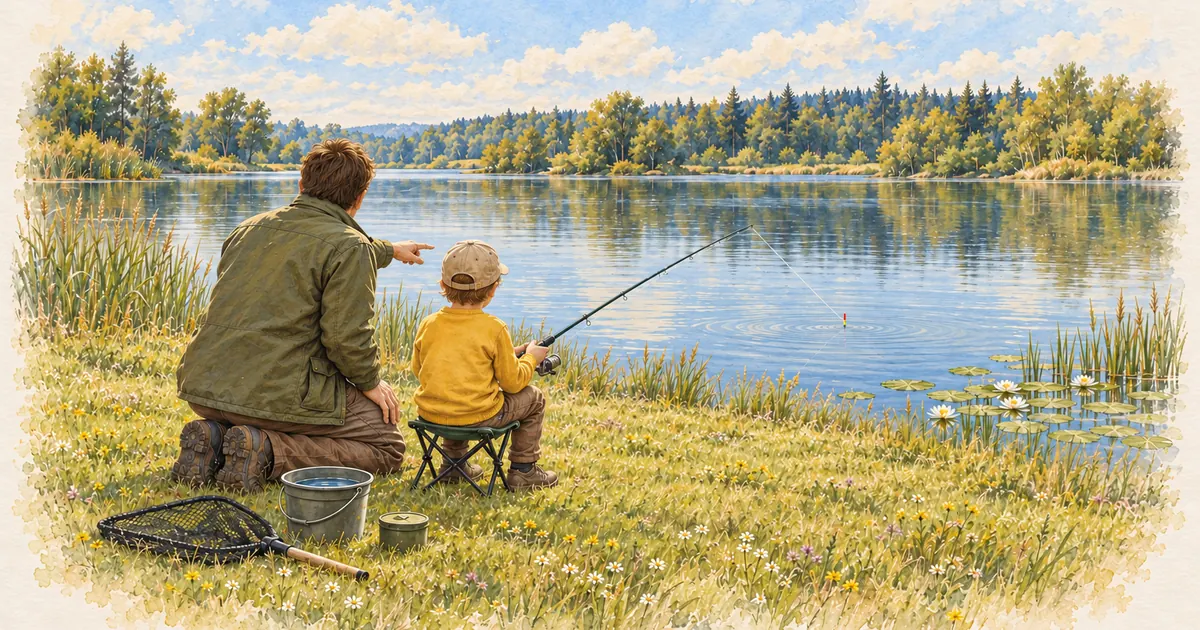
State laws arrange children’s fishing in similar stages, even though the age limits are far apart. At the bottom is helping: the child nets fish or casts an adult’s rod but has no rod of its own. Next comes accompanied fishing without a licence of their own, with an adult holding a valid fishing licence (Fischereischein) present. Some states then have a youth fishing licence (Jugendfischereischein), which is issued without an exam but stays tied to supervision. At the end comes the regular licence after passing the angling exam (Fischerprüfung).
Accompanying does not mean sitting somewhere on the same lake. Rhineland-Palatinate requires that the licence holder can step in immediately at any time (§ 33 para. 4 Landesfischereigesetz). Brandenburg prescribes constant, direct supervision for children under eight, who then fish under the adult’s day ticket (§ 18 para. 1 BbgFischG).
What younger children may and may not do
For the youngest, several states list exactly which tasks are allowed. In Saxony a child under nine has no rod of its own, but according to the fisheries authority may cast the adult’s rod and play the fish under supervision. In Berlin, children under twelve likewise fish only with the gear of an adult licence holder and only with a coarse-fishing rod. They may be left to do the netting there after instruction.
In its implementing regulation, Saxony-Anhalt allows anyone without a fishing licence (Fischereischein) to help an angler: casting and holding a rod (not a spinning or fly rod), landing a fish with the net and other helping tasks in which nobody handles the live fish. Bavaria lets people of any age try fishing without a licence if a responsible person with a licence is present. The newcomer then does not use an extra rod of their own. In Brandenburg, children aged eight and over may fish unaccompanied, and since 2026 younger children may fish accompanied with a coarse fishing rod. From eight, a youth fishing licence for coarse fishing with a hand-held rod is also available there on application, valid until the 18th birthday. In Baden-Württemberg, anyone helping a licence holder needs no licence, whatever their age (§ 31 Abs. 4 FischG). Thuringia, by contrast, expressly does not allow helpers without a licence to fish with a hand-held rod themselves (§ 26 Abs. 3 ThürFischG), and children there need the youth licence from eight.
When it comes to a caught fish, the states draw clear lines. In Bavaria, according to the Ministry of Agriculture, unhooking, stunning and killing remain the adult’s job when children are being introduced to fishing. Rhineland-Palatinate forbids children under ten to put a live fish on the hook as bait, and likewise to stun and kill fish. In Brandenburg, children under eight may neither net nor unhook, stun or kill fish. How killing is done properly is explained under Stunning and killing a fish.
All states at a glance
Ages mean completed years; “accompanied” usually means an adult with a valid licence. “None” means the state has no youth licence without an exam.
| State | Without own licence | Youth licence without exam | Licence with exam |
|---|---|---|---|
| Baden-Württemberg | helping a licence holder, any age | 7 to 15, supervision from 18 | exam from 10 |
| Bavaria | 7 to 17 accompanied | abolished | exam from 12, licence from 14 |
| Berlin | under 12 with the adult’s rod | 12 to 17, valid for one year | exam from 14 |
| Brandenburg | from 8 alone, younger accompanied | 8 to 17, coarse-fishing rod | exam from 14 |
| Bremen | under 14 accompanied | none | licence from 14 |
| Hamburg | under 15, one hand-held rod | none, other states‘ licences not recognised either | licence from 12 |
| Hesse | under 10 helping, 10 to 15 supervised | abolished in 2022 | licence from 14 |
| Mecklenburg-Western Pomerania | 7 to 13 with a fishing permit | not necessary | licence from 10, compulsory from 14 |
| Lower Saxony | inland waters without licence | does not apply | coast: licence required |
| North Rhine-Westphalia | 10 to 15 accompanied | abolished | exam and licence from 12 |
| Rhineland-Palatinate | 7 to 17 accompanied | abolished in February 2026 | licence from 13 |
| Saarland | no exception for children | under 16, supervised | exam from 13, licence from 14 |
| Saxony | under 9 with the adult’s rod | 9 to 15 | exam from 14, compulsory from 16 |
| Saxony-Anhalt | helping without a licence allowed | none | coarse fish licence from 8 (only this one up to 12), angling exam from 11 |
| Schleswig-Holstein | under 14, hand-held rod supervised | none | licence from 12 |
| Thuringia | helping only, not with a hand-held rod | 8 to 13, accompanied | exam from 10, licence from 14 |
Not legal advice: this overview is a guide, sources accessed on 25 October 2026 and rechecked on 3 November 2026. In 2026 alone, Brandenburg, Saxony-Anhalt, Rhineland-Palatinate and North Rhine-Westphalia changed their rules for children. What is binding is state law and the fishing permit (Erlaubnisschein) for the water; if in doubt, ask your state’s fisheries authority (Fischereibehörde).
Who may accompany
In most states the accompanying person must be an adult with a valid fishing licence (Fischereischein): in Bavaria, Hesse, Hamburg, Schleswig-Holstein, Saarland and Thuringia, and in Brandenburg for children under eight. Baden-Württemberg requires supervision by a licence holder aged 18 or over for the youth fishing licence. Bremen and North Rhine-Westphalia only mention the licence in the relevant provision, with no minimum age. In Mecklenburg-Western Pomerania, children aged 7 to 13 fish without a licence but with their own fishing permit. If the adult casts for the child, the state office says the adult is fishing and needs a licence and permit for it. The fisheries inspectors do not object to children under 14 fishing alongside, as long as a holder of fishing documents keeps an eye on them and that person’s restrictions are observed.
Not every licence is enough for this. In Schleswig-Holstein a holder of the holiday fishing licence may not supervise children, in Thuringia the same applies to the quarterly licence, and in Rhineland-Palatinate the special fishing licences do not qualify for accompanying. Hamburg allows children without a licence only a hand-held rod with a single bite point.
Expect an age check. Bavaria demands the young person’s ID in case of doubt; in Hesse the supervising person must prove their age on request with an official photo ID. In Mecklenburg-Western Pomerania, young people under 16 carry a photo ID or school ID alongside the licence.
Fishing permit and levy apply to children too
No fishing licence (Fischereischein) does not mean no permit for the water. North Rhine-Westphalia makes clear in § 37 that children without a licence also need a fishing permit (Erlaubnisschein). The Bavarian agriculture ministry says the same for accompanied young people, and in Mecklenburg-Western Pomerania the fishing permit from the holder of the fishing rights is enough for children aged 7 to 13. What such a permit says is explained on the page Fishing permit and water map.
The states differ on the fishing levy (Fischereiabgabe). Brandenburg exempts children and young people under 14; they only need the fishing permit. In Bavaria, accompanied young people pay no levy, and in Baden-Württemberg the youth fishing licence is levy-free. Rhineland-Palatinate, on the other hand, charges a levy of 3,60 euros even for children and young people who fish accompanied without a licence, if their main residence is there (§ 40 Abs. 2 LFischG). Hesse also charges a fishing levy for 10- to 15-year-olds who live there: 3,50 euros per calendar year, paid to the municipality (§ 35 Abs. 1, § 36 HFischG, § 27 Abs. 1 HFischV). In Schleswig-Holstein, only children under twelve pay no levy (§ 29 Abs. 1 LFischG). For the youth fishing licence in Baden-Württemberg, the parents must also give their consent.
From youth licence to exam
Where a youth fishing licence exists, it is an intermediate step. In Baden-Württemberg it expires at the end of the year in which the young person turns 16, and admission to the exam is possible from as early as ten. In Saxony, young people with this licence may also fish unaccompanied if they have been in an angling club for at least a year. Anyone there who has been a club member for two years and holds a youth licence can take the exam from 14 even without a preparatory course.
In Thuringia, the requirement to be accompanied ends as soon as a youth licence holder has passed the angling exam (Fischerprüfung). Berlin issues the youth licence without an exam for one year; it requires a fishing permit, club membership and an introduction by a holder of fishing licence A or B. Saxony-Anhalt abolished the youth fishing licence, which required a separate youth exam, at the end of March 2026. According to the Landesverwaltungsamt, licences already issued remain valid; instead, children from eight can get a coarse fish licence there after a coarse fish exam, and up to twelve it is the only one available. Hesse scrapped the youth licence back in November 2022; since then 10- to 15-year-olds have fished there under supervision without any document. Rhineland-Palatinate has not issued youth licences since 19 February 2026; older ones remain valid until they expire. Hamburg does not recognise exam-free licences from other states (§ 9 Abs. 4 HmbFAnG). So a youth licence from Baden-Württemberg or Saxony is not valid there.
How the course, exam and licence work in detail is explained on the page Fishing licence and angling exam. You can usually find a club near you through the state association; see Find an angling club.
Frequently asked questions
May my child fish with my rod while I stand next to them?
In many states yes, within limits. Saxony and Berlin allow younger children only the adult’s rod, Hamburg only a hand-held rod. How many rods in total may be in the water is regulated by the state and the fishing permit.
At what age does my child need a fishing licence of their own?
That depends on the state. In Mecklenburg-Western Pomerania and Bremen the requirement starts at 14, in Saxony at 16. In Rhineland-Palatinate, young people up to 17 do not need a licence of their own when accompanied.
May my child kill the fish themselves?
Federal law sets no minimum age; only someone with the necessary knowledge and skills may kill an animal (§ 4 Animal Welfare Act, Tierschutzgesetz). Only Brandenburg (not under eight) and Rhineland-Palatinate (not under ten) set an age limit in state law. The fisheries authorities in Saxony (not under nine) and Berlin (not under twelve) do not leave it to younger children either. In the other states I found no age rule; there the accompanying adult decides.
Related
- Fishing licence and angling exam: exam, guest licences and levy in each state
- Fishing permit and water map: who issues the permit and what it says
- Find and join an angling club: state associations, admission and guest permits
- Children’s rod: short, sturdy rods for getting started
- Pole fishing: fishing from the bank with a rod without a reel
- Stunning and killing fish: the procedure under animal welfare law
- Life jacket: buoyancy on the jetty and in the boat
- Hook injuries and first aid: what to do if a child is hurt by a hook
- Find fishing ponds: trout lakes and fishing parks by town and federal state
- Fishing in Germany: rules and waters by federal state
Sources
- Baden-Württemberg: Fischereigesetz (Jugendschein, Abgabe), Landesfischereiverordnung (Prüfung ab zehn) und Service BW: Fischereischein (Einverständnis der Eltern)
- Freistaat Bayern: Bayerisches Fischereigesetz (Begleitung, Prüfung, Schein) und Bayerisches Landwirtschaftsministerium: Angelfischerei in Bayern (Heranführen, Abgabe, Ausweis; Stand 24.06.2025)
- Fischereiamt Berlin: Angelfischen für Kinder (unter zwölf), Fischereischein (Jugendschein) und Anglerprüfung (Mindestalter)
- Land Brandenburg: Fischereigesetz (Kinder unter acht, Jugendschein; Stand 23.04.2026), Ministerium Brandenburg: Angelfischerei im Land Brandenburg (Kinder ab acht, Abgabe; Mai 2026) und Landesamt Brandenburg: Friedfischangeln (Neuerung 2026)
- Freie Hansestadt Bremen: Bremisches Fischereigesetz (§§ 35 und 36)
- Hamburg: Fischerei- und Angelgesetz (unter 15, Schein ab zwölf) und Durchführungsverordnung (eine Handangel)
- Land Hessen: Hessisches Fischereigesetz (§§ 29 und 30) und Regierungspräsidium Kassel: Leitfaden Fischereiaufsicht, 10. Auflage (Jugendschein abgeschafft, Abgabe für Jugendliche) und Hessische Fischereiverordnung (§ 27, Höhe der Abgabe)
- LALLF Mecklenburg-Vorpommern: Fischereidokumente (Kinder unter 14; Stand 16.06.2026), Hinweise zum Angeln durch Kinder (7 bis 13, aktualisiert 07.04.2025) und Landesfischereigesetz, Arbeitskopie (Schein und Ausweis)
- Niedersachsen: Ausführungsbestimmungen zum Fischereigesetz (Binnengewässer ohne Schein, Küste)
- Nordrhein-Westfalen: Landesfischereigesetz, Neufassung ab 1. Juli 2026 (§§ 31, 33 und 37), Verordnung über die Fischerprüfung (Alter) und LAVE NRW: Leitstelle für Fischereischeinwesen (Jugendschein abgeschafft)
- Rheinland-Pfalz: Landesfischereigesetz (§§ 33, 34 und 36; Stand 19.02.2026) und Gebührenverordnung der Fischereiverwaltung (Abgabe für Kinder)
- Saarland: Saarländisches Fischereigesetz (Jugendfischereischein, Aufsicht) und Landesfischereiordnung (Prüfung ab 13)
- Sachsen: Fischereibehörde: Angeln für Kinder und Jugendliche (unter neun, Pflicht ab 16), Sächsisches Fischereigesetz (Jugendfischereischein) und Fischereiverordnung (Zulassung zur Prüfung)
- Sachsen-Anhalt: Fischereigesetz (Friedfischschein ab acht; geändert 21.03.2026), Durchführungsverordnung (Helfen ohne Schein), Fischerprüfungsordnung (Alter) und Landesverwaltungsamt: Weg zur Fischereiausübung (Jugendschein bis März 2026)
- Schleswig-Holstein: Landesfischereigesetz (§ 26) und Landesportal: Hinweise für Angler (keine Aufsicht mit Urlauberschein, Abgabe erst ab zwölf)
- Thüringen: Thüringer Fischereigesetz (§§ 27 und 29) und Ausführungsverordnung (Prüfung ab zehn)
Text AI-assisted, drawing AI-generated. Sources opened and checked in October 2026; no graphics taken from the sources.
All details are guideline values without guarantee and do not replace legal advice. What counts is the fisheries law of your federal state and the conditions on the fishing permit for the water.