
Knowledge · Law and licences
Night fishing and weather shelter by the water
Anyone sitting by the water at night is dealing with two separate legal questions: whether fishing is allowed at that hour, and whether the weather shelter may stay up overnight. The first is answered by fisheries law and the fishing permit (Erlaubnisschein), the second by nature conservation law and waterway law. Here you will find the official night rules with their dates and the line between a brolly and a tent.
Two areas of law, two questions
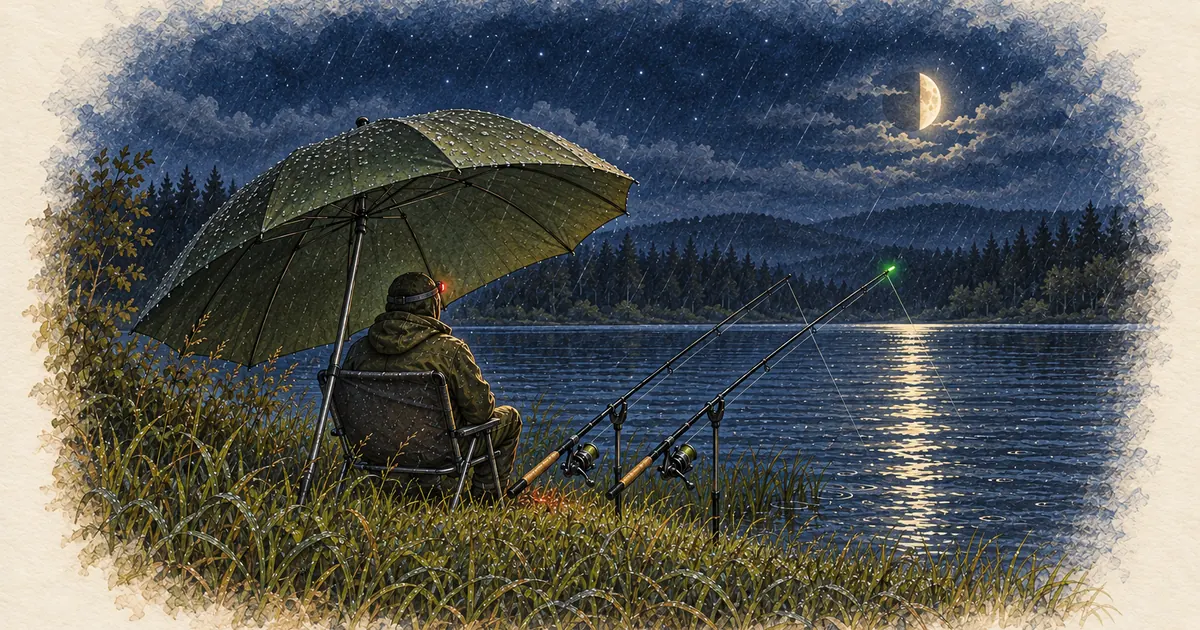
Whether you may fish at night is set by the state’s fisheries law, by regulations for individual waters and by the fishing permit. Whether you may put up a shelter on the bank or sleep in it depends on the state’s nature conservation law and, on federal waterways, on federal law as well. A permit for a night session therefore says nothing about whether a tent is allowed, and the other way round.
How a session in the dark works in practice, with light, bite indicator and safety, is covered on the page Night fishing. This page is only about the rules.
Where night fishing is officially restricted
Explicit night rules appear in the following regulations. The list shows what turned up in official texts and is not complete.
| Area | Rule | Source | Date |
|---|---|---|---|
| Saarland | no fishing at night, enclosed waters only from 5 ha | § 10 Landesfischereiordnung | amended 8.12.2021 |
| Moselle, Sauer, Our | no fishing at night | § 5 Grenzfischereiverordnungen RP und Saarland | 3.5.2021 and 11.5.2020 |
| Lake Constance, Bavarian part | fishing from 1 hour before sunrise to 1 hour after sunset, eel and wels catfish from the bank until 1 a.m. | § 5 para. 2 Bodenseefischereiverordnung | in force from 1.12.2025 |
| Untersee | fishing from sunrise to sunset, eel from 16 May to 31 October until midnight | § 18 para. 2 Unterseefischereiordnung | consolidated edition 8.4.2024 |
| Dümmer, Steinhuder Meer | no staying on the water at night, no anchoring either | § 11 DStMVO | amended 15.2.2013 |
| Brandenburg, joint fishing rights (Koppelfischerei) | hand-held rod from 1 hour before sunrise to 1 hour after sunset | § 7 para. 4 Fischereiordnung | amended 24.8.2026 |
In Saarland night runs from 7 p.m. to 7 a.m. from November to March and from 11 p.m. to 5 a.m. from April to October. The same hours appear in the regulations for border waters such as the Moselle. The Fischereiverband Saar can grant an exemption from the Saarland ban in justified individual cases, with conditions where necessary. On the Untersee, eel fishing after sunset is allowed from the bank only. In Brandenburg, Koppelfischerei means that several fishing rights exist side by side on the same stretch of water (§ 9 BbgFischG).
Baden-Württemberg abolished the general ban on night fishing in February 2022 with an amended state fisheries regulation. Since then, according to the Ministry of Agriculture, you may fish all night on most waters in the state. The ban remains in force on Lake Constance and at the Rheinau power station for fisheries reasons.
When the state sets nothing: fishing permit and water manager
Where no regulation applies, the water manager often decides. The Brandenburg state office names a ban on night fishing explicitly as one of the tightenings a manager may set beyond the law, and refers to the day ticket for it. The leaflet on the holiday fishing licence in Schleswig-Holstein says something similar: private holders of fishing rights may issue stricter rules, including night fishing bans, and usually print them on the fishing permit.
Conversely, the permit can expressly include night fishing. At the Berlin fisheries office, several annual, weekly and day tickets carry the note “night fishing included”. Read the terms of your permit before your first night session; more under Fishing permit and water map.
Not legal advice: The table lists only rules from official texts, as retrieved on 25 October 2026. Water rules issued by clubs and associations can be stricter. What counts is the law of your federal state, the regulations for the water and your fishing permit.
Stay awake: keeping watch over the rods
The Saxon fisheries regulation requires hand-held rods to be supervised at all times and makes clear that an electronic bite alarm does not replace that supervision (§ 4 para. 4 SächsFischVO). The Brandenburg booklet on coarse fishing states the same duty for hand-held rods that are out. Neither text provides an exception for the night. Whether a short nap next to the rod still counts as supervision is not expressly regulated. If in doubt, reel in your rods beforehand.
Brolly or tent: where the line falls
The Brandenburg Ministry of Agriculture has described in its angling brochure when a shelter still counts as weather protection. An angler’s tent, umbrella tent or similar cover is permitted there while fishing if it meets four conditions:
- It protects mainly against bad weather and is not meant for sleeping in.
- It holds two people at most and has no waterproof groundsheet.
- It is in muted colours and does not spoil the landscape.
- It stays in the same spot for no more than 12 hours without a break.
In Brandenburg, tents that do not meet these conditions may only stand on tent sites, campsites or designated bivouac sites. That fits the state’s nature conservation implementation act: in open countryside, tents and caravans belong on a tent site or campsite (§ 22 para. 4 BbgNatSchAG). Only walkers on foot, cyclists, riders and boaters may pitch a tent there for one night (§ 22 para. 1). Whether an angler counts as a walker, the act does not say.
Schleswig-Holstein has similar rules. Tents, caravans and motorhomes may only stand on approved sites (§ 37 Abs. 1 Landesnaturschutzgesetz). Hikers without a motor vehicle may camp for one night outside national parks and nature reserves if they are entitled to do so under private law and no other rule stands in the way (§ 37 Abs. 2). Camping on the sea beach is prohibited (§ 33 Abs. 1). Designs, pitching and the dangers inside a closed tent are described on the pages Fishing tent and Fishing umbrella.
Banks of federal waterways and reservoirs
Federal law applies on federal waterways. The use regulation prohibits using federally owned bank land and service roads for anything other than their purpose, expressly including camping or lighting a fire (§ 2 para. 1 no. 2 WaStrBAV). Pedestrians may enter these areas and cyclists may use the service roads. At the Eder and Diemel reservoirs, the reservoir regulation prohibits camping and lighting fires in the impoundment zone and on federally owned bank land (§ 15 para. 5 TspV).
In protected areas, their own regulation applies on top. The Brandenburg ministry points out that no weather shelters at all may be put up in legally protected biotopes, for example along near-natural stretches of stream, in wet meadows or on moors. The lower environmental and fisheries authorities can give information there.
Frequently asked questions
Is a fishing brolly legally a tent?
The Brandenburg ministry treats a brolly and an angler’s tent as weather shelter as long as they have no waterproof groundsheet, hold two people at most, are not used for sleeping and do not stay in the same place for more than 12 hours. No equally precise description from other states was found.
Does the night fishing ban in Saarland also apply to a small pond?
For enclosed waters it applies only from an area of 5 hectares, under § 10 para. 3 of the Landesfischereiordnung. What applies at an individual pond is stated in the fishing permit.
When does night legally begin?
That depends on the rule. Saarland and the regulations for the Moselle, Sauer and Our give fixed times that change with the season. The Bavarian Lake Constance regulation, the Brandenburg rule on Koppelfischerei and the regulation for the Dümmer and Steinhuder Meer, on the other hand, count from sunrise and sunset with an hour’s margin.
May I camp on a canal bank?
Not on federally owned bank land and service roads along federal waterways; § 2 WaStrBAV prohibits it. For other land, the state’s nature conservation law applies.
Related
- Night fishing: light, bite indicator and safety on a session in the dark
- Fishing tent and carp bivvy: designs and setting up for a long session
- Fishing umbrella: protection from rain, wind and sun
- Fishing permit and water map: where fishing hours and the manager’s bans are stated
- Thunderstorms and weather: when it is better to leave your spot
- Fishing in Saarland: waters and rules in the state
- Lake Constance: waters and rules at the lake
- Steinhuder Meer: waters and rules at the lake
Sources
- Saarland: Landesfischereiordnung (§ 10, Nachtzeit, Ausnahmen) und Grenzfischereiverordnung Mosel, Sauer und Our (§ 5)
- Rheinland-Pfalz: Landesverordnung über die Fischerei in den Grenzgewässern (§ 5, Nachtzeit)
- Freistaat Bayern: Bodenseefischereiverordnung (§ 5 Abs. 2, Angelzeiten)
- Regierungspräsidien Baden-Württemberg: Fischereiverträge, Gesamtausgabe (Unterseefischereiordnung § 18) und Landwirtschaftsministerium Baden-Württemberg: Petri Heil beim nächtlichen Angeln (Aufhebung 2022, Ausnahmen)
- NLWKN: Dümmer und Steinhuder Meer-Verordnung, Lesefassung (Stand 15.02.2013) (§ 11, nachts auf dem Wasser)
- Brandenburg: Fischereiordnung (§ 7 Abs. 4, Koppelfischerei), Fischereigesetz (§ 9, Begriff), Naturschutzausführungsgesetz (§ 22, Zelten), Ministerium: Angelfischerei im Land Brandenburg (Wetterschutz, Biotope; Mai 2026) und Landesamt: Friedfischangeln (Bewirtschafter, Aufsicht)
- Schleswig-Holstein: Merkblatt Urlauberfischereischein (Regeln auf dem Erlaubnisschein; Februar 2026) und Landesnaturschutzgesetz (§§ 33 und 37)
- Fischereiamt Berlin: Entgelte der Angelkarten (Karten mit Nachtangeln)
- Freistaat Sachsen: Sächsische Fischereiverordnung (§ 4 Abs. 4, Aufsicht)
- Bund: Wasserstraßen-Benutzungsverordnung (§ 2) und Talsperrenverordnung Eder und Diemel, § 15 (Zelten, Feuer)
Text AI-assisted, drawing AI-generated. Sources opened and checked in October 2026; no graphics taken from the sources.
All details are guideline values without guarantee and do not replace legal advice. Whether you may fish at night and put up a shelter is decided by the law of your federal state, the regulations for the water and your fishing permit.