
Knowledge · Tackle
Wound disinfectant for fish: What is proven
After unhooking a carp, some anglers put a wound treatment on the hook mark. Little is known about how this wound disinfection works on fish that are returned, and the first major laboratory test of the common products is critical. Gentle handling of the fish before and after unhooking does more.
What is common on carp waters
In Britain, since the late 1980s, carp fishing has developed its own form of wound care. After the hook is removed, a product goes on the hook mark or other open wounds, usually as a liquid, more rarely as a gel. According to Angling Times, such products are even compulsory at many British fisheries.
A study by De Montfort University in Leicester names propolis solutions as the market leader. According to the paper, povidone-iodine, potassium permanganate, malachite green and formalin are also applied to carp wounds. According to this paper, most packs carry no information on contents or hazards. There are no reliable figures on how widespread wound care is on German waters.
Anglers report carp that, years after a treatment, took the hook again with a healed wound. The molecular medicine specialist who prompted the study does not accept this as evidence: it would take a fish with the same wound that was not treated, for comparison.
What the laboratory study shows
The paper appeared in 2026 in the Aquaculture Journal and is the first to test commercially available wound products for carp in a measurable way. The British Institute of Fisheries Management advised on the selection. The products had to face three kinds of bacteria and the water mould Saprolegnia. The team measured their toxicity on a cell line from carp-type fish, and adhesion underwater on pieces of carp skin. The results:
- Most products did not inhibit any of the usual carp pathogens.
- None stuck to the skin well enough underwater.
- The four propolis solutions had no effect on any of the four pathogens and damaged the fish cells.
- In many products the carrier solution also made undamaged carp skin permeable. In the authors‘ view, this opens a new route into the body for germs.
- The povidone-iodine product inhibited all pathogens but clearly damaged the cells.
- Two products killed bacteria and mould, but in the cell culture also killed every fish cell. One of them contained malachite green.
Measurements were made in the laboratory, on cells and pieces of skin. The study did not examine how a hook wound heals on a living carp in a lake with and without a product. According to the authors, there is so far no reliable data that a wound product helps carp that are returned.
Why a product does not stay on fish skin
A layer of mucus covers the skin of the fish. The examination catalogue of the Bavarian State Institute for Agriculture describes it as protection against outside influences. Injuries are regarded there as entry points for fungi, bacteria and viruses, and after skin damage a wound is particularly prone to fungal infection.
It is precisely this mucus that makes wound care difficult. The fish constantly produces it anew and rubs it off easily, and an applied product is diluted or washed away in the water. For it to stick at all, the spot must be dry beforehand, and drying can bring germs into the wound. Liquids easily run into the eyes, gills and mouth. According to the study, veterinary guidelines advise keeping products away from the eyes and gills because these tissues are very sensitive.
According to a second review paper by the team, most so-called fungal infections in carp are caused by water mould. Saprolegnia colonises dead material and injured tissue, and outbreaks become more frequent in late autumn and winter. For the study leader, though, in carp in clean water the focus is not the infection but that the wound closes and heals. In his assessment, a product that attacks fish cells can even delay this healing.
More important than any product: how you handle the fish
An evaluation in Blinker, based on fisheries research at the IGB, shows what keeps injuries low when fish are returned. Hooks sitting at the front of the mouth are part of it, along with quick handling that does not damage the mucous membrane and as little time as possible in the air. A landing net with a rubberised mesh or unhooking directly in the water increases the survival rate.
- Landing: Hooks catch less in the rubberised mesh of a landing net, and the fish is freed more quickly. Tackle that is too light prolongs the fight. The line calculator shows what breaking strain the main line and hooklength need.
- Unhooking: According to Blinker, barbless hooks or hooks with a pinched-down barb are usually easy to remove, and often the fish stays in the water while you do it. Otherwise it goes onto a well-wetted unhooking mat. You put the disgorger ready beforehand.
- Handling: Only with wet hands. The Bavarian examination catalogue gives as the reason that otherwise the skin of the fish is damaged.
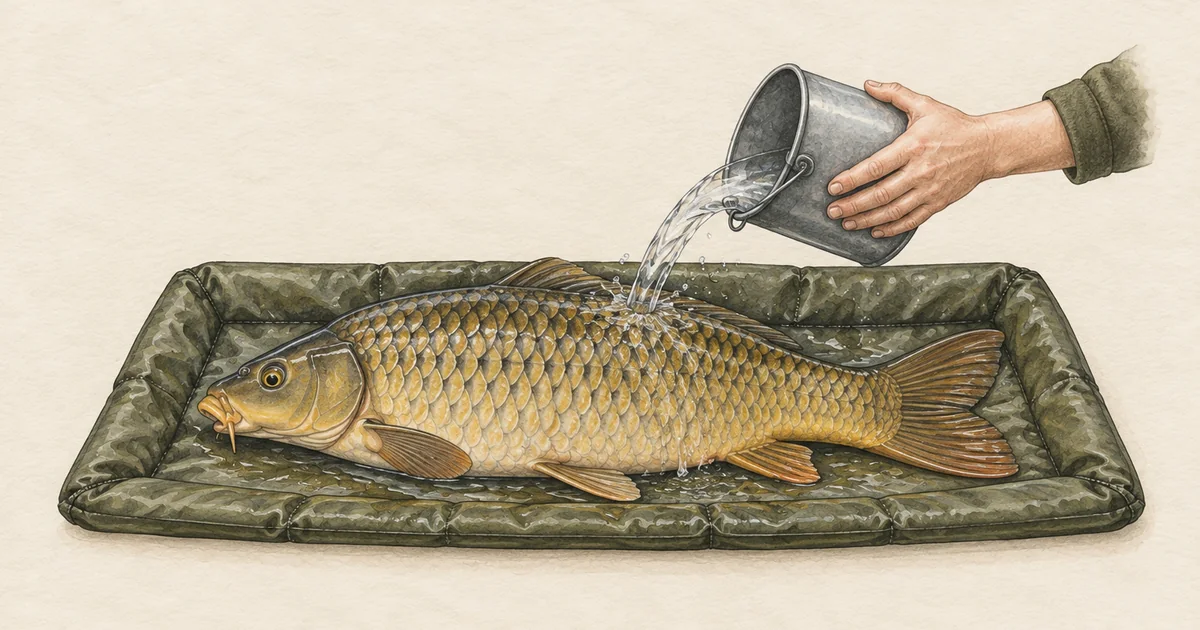
- Photo and release: For the picture the carp is only lifted briefly and doused with water. It goes back in the submerged mat until it swims off under its own power.
A team from Humboldt University in Berlin measured how much air a carp can tolerate. Ten minutes in the air straight after capture changed neither blood values nor signs of tissue damage in large carp in the wild. After nine hours in a carp sack, however, the same time in the air made the lactic acid level in the blood rise by 89 per cent. In the two months afterwards no fish died. The researchers advise taking the photo straight after the catch rather than after retention.
Carp and tench are among the hardiest species: averaged over published studies, according to this evaluation 5.7 per cent of released large carp-type fish died. In warm weather mortality rises in most species. More on the handling steps is under Landing and unhooking a fish.
No product, no dose: This page recommends no preparation and does not replace veterinary advice. The review paper from Leicester notes that treatment against bacteria should be based on identifying the pathogen and led by a vet. If an infection is suspected, in the study leader’s view the fish should be set aside, and the water’s operator calls in a vet. This page does not answer questions on medicines law.
Common mistakes
- Using a product with no list of contents. Without a list of ingredients you do not know what gets onto the fish and into the water. The study leader therefore left such an unlabelled bottle alone, and that was the reason for the study.
- Dabbing the hook mark dry. According to the study, drying can bring germs into the wound. Dry hands and cloths also damage the skin.
- Applying liquid generously. Whatever runs off ends up on healthy skin, in the gills and eyes. The carrier solutions, probably alcohol in the propolis products, made even undamaged skin permeable in the test.
- Holding the fish for a long time for treatment and a photo. Every extra action lengthens the time in the air. The Berlin measurements favour a photo straight after the catch.
Frequently asked questions
Do I have to treat a hook wound on a carp?
According to the authors of the laboratory study, a benefit has not been shown so far. In Britain some fisheries prescribe wound products. Whether your water has its own rules is in the water regulations or in the fishing permit (Erlaubnisschein).
Isn’t povidone-iodine a proven wound treatment?
In the laboratory test the povidone-iodine product inhibited all four pathogens but also clearly attacked fish cells. The authors point to tests in which even small amounts in the water damaged the gills of carp. They therefore see iodine only as second choice behind gentler natural substances, which, however, have yet to be researched further.
How long can a carp stay in the air?
The sources give no fixed limit. In the Berlin test large carp survived ten minutes in the air with no measurable consequences, and the researchers consider the species very resilient. From the point of view of fish welfare they nevertheless recommend not retaining the fish first and photographing it afterwards.
Related
- Landing and unhooking a fish: handling from landing net to mat
- Releasing a fish: when it is compulsory and what studies say about survival
- Unhooking mat: the wet surface for the fish on land
- Disgorger: the tool that gets the hook out quickly
- Landing net: net and frame for a gentle landing
- Carp: species profile
- Line calculator: breaking strain of main line and hooklength
- Hook injury and first aid: when the hook is in your own finger
Sources
- De Montfort University u. a., Aquaculture Journal 2026: Scale of Concern, Efficacy of Commercially Available Topical Carp Care Formulations (Laborprüfung der Wundmittel, Inhaltsstoffe und fehlende Angaben, Haftung, Zellschäden, Povidon-Iod, Augen und Kiemen)
- De Montfort University u. a., Aquaculture Journal 2026: Carp Pathogens of Recreational and Ornamental Aquaculture (Wasserschimmel, Jahreszeit der Ausbrüche, Behandlung nur tierärztlich geleitet)
- Angling Times: Could carp-care products be doing more harm than good? (Pflicht an britischen Fischereien, Aussagen des Studienleiters zu Vergleich, Heilung und Tierarzt)
- Humboldt-Universität zu Berlin, Fachgebiet Integratives Fischereimanagement: Consequences of air exposure on caught-and-released Common Carp (Luftzeit, Blutwerte, Überleben, Foto direkt nach dem Fang)
- Blinker: Catch and Release, Haksterblichkeit nach dem Zurücksetzen (Auswertung der Fischereiforschung am IGB: Einflussfaktoren, Sterblichkeit großer Karpfenfische, Wärme)
- Blinker: Catch and Release, so setzt Ihr Fische richtig zurück (nasse Matte, Foto, Zurücksetzen in der Matte, gummierter Kescher, Haken ohne Widerhaken, nicht zu leichtes Gerät)
- Bayerische Landesanstalt für Landwirtschaft: Staatliche Fischerprüfung in Bayern, Prüfungsfragen 2023/2024 (PDF) (Schleimschicht, Verletzungen als Eintrittspforte, Verpilzung, nasse Hände)
Text AI-assisted, drawing AI-generated. Sources opened and checked in October 2026; no graphics taken from the sources.
All figures are guide values without guarantee. This page recommends no product and does not replace veterinary advice; your water’s own rules are in the water regulations.