
Knowledge · Tackle
Bait box and tackle box: Lures and small items sorted
A lure box holds artificial lures and small parts in separate compartments so that nothing tangles, sticks together or rusts at the water. Crankbaits need their own compartments for this, soft lures need a plastic that tolerates their plasticisers, and used hooks only go back in dry.
Lure box, bait tub, tackle box
The equipment guide of the Fischereiverein Löningen, study material for the angling exam (Fischerprüfung), separates two containers: lure boxes for artificial lures and bait tubs for natural baits. It lists the tackle box as a separate accessory. Maggots and worms belong in a tub of their own, see Maggot tub and worm tub. Tackle box is the English umbrella term for boxes in which lures and small items travel to the water together.
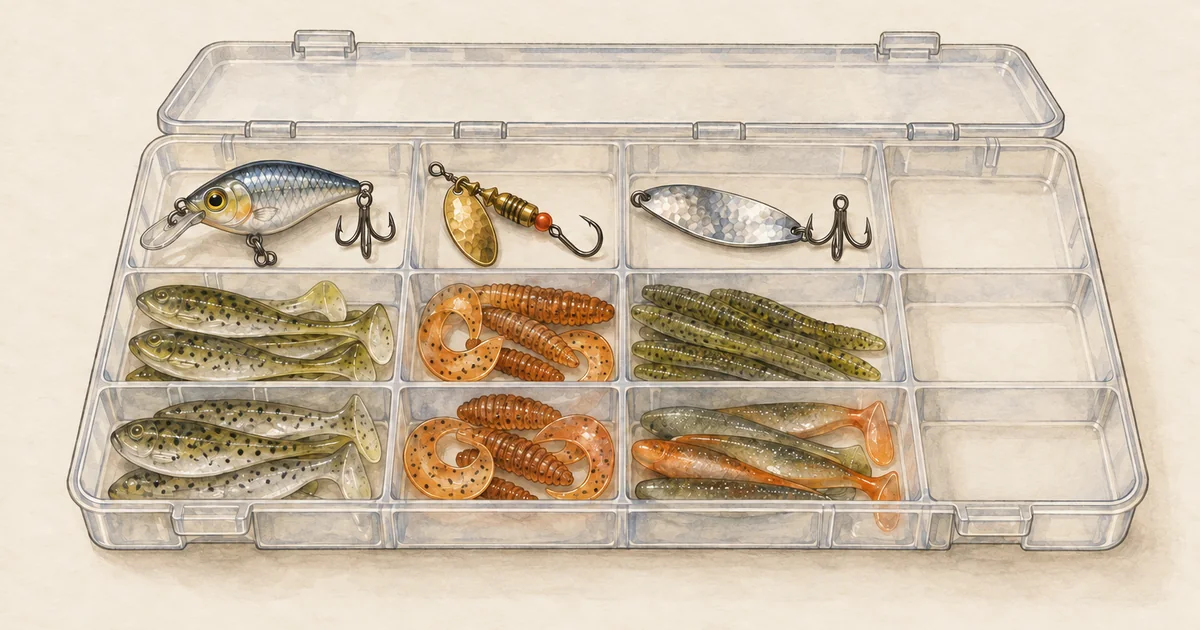
Designs and how they are divided
Lure boxes differ mainly in how the inside is divided.
| Design | Suits | What matters |
|---|---|---|
| Fixed small compartments | Hooks, weights, small floats | same sizes together, label the compartments |
| Adjustable dividers | Plugs, soft plastics, spoons | set the compartment to the lure’s length |
| Foam strips | Flies, nymphs | hook sits in the foam, easy to take out |
| Bag or rucksack with boxes | several boxes, bulky lures | compartments to fit the boxes |
Fixed compartments: Weights of the same size lie together in labelled compartments, so you quickly reach for the right size. For the shapes see Fishing weights.
Adjustable dividers: These are bars that you move to another groove. You set them to the lure size so that no space is lost.
Foam: Two strips of hard foam or EVA foam, glued into a flat tin, hold flies and nymphs. They sit in it and are easily pulled out.
Bags and rucksacks: The compartment layout of a fishing rucksack should be cut so that suitable boxes fit in. For a short lure-fishing session small boxes are enough, for many small items or big pike lures you need larger ones. If you need both hands in difficult terrain or on a bike, carry the kit on and in the rucksack. See also Fishing bag.
Sorting by method and target fish
It stays clear in two steps: first one box per target fish or method, then within it by lure type, so surface lures with surface lures and spoons with spoons. Two examples:
- Lure fishing for perch: small soft plastics separated by colour, jig heads by weight, weedless lures in a compartment of their own, plus a few light plugs with secured trebles.
- Coarse fish on the feeder: hooks by size, ready-tied hooklengths, feeders and weights by weight, stops and beads in the smallest compartment.
Before a day’s fishing, lures, weights and small items quickly go into the box and stay there afterwards. So tidy up now and then and sort out what you do not need. If a lot has built up over a season, Angling Times advises a big clear-out: tip the box out on a table, sort out old rigs, empty packets and bait remains, and wash the compartments, corners included, with a brush and soapy water.
Soft lures: a compartment of their own, the right plastic
To keep soft lures soft and mobile, they contain plasticisers. The Umweltbundesamt (German Environment Agency) describes plasticisers as substances that make brittle materials flexible. In soft PVC the common phthalates are not chemically bound firmly, they evaporate or wash out. For the box, three points from the specialist press matter:
- Soft plastic and box: According to Blinker, the plasticisers react with ordinary plastic. Within a few days lure and box fuse, or the soft plastic dissolves the wall. Boxes marked PE (polyethylene) or PP (polypropylene) count as resistant, “twisterfest” in angler’s slang.
- Soft plastic and soft plastic: If lures with and without plasticiser lie in the same compartment, they clump into a useless mush after a few days.
- Colour: Soft plastics of different colours stain one another. A white one next to a yellow one turns yellowish, so only similar colours in one compartment.
Lure boxes from tackle shops are, according to Blinker, now almost all “twisterfest”. Repurposed packaging and boxes from the DIY store are risky. Resistant plastic looks matt to milky and gives a little; clear, hard polycarbonate, which breaks when bent, does not get on with soft plastic.
Test before packing: Put a soft plastic shad on the box you are unsure about. After 24 hours at the latest you can see, according to Blinker, whether the two materials get on. If the lure has only stuck briefly and lightly, you can keep fishing it.
The plasticisers do not stay in the box. The Thünen-Institut examined 16 common soft plastic lures with two Canadian universities. Ten of them released various plasticisers in 61 days, including phthalates. The accompanying survey of anglers confirmed that artificial lures are often lost when fishing. Bitten or stuck-together soft plastics therefore belong in the bin and not on the bank.
Rust on hooks, jigs and trebles
Rust usually forms after fishing. The typical case: wet lures or used hooks stay in the closed box, and later surface rust sits on hooks, jigs, trebles, swivels and weedless lures. So take the used items out after fishing and let them dry before they go back into the compartment.
Salted and flavoured soft plastics make it worse. The salt, together with residual moisture, attacks the jig hook and makes it rust, often noticed only after winter. So: do not leave such lures on the hook for long, rinse the hooks with fresh water and store them dry and separately. Rust weakens the hook in the long run.
Before the new season you replace rusty hooks, split rings and weedless lures. Spare hooklengths are fine in the closed box: the guide mentioned above recommends storing lines in the dark because UV light harms the plastic. What a hooklength still holds after the knot is worked out by the line calculator.
Storing trebles safely
Plugs with two trebles snag on one another quickly in an open compartment. So stretch a rubber band between the two hooks before packing. The trebles then lie against the lure, the plugs do not scratch each other, and when rummaging you are less likely to hook yourself.
Even so, never reach blindly into a compartment full of trebles. If a hook is in your skin, Hook injuries and first aid sets out what the first-aid sources advise. This page is no substitute for medical advice.
Crankbait box, lure wallet and zip bags
Crankbait box
A crankbait box has long, narrow compartments, each holding one crankbait. It does the job that the rubber band between the trebles does in an open compartment: no lure touches the next, so nothing can hook into each other or scratch its neighbour when the box gets shaken about on the way. Blinker recommends boxes with slot-in dividers, because you can rearrange them for large lures or small parts as needed. If you want to swap trebles for single hooks altogether, see Treble or single hook.
For large pike crankbaits and jerkbaits, a DIY article in Blinker shows another solution: sawn-off lengths of pipe stand upright in a tall plastic crate, with one lure hanging in each. The rear treble sits in a notch at the top edge of the pipe, and a few small holes drilled in the bottom of the crate let drip water run out so that trebles and split rings don’t rust. A Blinker report on jerkbait fishing for pike keeps the lures to hand in a bucket prepared like the bucket in which sea anglers keep their pirks.
In the long run, what lies next to the crankbait also matters. The collectors‘ blog of Fisch & Fang warns against storing crankbaits near plastics that give off substances (outgassing). After a few years, the paint on the side the lure rests on can shrivel. For lures stored for a long time, the same blog also advises against ordinary rigid foam and expanded polystyrene as a base, because both attack paint and lacquer over time. Soft lures give off plasticisers, as described above, and therefore don’t go into the crankbait box.
Lure wallet and lure folder
Lure wallets, folding lure bags and lure folders are bags that roll up or fold shut, with flat slip-in pockets or zip pockets inside. Rute & Rolle describes a trout angler who arranges his small spoons row by row in two folders, by type, colour and weight. Flat lures such as the trout spoon lie side by side this way and stay sorted at a glance.
If soft lures go into the pockets of a wallet, the same rules apply as in the box: the pocket material must tolerate the plasticisers, lures with and without plasticisers go in different pockets, and similar colours stay together. Crankbaits and other painted hard lures don’t belong there. A second article from the collectors‘ blog shows how thoroughly plasticisers attack hard plastic: the little plastic boxes in which a manufacturer supplied its lures in the 1950s are today mostly broken or badly eaten away by plasticisers from twister tails. If it doesn’t say what the pockets of a wallet are made of, do the 24-hour test from the box further up.
Zip bags
Resealable bags separate soft lures within a large box or bag by type and colour. Whether a bag tolerates the plasticiser is revealed by the marking, if one is printed on it. In the EU identification system for packaging, 2 stands for HDPE and 4 for LDPE, both polyethylene, and 5 for polypropylene. These are the plastics PE and PP that Blinker names as resistant for soft lures. The marking is voluntary. If it is missing or there is a different number, the test helps again.
- Take soft lures off the jig head. According to Rute & Rolle, lead and plasticiser react when rigged lures are left for a long time: the head area turns white, splits open or turns liquid.
- One type and one colour family per bag, lures with and without plasticiser kept apart.
- Check the marking: 2, 4 or 5. Otherwise first leave a single soft lure in the bag for a day.
- Label the bags and lay them flat in the box or tackle bag.
- Take an empty bag with you. Blinker considers a bin bag or plastic bag for rubbish at the water sensible. Chewed-up soft lures and old hooklengths go in there.
Common mistakes
- Soft lures in the DIY-store tub. In the worst case lure and box melt together.
- All soft plastics in one compartment. Colours run, and lures with and without plasticiser stick to each other.
- Leaving the wet box closed. After a wet day the contents develop surface rust. Lay them out and dry them.
- Salted soft plastics on the jig hook over winter. In spring the hook is rusty or eaten away.
- Plugs with free trebles loose in the big compartment. They snag and prick when you take them out.
Frequently asked questions
How do I recognise a “twisterfest” box?
The plastic is marked PE or PP. Resistant material also looks matt to milky and gives a little. If you are unsure, do the 24-hour test with a single soft plastic.
Is old packaging any good as a lure box for soft lures?
According to Blinker that is risky, because it is unclear whether the materials get on. Put a soft plastic shad on the packaging as a test: after 24 hours at the latest you can see whether the two get along.
Are discoloured soft plastic shads still usable?
Yes, the discolouration just looks unattractive. If soft plastics of different material have fused into a lump, they belong in the bin.
Do maggots and worms belong in the lure box?
No. The study material from the Fischereiverein provides separate bait tubs for natural baits. What they look like is explained in Maggot tub and worm tub.
Can crankbaits and soft plastic shads be stored together?
Better not. Plasticisers from soft lures attack plastic, and the collectors‘ blog of Fisch & Fang warns against storing crankbaits next to outgassing plastics. Give soft lures their own box, wallet or zip bag.
Related
- Soft baits: soft plastic shad, twister and soft crayfish at a glance
- Hard baits: crankbaits and surface lures with treble hooks
- Fishing hooks: shapes, sizes and how to check sharpness
- Swivels, snaps and split rings: the small parts between line and lure
- Jig heads: weight, shape and hook size
- Fishing rucksack: carrying boxes and accessories on your back
- Hook injuries and first aid: when a hook is in your finger after all
- Line calculator: work out the breaking strain of hooklength and knot
Sources
- Blinker: Gummifische aufbewahren: So halten Deine Köder länger! (PE und PP, Köder mit und ohne Weichmacher, Farben, Rost durch Salz)
- Blinker: Gummifische richtig lagern: Darauf musst Du achten! (Reaktion mit Kunststoff, Baumarktboxen, 24-Stunden-Probe, Verfärbung)
- Blinker: Gummiband beim Angeln verwenden (Drillinge sichern), Blinker: Bastel-Tipp Fliegendose (Schaumstoffstreifen), Blinker: Angelrucksack (Boxen und freie Hände beim Rucksack) und Blinker: Mobil angeln (aussortieren)
- Blinker: Angler-Werkzeug, was muss noch mit ans Wasser? (Einsteckfächer, Müllbeutel), Blinker: Kleiner Bastelbericht zur kalten Jahreszeit (Wobblerkiste mit Rohren und Ablauflöchern) und Blinker: Winterjerken auf Hechte (Jerkbaits im Eimer)
- Fisch & Fang, Sammlerblog: Thema Köderaufbewahrung (Lack von Wobblern, Hartschaum) und Fisch & Fang, Sammlerblog: Beitrag über Originalverpackungen alter Kunstköder (von Weichmachern zerfressene Dosen)
- EU-Kommission: Entscheidung 97/129/EG über ein Kennzeichnungssystem für Verpackungsmaterialien (Nummern 2, 4 und 5, freiwillige Kennzeichnung)
- Rute & Rolle: Tipp gegen rostige Haken (Flugrost durch nasse Köder), Rute & Rolle: Schrauben statt stechen (Blei und Weichmacher am Jigkopf) und Rute & Rolle: Modern am Forellensee (Spoons in Mappen)
- Thünen-Institut (über idw): Schadstoffe in Weichplastikködern: Risiken für Angelnde und Umwelt (Weichmacher aus 10 von 16 Ködern)
- Umweltbundesamt: Weichmacher (Begriff) und Umweltbundesamt: Phthalate (PDF) (nicht fest gebunden)
- Fischereiverein Löningen: Gerätekunde (PDF) (Köderbox und Köderdose) und Zusammenfassung Gerätekunde (PDF) (Schnur dunkel lagern)
- Angling Times: How to Keep Your Fishing Gear in Top Condition (Box auswaschen)
Text AI-assisted, drawing AI-generated. Sources opened and checked in October and November 2026, no graphics taken from the sources.
All figures are guidelines without guarantee. How a soft lure gets on with a box depends on both materials; if in doubt, the test with a single lure helps.