
Knowledge · Tackle
Trout spoon: Small spoons for pond and stream
A trout spoon is a tiny metal spoon which, according to AngelWoche, weighs between 0,5 and 5 grams and is fitted with a single hook for the trout lake. Whether it flutters just below the surface or runs along the bottom depends on the thickness of the metal, its outline and your retrieve speed.
Trout spoon vs. classic spoon: smaller, lighter, one hook
According to the Bavarian exam questions for the angling exam (Fischerprüfung), a spoon (Blinker) is a wobbling metal attractor lure. The trout spoon belongs to this family but, according to the magazine Blinker, is much smaller and lighter than the kind of spoon you know from pike fishing. According to Blinker, most models weigh 1,5 to 4,5 grams; AngelWoche gives the full range as 0,5 to a maximum of 5 grams. Instead of a treble, a hook with three points, a trout spoon for the trout lake usually carries a single hook. How its big brother is built and how it runs is covered under Spoon.
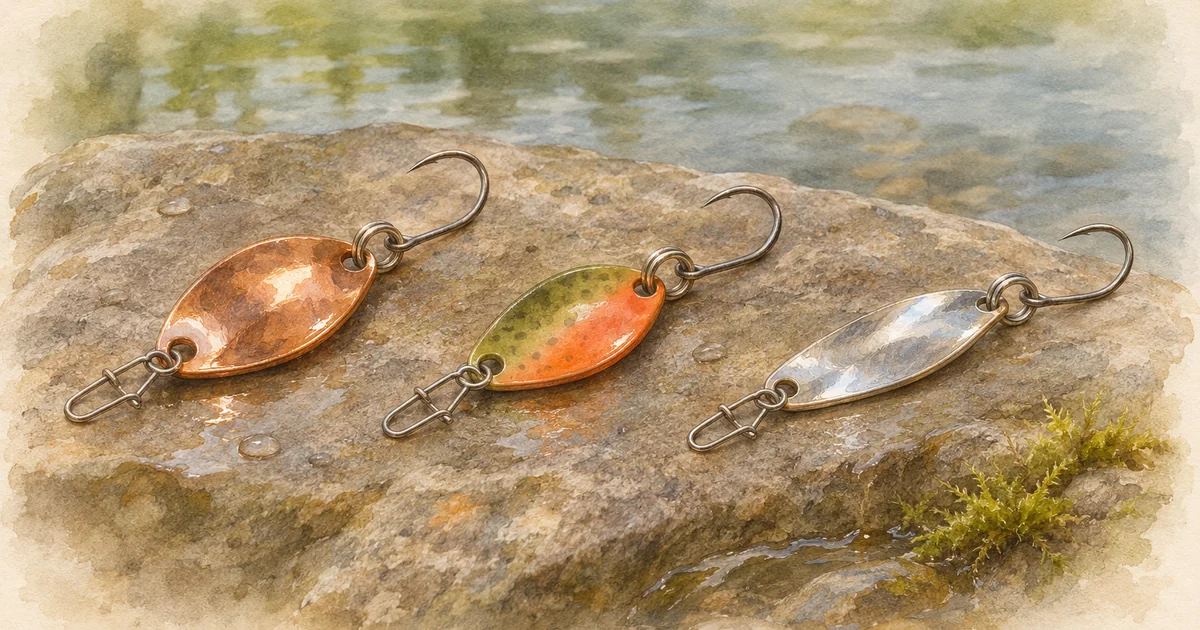
The little spoons come from Japan. According to Blinker, competitions with especially light spoons of 1 to 5 grams have been held there for many years. Lures this light need rods of their own, which Blinker calls spoon or trout area rods. Length, casting weight and action are explained on the Trout rod page. Use the Line calculator to check what your fine line still holds, knot included.
Metal thickness, size and outline
Two spoons of the same weight can run completely differently. According to Blinker, a spoon made of thick metal is more compact, offers the water less surface and therefore runs deeper. Thin metal flutters more and rises even with little pull. One article cites a 39-millimetre model: the thin version at 1,7 grams runs shallow, the thick one at 3,2 grams in mid-water or close to the bottom. Another compares two spoons of roughly the same size at 1,8 and 2,1 grams. The one made of metal 0,2 millimetres thicker sinks considerably faster.
Length matters too. According to Blinker, freshly stocked, hungry trout readily attack eye-catching spoons of 3 to 4 centimetres. If the fish have been in the pond for a while or are biting cautiously, small models of 2 to 2,5 centimetres often do better.
What the outline changes
A specialist article in Blinker sorts the shapes by their action. The fingernail, a broad oval, is considered the classic because it handles almost any retrieve: steady, with stops, fluttering down or jigged, meaning lifted with short jerks. Small, egg-shaped spoons are heavy for their size and sink fast. They swerve strongly to the side even at moderate speed and are good for finding depth and the catching zone on an unfamiliar water. Elongated and slim shapes cast far and run from the upper layers down to mid-water, slim ones with a heavy blade one level deeper too. The light diamond stays just below the surface even on a very slow retrieve. According to the article, it often needs a strike, which is otherwise unusual with spoons; that is why braid suits it.
Which spoon for which situation
The table summarises practical information from the angling press. These are starting points to experiment with, not measured values.
| Time | Spoon | Retrieve |
|---|---|---|
| Trout lying sluggishly at the surface | light diamond, thin metal | very slowly through the shoal, short stops |
| Large lakes, winter and early spring, fish in the shallows | compact, 2 to 3 g | count to three, retrieve slowly |
| Unfamiliar water, depth unknown | small, egg-shaped, heavy | let it sink to the bottom, retrieve with a jigging action |
| Fish hunting actively | slim, heavy blade | rod slightly raised, brisk retrieve |
| Trout lying deep, winter | thick metal, 2 to 2,5 g | count down to the bottom, very slowly just above it |
| Freshly stocked, fish hungry | 3 to 4 cm, eye-catching yellow | steady, with stops |
| Wary fish, heavy angling pressure | small, 2 to 2,5 cm, muted | slowly |
| Stream, channel or deep pool | light, matt colour | cast upstream, let it sink, slowly |
Retrieve: reel in slowly, build in stops
The basic retrieve is simple: cast out, let it sink, reel in slowly. Blinker advises interrupting the retrieve again and again with short pauses, briefly stopping the reel. The spoon then flutters down, and it is in exactly this phase that bites often come. So keep the line tight while it does. In cold water you retrieve more slowly, in winter only fast enough for the spoon to just keep working. Counting down from the surface, the sawtooth retrieve and why you keep reeling when you get a bite are covered under Pond trout fishing.
Searching the depth from the bottom up
- Cast out and count until the spoon is lying on the bottom. You notice this because the line goes slack.
- On the next cast, start retrieving one count earlier. The spoon then runs just above the bottom.
- Count one number less on each further cast until bites come. Blinker gives an example: if the spoon needed eight seconds to reach the bottom, you start at seven.
- Remember the number. Another Blinker article works it out like this: bottom at twelve, at ten the lure runs close to the bottom, at eight more in mid-water.
- If you switch to a spoon of a different weight or metal thickness, count again. It sinks at a different speed.
Maggot on the hook: hook it by one end only
If the trout only nip at the spoon without getting hooked, Blinker describes a trick from the cold season: add a waxworm, two maggots or a small piece of worm to the hook. The maggot is hooked by one end only and trails out straight behind. Threaded on completely, it slows the action; hooked in an L shape, it makes the spoon spin. On small or calm-running spoons the natural bait gets in the way so much that they hardly move any more; the trick only suits larger models with a strong action. Whether natural bait may be added to an artificial lure is set out in the pond rules.
Colour by light, water clarity and angling pressure
There are no fixed rules for colour, only experience. A trout lake angler writing in Blinker uses muted, natural shades such as olive, brown, black, copper or brass in clear water and sunshine, and garish shock colours when the water is murky and the sky overcast. The tackle course notes of the Fischereiverein Löningen for the angling exam give the same rule of thumb for artificial lures in general: a dark lure in sunshine and clear water, a light one under cloud and in murky water. According to Blinker, freshly stocked fish readily take eye-catching yellow spoons, settled-in fish rather muted ones. For bare metal spoons, another Blinker article places copper differently: there, silver suits sunshine and clear water, copper suits cloud, slight murkiness and high angling pressure. So the angling press does not agree on this point.
Pay attention to the contrast between front and back. The spoon swings from side to side on the retrieve, shows both sides in turn and flashes as it does so; as pairs, Blinker mentions black with silver or orange with copper, for example. For heavily fished waters, Rute & Rolle describes matt, dark patterns that imitate insects, and finishes with parr marks, the round juvenile spots of young trout. Bare metal spoons can tarnish over time. Tarnished spoons shine less and, according to Blinker, sometimes convince wary fish better; so do not polish off the patina, but try new and tarnished spoons in turn.
Spoon set for a day’s fishing
You do not need more than a few spoons. One Blinker article considers four to six enough to start with, two each in shock colours, dark and natural. To tick off before you set out:
- a spoon made of thick metal for deep areas
- a thin one for shallow water and fish near the surface
- an all-rounder for mid-water
- each type in one garish, one natural and one metallic colour
- snaps for quick changes, landing net and disgorger
- pond rules read: hooks, barbs, natural bait on the lure
Spoons in a stream
According to Blinker, the light tackle from the trout lake also fishes well on a small stream. The short rods can be worked under overhanging trees. The article describes casting the spoon upstream into an outside bend, letting it sink into the deeper water and then bringing it back very slowly, so that the fine rod tip signals its movement. As the line it names 0,16 millimetres.
Rute & Rolle sees the spoon’s strengths on shallow stretches that can hardly be fished with crankbaits, and in deep pools, the scoured-out basins with calmer water. There you retrieve it steadily with or against the current at a suitable speed and add a light twitch now and then. According to the article, big trout on heavily fished waters are wary of lures that slap loudly onto the water; the spoon, by contrast, enters almost silently. In the Bavarian exam questions, the spoon is part of the exam material as a lure for brown trout, and for salmonid waters, meaning trout and grayling waters, the spinner with a single hook is regarded there as ethical angling practice. Spots, season and approach are covered under Brown trout fishing.
Law: whether you need a fishing licence (Fischereischein) on a stream or pond, and whether artificial lures, trebles or barbs are allowed, is governed by your federal state (Bundesland), the water or pond rules and your fishing permit (Erlaubnisschein). Closed seasons and minimum sizes are on the fish pages; what the states require in terms of tackle is under Mandatory equipment.
Hooks: single hooks, barbs, barbless hooks
With the hook, two goals pull against each other. A barb holds the fish more securely when it jumps during the fight; the stream angler writing in Blinker is glad his club allows single hooks with barbs. A hook without a barb, called a barbless hook (Schonhaken) in the angling exam, is easier to remove. A review by Carleton University in Canada on catch and release states that such hooks reduce injuries and unhooking time. That they lower mortality, however, is hardly proven. The Bavarian exam questions rate artificial lures with single hooks as gentler on the fish than those with trebles.
According to Blinker, trebles are often banned at trout lakes. According to the same article, completely barbless hooks often pull out, so it recommends a single hook with a micro barb, a very small barb. Whether the barb must be absent is stated in the pond rules or the fishing permit. Which hook types are common on spoons is described under Pond trout fishing; how to convert a lure to single hooks with split-ring pliers is covered under Treble or single hook.
Common mistakes
- Too many spoons with no system. If you do not keep type, weight and colour apart, you will not know what to change at the water. If bites fail to come, according to Blinker it is usually down to the depth or size of the lure, less often to the fish’s mood.
- Thin metal for fish on the bottom. A thin spoon rises even with a light pull. Where the trout are lying deep, a model made of thicker metal belongs on the line.
- Taking a treble to the pond. According to Blinker, trebles are often banned and hook the trout on the outside. Check the pond rules beforehand.
- Lifting the rod high during the fight. If the trout jumps, the small hook is easily levered out. Blinker advises keeping the rod tip pointing towards the water.
Frequently asked questions
How heavy should a trout spoon be?
According to Blinker, most spoons weigh 1,5 to 4,5 grams. For the shallow areas of large trout lakes Blinker gives 2 to 3 grams, for winter 2 to 2,5 grams. Under 1 gram they hardly cast far enough; over 3 grams they quickly sink to the bottom in the shallows.
Which colour should I try first?
In clear water and sunshine, practitioners usually recommend muted, dark shades; in murky water and under cloud, garish colours. Look for a clear contrast between front and back. If bites fail to come, check the depth and size of the spoon first.
Can I fish with a spoon in a stream too?
According to Blinker, the light tackle from the trout lake also suits small streams. Cast upstream, let the spoon sink into the deeper channel and retrieve it slowly. Whether artificial lures are allowed on your stretch, and which hooks, is stated in your fishing permit (Erlaubnisschein).
Related
- Spoon: action, rigging and choice of colour for the bigger spoon
- Trout rod: spoon, sbirolino and pond rods compared
- Pond trout fishing: counting down, sawtooth retrieve and switching methods
- Fishing a trout pond: licence, fish-holding spots and pond rules
- Rainbow trout: appearance and habits of the pond trout
- Brown trout fishing: spots and lures on the stream
- Treble or single hook: converting artificial lures
- Line calculator: checking the breaking strain of fine lines with knots
Sources
- Blinker: Spoon-Angeln, lock die Forellen aus der Reserve (Gewichtsbereich, kleiner als Hechtblinker, Herkunft Japan, Umrisse und ihr Lauf, Spinnstopps, Hakenarten, Drillinge oft verboten, Mikro-Widerhaken, Snap) und Seite 2 (Blechstärke und Sinken, Winterführung, Farbe nach Besatz, Rutenspitze zum Wasser)
- AngelWoche auf blinker.de: Spinnfischen im Forellensee, Löffel Dir eine (Gewicht 0,5 bis 5 g, Einzelhaken)
- Blinker: Fit für den Forellensee, so wählst du die richtigen Spoons (dickes und dünnes Blech, Größe, Farbe, Kontrast, Zählen ab Grund, Satz aus drei Bauarten)
- Blinker: Spoons in großen Forellenseen (2 bis 3 g im Flachen, zu leicht und zu schwer) und Blinker: Forellensee im Winter (2 bis 2,5 g, vier bis sechs Spoons, Zählen bis Grund, Rute im Drill, Kescher und Hakenlöser)
- Blinker: Spoons plus Bienenmaden (Made einhängen, nur bei kräftig laufenden Spoons) und Blinker: Blanke Spoons im Forellensee (Silber und Kupfer, angelaufene Spoons)
- Blinker: Spoons auf Abwegen, gelöffelte Forellen am Bach (Gerät und Führung am Bach, Widerhaken laut Vereinsregel) und Rute & Rolle: Löffel für Forellen (Herkunft, flache Strecken und Gumpen, leises Eintauchen, matte Dekore, Parrmarken)
- Bayerische Landesanstalt für Landwirtschaft: Prüfungsfragen Staatliche Fischerprüfung 2023/2024 (PDF) (Blinker als taumelnder Reizköder, Blinker und Bachforelle, Einzelhaken in Salmonidengewässern, Schonhaken)
- Fischereiverein Löningen: Gerätekunde (PDF) (Farbregel für Kunstköder, Schonhaken)
- Carleton University u. a.: Best practices for catch-and-release recreational fisheries, Fisheries Research 2016 (PDF) (Haken ohne Widerhaken, Verletzung, Abhakzeit, Sterblichkeit)
Text AI-assisted, drawing AI-generated. Sources opened and checked in November 2026; no graphics taken from the sources.
All information is for guidance only and without guarantee. Which spoon catches depends on the water, the weather, the stocking and the retrieve; hooks and lures are governed by the pond rules and the fishing permit.