
Knowledge · Tackle
Trout rod: Sbirolino, spoon and pond rods
A trout rod is not a single design. You fish small spoons on short, soft rods of around 2 m and the Sbirolino on rods of 3 to over 4 m; in between is the pond rod for float and bottom rigs. Which one you need depends on bait, casting distance and bank.
What all trout rods have in common
Blinker counts trout among the fish with a softer mouth and recommends a soft, sensitive rod for them. The exam questions of the Bavarian angling exam (LfL) give as a rule for combining rod, line and hook: soft rod tip, thin line, small hook. Length, casting weight and action change with the method. By action, the exam questions mean how the force is distributed over the body of the rod when casting and playing a fish. Basic terms are explained in the overview Fishing rods.
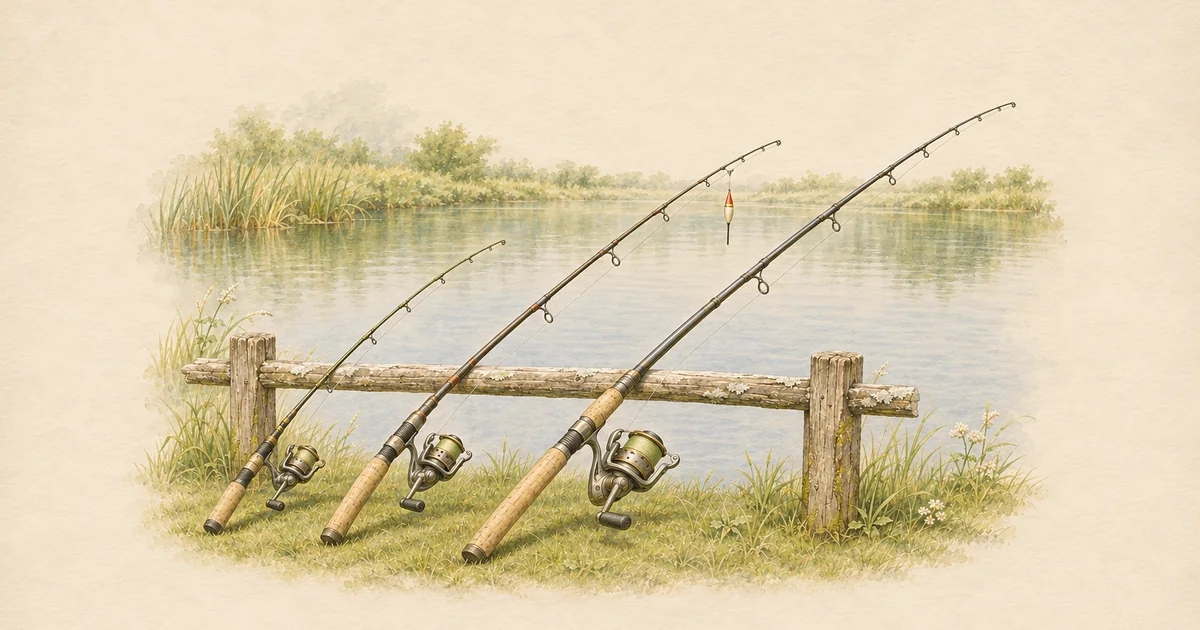
Spoon rod: short and soft throughout
Spoons are small spoon lures of a few grams; shapes and weights are covered under Trout spoon. For them Blinker names rods of 1,80 to 2,10 m whose casting weight rarely exceeds 7 g. A second author in the same article describes the spoon rod as an ultralight spinning rod of at most 8 g and 1,80 to 2,20 m. Blinker lists it as a special rod within the UL class, the ultralight rods.
When retrieving, you hold the short rod with the tip pointing down. It is soft along its whole length: according to Blinker, all spoon rods for trout have a through action. When a trout grabs, the rod is already bent and cushions every run. For the reel, a trout lake practitioner in Blinker names sizes 1000 or 2000 with a drag that starts smoothly. Line and retrieve are covered under Trout fishing at a pond.
On streams and small rivers
According to Blinker, the spoon rod from the pond also works on a stream, because the short, light rods are easy to handle under overhanging trees. Rute & Rolle, however, describes the stream rod as crisper than the soft pond rod. One author fishes 1,80 to 2,10 m with 0,5 to 7 g casting weight and looks for a fairly fast blank with a sensitive tip. Fast means the blank springs back quickly after bending. The rod should not be too soft, because even 50 cm brown trout take small lures.
A second article names 1,80 m up to 12 g, not too stiff, with a reel with a 6:1 gear ratio and somewhat stronger line, because roots and stones lurk in the stream and there is no room for a long fight. Fine lines and lures are explained in Ultra-light fishing, lies and baits in Brown trout fishing.
Which baits and hooks are allowed on the stream is stated in the water rules and the fishing permit (Erlaubnisschein). In the Bavarian exam questions, the spinner with a single hook counts as fair practice in salmonid waters, i.e. trout waters. That is exam material, not a regulation.
Sbirolino rod: long for the long hooklength
The Sbirolino is a casting weight that runs freely on the line. It is followed by a hooklength that Blinker gives as at least 1,50 to 2,20 m. That determines the length of the rod. Because of the long hooklengths, Fisch & Fang names at least 3,30 m, better 3,60 to 4,60 m, with a soft tip, semi-parabolic action and casting weights up to about 30 g. Semi-parabolic means the rod bends down to about the middle. Blinker, on the other hand, manages with a rod of around 3 m at most waters, because vegetation on the bank often limits the length. A longer rod gives more leverage and longer casts.
One rule of the Sbirolino rig depends directly on the rod. According to Rute & Rolle, the hooklength is at most as long as the rod. The test according to Fisch & Fang: wind the Sbirolino up to the tip ring; the fish must then still be within reach of the net. So if you want to fish with a 4 m hooklength, you need a rod of at least 4 m. For the long rod Blinker recommends a landing net with a long handle.
For casting weight, the Sbirolino counts most. On a water of 1,5 hectares, according to Blinker, it can weigh over 30 g. Then the rod needs backbone, otherwise it gives on the cast. A stiff broomstick is still wrong, though, because the stiffer the rod, the less you feel.
The number on the blank
Many trout rods are telescopic and strikingly colourful, and carry a printed number, the casting class. The higher it is, the higher the casting weight. Blinker names classes 0 to 9 depending on the manufacturer, another Blinker article 0 to 8. An example series in Blinker: class 2 with 3,90 m and 2 to 6 g, class 4 with 4,10 m and 8 to 15 g, class 5 with 4,20 m and 12 to 20 g, class 6 with 4,30 m and 15 to 30 g. For the Sbirolino, classes 4 and 5 are considered standard, for tremarella with the float classes 1 to 3. Tremarella is a method from Italy in which you move the rig by constantly making the rod tremble.
Worked example: A 15 g Sbirolino plus an assumed 1 g for bead, swivel, hook and two waxworms makes 16 g. A class 4 rod with 8 to 15 g would be overloaded. Class 5 with 12 to 20 g fits; the 16 g lies exactly in the middle of the range. The values apply only to the example series from Blinker. If a casting weight in grams is printed on your blank, work with that.
The reel for the long rod
According to Blinker, many reels for spinning retrieve too much line per turn to work the bait slowly. For the Sbirolino the article names a gear ratio of 5:1, at most 5,9:1, and a large spool. A trout lake practitioner uses large match reels in sizes 4500 to 6500 because they balance long rods. With 20 g casting weight, in his experience he casts 15 to 18 m further with a 6500 than with a 3000. But the large spool retrieves more line per turn, so after switching you can easily troll too fast. What gear ratio and retrieve mean is covered under Fixed-spool reel.
Pond rod for float and bottom rigs
For float and bottom rigs at a small pond, Blinker names light rods of 2,70 to 3,30 m with a sensitive tip and up to about 30 g casting weight, and 3,60 to 3,90 m on larger lakes. According to Blinker, a match rod from the cellar does the same job if its casting weight goes up to 30 g. Up to 12, 15 or 20 g is just as good. For the bottom rig, Fisch & Fang calls for at least 3 m and a fine tip that cushions runs, plus a reel with a smoothly working drag.
As a second rod in the rest at small ponds, a Blinker author uses rods of around 3 m up to 15 g, 0,18 mm monofilament and usually a small freespool reel. On a normal fixed-spool reel he leaves the bail arm open. With the bail closed, a strong trout can pull the whole rod into the water on the bite.
Close in, another Blinker author works the bait under control on the Bolognese rod, usually 5 to 7 m, because these lengths are still easy to handle. Other float rods are compared in Float rod.
Soft tip and hook pulls
A hook pull means the hook tears out of the mouth during the fight. According to Blinker, head shakes and runs are the danger. Three buffers absorb them: rod, line and drag. Monofilament stretches and cushions, braid does not, so with braid the hook pulls out more easily. Blinker therefore only recommends braid when the trout are feeding very far out. Set the drag to suit (Setting the reel drag).
But too soft is also a mistake. On streams Rute & Rolle advises against a noodle rod with no backbone at all, and Blinker warns against a Sbirolino rod that gives on the cast. The soft tip should absorb the jolt, but below it the rod needs enough power to guide the fish. How to play a jumping trout is covered under Fishing for rainbow trout.
Which rod suits which water
Guide values from the sources below; what counts is the rating printed on your rod.
| If you … | Length | Casting weight | Action |
|---|---|---|---|
| cast spoons at a pond | 1,80–2,10 m | rarely over 7 g | soft, through action |
| work spinners and small crankbaits on a stream | 1,80–2,10 m | 0,5–7 g, up to 12 g | fairly fast, fine tip |
| fish a float or bottom rig at a small pond | 2,70–3,30 m | up to about 30 g | sensitive tip |
| cast the Sbirolino to medium range | around 3 to 4,60 m | up to about 30 g, class 4–5 | soft tip, semi-parabolic |
| have to cast far out on a large lake | 3,60–4,30 m | 15–30 g, more for heavy Sbirolinos | with backbone, not a broomstick |
One rod to start with at the pond
Is an all-round rod enough at a trout lake? Blinker answers yes; specialist rods just make fishing more pleasant and more productive. As a compromise for float, bottom rig and light Sbirolino at a small pond, a rod of around 3 m with a sensitive tip and 15 to 30 g casting weight is a good choice, going by the values in the Blinker articles for small ponds and the second rod. A size 2000 or 3000 reel with 0,18 mm monofilament goes with it. What this line holds after the knot and what drag setting goes with it is worked out by the Line calculator.
It is too strong for spoons of 1,5 to 4,5 g, so a spoon rod, which also works on streams, comes later. Before buying, this order helps:
- Weigh the heaviest rig: The total should be in the middle of the casting weight range.
- Decide on the longest hooklength: The rod should be at least as long.
- Look at the bank: Under trees and bushes, a rod of around 3 m is handier than a 4 m one.
- Fit the reel: The rod should not be top-heavy; long rods need a larger reel.
- Read the pond rules: How many rods you may use and which hooks are allowed is stated there.
Rules at the pond: The number of rods, baits and hooks are set by the pond rules. The guidance and recommendations of LAVE NRW for operators of fishing ponds provide for pond rules displayed where they can be seen, which among other things set two rods per person. This concerns businesses in NRW, not every pond. According to Blinker, trebles are often banned for spoon fishing. According to the Bavarian exam questions, a Schonhaken is a hook without a barb; whether you need one is stated in the pond rules. More under Fishing at a trout pond, Treble or single hook and Fishing permit (Erlaubnisschein) and water map. What individual states require in the way of equipment is covered under Mandatory equipment.
Common mistakes
- Spoons on the pond or match rod: The light spoon does not load the blank, flies short, and you can hardly feel it working.
- Hooklength longer than the rod: When landing, the Sbirolino hangs at the tip and the fish does not reach the net.
- Fast spinning reel for trolling: With a high retrieve rate the bait runs too fast. The same applies after switching to a larger spool.
- Resting rod with the bail closed: A strong trout can pull it out of the rest into the water.
- Breaking the tip when setting up and packing away: According to Blinker, most damage happens when setting up, packing away and in transport. According to the Bavarian exam questions, the tip breaks easily. On a telescopic rod, pull out the tip section first, do not lay the rod on the ground, and slide the protective cover over the front section for transport.
Frequently asked questions
Is a normal spinning rod suitable for the trout pond?
For float and bottom rigs an all-round rod is enough, according to Blinker. For spoons a spinning rod is usually too strong, because according to Blinker spoon rods rarely exceed 7 g casting weight, and for long Sbirolino hooklengths it is often too short.
Multi-piece or telescopic rod for trout?
Long trout rods are usually telescopic, because at over 4 m a multi-piece rod would be impractical, according to Blinker. A folding reel seat saves weight, according to Blinker, and some models have sliding guides, which let more guides fit on the blank. If the tip breaks, you only replace that section. The pros and cons of both designs are compared on the page Telescopic rod.
Which line belongs on the trout rod?
At the pond Blinker names 0,18 mm monofilament, for the Sbirolino 0,18 to 0,22 mm, because monofilament cushions the fight. On streams an author from Rute & Rolle fishes thin braid with a fluorocarbon leader. The types of line are compared in Fishing line.
Related
- Trout fishing at a pond: spoon, Sbirolino and trolled float through the day
- Sbirolino rig: set-up, length of the hooklength and retrieve
- Sbirolino and water ball: designs and weights
- Trout spoon: small spoons for pond and stream
- Fishing at a trout pond: licence, pond rules and fish-holding spots
- Spinning rod: classes, balance and designs
- Float rod: match, Bolognese and pole compared
- Line calculator: breaking strain after the knot and drag setting
Sources
- Blinker: Forellenrute, entscheidende Faktoren für die richtige Rutenwahl (Wurfklassen, Teleskop, Schäden)
- Blinker: Angeln mit Sbirolino (Länge, Rückgrat, Rolle, Schnur) und Blinker: Tremarella (Klassen, Spitze)
- Blinker: Spoon-Angeln (Spoonrute, Drillinge) und Blinker: Spinnrute, welche Rute passt (weiches Maul, UL)
- Blinker: Tipps und Tricks am Forellensee (Teichrute), Blinker: Die Zweitrute (Bügel offen) und Blinker: Forellenangeln mit der Bolorute (Länge)
- Blinker: Die richtigen Rollen für den Forellensee (Rollengrößen) und Blinker: Spoons am Bach (Spoonrute am Bach)
- Fisch & Fang: Zielfisch Forelle, so fangen Sie am Forellensee (Sbirolino- und Grundrute) und Fisch & Fang: Auf Meerforelle mit Sbirolino und Fliege (Daumenregel Vorfach)
- Rute & Rolle: Leicht auf Forellen am Bach (Bachrute) und Rute & Rolle: 5 Tipps für Bachforellen (Bachrute, Schnur) und Rute & Rolle: Meerforellen, Tipps für Sbirolino (Vorfach höchstens Rutenlänge)
- Bayerische Landesanstalt für Landwirtschaft: Prüfungsfragen zur Fischerprüfung 2023/2024 (PDF) (Aktion, Spitze, Haken)
- LAVE NRW: Hinweise und Empfehlungen zum Betrieb von Angelteichen (PDF) (Teichordnung)
Text AI-assisted, drawing AI-generated. Sources opened and checked in November 2026; no graphics taken from the sources.
All information is a guide without guarantee. Length, casting weight and casting class differ by model and manufacturer; the number of rods and the hooks are governed by the pond or water rules.