
Knowledge · Tackle
Sbirolino and bubble float: Casting weight for light baits
A sbirolino gives casting weight to baits that are too light to cast on their own: waxworms, paste, a fly. Whether it floats or sinks is determined by its buoyancy, not its weight. The fillable bubble float does a similar job and also shows bites, but offers more resistance to the biting fish.
Design: body, tube, weight
Every sbirolino has a body and a tube through which the main line runs (Blinker). It slides freely on the line; the order of the parts down to the hook is under Sbirolino rig. Fisch & Fang sees it purely as a casting weight and not as a bite indicator. The water rules of the Landesverband Sächsischer Angler (2024 edition, point 2.5) put it in a similar way: there the sbirolino rod is described as a tackle combination in which the sbirolino provides the casting weight.
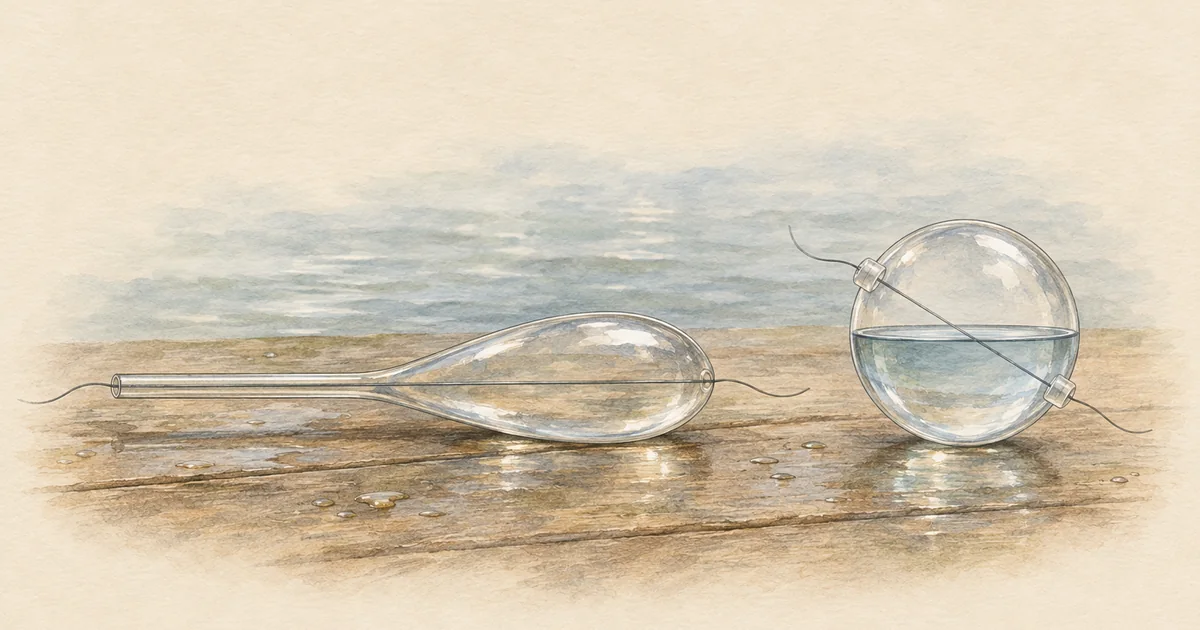
According to Blinker, the bodies are made of plastic, hard foam or, less often, balsa wood. On cheap models the whole body is also the weight. Many of these are poorly balanced and sit clumsily in the water. Hard-foam bodies, on the other hand, contain a brass weight that trims the sbirolino, in other words balances weight and buoyancy against each other.
The tube is more than a line guide. It keeps the sbirolino steady in flight and prevents tangles, and the longer it is, the more cleanly it flies. A bent tube spoils the cast, but according to the same source it does not lead to more missed bites. Models with wings are supposed to fly particularly far, but some flutter in the air and lose distance as a result.
Bulbous or slim
A bulbous body has its centre of gravity well forward. It flies well but sinks almost head first. A cautious trout can then feel resistance when it bites and let go of the bait again. A slim body with its centre of gravity in the middle sinks almost horizontally and hardly brakes on the bite (Blinker). So if you get a lot of missed bites, check the shape too.
Floating, slow or fast sinking
Sbirolinos come in floating, slow-sinking and fast-sinking versions (Rute & Rolle). Blinker thinks nothing of suspending models, often called suspenders: a sbirolino either floats or sinks. You cannot tell which from the weight. Blinker lists slow- and fast-sinking versions in 10, 15 and 20 grams each. For the same weight, the slow-sinking model is thicker because more buoyant material has to offset the weight.
Reading the printed figures
Many bodies carry two numbers. According to Fisch & Fang, the first is the total weight in grams, which determines the casting distance. The second is the underwater weight with which the sbirolino pulls down in the water, and it sets the sink rate. According to the magazine, fast-sinking models have a ratio between the two numbers of about 5:1 to 3:1 and run at a depth of around three to six metres.
Other models carry a running depth in metres or a coloured ring. According to Blinker, both are only a rough guide for a medium retrieve speed. If you stop reeling, a sinking sbirolino keeps sinking to the bottom.
Worked example: The body is marked 20/5. The sbirolino weighs 20 grams and pulls down with 5 grams under water. 20 divided by 5 gives 4:1, which is within the range Fisch & Fang gives for fast-sinking models. A 20/2 has the same total weight but only pulls down with 2 grams under water, so 10:1, and therefore sinks more slowly. The source gives no running depth for ratios like this. How to count down the sink rate of a model yourself is explained in the Sbirolino rig.
Which sbirolino for which depth
The table sorts information from Fisch & Fang and Blinker by where the trout are holding. Most rows come from articles about trout lakes.
| Trout are holding | Sbirolino | Notes |
|---|---|---|
| just below the surface, warm season | floating or shallow running | hooklength around 2 m |
| in mid-water, for example in spring | slow-sinking | hooklength at least 2 m |
| deep, around 3 to 6 m | fast sinking, marked about 5:1 to 3:1 | colour usually unimportant from about 1,5 m depth |
| sluggish on the bottom, cold season | fast sinking as a bottom weight, present the bait still | hardly sinks into the mud; for slow trailing a light float is better |
If you do not know where the fish are, Rute & Rolle advises retrieving every cast at the same speed and switching models in between. That way you search all the layers one after another. The faster you reel, the shallower any sbirolino runs. For this you need several sink rates in your bag; three weights of the same type will not help. For very slow trailing in winter, Fisch & Fang considers the sbirolino unsuitable and uses a light float instead.
Weight in grams and the rod’s casting weight
Choose the total weight according to the distance you need. Blinker points out that on a water of 1,5 hectares a sbirolino can weigh over 30 grams; the rod then needs some backbone. Fisch & Fang considers 70 to 80 metres of casting distance achievable.
On the coast the figures differ. For sea trout, Fisch & Fang gives 15 to 25 grams and advises against heavier models, because a large sbirolino lands with a louder splash and is more likely to scare fish. Rute & Rolle uses sinking or slow-sinking models of 20 to 35 grams there, and 20 grams at close range. For garfish, according to Blinker, a floating or slow-sinking sbirolino of around ten grams offers very little resistance to the fish as it swims off.
Sbirolino and bait together must stay within the rod’s casting weight. The tackle notes of the Fischereiverein Löningen state, as exam material, never to load a rod beyond its stated casting weight. For the trout lake, Fisch & Fang gives match and sbirolino rods rated up to about 30 grams. A 35-gram sbirolino from the coast therefore belongs on a stronger rod; Rute & Rolle describes a casting weight of 10 to 40 grams for this. Length and action are covered under Trout rod, and you can find the right line strength in the Line calculator.
Colour
Blinker distinguishes between transparent, milky-white and coloured sbirolinos. Transparent ones are meant for clear water but reflect the light in bright sunshine. Milky-white ones are easy for the angler to see on the surface, red ones are said to be easier to follow in flight, and black scares fish least according to the same source. A Blinker article on the colour of floats and sbirolinos observes that trout visibly avoid large orange or neon-green bodies, especially on small, heavily fished ponds. Matt, dark or clear bodies have proved themselves there, while glossy ones also reflect light. Below a depth of around 1,5 metres, colour is usually unimportant according to the article, because the fish no longer have the body directly in view.
The bubble float
The bubble float is a hollow ball that you fill with water to bring it up to the casting weight you need. An author in Blinker explicitly calls it a bite indicator, and that is the difference from the sbirolino. He recommends round bubbles for static fishing and oval ones for trailing, and both can be rigged fixed or running freely. For the trout lake he gives diameters of 2,5 to 5 centimetres, chosen according to casting distance: small bubbles from the bank and on small ponds, 5 centimetres only for very long casts or in strong wind.
Filling and trimming a bubble float
- Choose the size. According to the casting distance you need, as described above.
- Open and fill. Open the two rubber plugs and pour in water. An article in Blinker fills it halfway for chub at the surface.
- Match the amount of water to the depth. When the author of the bubble-float article in Blinker trails floating paste just below the surface, he fills the bubble until it only just sticks out. A split shot in front of the hook pulls the paste under the water.
- Close it and set the distance. A rubber stop or two small split shot hold the bubble in place in front of the hook. With very cautious trout it is better to let it run freely on the line.
- Add lead for deeper layers. For static fishing in mid-water he splits the loading roughly 2:1 between water and lead; close to the bottom he reverses this, so lead provides about two thirds. When he trails close to the bottom, lead takes on 70 to 80 per cent of the carrying capacity and water makes up the rest.
- Choose the hooklength. He gives 80 to 150 centimetres for static fishing at the surface and around 50 centimetres for static fishing on the bottom. When trailing with paste at the surface it is 100 to 150, in mid-water and close to the bottom 80 to 120 centimetres.
An example with our own calculation: if your bubble carries 6 grams, the 2:1 rule for static fishing in mid-water gives about 4 grams of water and 2 grams of lead, and on the bottom the other way round, about 4 grams of lead. When trailing close to the bottom it would be 4,2 to 4,8 grams of lead. How to spread shot over a total weight is worked out in Float shotting.
Bubble float or sbirolino
According to Blinker, the classic bubble float brakes much more on the bite than a floating sbirolino. Even a 30-gram sbirolino is said to be clearly more sensitive than a bubble of the same weight and to fly better. The bubble has its place where it is also meant to show bites, and as a rattle: filled with a few split shot, it clatters in choppy water. This makes bite indication less sensitive. The author of the bubble-float article then presents the bait on a short hooklength of 40 to 60 centimetres close to a transparent bubble.
Common mistakes
- Judging the sink rate by the weight. A 30-gram sbirolino does not automatically sink faster than a 10-gram one; Blinker calls this conclusion a cardinal error. Read the second number.
- Hooklength too short, especially on a floating model. A floating sbirolino ploughs through the water and leaves a wake behind it that makes cautious fish suspicious (Fisch & Fang). Usual lengths are under Sbirolino rig.
- Rig tangles on the cast. Stop the line before the rig hits the water, then the hooklength straightens out. Fisch & Fang also puts a piece of plastic tubing, two rubber beads and an anti-twist swivel between sbirolino and hooklength. Beads and tubing are under Stops and beads, swivels under Swivels and snaps.
- Large, brightly coloured body just below the surface. On a small, heavily fished pond, trout avoid sbirolinos and bubbles like these. Use smaller, matt or clear models there.
- Carrying on with a bent tube. It costs casting distance and steadiness in flight. According to Blinker it does not cause more missed bites, but you should still carry a spare in your bag.
Frequently asked questions
Are there suspending sbirolinos?
No. According to Blinker, a sbirolino either floats or sinks, even though suspending models are often talked about. A printed running depth does not mean it will stay there either: during every pause in reeling, a sinking model keeps sinking.
Do I need a dedicated rod for the sbirolino?
Not necessarily. On the coast, according to Fisch & Fang, the usual sea trout spinning rod of around three metres is enough. Classic sbirolino rods are 3,60 to 3,90 metres long because the hooklengths are sometimes over three metres long. With a shorter rod, according to the magazine, you can then hardly keep the fish under control. More under Trout rod.
Can I use a sbirolino and a bubble float anywhere?
That is set by your federal state (Bundesland), the water rules of the fishery manager, the pond rules and your fishing permit (Erlaubnisschein). An example of an association rule: the water rules (Gewässerordnung) of the Landesverband Sächsischer Angler (2024 edition, point 4.2.3) list fishing with a bubble float and sbirolino and a lure for the association’s still salmonid waters. They only apply to these waters. For your water, what counts is what is in your fishing permit; more under Fishing permit and water map.
Related
- Sbirolino rig: set-up in six steps, hooklength lengths and counting down
- Trout rod: length and casting weight for sbirolino and pond
- Trout fishing at a pond: an overview of methods at the trout lake
- Bait paste: shaping paste so it spins behind the sbirolino
- Stops and beads: knot protection in front of the swivel
- Fishing a trout pond: pond rules, stocking and treating fish gently
- Line calculator: comparing the breaking strain of mainline and hooklength
- Floats: the light float for slow trailing in winter
Sources
- Blinker: Angeln mit Sbirolino: Alles, was Du wissen musst (Aufbau, Werkstoffe, Messinggewicht, Röhrchen, Flügel, Körperform, Farben, kein Schweben, Gewicht und Sinken, Lauftiefenangaben)
- Blinker: Angeln mit Wasserkugel: Erfolgreich am Forellensee (Bissanzeiger, Form, Größe, Füllmenge, Verhältnis Wasser zu Blei stationär und beim Schleppen, Rassel, Vorfachlängen) und Döbel mit der Wasserkugel (Gummipfropfen, halb füllen, Abstand fixieren)
- Blinker: Spinnfischen auf Hornhecht (Widerstand von Wasserkugel und Sbirolino, zehn Gramm) und Farben von Posen und Sbirolinos am Forellensee (Scheuchwirkung, 1,5 Meter, matte Körper)
- Fisch & Fang: So fangen Sie am Forellensee (Wurfgewicht ohne Bissanzeige, Aufdruck, Verhältnis 5:1 bis 3:1, Wurfweite, Ruten bis 30 Gramm, Winter, Grundgewicht), Forellensee-Einmaleins (Modell und Vorfach nach Jahreszeit) und Auf Meerforelle mit Sbirolino und Fliege (Gewicht an der Küste, Aufklatschen, Spur, Verwicklungen, Rutenlänge)
- Rute & Rolle: Weitwurfrakete Sbirolino (Sinkstufen, Modellwechsel, Tempo und Tiefe) und Meerforellen: Tipps für Sbirolino (20 bis 35 Gramm, Rutenwurfgewicht)
- Landesverband Sächsischer Angler: Gewässerordnung, Ausgabe 2024 (PDF) (Begriff Sbirolinoangel, Regel für stehende Salmonidengewässer des Verbands)
- Fischereiverein Löningen: Gerätekunde zur Fischerprüfung (PDF) (Wurfgewicht der Rute nicht überschreiten)
Text AI-assisted, drawing AI-generated. Sources opened and checked in November 2026; no graphics taken from the sources.
All information is a guide only, without guarantee. How deep a sbirolino actually runs depends on the model, bait and retrieve speed; which rigs are allowed is set by the water rules and your fishing permit.