
Knowledge · Fishing methods
Trout fishing at a pond
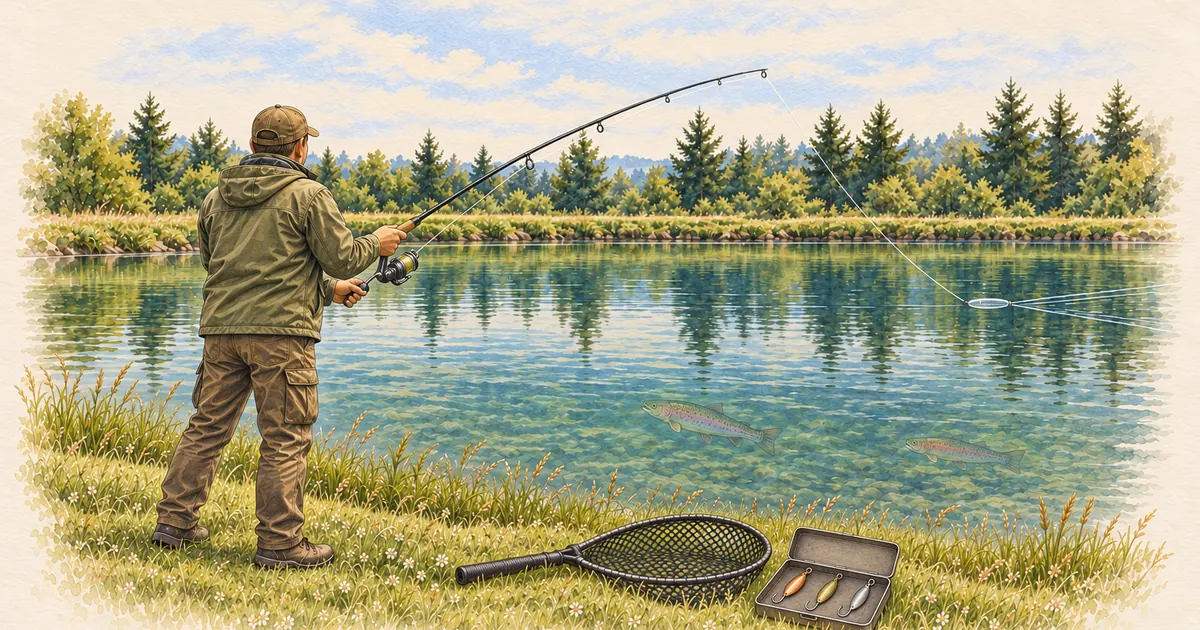
In trout fishing at a pond, three methods take turns: the small spoon on a short rod, the sbirolino for long casts and the trolled float with paste. After a bite, cast to the same spot again straight away, because a trout rarely comes alone.
Spoon: the small blade on a short rod
Spoons are spoon lures a few centimetres long, fished like in spinning. According to Blinker, most weigh between 1,5 and 4,5 grams; on trout lakes they usually carry a single hook.
Blinker lists spoon rods of 1,80 to 2,10 metres, also called trout area rods, whose casting weight rarely exceeds 7 grams. The rod is short because you hold it low while working the lure. On reel and line the Blinker authors disagree: reel sizes from 500 to 2500, monofilament line of 0,14 to 0,20 millimetre or thin braid with a good metre of fluorocarbon in front. They agree on the drag. It has to be finely adjustable and start smoothly, because the trout takes line straight after the bite (Setting the reel drag).
Before the first cast, a test run in the shallows at your feet is worthwhile. Some spoons veer strongly sideways on the retrieve, others run steadily. A spoon that veers strongly does not need extra movement from the rod, according to Blinker; a steady one you can bring to life with small rod movements.
Finding the depth: counting down and letting it sink
According to Blinker, trout rarely leave their swimming depth to chase a lure. So after the splash you count before you start winding (count-down). Blinker gives 30 to 50 centimetres per second for the sink rate, depending on weight and thickness of the metal. A heavy spoon is therefore at least 1,5 metres deep after five seconds. In spring on large trout lakes, counting to three is usually enough according to Blinker, and the spoon then sits about a metre deep. When the fish stand just under the surface, you start winding at once or count only to one.
On the retrieve the spoon rises, because the line pulls it upwards as it gets closer to the rod tip. Blinker therefore advises letting it sink for two seconds every 10 to 15 turns of the handle. That creates a sawtooth path that stays at roughly the same depth (Fig. 1, top).
The method has limits. The line lies on the water and slows the sinking, a thick one more than a thin one. According to Blinker you do not reach great depths with such light lures. For shallow areas of large lakes, Blinker recommends compact spoons of 2 to 3 grams: heavier ones over 3 grams sink too fast to the bottom and snag, lighter ones under 1 gram do not fly far enough and tend to run at the surface.
Remember the count. A trout rarely comes alone, writes Blinker. After a bite, cast straight back to the same spot and count the same number, and the spoon is again working at the fish’s depth.
Working the lure, colour and the bite
With a spoon the rod tip points towards the water. According to Blinker, this lets you feel every nudge, get the fish under control faster in the fight and stop it from jumping and shaking off the hook. The colder the water, the slower you wind; in winter just fast enough for the spoon to keep working.
You do not strike on the bite. Blinker advises simply carrying on winding, because the trout usually hooks itself. Anyone who strikes after a missed attack pulls the lure out of its field of view. If it keeps running, the fish often attacks again at once.
On colour, Blinker gives two rules of thumb. Freshly stocked trout that are still keenly looking for food readily take bright yellow spoons; once they have settled in, muted colours are better. With bare metal spoons the light reflection counts: silver flashes most and suits sun and clear water, copper suits cloud, slight turbidity and heavy angling pressure, brass suits changeable weather.
Sbirolino when the fish stand far out
With light spoons and short rods you do not get far out. On small ponds that rarely matters, because the productive zones are often close to the bank, according to Blinker. On large waters you can present the spoon on a sbirolino with a long leader (Fig. 1, middle). For this you change rod: instead of the soft spoon rod you need a stronger model with more backbone. Rig, weights and counting down the sbirolino are explained on the page Sbirolino rig.
Towed float with dough
Towing the float presents the bait very slowly. You cast out and wind the dough gently through the water, setting the depth by the position of the float. Rute & Rolle recommends slim floats with a carrying capacity of three to six grams and a three-way swivel between the main line and the hooklength so that the line does not twist. According to Blinker, the dough rotates as it is towed and pulls pressure waves and a scent trail behind it.
How long the hooklength should be depends on how the fish are biting; for very cautious fish Rute & Rolle gives 1,5 metres and more. A small split shot around ten centimetres in front of the bait makes it flutter down during pauses in the retrieve, so you search several depths along the way. Change the speed until bites come: in winter retrieve very slowly, in summer faster.
When you feel a bite, you stop winding and give the line a little slack. According to Rute & Rolle, you strike only when the float moves away steadily or goes under. How to choose and shape the dough is explained under Angling dough, and the stationary float under Float rig.
Change the method through the day
According to Blinker, how the fish bite at a trout lake sometimes changes by the hour, with the time of day, weather, fishing pressure and season. The article describes a sequence from a fast, conspicuous bait to a slow, inconspicuous one.
| Time | Method | Reason according to Blinker |
|---|---|---|
| early in the morning | vary spoons, depth, pace and colour | fish are often keen to move, so you find their position quickly |
| attacks become less frequent | small soft plastics, slowly with small twitches | can be worked more slowly than metal |
| artificial lures stay unsuccessful | towed float with dough | different movement, scent in the water |
| summer, midday, fish near the surface | a very fine rig, one maggot or a tiny piece of dough | large baits look suspicious |
In the cold season the day can run differently: in large, deep lakes the trout are, according to Blinker, often still sluggish in the morning in spring, and spoons then catch better at midday, when the sun warms the shallow water.
Two rods make changing easier: one fishes permanently alongside, and you search with the other. In the LAVE NRW guidance on running angling ponds the number of rods is limited to two per person; at your pond the pond rules may set something different.
Hooks and landing net: landing the fish gently
In the exam questions for the angling exam (Fischerprüfung) in Bavaria (LfL), lures with single hooks count as more fish-friendly than those with trebles. For spoons, Blinker advises single hooks with a small barb: trebles are not allowed at many ponds and often hook the trout outside the mouth, while completely barbless hooks easily pull out. Whether a barbless hook (Schonhaken) is mandatory is stated in the pond rules.
According to the LAVE NRW guidance, caught fish must be lifted out of the water promptly and gently with a landing net. A net with a rubberised surface is, according to LfL, particularly kind to fish because hooks hardly penetrate it. Blinker recommends a long-handled landing net with a rubberised mesh for spoons. How to stun and kill a fish you are taking home is described under Stunning and killing fish.
Law: Whether you need a fishing licence (Fischereischein) at the pond is regulated by your federal state (Bundesland). The number of rods, permitted baits and hooks and the catch limit are set by the pond rules. More under Fishing at a trout pond and Fishing permit and water licence.
Frequently asked questions
Do I have to strike when a fish takes the spoon?
No. According to Blinker you simply keep winding, and the trout usually hooks itself. If it missed the hook, it often attacks again straight away as long as the lure keeps moving.
How deep is the spoon after five seconds?
At the 30 to 50 centimetres per second that Blinker gives, the calculation comes to about 1,5 to 2,5 metres. Thick line slows the sinking, and a spoon made of thin sheet metal sinks more slowly. The figure is a guide, not a measurement for your lure.
Why does nothing bite on the spoon after a while?
At heavily fished ponds the fish, according to Blinker, get used to the many spoons in the water. Then a slower lure, a subdued colour or a switch to the towed float with dough helps.
Related
- Fishing at a trout pond: licence, swims, seasons and basic tackle
- Sbirolino rig: set-up, weights and counting down
- Angling dough: the bait for the towed float
- Fishing for rainbow trout: baits and approach for rainbow trout
- Brown trout: appearance and way of life
- Angling ponds in Germany: find ponds near you
- Angling ponds in Denmark: find ponds for your holiday
- Angling ponds in Poland: find ponds for your holiday
Sources
- Blinker: Spoon-Angeln, lock die Forellen aus der Reserve (05.07.2023, aktualisiert 20.08.2025; Gerät, Haken, Biss, Sbirolino)
- Blinker: Spoon-Angeln, Seite 2 (Anzählen, Sägezahn-Führung, Farben, Kescher)
- Blinker: Spoons in großen Forellenseen (19.03.2025; Gewicht, Anzählen, Frühjahr)
- Blinker: Blanke Spoons im Forellensee (22.06.2026; Silber, Kupfer, Messing)
- Blinker: Am Forellensee immer die richtige Methode wählen (20.03.2026; Ablauf über den Tag)
- Rute & Rolle: Schleppen und zittern (20.09.2017; geschleppte Pose)
- LAVE NRW: Hinweise und Empfehlungen zum Betrieb von Angelteichen in NRW (Rutenzahl, Unterfangkescher)
- LfL Bayern: Staatliche Fischerprüfung, Prüfungsfragen 2023/2024 (Einzelhaken, Gumminetz, Schonhaken)
Text AI-assisted, drawing AI-generated. Sources opened and checked in October 2026; no graphics taken from the sources.
All details are guide values without guarantee. The pond rules govern the number of rods, baits, hooks and the catch limit, and state law governs the fishing licence (Fischereischein).