
Knowledge · Tackle
Fish grip: Hold fish securely without injuring them
A fish grip clamps the fish by the lower jaw with two jaws, and many models have a spring balance in the handle. This lets you hold a struggling fish with one hand without touching spines or teeth. In two laboratory experiments with bonefish and barramundi, however, 80 to 100 per cent of the fish afterwards had injuries to the mouth.
Design: jaws, trigger and scale
Most grips work with two opposing metal jaws, often bent like a C. One jaw goes into the mouth onto the lower jaw, the other rests on the outside of its underside. When you pull back the trigger, the jaws open; when you let go, they close and lock. That is how it is described by a 2008 study in the journal Fisheries Research, which examined a widespread model with a tubular handle and spring balance.
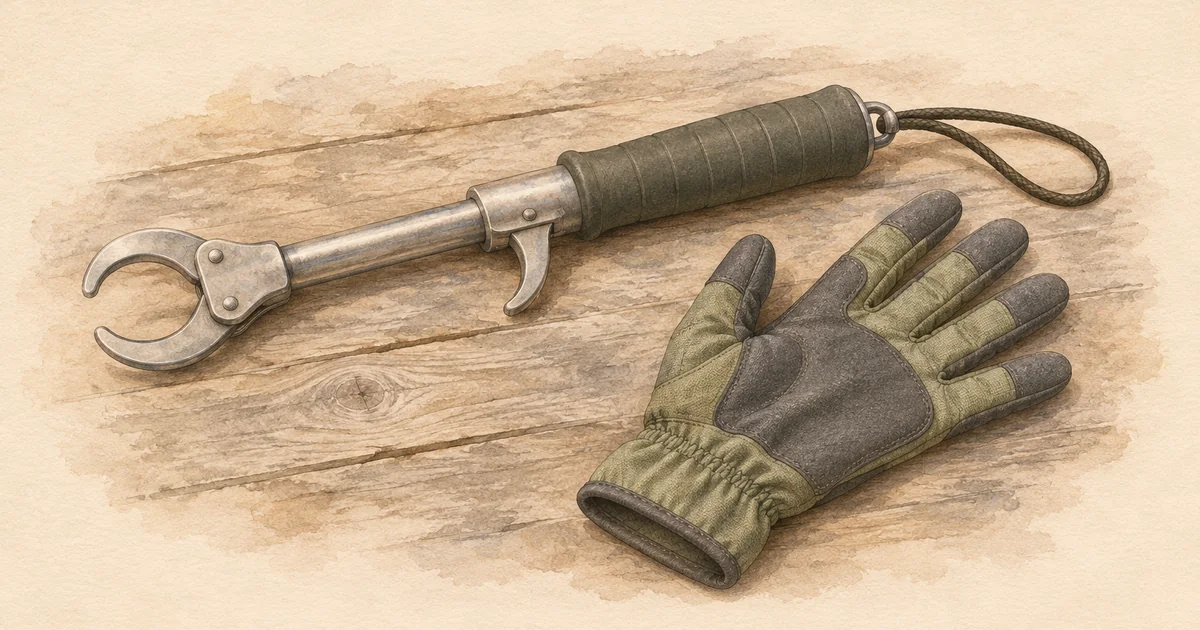
Two features make the device popular and at the same time problematic. The weight of the fish pulls the jaws tighter, so your hand does not have to squeeze. And because the fish is hanging from it anyway, many handles contain a scale. The researchers consider it possible that its spring dampens jolts somewhat, and mention devices with a swivel that is meant to absorb twisting at the head. Blinker explains its popularity among lure anglers with its small size, low weight and built-in scale. What a scale in the handle is worth is covered under Fish scales.
Be careful with the word lip grip: Blinker also uses it for a hold without a device, the mouth or perch grip. The thumb goes into the mouth, and the bent index finger presses from outside under the lower jaw. According to the magazine, European anglers adopted it from American black bass anglers. The gaff, a pole with a hook, is something else; for fish that are to go back, a review in Fisheries Research advises against both.
What studies show about jaw injuries
The first targeted test comes from researchers at Carleton University, the University of Illinois and an institute in the Bahamas (Fisheries Research, 2008). They caught wild bonefish with a net, a marine species that anglers almost always release. The fish were 38 to 54 centimetres long. After a minute of chasing in the tank, the researchers held ten fish each for 30 seconds: on the grip horizontally in the water, on the grip vertically in the air, or by hand only under water.
After 48 hours, all fish were alive. However, 18 of the 20 fish that had hung on the grip were injured: all ten from the air and eight of the ten from the water. In the group without a grip, only one fish showed slight inflammation in the lower jaw. The wounds ranged from bruising without puncture, through holes and tears of 5 to 28 millimetres in the tissue between lower jaw and throat, to broken lower jaws and a tongue torn away from the floor of the mouth. The researchers rated around 40 per cent as severe. Most occurred when the fish thrashed violently on the grip, not from the pressure of the jaws themselves.
Important in practice: staying in the water hardly protected the jaw. How often the jaws pierced the tissue and how large the holes were did not differ statistically between the two grip groups. The authors warn that such wounds can encourage infections and make feeding more difficult, especially for a fish that looks for its food on the bottom.
A year later, fisheries researchers from the government of Australia’s Northern Territory examined 21 barramundi of 53 to 102 centimetres (North American Journal of Fisheries Management, 2009). The fish hung on the grip above the water for 20 seconds, ten unsupported and eleven supported horizontally with one hand; another ten lay in the landing net for the same time. Afterwards, all barramundi that had hung unsupported had small holes in the membranes of the lower jaw, as did 81 per cent of those supported. X-rays showed that lifting by the grip shifted the vertebrae against each other, and after three weeks this had not reversed. Two fish died after ten days, but their deaths could not be attributed to any treatment.
A review of gentle angling methods in Fisheries Research therefore advises not landing fish that are to go back with a grip or a gaff. In the authors‘ assessment, grips probably do less damage to species with a strong, bony mouth. Very large specimens can still injure their mouth and vertebrae when hanging by the jaw, and for most species there are no experiments.
Limits of the figures: Both experiments took place in the laboratory, with ten to eleven fish per group and only with bonefish and barramundi. For pike, zander, perch or sea bass, the sources evaluated here give no measurements of their own. In both experiments, however, the grip frequently injured the mouth, even in the water and with hand support.
What a grip is good for and what it is not
The IGFA, the international association for record catches, sees the grip as an aid for controlling a fish. According to its recommendations on handling the catch, however, large fish should not be lifted vertically out of the water, because this can damage jaw muscles, bones and internal organs. It is better to grip the fish and support its underside, always horizontally. The device is widespread because it protects the hand: the barramundi study gives as the reason that anglers can use it to lift and unhook their catch easily and safely. With sea bass, Blinker warns about the spine on the rear edge of the gill cover; the fish page therefore recommends gripping by the lower jaw or using the landing net. The sources evaluated here do not mention any grip experiments on this species.
| If … | then better | According to |
|---|---|---|
| the fish is to go back and the hook is at the front | unhook in the landing net in the water, without a grip | Review |
| a pike has been landed | no grip; landing net or gill-cover grip | Pike Anglers‘ Club, DHC |
| a perch with no hook in its mouth is being held | hand grip on the lower jaw, support the belly | Spoon |
| a sea bass is being landed (spine on the gill cover) | grip the lower jaw or use the net; if a grip, then in the water with belly support | Blinker, IGFA |
| the fish is being weighed | wet weigh sling, zero the scales first | Pike Anglers‘ Club, Angling Trust |
| a photo is being taken | horizontal, support the underside, just above the water | IGFA, Angling Trust |
Pike: no grip, gill-cover grip with practice
The British pike anglers‘ association Pike Anglers‘ Club states in its code of conduct that jaw grips must never be used to hold or unhook a pike. Weighing is done in the sling, not on the scale hook under the chin. For unhooking, according to the code, the pike should lie on its back, with one hand holding the lower jaw through the gill cover without touching the gill rakers. The Deutscher Hechtangler-Club describes the gill-cover grip in a similar way in a guide published by Blinker; the hand position is covered under Disgorger and artery clamp. The Waidgerecht project of Humboldt-Universität and IGB recommends holding the pike horizontally, not vertically.
Grips on a pike’s head require practice. In the Bavarian question catalogue for the angling exam (Fischerprüfung), question 4.173, the correct answer is that gripping behind a pike’s head carries the risk of reaching into the gills and injuring both fish and person. If you lift the fish vertically with the gill grip, according to Blinker its whole weight rests on the neck vertebrae. If you have not mastered the grip safely, use the landing net; the routine is covered under Landing and unhooking fish.
Perch: the hand grip needs support
With perch, the hand grip on the lower jaw replaces the fish grip. Blinker names two conditions: the thumb only goes into the mouth if there is no longer a hook in it. And if you turn the perch horizontal with one hand, you strongly overextend the lower jaw, which can break. Your second hand therefore belongs under the belly. The review sees it the same way: fish without sharp teeth can be held by the lip between thumb and index finger, but the body needs the support of the other hand so that jaw and vertebrae are not damaged.
If you use a grip
If you still use a grip, these steps reduce the damage. They cannot prevent it:
- Let a fish that is still thrashing hard after the fight rest in the water first, for example in the landing net. The Angling Trust guidance advises this after a hard fight, and in the bonefish study most wounds occurred while the fish was thrashing on the grip.
- Leave the fish in the water and close the jaws around the lower jaw: one inside, one outside.
- Immediately support the belly with your free hand and hold the fish horizontally. That way the fish does not hang vertically by the jaw, which IGFA and the review warn against. The support hardly prevented the holes in the jaws of the barramundi: 81 instead of 100 per cent.
- Never lift the fish vertically out of the water on the grip and do not weigh it on the grip. For weighing, the fish belongs in a wet weigh sling.
- Keep it short. In both experiments, 20 to 30 seconds were enough to cause the injuries.
For large fish such as carp, tench, pike, wels catfish and barbel, the Angling Trust recommends strong tackle; the line calculator works out the breaking strain of your line and knot.
Unhooking glove instead of a grip
According to Blinker, landing gloves have become fashionable among predator anglers. They protect the hand, but there is no evidence of a benefit for the fish: the review knows of no study in which gloves remove less slime than bare hands, and one experiment found similar losses. The authors consider clean, wet hands or gloves without a rough surface both usable. Blinker warns against rough gloves that damage the mucous membrane and against the lack of feel with the gill grip. The magazine therefore advises wearing one only when there is a risk of a hook going into your fingers. Material and cut protection are covered in Fishing gloves.
Common mistakes
- Lifting the fish on the grip. For the photo or the scales, the fish then hangs vertically by the jaw, exactly the position IGFA and researchers warn against.
- Using the grip although the landing net would do. If the fish is already in the net, it can be unhooked there in the water.
- Clamping a thrashing fish. That is exactly when the severe wounds occurred in the experiment.
- Holding the pike on the grip. Pike anglers expressly reject this.
- Turning the perch horizontal with one hand. The lower jaw is overextended; the second hand belongs under the belly.
Frequently asked questions
Does a fish grip injure the fish?
In two laboratory experiments, yes: 80 to 100 per cent of the bonefish and 81 to 100 per cent of the barramundi had injuries to the mouth. In the short term, no fish was shown to have died from it. However, the researchers consider effects on feeding and infections possible.
Am I allowed to use a fish grip?
That is governed by state fisheries law and the water regulations (Gewässerordnung); what applies on your water is stated in the water regulations and the fishing permit (Erlaubnisschein). The Landesverband Sächsischer Angler, for example, prohibits grips and gaffs on its association waters (water regulations no. 1.17). That is an association rule, not a state requirement. What the federal states themselves prescribe in terms of gear is covered under Mandatory equipment.
Can I weigh the fish with the scale in the grip?
Technically yes, but it is unfavourable for the fish, because it hangs vertically by the jaw. The review considers weighing by the lower jaw or gill cover potentially harmful to the gills and mouth. A wet weigh sling, whose weight you subtract beforehand, is gentler.
Is the perch grip the same as a lip grip?
In everyday usage, often yes. Blinker calls the hand hold lip grip, mouth grip or perch grip. What is meant then is not a device but the thumb in the mouth and the index finger under the lower jaw, plus support under the belly.
Related
- Landing and unhooking fish: landing net, hands, mat and time in the air
- Landing net: mesh, size and handle
- Unhooking mat: lay down softly, unhook gently
- Disgorger and artery clamp: removing hooks deep in the mouth, the gill-cover grip on pike
- Weigh sling: weighing fish without hanging them up
- Fishing gloves: when a glove helps and when it does harm
- Returning fish: legal position and survival rates
- Line calculator: breaking strain of line and knot
Sources
- Fisheries Research: An evaluation of the injury and short-term survival of bonefish as influenced by a mechanical lip-gripping device (2008, PDF beim Bonefish & Tarpon Trust) (Aufbau des Greifers, Versuchsaufbau, Verletzungen und ihre Ursache, Folgen für das Fressen)
- North American Journal of Fisheries Management: Injuries to Barramundi Resulting from Lip-Gripping Devices in the Laboratory (2009) (Fischereiforschung Northern Territory, Grund für den Greifer, Löcher im Unterkiefer, verschobene Wirbel)
- Fisheries Research: Best practices for catch-and-release recreational fisheries, angling tools and tactics (Übersichtsarbeit, PDF) (Greifer und Gaff beim Zurücksetzen, Maulform, Lippengriff mit Stütze, Handschuhe, Wiegen)
- IGFA: International Angling Rules (Greifer als Hilfsmittel, große Fische nicht senkrecht heben, Unterseite stützen)
- Pike Anglers‘ Club of Great Britain: Code of Conduct (PDF) (kein Greifer beim Hecht, Wiegen in der Schlinge, Griff durch den Kiemendeckel)
- Angling Trust: Best Practice Guide to Freshwater Angling (PDF) (Ruhepause im Kescher, kräftiges Gerät, Waage nullen, Foto über dem Wasser)
- Blinker: Fische landen, Kescher, Lip-Grip und Co. (Beliebtheit des Greifers, Landehandschuhe, senkrechter Kiemengriff), Blinker: Einen Barsch mit dem Lip-Grip richtig halten (2026) (Barschgriff, überstreckter Unterkiefer) und Blinker: Steckbrief Wolfsbarsch (Dorn am Kiemendeckel)
- Blinker: DHC-Tipps zum schonenden Zurücksetzen (Kiemendeckelgriff beim Hecht) und Humboldt-Universität zu Berlin und IGB: Projekt Waidgerecht, Pike (waagerecht halten)
- Bayerische Landesanstalt für Landwirtschaft: Prüfungsfragen zur Fischerprüfung 2023/2024 (PDF) (Frage 4.173, Griff hinter den Kopf beim Hecht)
- Landesverband Sächsischer Angler: Gewässerordnung (PDF) (Nr. 1.17, Greifer und Gaff an den Verbandsgewässern untersagt)
Text AI-assisted, drawing AI-generated. Sources opened and checked in November 2026; no graphics taken from the sources.
All information is a guide only and given without guarantee. The study figures come from laboratory experiments with bonefish and barramundi and cannot be transferred unchanged to other species; the water regulations and fishing permit are what count.