
Knowledge · Waters and fish behaviour
Read the current
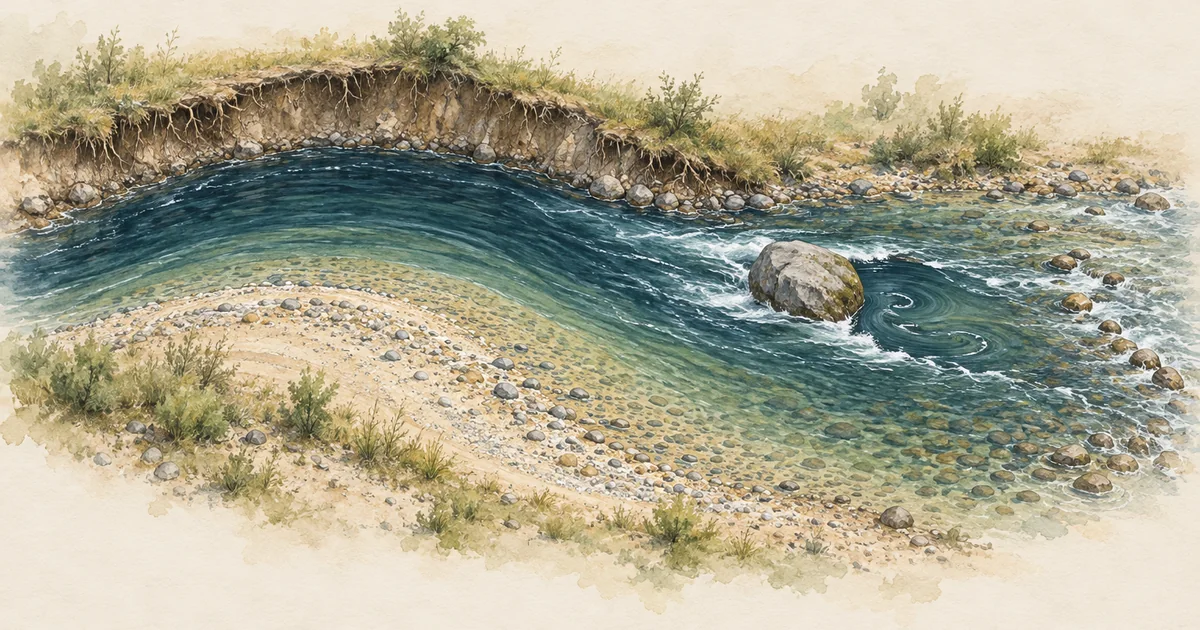
Reading the current means telling fast and slow water apart on a river and working out depth, bottom and holding spots from it. Cut bank, slip-off slope, eddy, pool, riffle and current seam form where the water is diverted, slowed or accelerated.
Why fish stand beside the current
Swimming against the current costs strength, and small fish endure less than large ones. The Leibniz Institute of Freshwater Ecology and Inland Fisheries gives the critical swimming speed for this: the speed at which a fish is completely exhausted after one hour. For a trout about 20 centimetres long it is 1 metre per second, for young fish of 2 to 4 centimetres 0.17 to 0.37 metres per second.
The same current carries the food. Grayling eat drift and insects landing on the water as well as bottom animals, and brown trout up to 35 centimetres do the same: small animals that drift down or fall onto the water (Regierungspräsidium Tübingen). A spot in calm water, from which the fish can reach the fast water, is therefore favourable.
In a flume, trout preferably stayed in the wake of an obstacle and used clearly fewer muscles there (Spektrum.de on a Harvard study from 2003). For rainbow trout the swimming costs behind the obstacle in fast current fell by almost half. For feeding, though, the shelter only paid off up to about 50 centimetres per second. Above that, every dash into fast water cost around 65 percent more energy and succeeded 40 percent less often (University of Florida, Journal of Experimental Biology 2020).
Calmer water exists even without an obstacle: near the bed the flow speed drops sharply (Lexikon der Geowissenschaften), and at the bank it is usually lower than in the main current. The bottom-oriented barbel lives on the bottom.
River bend: cut bank on the outside, slip-off slope on the inside
The line of the fastest current is called the thalweg. On a straight stretch it lies roughly in the middle, in a bend close to the outer bank and usually over the deepest water (Lexikon der Geowissenschaften).
- Cut bank: On the outer bank the fast water undercuts the slope and digs a deep channel, often a pool at the apex of the bend (Lexikon der Geographie: cut bank, pool). In deep, well-flushed channels, adult grayling, barbel and common nase look for food (Regierungspräsidium Tübingen). Under the hollowed bank the water is usually calmer and cool, and fish find shelter there (Land Niederösterreich).
- Slip-off slope: On the inner bank the water slows and leaves material behind. The bank is flat, and often a gravel bar lies in front of it (Lexikon der Geographie: slip-off slope; LANUK). Depth and current increase towards the channel without a step. Young grayling, barbel and nase spread out there by size and swimming ability, and the fry stay in the shallow, calm water at the edge (Regierungspräsidium Tübingen).
From the bank, colour often shows the channel: deep water looks darker (Blinker). On the cut bank of natural rivers the slope sometimes breaks away massively (Umweltbundesamt). Keep your distance from the edge, see Bank and waders.
Eddy and current shadow
Behind every obstacle lies an area with little pull, the current shadow. Where the water flows back there against the direction of flow, the spot is called an eddy. Trout use the current shadow of stones, dead wood and other obstacles (Hessisches Umweltministerium).
- Stones and boulders: A single boulder creates a calm area in the middle of the main current (Regierungspräsidium Tübingen). The grayling usually lives in hollows behind large stones (FishBase).
- Dead wood: A trunk deflects the current, creates eddies and so lets pools form too (Land Niederösterreich).
- Groynes: In their current shadow lie areas of weak flow, in places with slowly returning water. A groyne field from above is shown in Fishing on the river.
- Bridge piers: Nase often stand beside the eddies that piers or rocks create (FishBase).
- Confluences: Where a stream runs in, a current seam forms along which food drifts. Return currents beside it often form a spot where a fish stands without great effort, writes the Blinker about the brown trout.
Fine material settles in the current shadow. Sand or mud behind an obstacle therefore indicates slow water.
Riffle and pool in turn
A riffle is shallow, fast and usually turbulent, and its bed consists almost only of gravel, stones and boulders. A pool, called Gumpen in the south, is a hollow that the river digs into the bed at raised discharge (Regierungspräsidium Tübingen). In natural rivers the two follow each other: the Umweltbundesamt describes for upland rivers a clear alternation of shallow rapids and deeper quiet stretches, in English riffles and pools. At medium and low water the current in the pool becomes weaker (Lexikon der Geographie).
| Where | Water | Use according to RP Tübingen |
|---|---|---|
| Riffle | shallow, fast | young trout; barbel and nase feed here |
| Flow channel | deep, well flushed | adult grayling, barbel, nase feed here |
| Pool | deep, calmer | Holding spot, daytime resting place, winter quarters |
| Shallow bank | shallow, weak current | Fry of many species |
According to the same source, the grayling stands in deep, strongly flushed channels in summer, and in winter mainly in deep, slowly flushed pools and channels. At the riffle, anglers search above all the tail: there the water calms first, and a channel or hole has usually formed (Blinker).
Note: In the gravel of shallowly flushed spots lie, depending on the season, eggs and fry of brown trout, grayling and other gravel spawners. Whether you may wade there and which closed seasons apply is set by your federal state (Bundesland) and stated in the fishing permit (Erlaubnisschein), see Closed season and minimum size explained.
Spotting the current seam
The current seam is the line where fast water meets slow water: behind obstacles, at the edge of a groyne field, at confluences. Fisch & Fang names the seam between groyne field and main current as a spot for barbel. At the surface it gives itself away like this:
- Surface pattern: Surveyors classify the current by whether the surface looks smooth, rippled or tumbling (Lexikon der Geographie). Where a smooth strip meets a rippled one, the seam lies between them.
- Foam and scum film: Foam forms where waves and turbulence churn the water, and collects in calmed spots such as eddies or below weirs (Kanton Bern). On still water in the groyne field there is usually a light scum film (Blinker).
High water and low water
When the river rises, the water becomes faster and the fish need shelter. Specialist sources name bays, deep and slow-flowing areas and side arms as refuges (Regierungspräsidium Tübingen, Land Niederösterreich). In engineered rivers, water level and flow speed rise in the river bed without any new shelter forming (IGB). Groynes lose their calm zones as soon as they are completely overtopped.
Zander and other predators are pushed out of the main current by the increasing flow, according to Blinker, into shallow groyne fields and sheltered harbour entrances. The seam where they stand then lies in the groyne field between the return flow and the still water. The DLRG warns that even knee-deep current can sweep a person away. At high water, stay on firm bank.
At low water parts of the gravel bars lie dry. Deep channels can be a cooler refuge in summer, especially when groundwater flows in (Regierungspräsidium Tübingen). The Bavarian State Office for the Environment speaks of permanent stress for aquatic animals living in a small space at high temperatures and little oxygen. The Struktur- und Genehmigungsdirektion Nord in Rhineland-Palatinate advises giving up fishing in such phases. Background: Water temperature and oxygen.
Rigs and methods for strong current
- On the bottom: Bottom fishing and feeder fishing with the running lead rig. An author at Fisch & Fang mostly uses 50 gram feeders on the Rhine, sometimes 20 at low water, and more than 100 grams at high levels.
- At the seam: Float fishing with the float rig, the amount of lead is worked out by float shotting.
- For predators: Spinning, at seams for example with the drop shot rig.
- At riffle and channel: Fly fishing with a nymph or dry fly.
Frequently asked questions
What is the difference between an eddy and a current shadow?
A current shadow is any calm area behind an obstacle. It only counts as an eddy once the water there flows back upstream. Floating debris then drifts upstream.
How can you spot a pool (Kolk) from the bank?
Deep water looks darker than its surroundings. Pools also lie in predictable places: on the outside bank at the apex of a bend, below drops and behind obstacles.
Do big fish always sit in deep water?
No. Barbel rest in deep, sheltered spots and from there sometimes travel several hundred metres to feeding grounds, including shallow riffles. More on the fish pages, for example chub and barbel.
Related
- Fishing on the river: groynes, weirs, permits and safety
- Types of water: stream, river, lake and canal compared
- Chub, brown trout and zander: holding spots through the seasons in pictures
- Fishing calendar: best months for each species
- Angling glossary: eddy, pool and other terms from A to Z
- Fish zones of a river: which species live in which stretch
Sources
- Regierungspräsidium Tübingen: Fischökologisch funktionsfähige Strukturen in Fließgewässern (Rausche, Rinne, Kolk, Gleitufer, Hochwasser)
- IGB: Die fischökologische Bedeutung von Flussauen (Schwimmleistung, Hochwasser)
- Journal of Experimental Biology: Oxygen consumption of drift-feeding rainbow trout; Spektrum.de: Gegen den Strom (Schwimmkosten)
- Spektrum-Lexika (Geowissenschaften, Geographie): Stromstrich, Gerinneströmung, Prallhang, Gleithang, Kolk, Strömungsdiversität (Begriffe)
- Umweltbundesamt: Hydromorphologische Steckbriefe der deutschen Fließgewässertypen (PDF, 60 MB; Schnellen und Stillen, Kolke, Uferabbrüche)
- Land Niederösterreich: Lebensraum Gewässer; LANUK: Weiteres zur Ökologie der Fließgewässer (Prall- und Gleitufer, Totholz)
- Hessisches Umweltministerium: Ein Bach ist mehr als Wasser (Kehrwasser, Strömungsschatten)
- FishBase: Grayling, Nase (Standplätze)
- Kanton Bern: Schaum in Oberflächengewässern
- Blinker: Angeln auf Bachforellen: Das sind die Top-Stellen, Angeln bei Hochwasser; Fisch & Fang: Barben in Strömen (Praxis)
- DLRG: Hochwasser; SGD Nord: Vortrag zur Hege von Fischbeständen im Klimawandel; LfU Bayern: Auswirkungen von Niedrigwasser (Gefahr, Niedrigwasser)
Text AI-assisted, drawing AI-generated. Sources opened and checked in October 2026; no graphics taken from the sources.
All figures are guidelines without guarantee. Every river is different: water level, fishing permit (Erlaubnisschein) and water rules (Gewässerordnung) take precedence over this description.