
Destinations · Poland
Fishing on the Oder
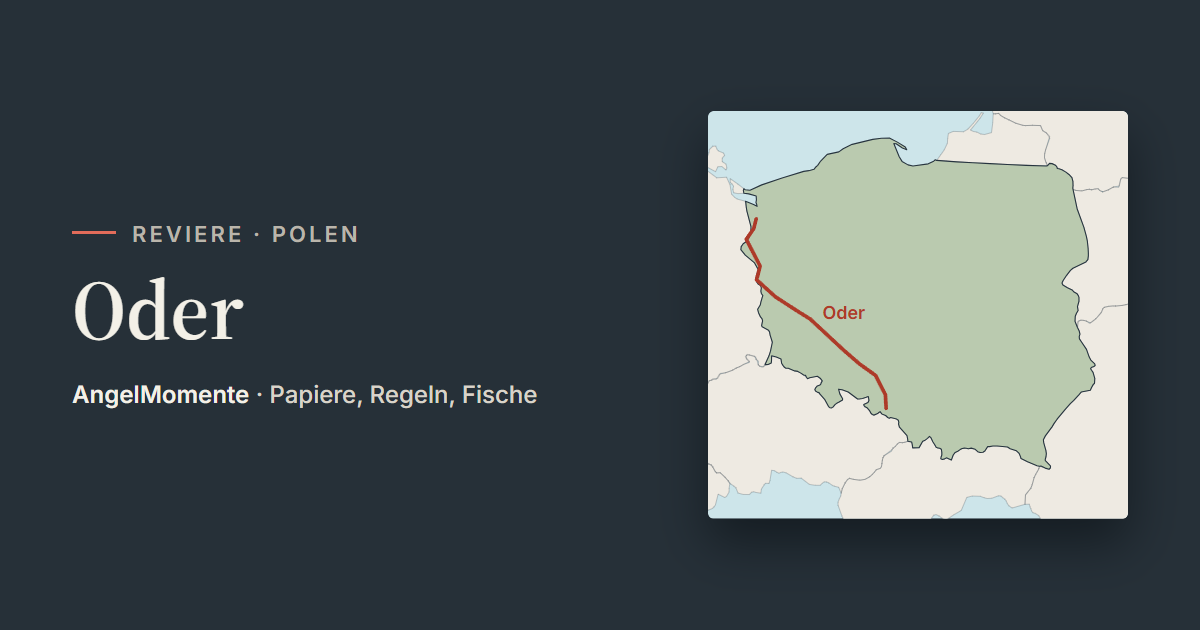
The Oder rises in the Czech Republic, flows through Wrocław and forms the border with Germany on its lower reaches until it merges into the lagoon at Szczecin. For zander, wels catfish and asp you need, on the Polish side, the permit of the fishing-rights holder, on many stretches a district of the PZW angling association; on the German bank Brandenburg law applies.
- Papers
- PL: permit from the PZW district; DE bank: permit under BbgFischG
As of October 2026
At a glance
- Papers
- PL: permit from the PZW district; DE bank: permit under BbgFischG
| Fish | Minimum size | Closed season | Catch limit | Note |
|---|---|---|---|---|
| Zander | 45 cm | 1.3.–31.5. | – | BB: 45 cm, 1.4.–31.5. |
| Wels catfish | 70 cm | 1.1.–31.5. | – | |
| Asp | 40 cm | none | – | BB: 40 cm, 1.4.–30.6. |
| Barbel | 40 cm | 1.1.–30.6. | – | BB: 40 cm, 1.5.–31.7. |
| Pike | 45 cm | 1.1.–30.4. | – | BB: 45 cm, 1.2.–31.3. |
| Eel | 50 cm | 1.12.–31.3. | 2 per day | BB: 50 cm, no closed season |
| Burbot | 30 cm | none | – | Value below the mouth of the Warta; BB: 30 cm |
Polish regulation of 12.07.2023 (longest stretch); values for the Brandenburg bank in the note (BbgFischO). PZW districts may be stricter. As of October 2026. The regulation and your fishing permit (Erlaubnisschein) take precedence.
Location and waters Wrocław, Zielona Góra, Słubice and Kostrzyn
The statistics office GUS gives the Oder as 841 km long, of which 716 km are in Poland and 187 km form the border (Statistical Yearbook 2025). For fisheries the river is divided into fishing districts (obwód rybacki). Each has exactly one rights holder. A few stretches:
- Wrocław: The Wrocław district manages several fishing districts of the Oder, for example near Oława, Jelcz-Laskowice, Wrocław-Kozanów and Brzeg Dolny.
- Up to the mouth of the Pliszka: The Zielona Góra district manages the Oder from the mouth of the Dobrzejówka to the mouth of the Pliszka, so also beyond the mouth of the Neisse (list of waters 2026).
- Słubice and Kostrzyn: From the mouth of the Pliszka to the mouth of the Myśla, the Gorzów district is responsible.
- Down to Szczecin: Below the mouth of the Myśla, ask the PZW district of Szczecin who manages your stretch. From the border bridges in Szczecin, sea law applies; this is described in the profile Szczecin Lagoon.
Fish and best time Zander, barbel, asp, wels catfish and sturgeon
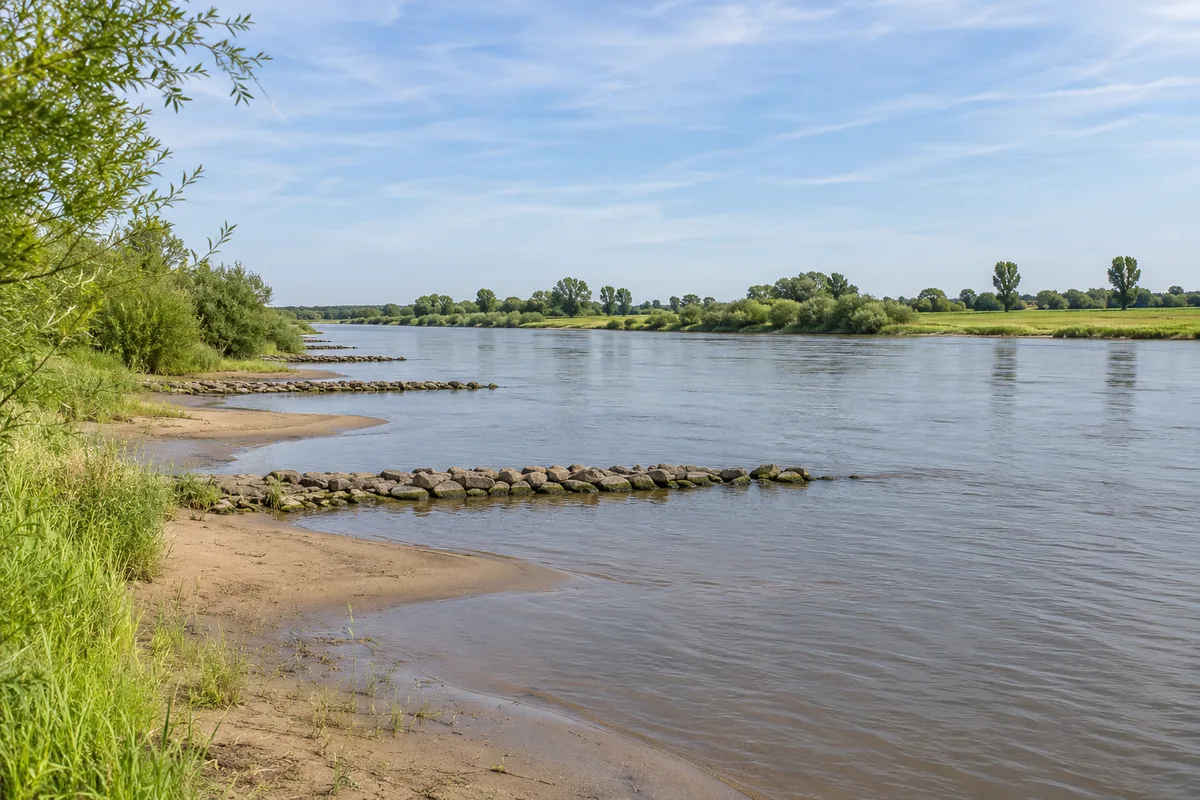
The Wrocław district stocks zander in the Oder at Wrocław, in June 2026 for example at Wrocław, Jelcz-Laskowice and Brzeg Dolny, plus barbel at Wrocław-Kozanów. The Natura 2000 data sheet “Dolna Odra” for the lower reaches lists the asp and the wels catfish (EUA). The sturgeon is protected all year round in Poland. The administration of the Lower Oder Valley National Park asks anglers to report catches of tagged sturgeon.
The closed seasons in the box set the framework. The catch calendar shows when each species bites.
Papers and permit Day permit online, no Polish fishing licence
On the Polish side, as a guest you do not need a Polish fishing licence (karta wędkarska) if you have the permit (zezwolenie) of the fishing-rights holder (Inland Fisheries Act, Article 7). The three districts sell online:
- Wrocław: Day and multi-day permits are also available to non-members, expressly including foreigners (e-permit).
- Zielona Góra: Permits for 1, 3, 7 or 14 days, also for non-members (e-permit).
- Gorzów: In the form you choose “Obcokrajowiec” (foreigner), and the karta wędkarska number is then not required (e-permit).
At the border: The border runs in the river. The German-Polish agreement on border waters expressly does not regulate fishing. On the German bank the Brandenburg Fisheries Act applies: anyone without their own fishing right needs the permission of the German fishing-rights holder. Which other papers Brandenburg requires is covered under Fishing in Brandenburg. Fish with the papers of the bank you are standing on, and ask the issuer how far your permit reaches into the water.
Special rules Two rods, winter closure and trolling
In Poland: at most two rods, 50 m distance from dams and weirs. Below the mouth of the Warta, burbot needs 30 cm and has no closed season. The districts set their own rules:
- Wrocław 2026: Pike, zander, sea trout, salmon and eel together at most two fish per day. At the fish pass in Oława there is a protected zone (obręb ochronny), see permit 2026.
- Zielona Góra 2026: From the mouth of the Strumień (Łomianka) to the mouth of the Neisse, the Oder is closed from 1 November to 31 March.
- Gorzów 2026: Trolling only by day from 16 June to 31 October, and not at all from the road bridge in Kostrzyn to kilometre 618. In the marinas of Górzyca and Kostrzyn fishing is banned all year, and in the harbour channel of Słubice from 15 December to 31 March (rules 2026).
- Lower Oder Valley National Park (German bank): In protection zones Ia and Ib fishing is banned, in the polder waters from 1 March to 30 June, and there also at night. Around beaver lodges you keep 50 m away. The maps are in the leaflet 2026.
As of October 2026. The values in the “At a glance” box come from the Polish regulation of 12 July 2023; the Brandenburg values are in the note. The PZW districts decide their rules anew every year. The regulations and the conditions of your permit apply.
Safety
- Golden algae: After the fish die-off of 2022, the environment ministry reported, for that year, up to 600 million cells of golden algae (Prymnesium parvum) per litre in the Oder and the Gliwice Canal. Since August 2022 the environmental inspectorate GIOŚ has additionally been monitoring the Oder. Where the algae occur, the ministry says you should not fish. After contact with such water you clean and disinfect clothing and tackle (questions and answers).
- Summer 2026: In August the algae appeared in the Gliwice Canal. On 8 September the ministry reported that they had disappeared there and had not been detected in the Oder (announcement).
- Reporting: You report discoloured water, foam or dead fish to the provincial environmental inspectorate or Wody Polskie on 22 470 10 01. You do not collect dead fish yourself.
- Gauges: Water levels and forecasts are shown by the IMGW-PIB in the Hydro-Portal. More under Bank and waders.
Related
- Fishing on rivers, Fishing in Poland, Szczecin Lagoon and Vistula
- For the German bank: Fishing in Brandenburg
- Species on the Oder: zander, wels catfish, asp, barbel
- Closed season and minimum size explained
Sources
- Verordnung über Schutz und Fang der Fische in Binnengewässern (12.07.2023), Binnenfischereigesetz (Stand 21.04.2026) und deutsch-polnisches Abkommen über die Grenzgewässer (1992)
- Brandenburgisches Fischereigesetz, Fischereiordnung (geändert 24.08.2026) und Nationalpark Unteres Odertal: Merkblatt für Angler 2026
- PZW Wrocław: Erlaubnis 2026 und Besatz 2026; PZW Zielona Góra: Gewässer und Regeln 2026; PZW Gorzów: Regeln 2026
- Ministerium für Klima und Umwelt: Oder, Fragen und Antworten und Meldung vom 08.09.2026
- GUS: Statistisches Jahrbuch 2025; Natura 2000: Dolna Odra (PLH320037); IMGW-PIB: Hydro-Portal (abgerufen 04.10.2026)
Guide without guarantee, as of October 2026. On the Polish side the regulation on the protection and catching of fish and the conditions of your permit take precedence, on the German bank Brandenburg fisheries law, each in its current version.