
Waters · Germany
Fishing on the Neckar
The Neckar flows 367 km from the Black Forest to Mannheim, and the lower 203 km are a navigable waterway with 27 barrages. The river is divided into leased stretches. So besides the fishing licence (Fischereischein, colloquially Angelschein) you need a fishing permit (Erlaubnisschein) for your exact section.
- Papers
- Fishing licence and the fishing permit from the lessee of your stretch
As of October 2026
At a glance
- Papers
- Fishing licence and the fishing permit from the lessee of your stretch
| Fish | Minimum size | Closed season | Note |
|---|---|---|---|
| Zander | 45 cm | 1.4.–15.5. | |
| Pike | 50 cm | 15.2.–15.5. | |
| Barbel | 40 cm | 1.5.–15.6. | |
| Common nase | 35 cm | 15.3.–31.5. | |
| Eel | 50 cm | 15.9.–1.3. | Closed season applies in the Rhine system |
| Carp | 35 cm | none | |
| Tench | 25 cm | 15.5.–30.6. | |
| Ide | 25 cm | 1.4.–31.5. | |
| Wels catfish | – | none | Check with the permit issuer first about releasing |
| Perch | – | none |
Landesfischereiverordnung Baden-Württemberg (last amended 10 February 2026); the lessee sets catch limits on the fishing permit. Different state rules may apply on the border section with Hesse. As of October 2026. The regulation and your fishing permit are what count.
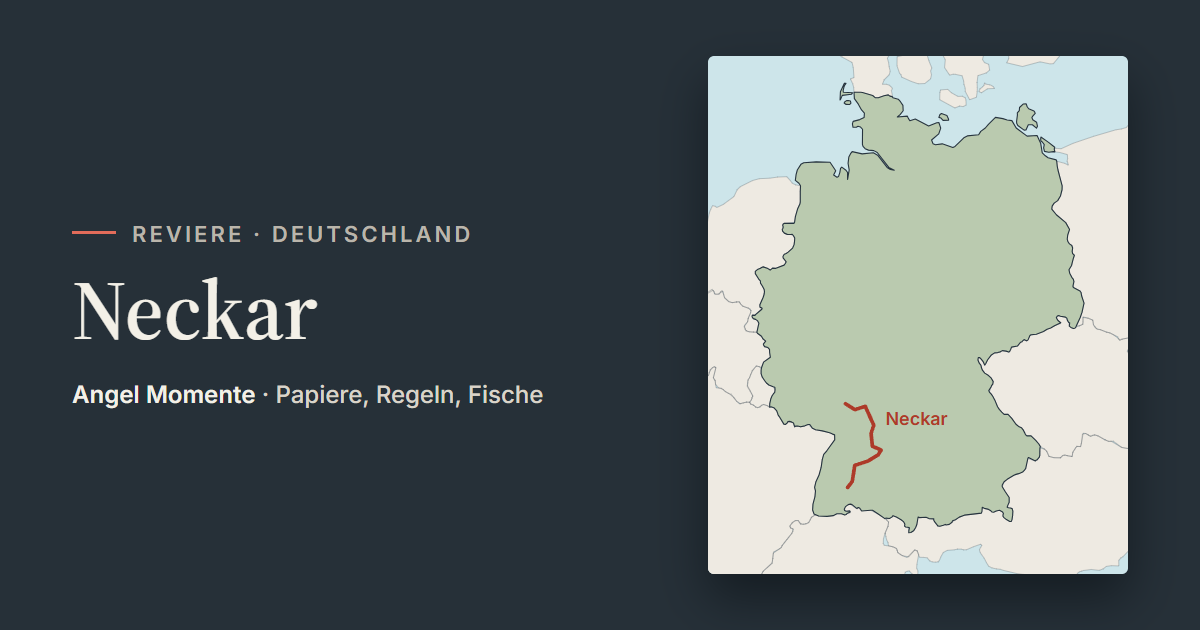
Location and waters Neckar from Schwenningen to Mannheim, federal waterway from Wernau
The Neckar rises near Schwenningen and drains around 14.000 km². It is a federal waterway from Wernau. Development began in 1922, Stuttgart was reached in 1958 and Plochingen ten years later. Between the barrages lie impounded reaches 0,7 to 13,9 km long (WSA Neckar: Bundeswasserstraße Neckar). The Neckar kilometres count upstream from the mouth at the Rhine. Between Neckarsteinach and Hirschhorn, at about km 39 to 47, the river forms the border with Hesse.
The barrages have changed the character of the river. The unimpounded lower Neckar belonged to the barbel zone, which survives in outline only in the weir arms near Ladenburg and Wieblingen. The impoundments are a mixture of barbel and bream zones (Fischereibehörde Karlsruhe: Fischfauna und Fischerei im Unteren Neckar).
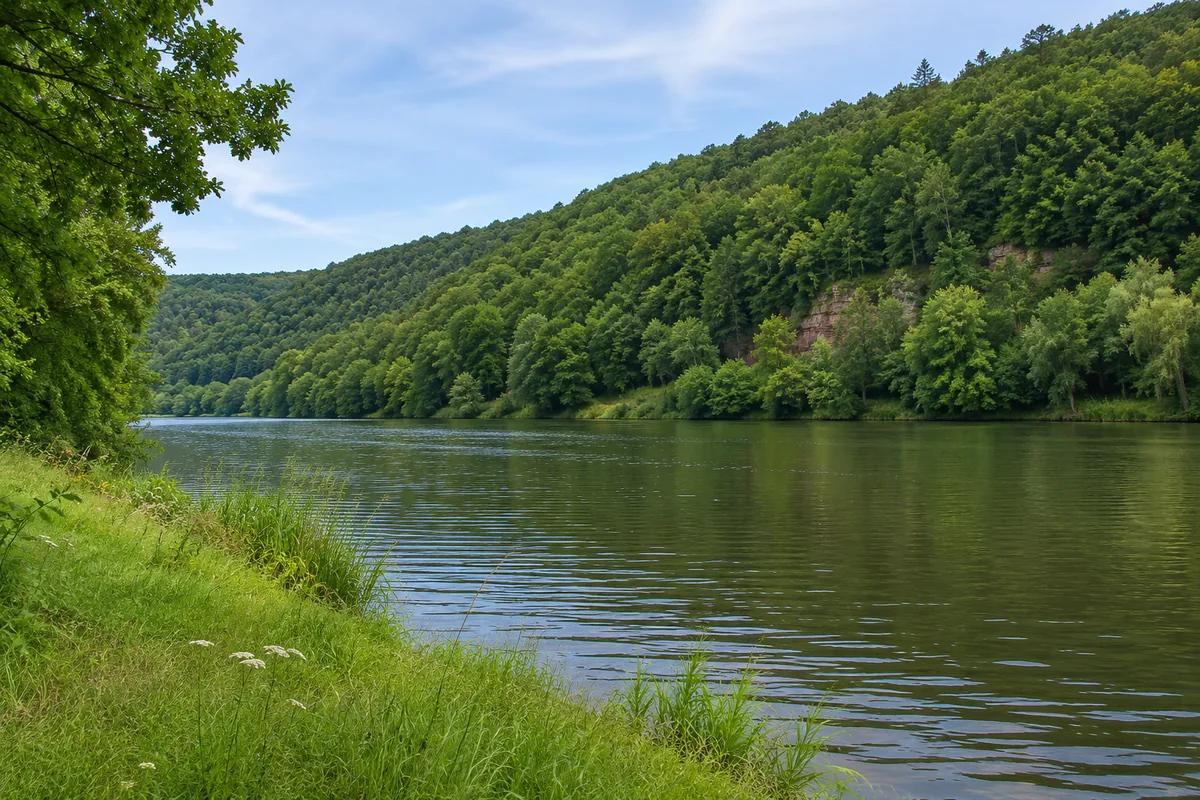
Fish and best time Barbel, common nase, zander, wels catfish, pike and eel
For the Neckar between Mannheim and Heidelberg, survey fishing in 2004 and 2005 recorded these species, among others:
- Predators: zander, pike, wels catfish, asp and perch.
- Current-loving fish: barbel, common nase, chub, dace and ide.
- Others: eel, carp, bream, roach and tench.
- Protected all year: vimba, bitterling, bullhead and lampreys, which were also recorded. If you catch one, release it immediately.
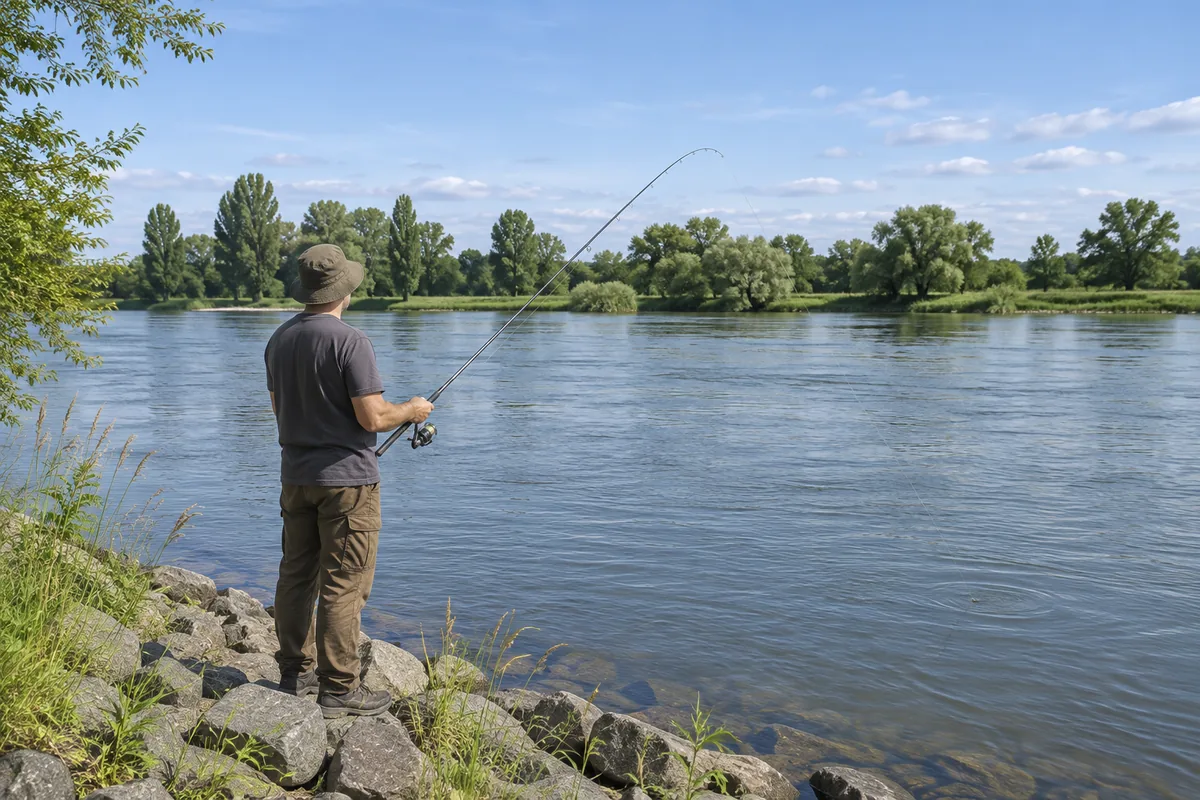
In the net catches, large barbel and common nase were the most frequent alongside perch and chub, while carp turned up mainly in side waters and shallow zones. At the time the study put the fish stock at a quarter to a half of its former level. On the middle Neckar near Ludwigsburg, monitoring from 2011 to 2014 in the river and in the Neckarbiotop Zugwiesen found many of these species, plus bighead, tubenose and round goby. The issuer of the fishing permit can tell you what lives on your stretch. The catch calendar shows when each species bites.
Papers and permit Fishing licence and fishing permit from the management associations
- Fishing licence (Fischereischein): It is issued by the municipality of your main residence, usually for life. It is valid only with the fishing levy (Fischereiabgabe) paid, which is 12 euros per calendar year. Licences from other federal states are also valid here, as long as your main residence is not in Baden-Württemberg (Fischereigesetz, §§ 31 and 35). More under Fishing in Baden-Württemberg.
- Guests: If you stay in Germany for no more than one month, you do not need proof of required knowledge (Sachkundenachweis). If you have no main residence in the state, the municipality where you want to fish is responsible.
- Children and young people: From the age of 7 there is the junior fishing licence (Jugendfischereischein), at the longest until the end of the year in which you turn 16. It is valid only under the supervision of a person aged at least 18 with a fishing licence, and the levy does not apply.
- Fishing permit (Erlaubnisschein): Only with it may you fish. It states the stretch, permitted tackle and boats, quantity limits and any differing minimum sizes (Schonmaße). More under Fishing permit and water map.
On the navigable Neckar the Wasserstraßen- und Schifffahrtsamt does not sell permits itself. It has leased the federally owned fishing rights from km 36,36 to 200,03 to fisheries management associations (Hegegemeinschaften). They or their sales outlets issue day and annual permits, each for one association’s area. The authority’s list with contacts divides it up like this:
- km 0 to 36,36, mouth at the Rhine to Neckargemünd: Pachtgemeinschaft Kurpfalz, no federally owned rights (issuing points for anglers outside a club)
- km 36,36 to 85,8, Neckarsteinach to Neckarzimmern (I to III): Fisch-Hegegemeinschaft Bad. Hess. Neckartal
- km 93 to 113, Haßmersheim to Heilbronn (IV and V): Fischhegegemeinschaft “Mittlerer Neckar”
- km 113 to 137, Heilbronn to Besigheim (VI): Fischhegegemeinschaft Mittleres Neckartal VI
- km 137 to 150, Besigheim to Pleidelsheim (VII): Fischerei-Hegebereich Neckar VII
- km 150 to 165, Pleidelsheim to Poppenweiler (VIII): Hegegemeinschaft Stuttgart-Benningen
- km 165 to 185, Poppenweiler to Stuttgart (IX): Württembergischer Anglerverein. Its online permits for management areas 8 and 9 are available for 2027 from 1 January 2027.
- km 185 to 199, Stuttgart to Deizisau (X): Fischhegegemeinschaft Esslingen, also for guests (Fischereiverein Esslingen: Neckar Abschnitt 10)
The list shows no section between km 85,8 and 93 or above km 199; for those, ask the authority. Above the federal waterway the state, the municipality or the owner of the riverbed may hold the fishing rights and lease them out. Who holds the rights on your stretch is recorded in the register at the Landratsamt or Stadtkreis. One example is the Fischereiverein Horb, which also issues permits to non-members on its roughly 12 km of the Neckar.
Special rules Closed stretches, protected zone, two rods and catch log
- Closed stretches: Permits for the leased federal waterway are not valid in protected and closed areas, not within 100 m above and below fish passes, and not within 50 m above and below locks, weirs and power stations (WSA Neckar: Fischereiberechtigung). Across the state, the state fisheries regulation bans all fishing in fish passes and within a 30 m radius of their entrances and exits.
- Ladenburg protected zone (Schonbezirk): From the weir at km 12, 300 m downstream across the full width are closed to all fishing (regulation of the Regierungspräsidium Karlsruhe of 4 December 2025).
- Tackle: no more than two rods with three hooks each, constantly supervised. The Zocker rig is banned. Keep 50 m from nets and fyke nets. Live baitfish are not permitted insofar as this conflicts with the Animal Welfare Act (Tierschutzgesetz).
- Catch log (Fangbuch): A permit for the federal waterway comes with a catch log, which you return on time. You pay a deposit for it. It also sets out the stretch, minimum sizes, closed seasons and catch limits.
- Non-native species: You must not release non-native fish that have no closed season and no minimum size. On the Neckar this applies, for example, to pumpkinseed, topmouth gudgeon and the gobies that have spread here. For wels catfish and asp, ask the issuer of your fishing permit.
- Bank paths: You must not drive on the bank paths along the waterway. Parking, camping and lighting fires on the bank plots are also banned. Check with the issuer of your fishing permit whether you may fish at night or from a boat. More under Night fishing and weather shelter.
- African swine fever: The Pachtgemeinschaft Kurpfalz reports closed stretches in Mannheim. Watch for prohibition signs.
The values in the box come from the state fisheries regulation (Landesfischereiverordnung). The Regierungspräsidien can extend them for a limited time, and your fishing permit may differ. On the border section with Hesse, ask the management association which state’s rules apply at your spot. More under Fishing in Hesse.
As of October 2026. The Landesfischereiverordnung applies as last amended on 10 February 2026, the Fischereigesetz in the version of 15 October 2024. The fish data from the lower Neckar date from 2004 and 2005, those from Ludwigsburg from 2011 to 2014. Read the provisions on your fishing permit in full before your first cast.
Safety
Cargo ships run on the Neckar. If you are out by boat, expect wash, suction from passing ships and fluctuating water levels when mooring. Boats keep away from the suction at the lock gates (WSA Neckar: Hinweise für Wassersportler, as of 2019). During floods, the locks stop operating. More under Boat and life jacket and Bank and waders.
Related
- Fishing on a river and Fish zones in a river
- Rhine, Fishing in Baden-Württemberg and Angling club
- Barbel, common nase and zander in the fish lexicon
Sources
- Wasserstraßen- und Schifffahrtsamt Neckar: Fischerei und Angeln, Fischereiberechtigung, Hegegemeinschaften, Bundeswasserstraße Neckar und Hinweise für Wassersportler (Stand 2019)
- Land Baden-Württemberg: Fischereigesetz (letzte Änderung 15. Oktober 2024) und Landesfischereiverordnung (letzte Änderung 10. Februar 2026)
- Hartmann und Hüsgen, Fischereibehörde Regierungspräsidium Karlsruhe: Vom Wildfluss zur Wasserstraße, Fischfauna und Fischerei im Unteren Neckar
- Stadt Ludwigsburg und Wasserstraßenverwaltung: Fische im Neckarbiotop Zugwiesen
- Regierungspräsidium Darmstadt: Hochwasserrisikomanagementplan Neckar, Erläuterungsbericht
- Pächter: Pachtgemeinschaft Kurpfalz, Württembergischer Anglerverein, Fischereiverein Esslingen und Fischereiverein Horb
Guide without guarantee, as of October 2026. The Fischereigesetz and the Landesfischereiverordnung Baden-Württemberg, regulations of the fisheries authorities and the provisions on your fishing permit are what count.