
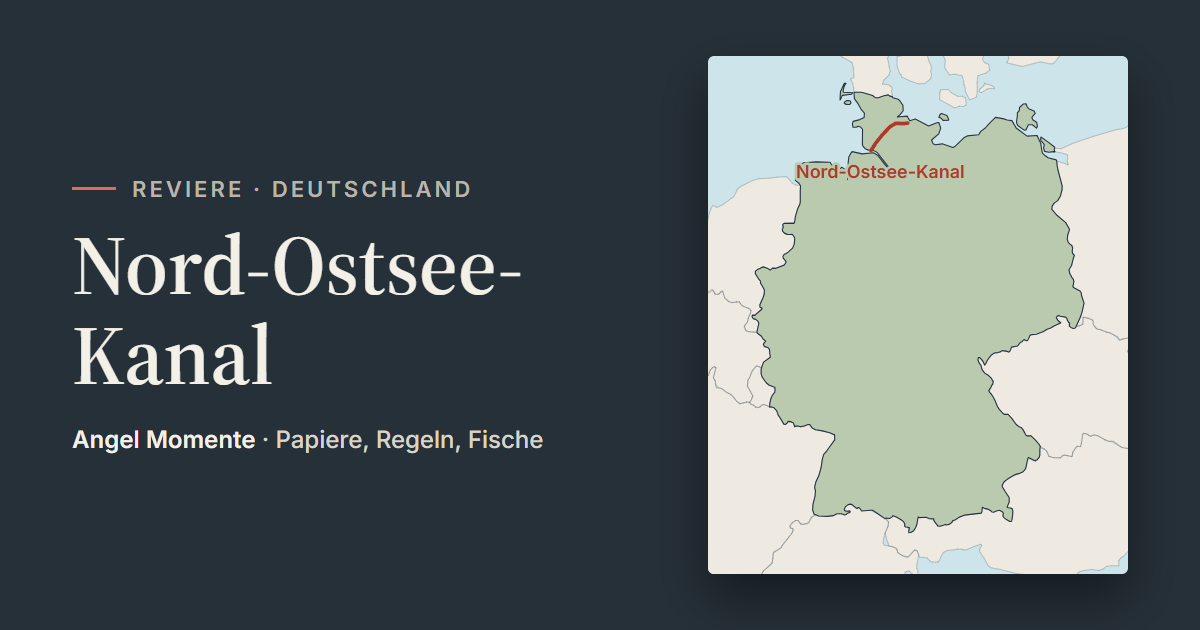
Waters · Germany
Fishing on the Kiel Canal
The Kiel Canal (Nord-Ostsee-Kanal) runs for just under 99 kilometres from Brunsbüttel on the Elbe to Kiel-Holtenau. Large seagoing ships pass close to the bank, and in the water there are zander, eel, bream and, in spring, herring. Along almost the entire length the fishing permit is issued by the Landesangelverband Schleswig-Holstein.
- Papers
- Fishing licence or holiday licence, levy, LAV fishing permit
- Season
- all year, night fishing allowed
As of October 2026
At a glance
- Papers
- Fishing licence or holiday licence, levy, LAV fishing permit
- Licence and permit
- Season
- all year, night fishing allowed
| Fish | Minimum size | Closed season | Catch limit | Note |
|---|---|---|---|---|
| Zander | 45 cm | 1.3.–31.5. | 3 per day | Closed season and limit as per fishing permit; state law 15.3.–15.5. |
| Eel | 50 cm | none | – | |
| Perch | – | none | – | |
| Bream | – | none | – | |
| Roach | – | none | – | |
| Ide | – | none | – | |
| Herring | – | none | – | no more than two hook points |
| Sea trout | 40 cm | 1.10.–28.2. | – | |
| Carp | 35 cm | none | – |
Schleswig-Holstein state law (BiFVO); the LAV fishing permit is stricter for zander. As of October 2026. What counts are the regulation and your fishing permit (Erlaubnisschein).
Location and waters Kiel Canal between Brunsbüttel and Kiel
Since June 1895 the canal has linked the North Sea with the Baltic. It is 98,6 kilometres long, today about 11 metres deep and 162 metres wide at the surface except on the eastern section. With around 27.000 ships a year, no other artificial seaway in the world carries more traffic. At the same time it is the largest artificial drainage channel in the state (WSA Nord-Ostsee-Kanal).
The water changes along the way. In the western part between Kudensee and Breiholz it is so low in salt that the association stocks carp there. Towards Kiel, on the other hand, saltwater species appear. How to fish a canal is explained under Fishing on the canal.
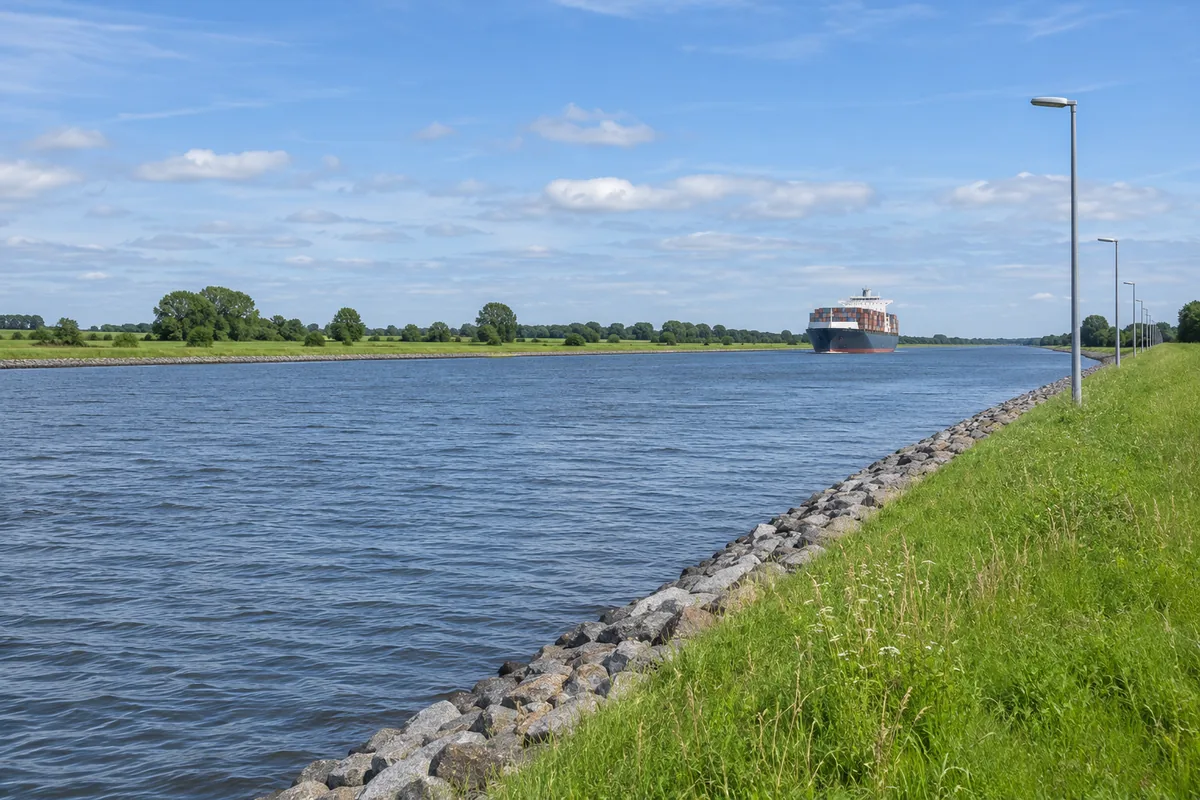
Fish and best time Zander, eel, herring and brackish-water perch
Zander and eel are the canal’s best-known fish, and zander is now the most popular. Anglers reported more than 10,5 tonnes to the association for one year, and that is only the catch reports that were handed in. It finds good food in the round goby, which has lived in the canal since the mid-2000s. If you are after coarse fish, you will find well-grown bream, roach and ide. Often overlooked are the big perch from the brackish water (LAV, Gewässerseite; LAV, Zander im Kanal).
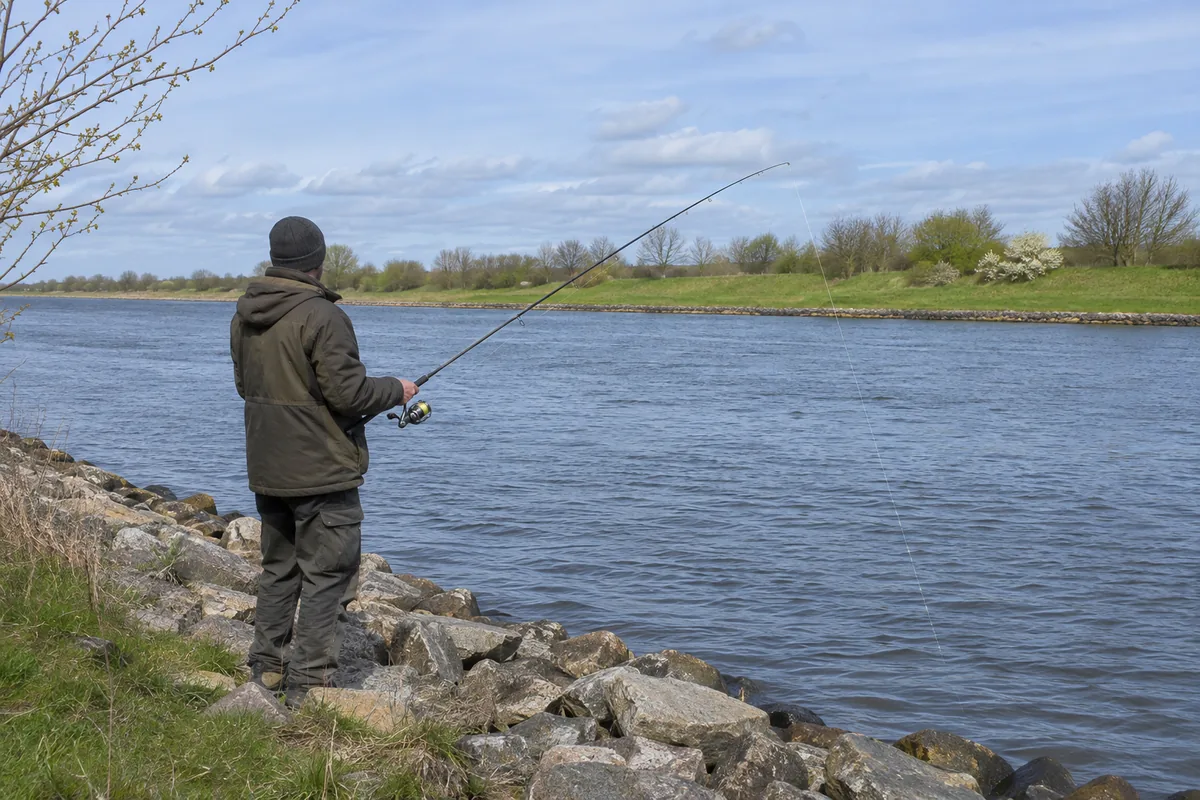
Further east, Baltic fish join them: flounder in large numbers, plus cod, whiting and sea trout. Under fisheries law the canal counts as inland water. The EU ban on cod definitely applies only beyond the Holtenau lock, in the Kiel Fjord (Kieler Förde). No authority says clearly whether it also applies in the canal, so it is better to release any cod you catch. In the fjord you may not keep any cod in 2026 and only one marked salmon a day, recognisable by its missing adipose fin. In spring and autumn shoals of herring move into the canal. March and April used to be the herring months; in 2026 the run came from the second week of March, and commercial fishermen now catch them as early as January (LAV, Hering 2026). The course of the year for all species is shown in the catch calendar.
Papers and permit Fishing licence, fishing levy and LAV fishing permit
Under fisheries law the canal counts as an inland water, so you need a fishing permit (Erlaubnisschein) in addition to the fishing licence (Fischereischein). In Schleswig-Holstein the licence requirement applies on every water, and licences from other federal states are fully recognised. If you have not taken the exam, you can get a holiday fishing licence (Urlauberfischereischein) for 28 days, which can be extended once a year by a further 28 days. Everyone pays the fishing levy (Fischereiabgabe) except children under 12, even with a licence from another federal state. Children under 14 need no licence but must be supervised by an adult with a regular fishing licence. A holiday licence is not enough for this. Since October 2025 applications and proof have been handled digitally only (Land Schleswig-Holstein, Hinweise für Angler).
The Landesangelverband Schleswig-Holstein (LAV) holds the fishing rights along almost the entire length. The few short sections not included are listed on the fishing permit. The association sells the permit online via Hejfish, and you may carry it on your phone. From the age of 16 you also need an official photo ID (LAV, Erlaubnisscheine; LAV, Nachweispflichten).
Special rules Zander closed season, herring rig, keepnets and boats
The association’s conditions go beyond state law. On the canal, zander are protected from 1 March to 31 May, whereas the state regulation only provides for 15 March to 15 May. You may keep no more than three zander a day. When fishing for herring, no more than two hook points are allowed on the canal. Every herring is stunned and then has its throat cut or is bled. Fishing is allowed all year, including at night, and you report your catches to the association. You may not drive on the side tracks along the canal; the car stays in a car park.
Banned throughout the state are live baitfish and any fishing where returning the fish is planned from the outset. The state regulation does not allow a keepnet where ships cause strong drawdown and surge, and that is the case with the seagoing ships on the canal (state information sheet). Pleasure craft may only pass through the canal, only by day and not in poor visibility. Sailing is banned, as is stand-up paddling. According to a notice from the waterways administration, fishing on the canal’s water surface is only permitted with special permission from the waterways offices. So if you plan more than fishing from the bank with a fishing permit, clear it with the WSA beforehand.
Safety
Suction and waves from seagoing ships wash out the embankments under water, and parts of the bank can slip. Between canal kilometres 5 and 75 the WSA is therefore repairing the banks. Several service roads are closed; the WSA keeps an overview (WSA, Uferböschungen; WSA, gesperrte Betriebswege). Keep away from the edge when a large ship passes, and observe barriers. More under Bank and waders.
Related
- Fishing in Schleswig-Holstein: all the papers in the state
- Baltic Sea in Schleswig-Holstein and Elbe: the waters at both ends of the canal
- In the fish lexicon: zander, eel, herring and flounder
- Bottom fishing and Night fishing
- Closed season and minimum size explained
Sources
- WSA Nord-Ostsee-Kanal: Der Nord-Ostsee-Kanal, Sportschifffahrt, Instandsetzung der Uferböschungen
- Seeschifffahrtsstraßen-Ordnung: § 51 und § 38; Bekanntmachung zu § 38 SeeSchStrO, Nr. 22.3 (Bundesanzeiger 2014), Wortlaut unverändert auf ELWIS
- Land Schleswig-Holstein: Hinweise für Angler, Merkblatt zum Urlauberfischereischein, Binnenfischereiverordnung, Anlage 1, Fragen zum Fischereischein
- EU: Verordnung (EU) 2025/2454, Fangmöglichkeiten in der Ostsee für 2026
- LAV: Kiel Canal, Erlaubnisscheine, Der Hering ist da
As of October 2026. The closed season, catch limit and rig rules come from the conditions of the fishing permit and may change every year. The work on the banks is expected to last until 2027.
Guide without guarantee, as of October 2026. What counts are the state fisheries act (Landesfischereigesetz) and the inland fisheries regulation (Binnenfischereiverordnung) of Schleswig-Holstein, the Seeschifffahrtsstraßen-Ordnung and the conditions on the fishing permit of the Landesangelverband.