
Knowledge · Tackle
Shock leader: Breaking strain, length and knot
A shock leader is a length of much stronger line in front of the thin main line. When you cast heavy leads, it absorbs the force that would otherwise snap the main line, and it stands up better to stones and mussels. Here you will find guide values for breaking strain and length, the materials, and how the knot travels through the rod rings.
What the shock leader is for
The question catalogue for the angling exam (Fischerprüfung) in Saxony-Anhalt describes the shock leader as a stronger line attached to the front end of the main line. Its first job is the cast. According to Sea Angler, a main line with a 15 lb (about 6,8 kg) breaking strain would snap during the swing back. Even so, the thin main line is worth it: it offers less surface to the wind and, according to Blinker, causes less friction in the rings. The shock leader combines both: thin line on the spool, strong line where the load sits during the cast.
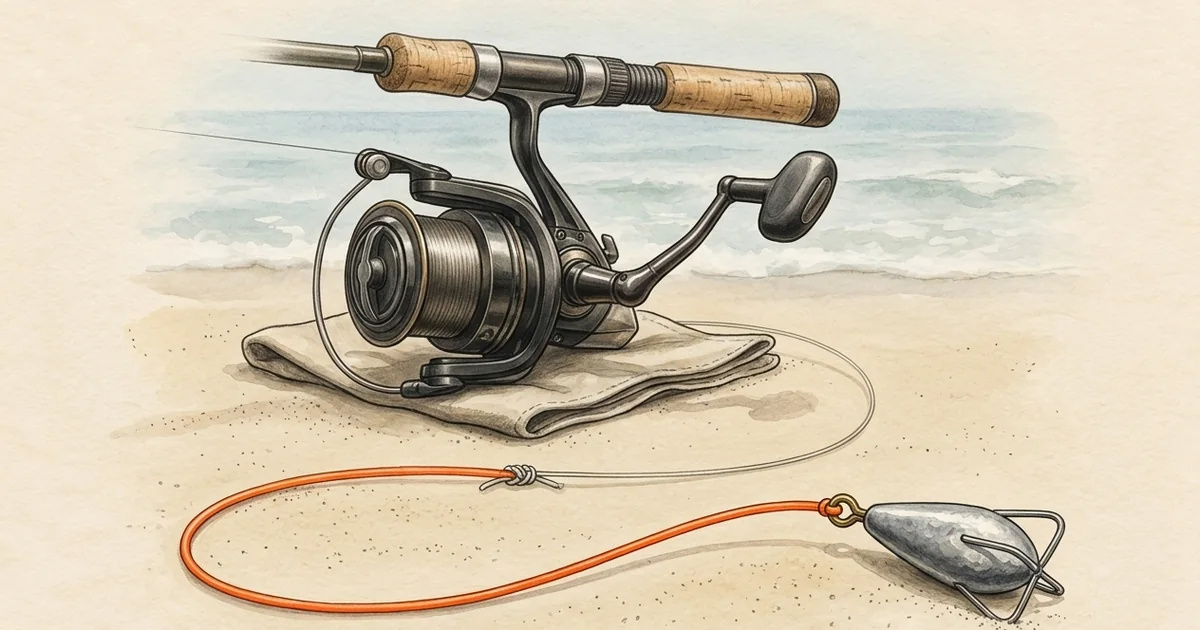
The second job is protection against abrasion. According to Blinker, thin braid is quickly cut on sharp mussel shells and stones, while mono copes with such contact much better. When heavy feeder fishing with braid, a shock leader is therefore almost a must.
Blinker calls the shock leader an extra-long hooklength. Still, the order on the line is clear: main line, shock leader, and only then the actual hooklength or the surf rig. When pirking from a boat, you hardly cast far; according to Blinker, there is often just a leader of about 100 cm of soft mono (0,40 or 0,45 mm) in front of the braid. It chafes through more slowly over rough ground and cushions the head-shakes of a cod. On rocky shores with mussels, barnacles and wrack, Blinker recommends a 3 to 5 m length of mono or fluorocarbon of 0,50 or 0,60 mm. With that you can even lift a fish out of the water. As a buffer during the fight, Rute & Rolle names two to three rod lengths of mono, see Braided line.
Breaking strain by lead weight
Sea Angler quotes a British rule of thumb: 10 lb of breaking strain per ounce of lead. A 5 oz lead (about 142 g) therefore needs 50 lb (about 22,7 kg), and a 6 oz lead (about 170 g) 60 lb (about 27,2 kg). For a powerful pendulum cast, in which the lead swings in a wide arc, the magazine adds 10 lb in reserve. For gentler overhead casts, it names shock leaders from 40 lb (about 18,1 kg). The 60 lb at 0,70 mm given on the Surf rod page are in the same range.
| Use | Shock leader | Source |
|---|---|---|
| Surf, lead around 150 g | at least 50 lb (about 22,7 kg) | Sea Angler |
| Surf, lead around 170 g | at least 60 lb (about 27,2 kg) | Sea Angler |
| Sea, mono | up to 0,70 mm | Spoon |
| Surf, braid | 0,25 to 0,30 mm | Rute & Rolle |
| Heavy feeder fishing | no more than 0,35 mm | Spoon |
| Feeder fishing in current | 0,28 to 0,32 mm mono | Fisch & Fang |
Worked example: your lead weighs 150 g, which is about 5,3 oz. According to the formula, the shock leader needs about 53 lb, or roughly 24 kg. For a powerful pendulum cast, add 10 lb, giving about 63 lb or 28,6 kg in total. The unit converter does the conversion, and the line calculator shows how much breaking strain is left after the knot.
Length: turns, rod and drop
During the cast, the shock leader must reach from the spool through all the rings to the hooklength. The last section is the drop, on which the lead hangs below the tip before the cast. The guide values differ:
- Rod length plus five or six turns on the reel, so that no load falls on the thin main line during the cast (Blinker).
- Rod length plus two to three metres when feeder fishing with heavy feeders in current; a few turns should stay on the reel (Fisch & Fang).
- About two rod lengths for surf fishing for cod (Sea Angler).
- Three rod lengths, which is about 11 m with 12 ft (3,66 m). That way, according to Angling Times, a few turns are still on the spool when the fish is under the rod tip.
Tapered shock leaders are longer. Blinker names ready-made buffer lines of about 10 m and a tapered leader of about 15 m: the thick mono passes through the rings first and takes the greatest pressure off them before the braid follows. If the reel moves to the lower end of the handle, the shock leader, according to Sea Angler, gets a few feet longer for the same drop.
Mono, tapered line or braid
Mono is the standard choice. Its stretch cushions casting mistakes. That is why a British specialist magazine considers non-stretch material a poor and sometimes risky choice for shock leaders with heavy sea leads. More under Monofilament line.
Tapered line (in German Keulenschnur) gets thicker towards the front, without any knot in between. Blinker describes a tapered line from 0,58 to 0,33 mm that changes colour every 25 m, so you can find the spot with the bites again. It costs more. A shorter tapered leader from 0,65 to 0,28 mm is knotted to the braid instead. Because its thin end measures only 0,28 mm, the knot to the braid stays small and, according to Blinker, hardly catches any weed.
Braid as a shock leader is recommended by Rute & Rolle for more distance: 0,25 to 0,30 mm withstands the cast, slides through the rings more easily than mono of 0,60 or 0,70 mm, and the knot is smaller. Without stretch, the rod loads better. In return, the magazine calls for a casting glove or finger guard. Here the sources contradict each other: Rute & Rolle sees the lack of stretch as an advantage, the British specialist magazine as a risk.
Knots and rings
The connecting knot has to pass through all the rings during the cast. Blinker wants it as small as possible, with the tag ends trimmed short. Options include:
- Wrapped knot around an overhand knot: the thin line is wrapped several times around the thick line behind a small knot tied in it. Blinker uses a figure-of-eight knot and a half blood knot. Sea Angler names this type for beginners, but not for snaggy ground. Instructions: Shock leader knot.
- Cross-wrap: Blinker considers the FG knot the slimmest and strongest connection.
- Doubled shock leader: Angling Times prefers the Albright knot because it stays small.
- Ends of equal thickness: for tapered shock leaders, Sea Angler names the blood knot.
If a connecting knot has to pass through, larger rings have the advantage, according to Blinker. For feeder fishing, Angling Times warns against casting braid with a shock leader through a quiver tip with small rings, because the line may then snap during the cast. If the reel sits low on the surf rod, Sea Angler recommends an additional butt ring of 30 to 40 mm diameter, because otherwise the knot can catch on the original first ring. On the fixed-spool reel, according to Sea Angler, the knot should lie at the top of the spool before the cast, so that it does not drag loops of line with it.
Safety when casting
According to Sea Angler, a crack-off in mid-cast is dangerous and potentially fatal. The magazine considers it irresponsible to cast from a beach or a pier without a shock leader. It is necessary there with leads of more than 3 to 4 oz (about 85 to 113 g) on main lines under 30 lb (about 13,6 kg). Even with a shock leader, a cast can go wrong, for example through damaged line, a slipping thumb or a slip.
- Keep the casting area clear: Blinker warns about walkers on the beach; a fast-flying 180 g lead could be fatal. Only cast when nobody is behind you, beside you or in the direction of the cast.
- Drag closed: Rute & Rolle advises closing the drag fully for the cast. If it gives line, the risk of injury increases.
- Protect your finger: during the cast, the line presses hard on your index finger. Blinker recommends a finger stall or glove; in cold and wet conditions the shock leader cuts in particularly quickly. Designs are shown under Fishing gloves.
- Check the line: Sea Angler counts damaged line among the causes of failed casts. So check the shock leader after every snag and every contact with stones before you cast at full power again.
Common mistakes
- Too short: according to Blinker, the knot can then pull a few turns of braid off with it during the cast. The result is a bird’s nest, a tangle of line that has run off uncontrolled.
- Too weak for the lead: work it out with the formula from the section on breaking strain and add a little for pendulum casts.
- Bulky knot with long tag ends: it slows the cast and catches on small rings. If there is weed in the water, a large knot also collects plant material that causes trouble at the tip ring.
- Braid as a shock leader without finger protection: the thin line cuts into your finger when you cast at full power.
Frequently asked questions
How strong does the shock leader need to be for a 150 g lead?
Sea Angler names at least 50 lb, about 22,7 kg. The rule of thumb of 10 lb per ounce gives about 53 lb. For powerful pendulum casts, the magazine adds another 10 lb.
Do I need a shock leader for spinning?
Usually not as protection for the cast, because Sea Angler only considers it necessary with leads above 3 to 4 oz. Against abrasion, however, a length of mono or fluorocarbon in front of the braid is worth it, because according to Blinker a mono leader copes better with rocks and mussels. For rocky coasts, the magazine names 3 to 5 m for this.
Is a tapered line better than a shock leader with a knot?
It saves the bulky knot, because it tapers without a join. According to Blinker, it has become the choice of many surf anglers, but it costs more. A short tapered leader in front of the braid is the middle way: the knot at the thin end stays small.
Related
- Shock leader knot: joining thin and thick line step by step
- Surf rod: length, casting weight and reel for the beach
- Surf rig: the hooklength at the end of the shock leader
- Surf fishing: reading the beach and how the session runs
- Fishing lines compared: mono, braid and fluorocarbon
- Feeder rod: quiver tips and casting a heavy feeder
- Line calculator: strength after the knot and spool filling
Sources
- Blinker: Ein paar Meter Sicherheit, was ist eigentlich eine Schlagschnur? (Zweck, Abrieb, Stärke, Länge, Knoten)
- Blinker: Brandungsangeln, alles, was man über diese Angelmethode wissen muss (Keulenschnur, verjüngte Schlagschnur, Perücke, Fingerschutz, fliegendes Blei)
- Blinker: Pilker richtig montieren und präsentieren (Vorfach beim Pilken), Norwegen mit Gummifisch (Felskante), Karpfen: Welche Rute für welchen Zweck? (große Ringe) und Futterkorb auf Distanz (Fingerschutz)
- Sea Angler: Learning About Leaders, Knots, Breaking Strains (Faustformel, Gefahr, Knoten), How to Tie the Shockleader Knot (50 lb bei 150 g, 60 lb bei 170 g), Beginner’s Guide to Cod Fishing (zwei Rutenlängen) und Beitrag zur Rollenposition (Dehnung, Startring)
- Rute & Rolle: Brandungsangeln, 10 Tipps für mehr Meter (Geflecht, Wurfhandschuh, Bremse) und Die richtige Schnur (Puffer im Drill)
- Angling Times: How to tie a shockleader for fishing (Länge, Knoten) und How to choose the right quivertip (Abriss bei kleinen Ringen)
- Fisch & Fang: 10 Tipps zum Heavy-Feedern im Strom (Stärke und Länge beim Feedern)
- Land Sachsen-Anhalt: Fragenkatalog zur Fischerprüfung (PDF, Stand 28.04.2022) (Begriff Schlagschnur, Perücke)
Text AI-assisted, drawing AI-generated. Sources opened and checked in November 2026; no graphics taken from the sources.
All figures are guide values without guarantee. Which shock leader suits you depends on lead weight, casting style, rod and bottom; the safety notes do not replace medical advice.