
Knowledge · Tackle
Perch baits: Which lure when for perch
Which perch lure is catching at any moment depends mainly on season, water depth and water. This overview sorts small soft baits, spinners, crankbaits and natural baits accordingly and points to the pages on lures and rigs.
The lure groups and their sizes
Four groups come into question for perch: soft baits, spinners, small crankbaits and natural baits. According to a brochure by the Deutscher Angelfischerverband (DAFV) on the Fish of the Year 2023, even perch of ten centimetres chase artificial lures as long as themselves or longer.
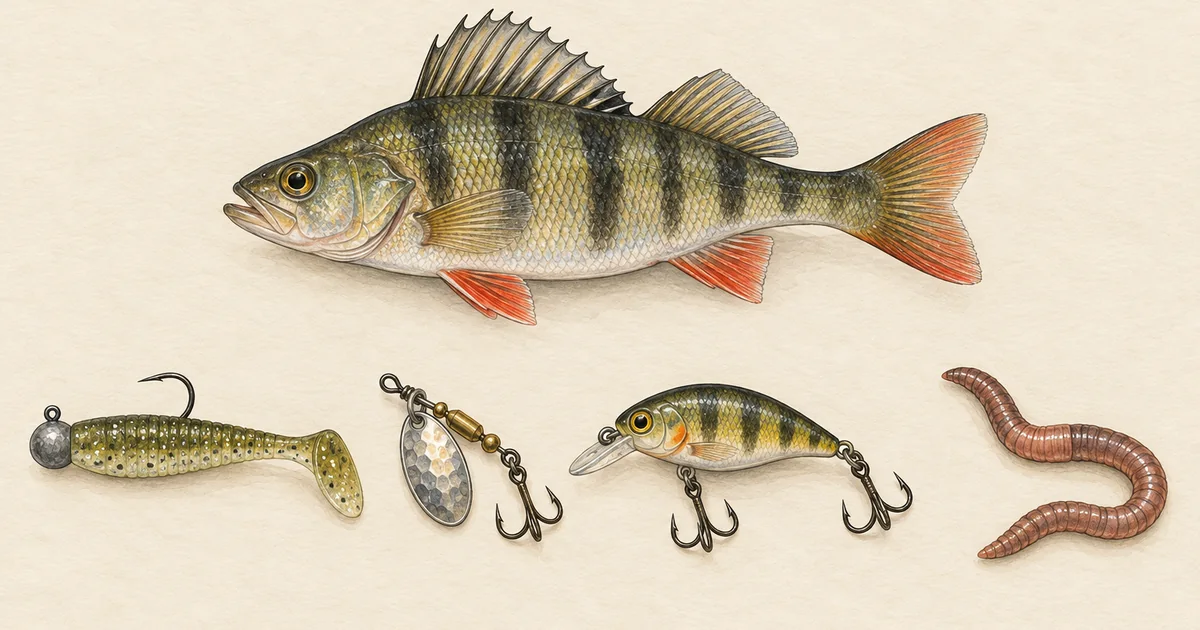
The brochure summarises studies. Perch swallow their prey whole, so small morsels fit almost any mouth and bring more bites. Larger lures catch larger perch on average, but bites become rarer. In one comparison, soft plastics (shads) of 8,5 cm tended to catch more and larger perch than a size 3 spinner.
| Lure group | Size (rough guide) | Water layer | |
|---|---|---|---|
| Soft plastic (shad), twister, pintail | summer 3–7 cm, winter 8–12 cm | Bottom to mid-water | Soft baits |
| Spinner | size 0 to 2 | top to mid-water | Spinner |
| Small crankbait | 3–5 cm | top, deep-diving crankbaits lower | Hard baits |
| Natural baits | Lobworm, small dead fish | Bottom to mid-water | Worms |
The trade press gives the sizes: Blinker suggests soft plastics of 3 to 7 cm in summer and 9 to 12 cm in winter, Fisch & Fang 8 to 10 cm in winter. For spinners, size 0 to 2 applies; for small crankbaits 3 to 5 cm and a running depth of up to about 1,5 m. An article in Rute & Rolle picks a soft plastic of about 6 cm on a 10 g head as an all-rounder.
Perch baits by season
Spring
According to the DAFV, perch spawn between March and June. The association points out that many waters have a predator-fish closed season (Raubfischschonzeit) in which artificial lures and baitfish are often banned. What applies at your water is set out in the fisheries regulation of your federal state (Bundesland) and on the fishing permit (Erlaubnisschein), more under Closed season and minimum size explained. A study in the brochure counts clearly more fishing days without a perch in spring than in summer, probably because perch move less in colder water and digest more slowly. In the cold season, lobworms and earthworms usually do better than artificial lures.
Late spring and summer
From late spring into autumn, small crankbaits are among the strongest perch lures, worked with short twitches of the wrist rather than reeled in steadily. Small soft plastics are fished in summer on jig heads of 2 to 7 g, and small models are also in demand among spinners and spoons. The twister also catches well in summer when you work it in jerks rather than steadily.
Autumn
Until the end of September dense shoals often stand along the bank, under jetties, at fallen trees and water lilies. When it gets colder they break up and move deeper. Then crankbaits help, plump plugs whose diving lip sets the running depth. The colder the water, the deeper they should run. Once you have found the shoal, you offer a lobworm or a small soft-plastic fish on the drop-shot rig.
Winter
In winter the lures get bigger and slower. One Blinker article fishes larger soft plastics on a lead head close to the bottom. If the bites stay away, slim tails such as the V-tail or pintail, which move more calmly, help, or on clear, bright days the drop-shot rig. Of the hard lures, those without a diving lip work better now, such as vibration lures or small spoons, which you pull slowly along the bottom. Fisch & Fang doubts that perch always stand deep in winter: the big ones often stayed shallower than the small ones, in the Rhine delta for instance between one and three metres.
Top, mid-water, bottom
Top: When perch drive small fish to the surface, you cast straight into the middle of it, for example a shallow-running crankbait worked with twitches. In summer perch roam through deeper areas by day and hunt in the shallows in the evening.
Mid-water: This is where the soft plastic on the jig head works. According to Rute & Rolle, its running depth depends on line strength, head weight and speed; weights are listed under Jig heads. You find the depth of the fish like this: let the lure sink to the bottom, reel in slowly, and the first bite gives it away.
Bottom: On the drop-shot rig the lure holds in place above the weight. In an experiment described in the DAFV brochure, two soft plastics hung one above the other on the drop-shot rig, and the lower one caught significantly more perch.
Do not fish too deep: Perch are sensitive to pressure changes when played. An article in the DAFV brochure therefore advises not searching deeper than ten metres in winter, because they hardly survive being played up from greater depth. More under Perch rod and Releasing a fish.
Lake, river and harbour
In a lake you look for perch on drop-offs and underwater hills. If an island sticks out of the water, it is the top of such a hill. One described approach is to switch: first search the area with a small crankbait until perch follow, then fish the spot thoroughly with a soft plastic on a drop-shot or Carolina rig.
In a river you find perch at sheet piling, under jetties and in harbours. Fisch & Fang describes harbours and gravel pits connected to the river as a gathering place for big perch from October, because the prey fish move there. Under jetties and boats, small balance jigs work well, horizontally hanging metal fish that dance on the spot with short up-and-down movements.
Rigs for perch lures
Build and presentation have pages of their own:
- Jig head rig: soft plastic and weight in one piece, for jigging and lift-and-drop.
- Drop-shot rig: the lure twitches on the spot above the weight, for cautious fish.
- Texas rig and Carolina rig: a rubber worm or crayfish slowly over the bottom, the Texas rig also in weed.
- Float rig: lobworm or dead baitfish at the right depth.
Natural baits: worm and dead baitfish
The lobworm under a float is the classic natural bait for perch. Do not let it hang rigid: the weight sits some distance from the hook, and an occasional twitch of the line moves the worm. If the perch are moving about, you offer it in mid-water; if they are sluggish, just above the bottom. On the drop-shot rig you shorten the worm by half after missed bites.
Perch suck in their food greedily. According to the DAFV, the hook therefore often sits deep in the mouth with worms and other natural baits. Strike promptly with natural bait and keep a disgorger ready; the procedure is shown in Landing a fish and unhooking it.
A freshly caught and killed small perch is named as the dead baitfish, on a float or on the drop-shot rig. Many federal states (Bundesländer) expressly ban live baitfish, for example Bavaria, Hesse and North Rhine-Westphalia; in Brandenburg the fisheries authority (Fischereibehörde) can allow an exception in an individual case. In Brandenburg the ban, including the exception, is in § 6 Abs. 1 of the fisheries order (Fischereiordnung). There, baitfish may also only be used in the water or water system where they were caught, except for deep-frozen and chemically preserved ones. What applies in your state to catching, origin, closed season and minimum size of baitfish is regulated by your federal state and set out in the state fisheries regulation (Landesfischereiverordnung) and on the fishing permit. How a fish is stunned and killed is explained in Stunning and killing a fish.
Common mistakes
- Changing the colour first. In the drop-shot experiment from the DAFV brochure, fluorescent soft plastics did not catch more than ordinary ones. Change depth, speed and size first.
- Reeling fast in winter. Fast-worked crankbaits hardly catch in the cold season; lures worked slowly over the bottom bring more.
- Aiming at big perch with mini lures. If you only catch small perch, use a bigger lure and change spot, more under Perch.
- Waiting long with natural bait. The perch swallows the bait, and the hook then sits deep.
- No bite-proof leader in pike water. Where pike occur, some anglers use thin, flexible wire even for perch, because pike hunt alongside at shoals of prey fish. More under Pike leader.
Frequently asked questions
Artificial lure or worm?
In a study quoted by the DAFV, artificial lures caught more perch than natural baits. Lure anglers are more mobile, though, and more likely to find feeding shoals, which skews the comparison. In the cold season, worms are often the better choice.
Is a perch-pattern lure worth it?
Perch also eat small members of their own species. Small crankbaits and soft plastics with perch stripes are therefore a good idea. On colour in general, the drop-shot experiment from the DAFV brochure shows that bright colours brought no advantage.
May I use a live baitfish?
As a rule, no. Many federal states (Bundesländer) expressly ban live baitfish, for example Bavaria, Hesse and North Rhine-Westphalia; in Brandenburg the fisheries authority (Fischereibehörde) can allow an exception in an individual case. State law and the water regulations decide what applies to dead baitfish, see Fishing permit and water map.
Related
- Perch: features, lies and spawning time
- Perch rod: rod, line and leader for light lures
- Jig heads: head weight by depth and current, hook size
- Soft baits: all soft plastics at a glance
- Spinner: build, blade sizes and presentation
- Worms: baiting lobworm and redworm and keeping them fresh
- Zander lures: the same overview for zander
- Line calculator: how much breaking strength is left after the knot
Sources
- Deutscher Angelfischerverband: Der Flussbarsch, Fisch des Jahres 2023 (Broschüre, PDF) (Laichzeit, Ködergröße, Dropshot-Versuch, Jahreszeit, Raubfischschonzeit, Haken, zehn Meter)
- Blinker: Barschangeln: 10 Tipps für Deinen Erfolg (Wobbler, Würmer, Twister, Balance-Jigs, raubende Barsche, Posentiefe)
- Blinker: Barschangeln im Sommer (Gummis und Köpfe, Wobbler, Spinner, Tag und Abend, Insel, Tiefe suchen) und Blinker: Barschangeln im Herbst (Schwärme, Crankbaits, Dropshot mit Wurm)
- Blinker: Barschangeln im Winter (Ködergröße, schlanke Schwänze, Dropshot, Hartköder, Stahlvorfach)
- Blinker: Spinnfischen mit dem Spinner (Spinnergröße 0 bis 2) und Blinker: Steckbrief Barsch (Pose, Köderfisch, Stege, Balance-Jigs)
- Fisch & Fang: Fünf Winter-Barsch-Mythen (Ködergröße im Winter, Tiefe, Häfen am Fluss)
- Rute & Rolle: Barsch-Special, Teil 2: Gummi und Blech (6-cm-Gummi, Lauftiefe)
- Land Brandenburg: Fischereiordnung (BbgFischO), § 6 (lebende Köderfische, Herkunft; zuletzt geändert am 24. August 2026)
Text AI-assisted, drawing AI-generated. Sources opened and checked in October 2026; no graphics taken from the sources.
All figures are guide values without guarantee. Which lure catches depends on the water, the season and the perch’s mood on the day; state law and the fishing permit decide which lures are allowed.