
Knowledge · Tackle
Spod rod and spod: Accurate feeding at distance
A spod is a container for feed that a powerful spod rod casts out to distance. It takes hemp, maize, maggots or groundbait to spots that a catapult and throwing stick can no longer reach. It only becomes accurate with a line clip, counted wraps and a cast that runs the same way every time.
When a spod is worth it
Spodding comes from the English word “spod” for the feed rocket. Rute & Rolle names the main reason: if you have no boat and no bait boat, or are not allowed to use either on the water, there is no other way to get many types of feed out to distance. The throwing stick can still manage large boilies, but its range drops noticeably with small balls. According to the same magazine, the catapult carries particles such as hemp or maize 15 to 20 m, or 30 m with a tailwind.
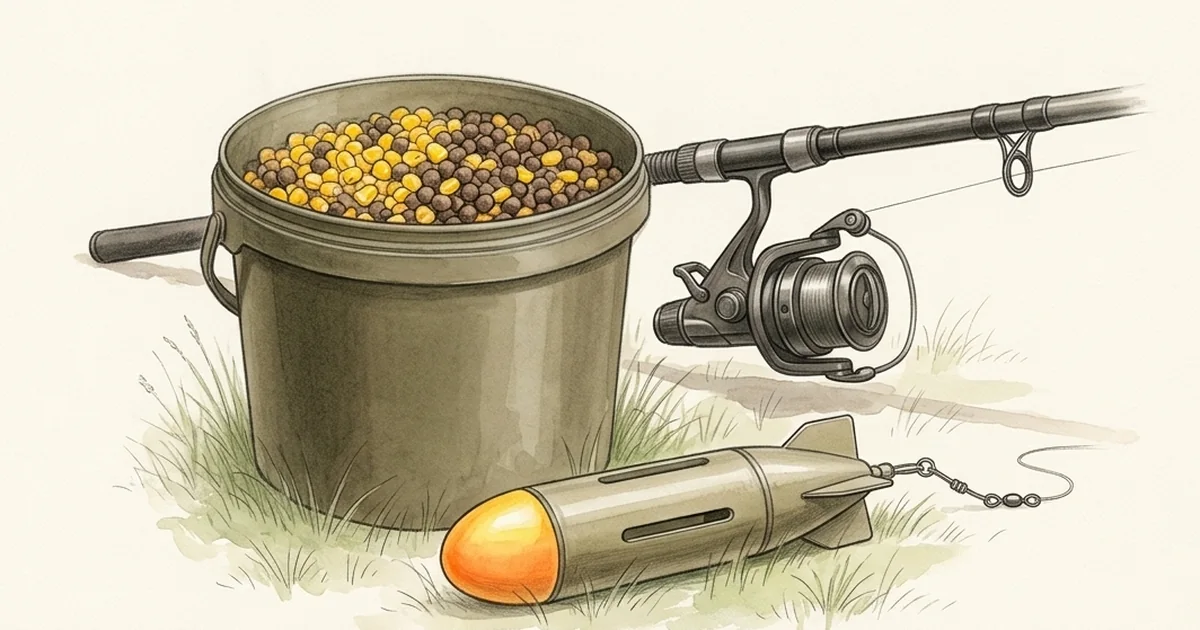
The magazines differ on how far the spod flies: Rute & Rolle gives well over 100 m, Blinker up to about 80 m depending on the caster’s skill.
The baited area turns out small. Where the spod lands, there is a small, dense patch on the bottom, according to Rute & Rolle, and the shallower the water, the less it spreads. Angling Times reports a diver’s observations: at a depth of about 3 m, boilies lie together within 30 to 45 cm, while maize flutters down and spreads over 60 to 90 cm. For a wider spread, the source recommends the catapult or less feed per cast.
| If you … | then take … | because … |
|---|---|---|
| want to feed right at your own bank | Baiting spoon on a landing-net handle | it places the feed quietly but only reaches a short way |
| want to put particles out at short range | Catapult | it is quick to load but only carries particles 15 to 20 m |
| want to get hard boilies a long way out | Throwing stick | it works without a rod but only carries boilies within a narrow size range |
| need particles, maggots or groundbait at long range | Closed spod | it carries almost any feed without losing any |
| want to feed in a river | Spod that only opens on the bottom | the current would otherwise drift the feed different distances |
According to Angling Times, the baiting spoon screws onto a landing-net handle; dedicated baiting poles are 20 or even 30 m long and place the feed silently. If overfilled, the spoon loses its load before reaching the target. A Blinker article uses the baiting spoon for spots close to the bank and the spod for distant plateaus.
Spod rod, reel and line
According to Rute & Rolle, a classic spod rod is 3,60 or 3,90 m long and usually has a test curve of around 5 lb. Blinker puts spod and marker rods at about 4 to 6 lb. The test curve is the weight that bends the blank through 90 degrees; more on this under Carp rod. According to Blinker, these rods are not meant for fishing with a baited rig; they cast feed or a feeler lead. The stiffness is needed because of the weight: a large spod can easily weigh close to 200 g when filled, according to Blinker.
For trying it out, Rute & Rolle says a small spod on an ordinary carp rod of about 3 lb is enough. However, it puts out little feed per cast and does not fly as far.
Worked example: Carp and spod rods are rated by test curve instead of casting weight. Blinker uses a rule of thumb of about 30 g casting weight per lb. A carp rod of 3 lb thus comes to about 90 g, a spod rod of 5 lb to about 150 g and one of 6 lb to about 180 g. The large spod at close to 200 g is already above what the formula allows a 6-lb rod. Blinker sets it up for carp rods from 1,75 to 3,75 lb; for spod rods it is only a rough approximation. Weigh your filled spod once with the fish scales before you give it full power for the first time.
According to Rute & Rolle, any robust long-distance reel you otherwise use for carp will do. Because you retrieve the empty spod after every cast, a high line retrieve per turn of the handle helps, which the magazine stresses specifically for spodding (basics under Fixed-spool reel).
No fish is played on the spod rod, so the only thing that matters with the line is casting distance. Rute & Rolle describes a braided main line of around 0,15 mm. On its own it would not withstand the force of the cast, so a thicker braided line of 0,25 to 0,30 mm sits in front of it as a shock leader, about two rod lengths long. Because braid hardly stretches, the rod loads up fully during the cast; mono would swallow part of the force. The opposing view on low-stretch shock leaders is set out under Shock leader, and the line calculator works out the breaking strain.
Open spod, hinged spod and bottom opener
Open spod
The classic design is open at the back. According to Rute & Rolle, it loses part of its load in flight, especially loose feed; groundbait works somewhat better. According to Angling Times, it also keeps releasing feed on the water until you reel it in. Give it a short jerk after it lands so that it empties.
Hinged spod
Closed spods consist of two halves. A catch keeps the flap shut in flight and only releases it when it hits the water (Rute & Rolle). According to Angling Times, this means even maggots, wet groundbait and even liquids can be put out at distance. The release sometimes opens too early and sometimes not at all, but according to the same source it can be adjusted. Rute & Rolle warns about grains in the mechanism and between the halves: then the spod does not close securely and opens during the cast.
Bottom opener for rivers
In a river, the current carries heavy and light pieces different distances before they reach the bottom. For this, Rute & Rolle describes spods that only open on the bed, essentially a castable bait dropper. They also need a dedicated spod rod.
On size, a tip from Angling Times helps: if you hit the clip badly, try a larger model; if you lack accuracy, try a medium-sized one.
Line clip, wraps and water depth
First you find the spot with the marker rod or a feeler lead on braided line. Once a good spot is found, the line goes into the clip on the spool so that you can find it again (Blinker). You record the distance in wraps around two distance sticks. Fisch & Fang sets them exactly one rod length apart; a Blinker article pushes two banksticks into the ground 5 m apart. If the sticks are 3,60 m apart and you count each round trip there and back as one wrap, it measures 7,20 m, and twelve wraps are then about 86 m. Blinker, by contrast, counts each single length from stick to stick. So write down your counting method next to your numbers.
Angling Times advises noting down the wraps and clipping the spod and the rods the same. Aim at an exact marker on the far bank, such as the left edge of a particular tree, and stand in the same spot for every cast. An author in Fisch & Fang stores up to three distances with three clips on the reel and starts with the shortest.
The calculation changes with water depth. A diver tested this for Angling Times at a depth of 3,35 m and a distance of about 46 m. With the spod clipped as far as the marker lead, the feed landed about 0,9 m behind the target area on both casts. For this depth, that meant about 0,9 m less line on the spod rod. This is not a fixed ratio; casting distance plays a part too: at just under 5,5 m depth the author would take off about 1,4 m. Fisch & Fang describes the same thing from the other side: the rig has to reach the bottom, so you add the water depth for it and cast it slightly further than the spod.
The moment at the clip matters too. According to Angling Times, the spod should reach it about 0,6 to 1,8 m above the water. Cast too hard or too flat and it springs back, even more so with braid, and the feed falls short. Cast too high and wind and line bow carry it off to the side. If you do not have to wind in any slack before the first pull on the retrieve, the hit was clean.
Procedure at the water
- Read the rules: the water rules (Gewässerordnung) and fishing permit (Erlaubnisschein) tell you whether, when and how much you may feed (see below).
- Find the spot: plumb with a marker rod or feeler lead, clip the line, count the wraps and note them down.
- Clip the spod rod: to the same distance, in deep water shorter by the depth correction (Fig. 2).
- Fill the spod: only as much as the rod and the water rules allow; keep the catch and seams free of grains.
- Check the casting area: nobody behind you, beside you or in the casting direction, and no line overhead (Power lines and fishing rods). The filled spod is a heavy projectile.
- Drag closed, finger protected: Rute & Rolle advises never casting heavy spods without finger protection, a firm plaster if need be, but better a casting glove (Fishing gloves). In an article on surf fishing, the same magazine advises closing the drag fully for the cast, because line being released increases the risk of injury.
- Cast: aim at the marker, stand the same, follow through the same and hit the clip just above the water.
- Retrieve and count: give an open spod a short jerk, reel in briskly and count your casts. Only top up once fish are in the swim, as the Anglerverband Niedersachsen advises.
Baiting according to the water rules
Whether you may groundbait, when and how much is governed by state law, the water rules (Gewässerordnung) and the fishing permit (Erlaubnisschein). At state level, Berlin, Saxony-Anhalt, Saarland and Rhineland-Palatinate regulate groundbaiting, and the water rules come on top of that. The overview is under Groundbaiting. Examples, as of November 2026:
- Berlin, Landesfischereiordnung § 18 Abs. 4 (last amended on 27 October 2025): at most 500 g of groundbait, weighed wet, per person and fishing day. “Introducing groundbait in advance, in the sense of baiting fish before the fishing day, is prohibited.”
- Saxony-Anhalt: In Natura 2000 areas, angling is only permitted “without pre-baiting fish” (§ 11 Abs. 2 Nr. 5 N2000-LVO). Across the state, the fisheries authority (Fischereibehörde) can restrict or prohibit groundbaiting under § 15 of the Fischereiordnung.
- Saarland, Landesfischereiordnung § 10 Abs. 1 Nr. 3: “the use of dyed maggots and dyed groundbait as well as midge larvae” is prohibited.
- Rhineland-Palatinate, Landeswassergesetz § 24: without permission, only the introduction “of natural attractants in small quantities for groundbaiting when fishing” is allowed, and not in drinking water reservoirs.
- Landesfischereiverband Westfalen und Lippe, association lakes: no baited spot without fishing at the same time, and at most 3 litres of boilies while fishing.
- Landesanglerverband Brandenburg, association waters: a total of at most 2 kg of dry or wet feed per fishing day taken to the swim or put into the water (water rules, 2019 edition, in force since 23 February 2019).
A Blinker article advises doing the noisy plumbing and spodding in spring a few days before the session, because disturbance at the swim unsettles the carp. Berlin, however, bans baiting before the fishing day, and the Landesfischereiverband Westfalen und Lippe bans any feeding in its lakes without fishing at the same time. So check beforehand what applies on your water. According to Blinker, the noise itself has different effects depending on the water: where the fish know the splash, it attracts them; where they do not, it can spoil a swim for the time being. How much feed the water can take is explained under Groundbaiting and groundbait.
Common mistakes
- Clipping the spod and rig to the same length. In deep water the feed then lands behind the spot (Fig. 2).
- Casting into the clip with full force. The spod springs back and the feed falls short, especially on braid.
- Grains in the mechanism. The hinged spod does not close securely and opens during the cast.
- Rod too weak for the full spod. Work out test curve and weight before you give it full power, and never cast without finger protection.
- Prebaiting where it is banned. Berlin prohibits feeding before the fishing day, and the association lakes in Westfalen und Lippe a baited spot without fishing at the same time.
Frequently asked questions
Can I cast a spod with my carp rod?
A small spod, yes. Rute & Rolle names carp rods of around 3 lb for this; the load per cast then stays small and the distance shorter. A spod rod of around 5 lb is built for large, well-filled spods.
How far does a spod fly?
Blinker gives up to about 80 m depending on skill, Rute & Rolle well over 100 m. Wind and practice also play a part.
Open or closed spod?
For loose feed, maggots and wet groundbait, the closed one, because it hardly loses anything in flight. The open spod loses feed in flight and keeps releasing some on the water too.
Why does my feed land behind the marker float?
Usually the spod rod is clipped as far as the marker lead. The marker line reaches down to the bottom, while the spod flies further at the surface. Clip it shorter: at 3,35 m depth, by about 0,9 m according to a test by Angling Times.
Related
- Distance sticks: counting wraps and recording the distance for all rods
- Marker rod and marker float: feeling out the bottom before you feed
- Shock leader: length, material and knots for hard casts
- Throwing stick for boilies: hard balls out to distance without a rod
- Catapult: particles and balls of feed at short range
- Bait boat: feeding by remote control where it is allowed
- Carp fishing: choice of swim, rig and feed through the year
- Line calculator: checking the breaking strain of main line and shock leader
Sources
- Rute & Rolle: Karpfen: Füttern mit der Spod-Rute (Begriff, Weite, Rute, Rolle, Schnur, Fingerschutz, Bauformen, Futterplatz)
- Rute & Rolle: Das Einmaleins der Rollenübersetzung (Schnureinzug), Karpfenangeln am Fluss (Grundöffner) und Brandungsangeln: 10 Tipps für mehr Meter (Bremse)
- Blinker: Karpfen: Welche Rute für welchen Zweck? (4 bis 6 lb), Karpfenangeln: Crash-Kurs (30 g je lb) und Angeln im Oktober (80 m, 200 g)
- Blinker: Erfolg an neuen Ufern (Clip, Futterkelle), Saisonstart an der Kiesgrube (Futterschaufel), Anfüttern mit Schleuder und Rakete (Erdspieße), Fehlerfrei ins Karpfen-Frühjahr (Unruhe), Das Hörvermögen von Karpfen (Geräusch)
- Fisch & Fang: Aktiv sein, denn das Angeln muss man fühlen (Entfernungsstäbe, drei Clips, Wassertiefe)
- Angling Times: How to spod more accurately (Tauchversuch, Clip, Streuung, Größe), 5 of the most effective methods of baiting for carp (geschlossene Rakete, Futterkelle) und Three Rods, One Spot (Wicklungen, Merkpunkt)
- Land Sachsen-Anhalt, Natura-2000-Portal: Begleitdokument Angelfischerei (PDF) (§ 11 Abs. 2 Nr. 5 N2000-LVO), Fischereiordnung des Landes Sachsen-Anhalt (§ 15), Landesfischereiordnung Saarland (§ 10) und Landeswassergesetz Rheinland-Pfalz (§ 24)
- Fischereiamt Berlin: Landesfischereiordnung in Auszügen (§ 18 Abs. 4), Landesfischereiverband Westfalen und Lippe: Häufige Fragen (Verbandsseen) und Landesanglerverband Brandenburg: Gewässerordnung (2 kg)
- Anglerverband Niedersachsen: Faktencheck Anfüttern (PDF) (Nachfüttern)
Text AI-assisted, drawings AI-generated. Sources opened and checked in November 2026, no graphics taken from the sources.
All figures are guide values without guarantee. How far and how accurately the spod carries depends on the rod, spod, wind and practice, and whether and how much you may feed is governed by state law, the water rules and the fishing permit.