
Knowledge · Tackle
Distance sticks: Hitting your baited spot and rig to the metre
Distance sticks are two sticks that you push into the bank at a fixed distance apart. You wrap the line of a clipped-up rod around them and count the lengths from stick to stick; the number times the distance gives the casting distance in metres. With the same number you set up every other rod and find the spot again on your next session.
Count instead of guessing
Before distance sticks came along, anglers clipped up after the cast and counted the turns of the reel handle while winding in. Angling Times recalls results such as 40 or 50 turns, and nobody knew how many metres that was. If you wanted to fish a little closer, you had to cast again, and every test cast crashed down on the swim.
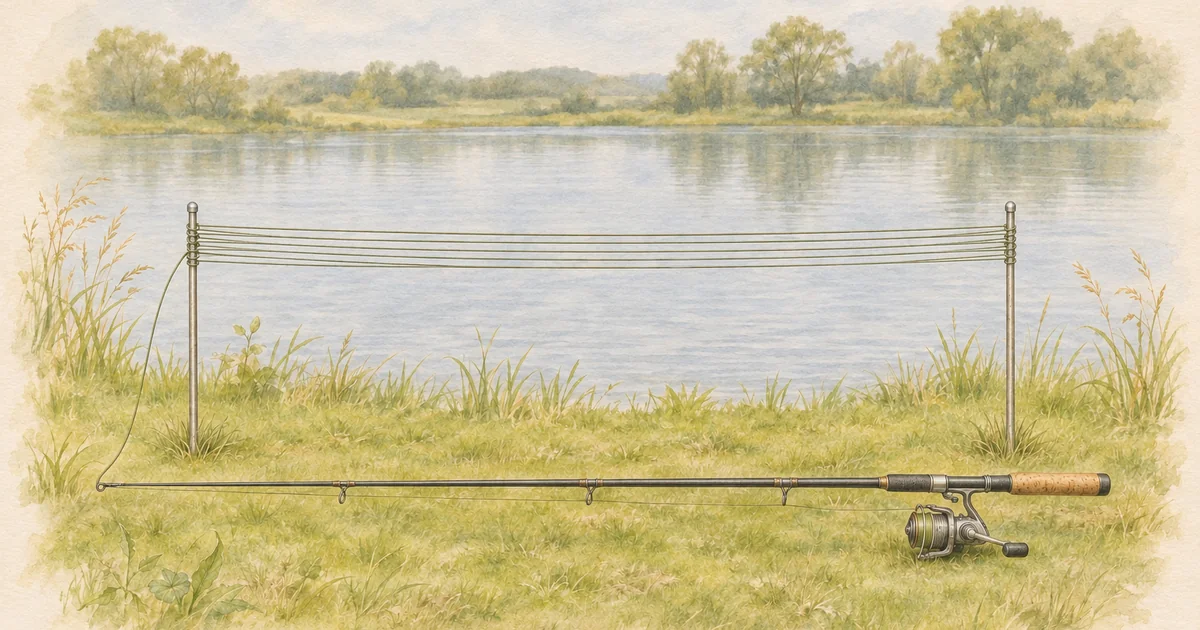
Distance sticks replace counting handle turns with a fixed measure on the bank. Basically they are two ground spikes pushed into the ground a known distance apart. Ordinary banksticks will do, but according to the same magazine dedicated sticks are easier to handle because they are built for this one job. The line clip on the reel holds the distance, and the sticks turn it into a number you can write down, transfer to other rods and call up again next week.
Spacing the sticks and how to count
The easiest way to set the spacing is with the rod: lay it flat on the ground and push one stick in at the tip and the other at the butt. If a stick falls over, it is quickly put back, and on your next visit the spacing is right again. A tape measure works just as well, but in Angling Times‘ experience it is more likely to be left at home than the rod. Angling Times recommends one rod length and names 12 ft as a good spacing. A Blinker article, by contrast, works with ground spikes 5 or 10 m apart.
According to the conversion table of the US standards institute NIST, one foot measures 0,3048 m and one yard 0,9144 m. Twelve feet are therefore 3,6576 m, rounded 3,66 m, and at the same time exactly 4 yd. You can convert other rod lengths with the unit converter.
Single length or full loop
Blinker counts every single length from spike to spike: if the spikes are 5 m apart and the line covers this length five times, that makes 25 m. Angling Times talks about “wraps” and, in the articles evaluated here, does not say whether a wrap means one length or a full loop there and back. On the page about the spod, one wrap counts there and back. Both work as long as you never change the way you count and write it down too. A full loop measures twice the spacing, so 7,32 m at 3,66 m. The table and the examples below count each length separately, like Blinker.
The table converts counted lengths into metres, rounded to 10 cm:
| Lengths | Spacing 3,00 m | Spacing 3,66 m (12 ft) | Spacing 3,96 m (13 ft) |
|---|---|---|---|
| 10 | 30,0 m | 36,6 m | 39,6 m |
| 15 | 45,0 m | 54,9 m | 59,4 m |
| 20 | 60,0 m | 73,2 m | 79,2 m |
| 25 | 75,0 m | 91,4 m | 99,1 m |
| 30 | 90,0 m | 109,7 m | 118,9 m |
The line clip on the reel
The clip sits on the rim of the spool of the fixed-spool reel. Once you put the line in it, no more line can run off during the cast, and the rig stops at the same point every time. For feeder fishing at distance, Blinker stresses always casting up to the clip in which the line for that distance is set. Fisch & Fang recommends a line-friendly clip. A Blinker article about securing loaded spare spools considers the clip mostly unsuitable for thick mono, because monofilament line usually gets kinked in it.
At the clip the cast comes to an abrupt stop. If you hit it too hard, the rig springs back towards you, according to Angling Times, and lands short of the swim. It is better to reach the clip when the rig is just above the water and then almost lower it. With heavy feeders, Fisch & Fang holds the rod pointing straight up so that it absorbs the force. How the spod flies into the clip when feeding and why it is clipped shorter than the rig in deep water is explained under Spod rod and spod.
Step by step from the marker rod to the second rod
- Set the sticks: lay the rod flat, push one stick in at the tip and one at the butt, and note the spacing.
- Find the spot: feel out the bottom with the marker rod. Once you have found the spot, put the line in the clip, then wind in (Angling Times).
- Fix the direction: choose a sighting point on the far bank and mark where you stand (section below).
- Measure the lengths: hook the lead onto one of the sticks. Pull the line off under tension, either via the reel’s backwind or with the bail arm open and a finger on the spool, and lay it round the sticks until the clip stops it. Angling Times lays it round the sticks in a figure of eight so that nothing tangles. Count every length.
- Write it down: number of lengths, spacing of the sticks, way of counting and sighting point. Angling Times notes this in the phone, along with depth and type of bottom.
- Wind back tightly: when unwinding from the sticks, trap the line between your hand and the blank so that it goes onto the spool under tension.
- Set up the second rod: hook its rig onto the same stick, unwind the same number of lengths, put the line in the clip. This is how a Blinker article measures the baited rods.
- Cast: aim at the sighting point from the same spot and hit the clip just above the water.
- Put the rod down: take the line out of the clip before the rod goes on the rod pod or banksticks.
Worked example: the sticks are 12 ft apart. When measuring the marker rod you count 20 lengths, that is 20 × 3,66 m = 73,2 m or 80 yd. For a second spot closer to the bank you count off 14 lengths: 51,2 m. If on your next session the sticks are only 10 cm further apart than when you measured, the rig already lands 2 m beyond the old spot after 20 lengths, because the error repeats with every length.
Sighting point on the far bank
Clip and sticks fix the distance, not the direction. For that you pick a point on the opposite bank. Angling Times recommends a precise target, such as the left edge of a particular tree, rather than “the big bush”. According to the same magazine, a tree or anything that stands out clearly against the sky helps you hit the same spot even in the dark. It is just as important that you stand in exactly the same place for every cast.
At night you can see neither the float nor where the rig or the bait lands. Then the sighting point gives the direction and the noted number of lengths the distance. By day the float shows the spot; the number finds it even when the float has long been wound in.
Marking the line instead of using the clip
The clip holds the line even when a fish wants to run. So you take it out during the fight, and afterwards the distance is lost. That is why some anglers also mark the spot directly on the line, in addition to or instead of the clip:
- Tape: after a successful cast, a Blinker article sticks a piece of tape on the line level with the bottom rod ring, in three colours for three spots. To switch, he releases the clip, winds in to the next colour and puts the line back in the clip there.
- Line marker or felt pen: when fishing with the swing tip, a Blinker author colours the line level with the clip for about 10 cm with a line marker or waterproof felt pen. After playing a bigger fish he clips it back in at the colour and is fishing on the bait again.
- Stopper knot: when Fisch & Fang expects big fish that take line off the spool while feeder fishing in current, the magazine fixes the casting distance with a stopper knot.
- Marker elastic: Angling Times shows a piece of marker elastic that is tied on level with the rod tip after clipping up. The article does not explain exactly where it sits.
A mark shows where the distance is, but not how many metres it is. If the line breaks, the mark is gone. With the noted number of lengths you can clip up to the same spot again after a break-off, and that is exactly why Angling Times advises always writing the number down.
Common mistakes
- Putting the rod down with the line still clipped. With a fast bite, line breakage is practically guaranteed, according to Blinker. Take the line out of the clip before the rod goes on the rest, and mark the distance on the line if you want to find it again after the fight.
- Winding back loosely. If the line runs from the sticks onto the spool without tension, it forms loops, according to Angling Times, which can cause a crack-off on the next cast.
- Changing the way you count. If you count lengths when measuring and full loops when setting up the second rod, you put it out twice as far.
- Setting the sticks by eye. Every centimetre of spacing is added again with every length. Use the rod or a tape measure and write the spacing down.
- Casting into the clip at full force. The rig springs back and lands short of the swim instead of on it.
Frequently asked questions
How far apart should I set distance sticks?
Simplest is one rod length, as Angling Times recommends. With a 12 ft rod that is 3,66 m. A Blinker article uses 5 or 10 m. What matters is that the spacing is the same every time and that you write it down.
Do ordinary banksticks work too?
Yes. Distance sticks are basically two ground spikes, and Angling Times explicitly names ordinary banksticks as an option. Dedicated sticks are built for the job and therefore handier.
Does a wrap count once or there and back?
Everyone decides that for themselves. Blinker counts each length from stick to stick, others count the full loop, which is twice as long. Write the way you count next to your numbers, and the distance will still be right on your next visit.
Are distance sticks worth it for feeder fishing too?
Yes. Angling Times describes them for the feeder and the bottom lead alike. With the feeder rod in particular, it matters that every feeder lands on the same spot, and with the counted lengths you can deliberately fish a few metres closer or further out without guessing.
Related
- Marker rod and marker float: find the spot before you measure it
- Spod rod and spod: bait to the same distance and depth correction
- Banksticks: ground spikes that also make good distance sticks
- Fixed-spool reel: spool, clip and backwind
- Unit converter: feet and yards into metres
- Line calculator: breaking strain of the line that takes the jolt at the clip
- Carp fishing: choice of swim, rig and bait
- Stopper knot: fixing the distance on the line
Sources
- Angling Times: How to use distance sticks for fishing (Kurbelzählen früher, Banksticks und eigene Stäbe, Abstand mit der Rute, Maßband, 12 ft, Spannung beim Abziehen, Achterform, straff zurückwickeln, Wicklungen notieren)
- Angling Times: Three Rods, One Spot (genauer Peilpunkt, gleicher Standort, Wicklungen im Telefon, Clip nicht zu hart treffen, Markiergummi), How to find the best spots to fish on for carp (nach dem Loten clippen und abmessen, Stäbe eine Rutenlänge auseinander, Peilpunkt im Dunkeln) und Improve your feature finding (Weiten, Peilpunkte und Tiefen notieren)
- Blinker: Praxis Karpfen, der perfekte Start im April (Erdspieße 5 oder 10 m auseinander, Strecken zählen, beköderte Ruten nachmessen, Clip vor dem Ablegen lösen, farbiges Klebeband)
- Blinker: Spitzen-Spiele mit der Schwingspitze (Schnur auf Cliphöhe markieren), Gummiband beim Angeln (Clip ungeeignet für dickes Monofil, Knicke) und Futterkorb auf Distanz (immer bis in den Clip werfen)
- Fisch & Fang: 10 Tipps zum Heavy-Feedern im Strom (Rute senkrecht, Stopperknoten bei kapitalen Fischen) und Das brauchen Sie zum Feedern (schnurschonender Clip)
- NIST: Guide to the SI, Appendix B.9 (Fuß und Yard in Metern)
Text AI-assisted, drawings AI-generated. Sources opened and checked in November 2026, no graphics taken from the sources.
All information is a guide only and without guarantee. How accurately you hit the spot depends not only on sticks and clip but also on wind, cast and water depth.