
Knowledge · Tackle
Marker rod and marker float: Feeling the bottom before your session
A marker rod is a powerful, stiff rod with braided line on which, instead of a bait, a heavy lead and a very buoyant float are attached. Before your session you use it to feel whether there is gravel, silt or weed in the swim, and to measure the depth foot by foot. It is not used for fishing.
What the marker rod is built for
Carp, tench and bream don’t feed randomly just anywhere on the bottom; they have spots they prefer. Whether a swim is any good is sometimes decided over a few centimetres. The marker rod tells you four things: how deep the water is, whether the bottom is hard or soft, whether weed grows on it and where the depth changes. That is where you find drop-offs and gravel bars, along whose edges the fish often patrol. How such features are spread across a lake is shown in Fishing on a lake.
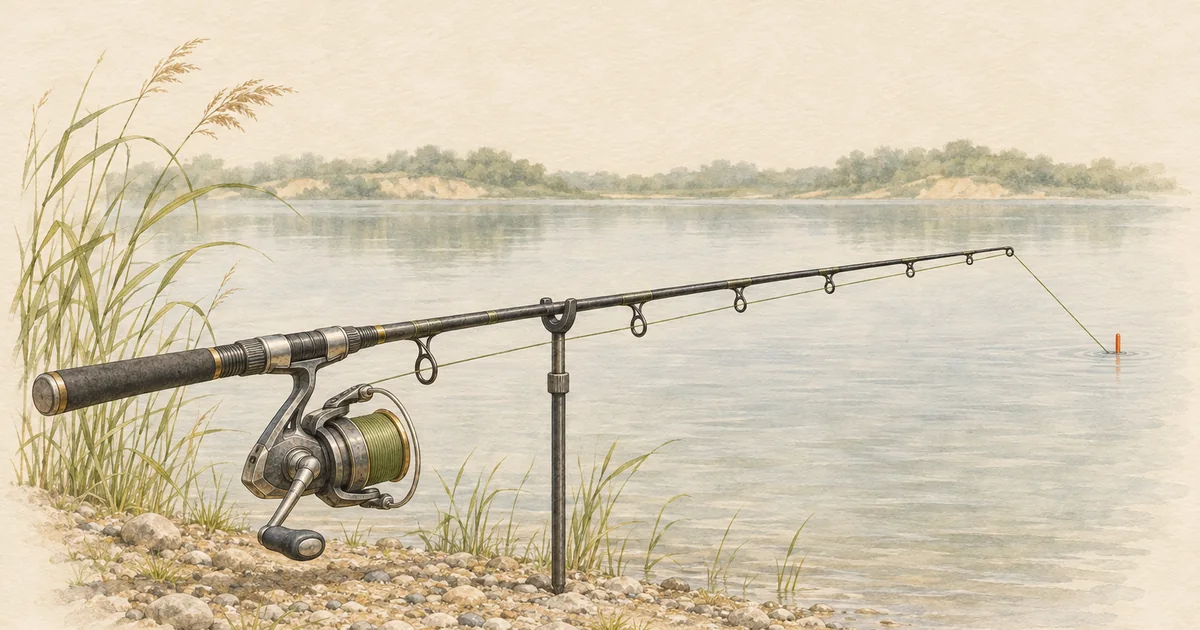
A baited rig is never fished on the marker rod. Just as powerfully built is the spod rod, which takes feed out to distance with the spod. The marker rod, on the other hand, plumbs the depth and feels out the bottom. How you then fish the spot you have found is explained under Carp fishing.
Rod, reel and line
The marker rod is harder than a rod for fishing. Its power is printed on the blank as the test curve, which is the weight at the tip that bends the rod through 90 degrees. Blinker gives about 4 to 6 lb for most marker and spod rods, that is around 1,8 to 2,7 kg. Angling Times gives 4,5 to 5,5 lb. What typical fishing rods have is explained under Carp rod. Stiff does not mean dead, though: what you are looking for is a fairly stiff blank with a soft tip that shows the vibrations of the lead.
Many marker rods have a whipping one foot in front of the reel, some a second one at two feet. One foot is 30,48 cm. If the mark is missing, stick a piece of insulating tape on the blank. If you prefer to count in metres, put it 50 cm in front of the reel, as with the plumbing rig.
The reel should be loaded with braided line, and plenty of it. The tackle guide of the Fischereiverein Löningen states as exam material that multifilament lines have no stretch. That is exactly what the marker rod relies on: mono stretches and swallows the fine knocks that the lead sends up from the bottom, whereas braid carries them right into your hand. Because it is thinner, it also casts further. How much line fits on the spool and how much backing goes underneath is worked out by the line calculator. More on the material under Braided line.
The marker rig
The rig carries no hook. Seen from the rod, it consists of three parts:
- Lead: It runs freely on the main line, on a boom if needed. That is a spacer that keeps the float off the bottom. According to Angling Times, ready-made marker kits usually consist of float, boom and a heavy lead with a notch. The lead must be heavy enough that the float cannot move it. If it is too light, the float drags it a bit closer unnoticed as you let it rise, and later you fish too short.
- Beads: A buffer bead protects the knot at the float. One Angling Times writer puts two beads between float and lead because with the greater spacing the rig tangles less often on the cast.
- Marker float: It sits at the end of the main line, is brightly coloured and very buoyant. This way it rises reliably despite the pull on the braid and through loose weed.
Two variants complement the rig. A bare lead without a float, the feeler lead, is enough if you only want to feel the bottom. A carp angler quoted by Blinker uses an 80-gram pear lead on braid for this from the boat. A lead with prongs, called a grappler in English, brings back whatever lies on top as you reel in: leaves, twigs, weed. Lead shapes are shown on the Fishing weights page, beads on the Stoppers and beads page.
Plumbing step by step
- Fix your position and a sighting point. Mark the spot you cast from so that every cast starts from the same point. Pick a target on the far bank as precisely as you can: the left edge of a particular tree rather than “the big bush”. That way you hit the direction even in the dark.
- Cast and feather. Stop the rig in flight just before it hits the water. This makes less noise, and float and lead tangle less often.
- Feel it down. Follow the lead down with the rod tip on a tight line. A hard thump suggests a firm bottom, a soft one silt or weed. In dense weed you may feel nothing at all.
- Feel the bottom. Stand side-on to the water and pull the rod low to the side, about one rod length at a time, then wind in the slack line. After it touches down, wait briefly, then pull slowly. It gets even more sensitive if you draw the braid in between two fingers. Fig. 2 and the table below it explain what you feel.
- Let the float rise. Once you have found a spot, wind the float down to the lead. Then pay out line on the freespool or with a slackened drag, one length from the reel to the mark each time, and count as you go. How the freespool works is explained under Freespool reel.
- Read the depth. Note the number at the moment the float breaks the surface. That is the depth in feet.
- Record the distance. Put the line in the reel’s line clip, retrieve the rig and measure the distance with distance sticks. When you cast your fishing rods, you stand at exactly the same spot.
- Cast all around and take notes. Cast to the left and right, shorter and further alongside, and the size and shape of the spot become clear. Write down distance, sighting point, depth, type of bottom and weed. A labelled photo on your phone is enough.
| Bottom | On touchdown | When drawing in |
|---|---|---|
| Gravel | hard, clear thump | the tip trembles, the lead bounces over the stones |
| Clay | a little softer than on gravel | even, smooth resistance, clay often sticks to the lead |
| mud | barely noticeable | smooth and even; the harder the lead is to pull free at first, the deeper the silt |
| weed | barely noticeable | heavy, firm resistance, plants collect on the lead until it tears free |
| Drop-off or bar | not clear | the lead catches briefly at the foot and then comes free |
A hard touchdown doesn’t mean the bottom is clean. Aquatic plants and filamentous algae can lie over firm ground too, and a bare lead simply slides over them. The lead with prongs shows what really lies on top. From silt, the lead sometimes brings back red bloodworms.
Worked example: The float breaks the surface at the seventh foot. 7 × 30,48 cm gives a depth of around 2,13 m. To save time, one Angling Times writer pays out two feet at once. If the float then appears after the fourth step, all you know is: deeper than 6 feet (1,83 m), at most 8 feet (2,44 m). If you want to set a rig precisely, count again foot by foot at this spot.
Marker rod, plummet and echo sounder
The plummet is a depth finder for float fishing: you use it to set the float so that the bait hangs at the depth you want. So it measures at the spot you are about to fish. The marker rod is a separate piece of kit. With it you search at distance before the session, feel the type of bottom and use the clip to set the distance for your fishing rods.
Without a float you can only roughly estimate the depth by counting until the lead touches down on a tight line. The marker float is more accurate. An echo sounder, from a boat or as a castable transducer from the bank, quickly shows where drop-offs run and how far weed beds extend. It often doesn’t show every detail of the bottom structure. The marker float gives the exact distance and the sighting point, the lead the hardness of the bottom. Some waters ban echo sounders or live sonar; examples are on the echo sounder page.
Buoys, markers and water rules
The marker float is first and foremost a measuring tool. When baiting up with a catapult or a throwing stick, it is also a visible target. Some fishery managers explicitly regulate buoys that stay in the water for longer. Two examples from club and association rules, read in full in November 2026:
- Landesanglerverband Brandenburg, water rules (Gewässerordnung), 2019 edition, point 1.7: “Placing buoys and other markers in the water to mark off the fishing spot you are using is not permitted.” Point 1.8 also prohibits leaving waste, aids and other items on the bank or throwing them into the water.
- Landesanglerverband Mecklenburg-Vorpommern, list of waters (Gewässerverzeichnis) valid from 1 January 2026, section 2.4: “It is not permitted to mark baited spots with buoys or other aids and thereby reserve a fishing place or fishing spot for yourself.”
These are the rules of these associations for their own waters, not state law. Neither text says explicitly whether a marker float left out while baiting up already counts as a marker in this sense. What applies on your water, including for boats and bait boats, is set out in the water rules and the fishing permit (Erlaubnisschein). If in doubt, ask the fishery manager.
Regardless of that, a marker buoy with its own line to a weight has a drawback: a hooked carp can swim into this line and get caught up in it. And every bit of plumbing disturbs the water. Casts, crashing leads and markers make carp wary, and they then keep their distance. So in spring it is better to plumb days before fishing. Don’t cast into reeds or water-lily beds. Why reed beds and water lilies need protecting is explained under Nature conservation on the bank.
Common mistakes
- Mono on the marker rod. Its stretch swallows the fine knocks from the bottom, and differences between bottom types hardly come through.
- Lead too light. The float drags it in as you let it rise. The spot you measured is then closer to the bank than the clip on the reel.
- Pulling too fast. Narrow gravel seams, small patches of clay and shallow hollows slip by unnoticed, and the bait later lands in the wrong place.
- Firm touchdown equals clean bottom. Filamentous algae and other plants can still lie on it. A lead with prongs gives you certainty.
- Plumbing at length just before the session. Every cast causes disturbance. If you keep crashing lead and float onto the baited spot, you drive away the fish you want to catch.
Frequently asked questions
Can I use a normal carp rod for plumbing?
Marker rods are considerably more powerful than typical fishing rods; the angling press gives a test curve of about 4 to 6 lb. What really matters for feel, though, is the line: without braid you won’t feel much of the bottom with any rod.
What do I do if the float gets stuck in the weed?
In dense weed the float gets caught and doesn’t come up. Then feel the bottom with a bare lead only and cast deliberately into visible gaps in the weed. A very buoyant float comes up through loose weed more easily.
Why is the depth counted in feet?
Many marker rods have their mark one foot in front of the reel, so you count in feet. One foot is 30,48 cm, so ten feet is just over 3 m. The unit converter handles other units. If you put the mark at 50 cm, you count directly in half metres.
Can the marker float stay out while fishing?
What counts are the water rules and the fishing permit (Erlaubnisschein) for your water. The Landesanglerverbände in Brandenburg and Mecklenburg-Western Pomerania prohibit buoys and other markers on their waters that are used to mark off or reserve a spot. If in doubt, ask the fishery manager.
Related
- Carp rod: length, test curve and action of the fishing rod
- Spod rod and spod: putting feed accurately out at distance
- Distance sticks: measuring the distance you found on land
- Plummet: measuring the depth for the float rig
- Echo sounder: seeing depth, bottom and fish electronically
- Braided line: why braid hardly stretches
- Line calculator: working out breaking strain and backing for the reel
- Carp fishing: from the baited spot to the fight
Sources
- Angling Times: How to find the best fishing spots in a lake (steife Rute mit weicher Spitze, Geflecht, Pose mit Auftrieb, schweres Blei, zwei Perlen, Wurf abbremsen, Kies, Schlamm und Kraut fühlen, Fuß-Markierung, Tiefe ablesen, Würfe neben die Stelle)
- Angling Times: How to find the best spots to fish on for carp (Testkurve 4,5 bis 5,5 lb, Rolle, Montage mit Boom und Pufferperle, Ablauf in Schritten, Lehm, Schlamm, Kraut, Kante, Pose im dichten Kraut, Clip und Entfernungsstäbe, auswerfbares Echolot)
- Angling Times: How to improve your feature finding to catch more fish (bevorzugte Fressplätze, langsam ziehen, Fadenalgen, Blei mit Zinken, Echolot und Marker kombinieren, Notizen) und Angling Times: How to Fish Three Rods on One Spot Accurately (genauer Peilpunkt, gleicher Standplatz, Pose als Ziel beim Füttern)
- Blinker: Karpfen: Welche Rute für welchen Zweck? (Testkurve 4 bis 6 lb, Zweck von Spod- und Markerrute) und Blinker: Loten beim Angeln (auffällige Pose mit Auftrieb, Marke 50 cm vor der Rolle)
- Blinker: Anfüttern beim Karpfenangeln (Geflecht ohne Dehnung, Tastblei 80 g, Markerpose, Grenzen des Echolots) und Blinker: Angel-Erfolg an neuen Ufern (Monofil schluckt die Rückmeldung, Nachteil von Markerbojen)
- Blinker: Fehlerfrei ins Karpfen-Frühjahr und Blinker: Karpfen-Spots im Verborgenen (Unruhe durch Loten, Marker und Bleie)
- Fischereiverein Löningen: Gerätekunde (PDF) (multifile Schnur ohne Dehnung, Grundsucher beim Posenfischen)
- Landesanglerverband Brandenburg: Gewässerordnung, Ausgabe 2019 (Punkte 1.7 und 1.8) und Landesanglerverband Mecklenburg-Vorpommern: Gewässerverzeichnis ab 01.01.2026 (PDF) (Abschnitt 2.4)
Text AI-assisted, drawings AI-generated. Sources opened and checked in November 2026, no graphics taken from the sources.
All information is for guidance only and without guarantee. How gravel, silt and weed feel depends on lead, line and distance; whether markers and buoys are allowed on your water is set by the water rules and the fishing permit.