
Knowledge · Tackle
Rig box and rig board: Tying hooklengths in advance and storing them tangle-free
A rig box keeps ready-tied hooklengths straight, sorted and labelled until you clip them on at the water. After a break-off you simply reach for the next hooklength instead of tying a new one with numb fingers. Which type suits you depends on the length and material of the hooklength.
What tying in advance saves you at the water
The hooklength is the short piece of line between the main line and the hook. The tackle notes for the angling exam (Fischerprüfung) provided by the Fischereiverein Löningen call it a weak link: if you get snagged, it should break, not the main line. With a ready-made replacement you are then quickly fishing again.
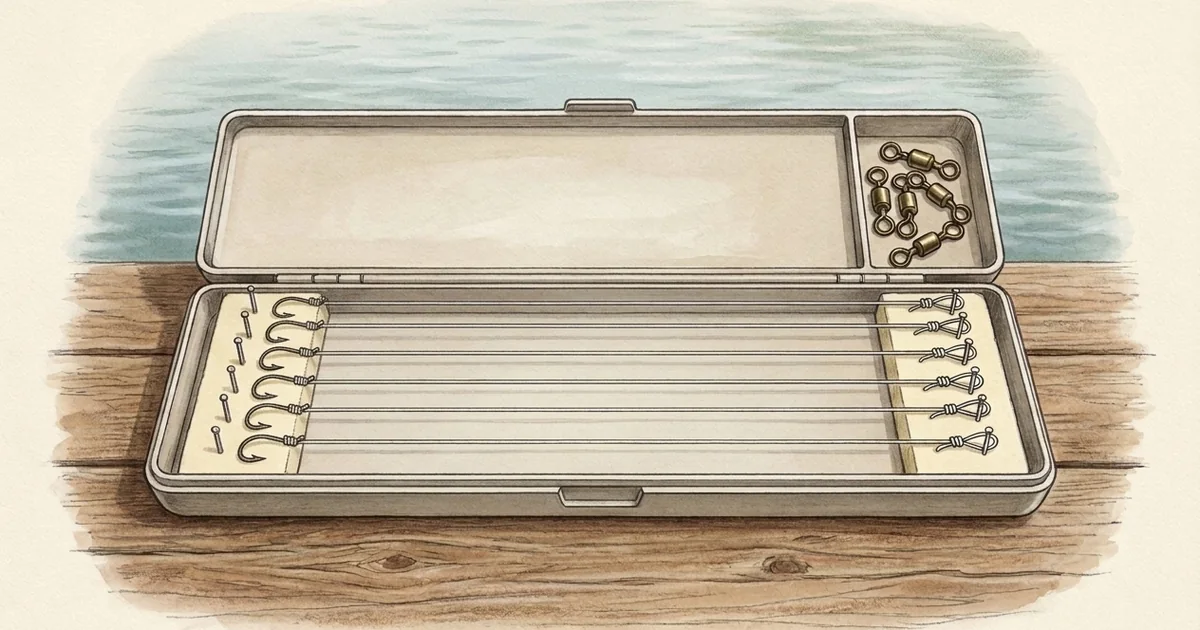
Angling Times describes the most frustrating moment: fish are feeding in the swim and the rod is lying on the bank because a new hooklength has to be tied or a fresh one found. For the same reason, Blinker advises making up wire traces for deadbaits and lures at home, so that a break-off does not cost fishing time. In winter there is the cold as well; according to Blinker it is torture to tie a rig with numb fingers. At night you only see knots and hook eyes by lamplight; more on this under Headtorch and fishing lamp.
Two examples from Blinker show how far this can go. A multiple world champion in feeder fishing ties his hooklengths during the winter months, 80 cm long and 0,10 to 0,27 mm thick depending on the target fish, and brings several ready-made rigs on labelled winders. For surf fishing, five of each rig, for example a flowing trace, a running rig and a grip-lead rig, should already be in the rig wallet. In carp fishing, a Blinker author does not resharpen a blunt hook but replaces it with a hooklength tied at home.
Types: board, plate, winder and folder
The types differ above all in whether the hooklength lies straight or wound up.
| Design | Suits | What matters |
|---|---|---|
| Rig board, rig box with pins | short carp and feeder hooklengths | straight between two pins |
| Cork or foam plate | Wire traces | pin both ends, no kink |
| Foam disc, spool | long hooklengths, zig rigs | large winding diameter, fewer curls |
| Winder | float rigs for pole and rod | wide and long enough for the float |
| Rig folder, hook packet | mono hooklengths, surf rigs | keep the loop taut when unwinding |
Rig board and rig box with pins
According to Blinker, a rig board consists of long foam strips on which pins hold the rigs in place. The hooklengths do not tangle and are ready to use straight away. They also come built into boxes, especially among carp accessories. Angling Times distinguishes two types: foam strips into which you simply push the hooklengths, and systems with pegs at fixed intervals. On these you tie every hooklength to exactly the same length, because the pegs act as a measure.
Plate with pins for wire
For wire traces, Blinker describes a simple home-made solution: a thick plate of cork or foam with a rounded top end. The trace is laid on it and fixed at both ends with pins. That way it reaches the water without a kink. Why that matters is explained further down under the checks and under Pike leader.
Discs and spools for long hooklengths
For long hooklengths, for example for zig rigs and floating baits, foam discs on which the hooklength is wound are common, according to Angling Times. A zig rig is a carp rig whose foam bait floats far up off the bottom, right up to just below the surface. In one Blinker guide, the hooklength behind the small buoyancy float is around 1,2 m long.
Winders for float rigs
On a winder, also called a float winder or pole winder, the whole rig sits together with float, shotting and hook. Blinker names plastic winders as the best storage for floats and hooklengths and warns against winders that are too narrow or too short, which squash float bodies or break the antenna and stem. More on this under Pole. The loop end is held by a line anchor, an elastic band with a hook. A version with a clip is gentler on the loop when you fix it.
Rig folder, hook packet and rig wallet
Shop-bought hooks to nylon often sit coiled in the pockets of a packet. According to Blinker, this keeps them tidy and to hand, but when you unwind them the coils easily pull into loops or knots. The trick from the same article: put your index and middle fingers inside the coil, keep it taut with them and pull the hook off sideways with a gentle touch. If nothing comes free, try from the loop end. If the coil has already knotted, the hooklength is usually lost, but the new hook is not: cut it off and tie it on again. For surf rigs and flatfish rigs, Blinker names rig wallets for storage.
Labelling: breaking strain before diameter
Three details belong on the label: length, breaking strain and hook size. Breaking strain comes before diameter, and there is a reason for that. For pole fishing, Blinker advises choosing a hooklength 0,02 mm thinner than the main line, but warns that some 0,12 lines are stronger than some 0,14 lines. Then, when you get snagged, the main line breaks instead of the hooklength. If you only write down 0,12, you will not notice. The Line calculator works out the comparison for you, and the Unit converter converts pounds into kilograms.
The length also belongs on the label. According to Blinker, ready-tied hooks usually have 45 to 60 cm of hooklength, while for the pole the magazine gives 15 to 35 cm as suitable. So you have to shorten shop-bought hooklengths for the pole or tie your own. With carp hooklengths with a hair, bait size comes into it too. Blinker describes the problem: if you tie at home, you often do not know whether a small or a large boilie will go on the hair later, and then the hair is too long or too short. The solution there is hooklengths for different bait sizes, each marked on the rig board. What else makes a carp hooklength is covered under Carp hooklength.
Worked example: According to the spool, your main line has a breaking strain of 2,2 kg, and you have two hooklength lines of 0,12 mm, one rated at 1,6 kg and one at 2,4 kg (assumed values). Only the first works as a weak link, even though both are the same thickness. So on the label you write ‘30 cm, 1,6 kg, size 16’ and not just ‘0,12’.
Tying in advance in six steps
- Decide on the main line and method, and work out the breaking strain and length of the hooklengths from them.
- Cut the hooklength line to length; on a board with fixed pegs, straight to the right measurement.
- Tie on the hook and moisten the knot before pulling it tight. According to Blinker, this creates less frictional heat.
- Test every knot by pulling before use; Blinker gives this advice too.
- Pin the hooklength straight on the board or wind it onto a winder or disc, and label it.
- Close the box and store it somewhere dark, cool and dry.
Storage: dark, dry, straight
Fishing line is plastic. The Löninger summary of tackle knowledge therefore states that UV light damages it and advises storing it in the dark. Blinker names cool and dry as the best storage conditions and warns that constant UV radiation makes line brittle and reduces its breaking strain. So a rig box does not belong on the parcel shelf or the windowsill. Fluorocarbon is considered less sensitive to UV than nylon, but it too is stored cool and dark.
With mono there is also line memory. Blinker describes it as the tendency of line to take on a shape and hold on to it. For the hooklength this means: however it has lain for a long time, that is how it comes out of the box. Wound tightly round a small packet, it springs off in curls. Stored straight on the board, it stays straight. Fig. 2 shows the difference. A curly carp hooklength can be straightened over steam, as described under Carp hooklength.
Order in your tackle box and bag
Blinker calls used hooklengths and rigs one of the most annoying things in fishing, because without order they tangle into a ball. The magazine recommends boxes with removable dividers that can be adapted to large lures or small items, and mentions systems with their own little boxes for small items, a box within a box. For you, that means: fresh hooklengths in a fixed place, and used ones never back between the fresh ones. Let wet hooklengths and hooks dry first, otherwise they rust, as described under Bait box and tackle box. Swivels, beads and stops get their own compartments, see Swivels and snaps.
Tying hooks: by hand or with a tying tool
Whether you use eyed or spade-end hooks makes a difference when tying in advance. According to Blinker, you tie an eyed hook on with the knotless knot much more quickly than a spade-end hook. For the spade-end hook, the Spade-end hook knot page shows how to do it by hand; all other knots are under Knots.
Hook-tying tools are also sold for spade-end hooks. This page has no independent expert source that tests how well knots tied with them hold. So the same rule applies to tool and hand: moisten, pull tight and test every knot by pulling before use. How much breaking strain remains after the knot is explained under Monofilament line.
Checklist before clipping on
A pre-tied hooklength has already been lying around for a while. So check it before it goes in the water:
- Hook point: Angling Times advises placing the point vertically on your fingernail and tilting it. If it slides, it is blunt. Then change or resharpen the hook; details under Fishing hook.
- Knot: test it by pulling, don’t just look at it.
- Line: no curls, no rough spots.
- Wire: no kink. The question catalogue for the angling exam (Fischerprüfung) in Saxony-Anhalt asks about exactly this.
- Label: breaking strain lower than the main line.
- Rust: no surface rust on hooks and swivels.
After every snag or contact with mussels and stones, check the point again. The Blinker article on mistakes in carp fishing advises doing this before every cast. For damaged hooklengths, for example curly ones, the Saxony-Anhalt question catalogue gives as the correct answer to dispose of them safely instead of keeping them as spares. They belong in the bin, not on the bank, see Disposing of fishing line and hooks.
Common mistakes
- Only noting the diameter. Lines of the same thickness have different breaking strains. If the hooklength is stronger than the main line, the whole rig breaks off when you get snagged.
- Winding mono tightly and storing it for a long time. It comes out of the folder in curls; better to keep it straight on the board.
- Wire traces loose in the bag. According to the question catalogue, a wire trace should have no kink; on the plate with pins it reaches the water straight.
- A winder that is too narrow. The float body gets squashed, and on a winder that is too short the antenna or stem breaks.
- Leaving the box in the sun. UV light makes line brittle and the breaking strain drops before the hooklength has ever been in the water.
Frequently asked questions
Rig board or rig folder: which is better?
For short hooklengths up to about the length of the board, the rig board keeps them straight and tangle-free. For long hooklengths and lots of small pole hooklengths, a folder or winder saves more space. Wind long hooklengths onto a disc with as large a diameter as possible, because mono keeps the curve it was lying in.
How long do pre-tied hooklengths last?
The sources for this page do not give a fixed period. What matters is storage: dark, cool and dry. Before use, check the knot, point and line, and if in doubt, tie a new one.
How do I get a shop-bought hooklength out of the packet without tangles?
Put two fingers inside the coil and keep it taut, then pull the hook off sideways. If that doesn’t work, try from the loop end. The important thing is not to let the tension drop.
How many hooklengths should I tie in advance?
There is no fixed number; it depends on snags and method. For surf fishing, Blinker gives five of each rig. For carp sessions, hooklengths for several bait sizes are worthwhile, so that the hair matches the bait.
Related
- Carp hooklength: material, hair and small parts on the rig
- Pike hooklength: steel, titanium and bite-proof mono hooklengths
- Fly leader and tippet: tapered leaders for fly fishing
- Bait box and tackle box: compartments, plastic and rust
- Floats: shapes and carrying capacity of the rigs on the winder
- Surf rig: the rigs from the rig wallet
- Hook sharpener: when you do want to resharpen a hook
- Line calculator: compare the breaking strain of hooklength and main line
Sources
- Blinker: Angler-Werkzeug: Was muss noch mit ans Wasser? (Rig-Board aus Schaumstoff mit Pins, benutzte Vorfächer, Boards in Boxen, Box in der Box)
- Blinker: Bastel-Tipp: Alles auf Platte (Stahlvorfächer zu Hause bauen, Platte mit Stecknadeln, ohne Knick)
- Blinker: Fehler beim Stippangeln (Wickelbretter, Schnuranker, Vorfach 0,02 mm dünner, Tragkraft vor Durchmesser, Vorfachlänge an der Kopfrute)
- Blinker: Feederangeln, Tipps vom Deutschen Friedfisch-Meister (Vorfächer im Winter geknüpft, 80 cm, 0,10 bis 0,27 mm, beschriftete Wickelbrettchen) und Blinker: Brandungsangeln (fünf Systeme je Art, Vorfachtasche)
- Blinker: So werden fertig gebundene Vorfächer abgewickelt (Hakenheftchen, Finger-Trick, verknotete Ringe) und Blinker: Stippangeln, die Sache mit den Angelhaken (Öhrhaken schneller gebunden als Plättchenhaken)
- Blinker: Richtiger Umgang mit monofiler Schnur (Memory-Effekt, kühl und trocken lagern, UV, Knoten anfeuchten und testen) und Blinker: 10 Tipps zum Angeln im Winter (klamme Finger)
- Blinker: Haarlänge bei der Karpfenmontage (vorgebunden auf dem Rig-Board, Ködergröße, Markierung), Blinker: 7 Fehler beim Karpfenangeln (Spitze vor jedem Wurf prüfen, vorgebundenes Vorfach statt Nachschärfen) und Blinker: Karpfen fangen mit dem Zig Rig (Schaumstoffköder, Vorfach rund 1,2 m)
- Angling Times: Buyer’s guide, the best fishing rig boxes (nur die allgemeinen Angaben: Zeitverlust beim Binden am Wasser, Schaumstoffleisten, Stifte in festen Abständen, Scheiben für lange Vorfächer) und Angling Times: Tips to land more of the carp you hook (Nagelprobe)
- Fischereiverein Löningen: Gerätekunde (PDF) (Vorfach als Sollbruchstelle) und Zusammenfassung Gerätekunde (PDF) (UV-Licht, dunkel aufbewahren)
- Ministerium für Wirtschaft, Tourismus, Landwirtschaft und Forsten Sachsen-Anhalt: Fragenkatalog zur Fischerprüfung (PDF, Stand 28.04.2022) (Stahlvorfach ohne Knickstellen, verkringelte Vorfächer beseitigen, Prüfungsstoff)
Text AI-assisted, drawings AI-generated. Sources opened and checked in November 2026, no graphics taken from the sources.
All information is for guidance only and without guarantee. How long a pre-tied hooklength lasts depends on the line, storage and knot; if in doubt, tie a new one.