
Knowledge · Tackle
Fly leader and tippet: Construction, diameters and length
The fly leader connects the thick fly line to the fly and gets thinner and thinner along the way. The strong end carries the energy of the cast onwards, while the fine end, the tippet, presents the fly and is the first to break if it comes to it. Whether the fly drifts naturally often depends more on length and taper than on the last hundredth of a millimetre.
Butt, mid-section and tip
There is a big jump between fly line and hook: the line is a thick, coated strand, while only a fine thread fits through the eye of a small fly. The leader bridges this jump. That fly leaders get thinner towards the tip is also stated in the tackle guide of the Fischereiverein Löningen for the angling exam (Fischerprüfung). According to Blinker, a leader consists of several sections whose taper and length strongly influence how the fly is presented.
- Butt: the thick section at the fly line. A leaflet from the US conservation organisation Trout Unlimited describes it as a fairly strong piece from which the leader tapers.
- Mid-section: Here the diameter drops in one or more steps. Its taper determines how evenly the energy travels to the fly.
- Tip or tippet: the thinnest section, to which the fly is tied. The Minnesota Department of Natural Resources points out that it gets shorter with every fly change.
Trout Unlimited gives an average of around 9 feet (2,74 m) for the whole leader. How long it ends up in each case depends on fly and water; guide values are below under “Length by situation”.
Knotless or knotted
The knotless tapered leader is one continuous strand drawn thinner and thinner. The knotted one is made from sections of decreasing diameter joined with the surgeon’s knot. According to a 2026 Blinker article, the knotless leader transfers power well, but its thick rear end sinks slowly, and a nymph on it often doesn’t get deep enough.
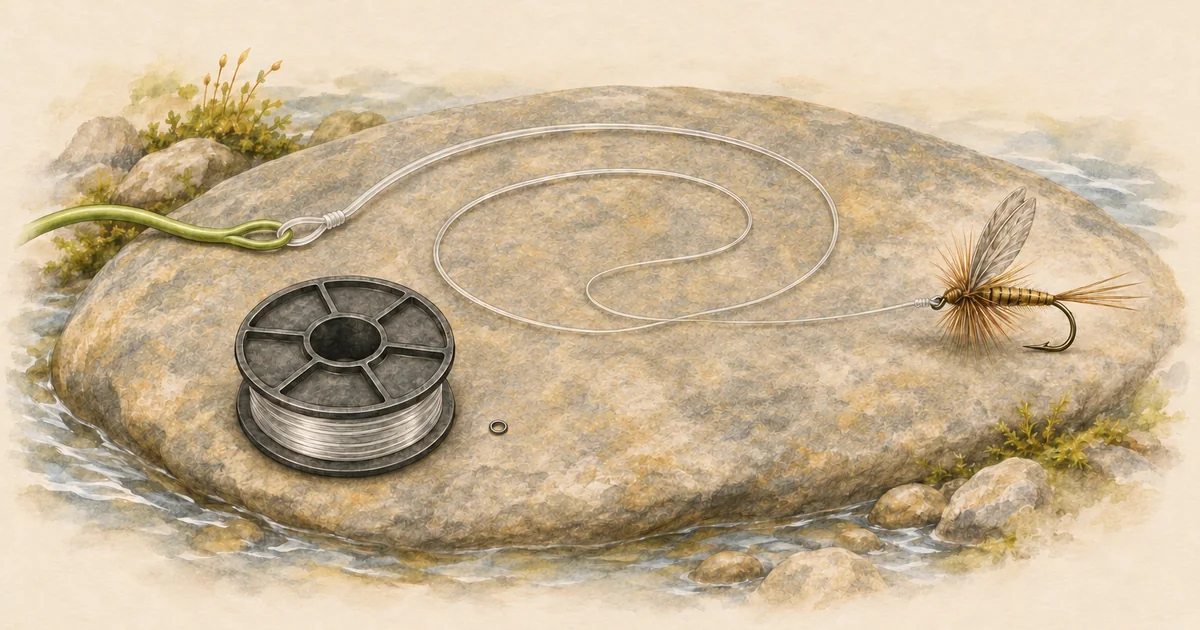
For the dry fly, the same article describes a set-up of 100 cm each of 0,31 and 0,26 mm, followed by a tippet ring and a tip of 100 to 150 cm of 0,16 to 0,14 mm (Fig. 1). For the nymph the upper sections are shorter and thinner: 60 cm each of 0,28 and 0,20 mm, then a tip of 100 to 200 cm. That way the leader sinks faster.
The X ratings on the spool
Leaders and tippet spools often carry a number with an X, such as 5X. According to the Texas parks and wildlife authority, it indicates the diameter: 0X is a thick tip, 8X a very fine one. So the higher the number, the thinner the line. Trout Unlimited gives the usual range as 03X for the thickest to 8X for the thinnest and writes that the rating indicates breaking strength and diameter at the same time.
The authorities and associations evaluated here do not give a conversion into millimetres that applies to all spools. German angling magazines such as Blinker give the tip in millimetres anyway, which is why the guide values in the following sections are also in millimetres. If the spool shows a millimetre value next to the X number, compare by that. The Line calculator estimates how much breaking strength remains after the knot.
Tip by fly and fish
The US sources give a general rule: the National Park Service assigns 5X and 6X to small flies, 3X and 4X to larger flies and stronger fish. According to Trout Unlimited, trout are usually fished with 3X to 6X. The table collects guide values from individual situations.
| Use | Fly size | Point | Source |
|---|---|---|---|
| tiny mayflies in autumn | 20 | 0,14 mm | Spoon |
| ant on a mountain lake | 16 | 0,14–0,18 mm, 80–100 cm long | Spoon |
| starting out with a 5-weight rod | not stated | 0,18 mm | Spoon |
| bushy dry fly, short casts in fast current | not stated | 0,20–0,25 mm | Spoon |
| streamer for perch | 4 | 0,22 mm, fluorocarbon 0,25 mm | Spoon |
| streamer for trout | not stated | 0,25–0,32 mm | Spoon |
For hooks in sizes 1 to 20, the Löninger tackle guide says: the higher the number, the smaller the hook. For an 8-weight rod Blinker recommends a tip of no less than 0,25 mm. Where pike are present, none of these tips will survive a bite; then a pike trace belongs in front.
Not too fine: According to a Blinker article, it is rarely the diameter when a fish refuses the fly. Tips that are too fine lead to break-offs and fights that go on until the fish is exhausted. In very clear, slow water going finer can help, but below 0,14 mm it is often unnecessary. How long fights stress the fish is covered under Fight, heat and depth.
Length by situation
Starting values from Blinker articles:
- If you are just starting out, use a knotless tapered mono leader the length of your rod, so around 2,70 m on a 9-foot rod.
- If the dry fly drags, that is, pulls a small bow wave, lengthen the tip.
- If the nymph needs to reach the bottom, set the tip according to the water depth: about 1,5 times as long as the water is deep.
- If you cast streamers on a floating line, start with 4,5 to 5 m and shorten in steps of 30 cm until the leader turns over fully. 3 to 4,5 m is usual.
- If you fish with an intermediate or sinking line, a short leader is enough. The line takes the fly down to depth.
- If you fish streamers in clear, calm water, the leader can be longer. It presents the streamer less conspicuously.
- If the water is coloured and churned up, choose a thicker leader for the streamer. It lasts longer, and the fight is shorter.
Worked example for the nymph: The run is about 80 cm deep. The tip should be around 1,5 times as long: 1,5 × 80 cm = 120 cm. With the two 60 cm sections of the nymph set-up in front of it, the leader measures around 2,40 m. At 1,20 m depth the tip grows to about 1,80 m.
Mono or fluorocarbon
Besides monofilament, Blinker also names fluorocarbon as leader material. The two behave differently:
- Fluorocarbon is stiffer and sinks faster. On nymph and streamer, a tip made of it takes the fly down to depth more quickly. In very clear water Blinker sees it at an advantage because it is supposed to be less conspicuous. What measurements actually show about visibility is covered under Fluorocarbon.
- Mono stays more flexible and is good enough on normal waters. According to the same article, trout generally aren’t bothered by it.
If you attach a fluorocarbon tip to a mono leader, join the two via a tippet ring: another Blinker article warns that otherwise fluorocarbon can cut through the mono.
Connection to the fly line
The simplest option is the loop connection. A surgeon’s loop goes on the thick end of the leader, and the fly line often already has a factory loop, as described on the fly line page. The Texas Parks and Wildlife Department shows the same solution for beginners: a double surgeon’s loop at both ends, then loop-to-loop. Correctly interlocked, such connections hold at least 90 per cent of the breaking strain according to Blinker, and the leader can be changed without shortening the line.
Smoother and without a loop is the nail knot, which Blinker calls the needle knot (Nadelknoten). The magazine recommends it for lighter fishing up to line weight 7. You tie the fly itself to the tip, for example with the clinch knot.
Adding tippet instead of changing the leader
Every fly change costs a piece of the tip. According to Blinker, bites then often dry up because the tip has become too short, not because the fish sees the leader. Instead of replacing the whole leader, you only replace the tip from the spool. With a tippet ring at the end of the mid-section, the leader keeps its length; a Blinker article on mountain lakes speaks of one leader lasting a whole season.
- Check the tip. If it is clearly too short, rough or knotted, cut it off.
- Choose the diameter. The tip is thinner than the end of the leader. The National Park Service gives the example of a piece of 4X towards the line with 5X attached for the fly; the Blinker set-up for the dry fly jumps at the ring from 0,26 to 0,16 to 0,14 mm.
- Measure. Pull off a little more than the tip is meant to be. For the surgeon’s knot, the Texas guide has the ends overlap by around 6 inches (15 cm).
- Connect. Without a ring you tie the tip on with the surgeon’s knot; with a ring, directly to the ring.
- Moisten and tighten. Blinker advises moistening every knot and pulling it down cleanly. If a curl forms in front of the hook eye, retie.
- Take the offcuts with you. Offcuts belong in your pocket, not on the bank. How to dispose of them is explained under Disposing of fishing line and hooks.
After every fish it is worth checking the tip: according to Blinker, even trout teeth roughen a 0,16 tip. Wind knots that form in the leader while casting cost breaking strain: according to the same magazine, a figure-of-eight knot reduces it and a simple overhand knot destroys it. Such a section has to come off.
Leader accessories
Fly box: For beginners, according to Blinker, a plastic box with foam inside is enough. Rust-coloured spots in the foam point to rusting hooks. Under the dressing the hook bend may then be weakened without you noticing and break during the fight.
Floatants keep the dry fly on top. A Blinker article from 2026 lists gels, liquids, pastes and desiccants and advises drying the fly well before treating it. The grease belongs on the fly, not on the leader; one Blinker article even warns against sun cream on your fingers. A greased leader lies visibly on the water, and fish turn away just before the fly.
Sinkants do the opposite: according to the same article, they usually degrease or lower the surface tension of the water so that wet fly, nymph and leader go under. To degrease, Blinker pulls the leader through a sponge with a little washing-up liquid and then through a cloth. The magazine advises using all of these products sparingly. You wash the sponge out at home, not in the water.
Checklist for the vest:
- Spare leader and tippet for retying, part of the basic kit according to Minnesota’s natural resources department; ideally in the diameters of the set-ups above
- Nail clippers for clean cuts, the cheap solution according to Blinker, or line scissors
- Floatant for dry flies and degreaser or sinkant for the leader
- Bite indicator for the nymph, according to Pennsylvania’s fisheries authority a small float on the leader
- Split shot for the tip so that the nymph sinks to the bottom, according to Pennsylvania’s fisheries authority; lead-free alternatives under Lead in angling
- Fly box with dry foam and a disgorger
Common mistakes
- The tip gets short without you noticing. After many fly changes the length is missing, and the fly drags or no longer sinks. Replace the tip in good time.
- Always fishing finer. Thinner tips mean more break-offs and longer fights. First check length, drift and grease on the leader.
- Greasing the leader as well. Floatant or sun cream on your fingers makes it shine on the surface.
- Tightening knots dry. A curl remains in front of the eye, which according to Blinker the fish sees too.
- Casting bushy flies far on a thin tip. Blinker calls this a common mistake with heavily hackled flies. They belong on short casts and a stronger tip of 0,20 to 0,25 mm.
Frequently asked questions
What is the difference between leader and tippet?
The leader is the whole tapered section between fly line and fly. The tippet is its thinnest end, to which the fly is tied. Tippet is also the name for the material on the spool that you use to renew the tip.
Which X rating suits trout?
Trout Unlimited usually gives 3X to 6X for trout. According to the National Park Service, small flies belong on the fine end, that is on 5X or 6X. In millimetres, Blinker recommends a tip of 0,18 mm on a 5-weight rod, and considerably stronger tips of 0,25 to 0,32 mm for streamers for trout.
Why does the fish rise and then turn away?
A Blinker article names a common reason: a leader that floats on the water because of grease from your hands. Degrease it or tie on a fresh tip.
Related
- Fly line: weights, profiles and factory loops
- Fly rod: which line weight suits which fish
- Fly reel: backing, line and leader on the spool
- Fly fishing: casting and fishing dry fly, nymph and streamer
- Nail knot: tying the leader firmly to the fly line
- Fluorocarbon: how much truth there is in the promise of invisibility
- Line calculator: breaking strain of the tip after the knot
- Releasing a fish: unhooking gently after a short fight
Sources
- Blinker: Vorfächer fürs Fliegenfischen, dick oder dünn? (Aufbau aus mehreren Teilen, Aufbauten, Spitzenlänge, Entfetten); Blinker: Schwimmpräparate für Trockenfliegen (Schwimm- und Sinkmittel, sparsamer Einsatz)
- Blinker: Fliegenfischen für Anfänger, die besten Geräte-Tipps; Blinker: Angeln mit Streamer (Einstieg, Streamer-Vorfach, Material)
- Blinker: Knoten fürs Fliegenfischen; Blinker: Fehlerquellen beim Fliegenfischen (Verbindungen, Windknoten, Rost)
- Blinker: Fliegenfischen am Bergsee; Blinker: Fliegenfischen im Herbst; Blinker: Erfolg mit Trockenfliegen; Blinker: Barsch fangen mit der Fliege; Blinker: Fluorocarbon Angelschnur (Spitzen in einzelnen Situationen)
- Texas Parks and Wildlife Department: Basic Fly Fishing (PDF); U.S. National Park Service: Fly Fishing (X-Stufen, Chirurgenknoten, Schlaufen)
- Trout Unlimited: Intro to Fishing, Merkblatt (PDF) (Butt, Länge, Spanne der X-Stufen, X-Stufen für Forelle)
- Minnesota Department of Natural Resources: Fly-Fishing Basics (PDF); Pennsylvania Fish and Boat Commission: Fly Fishing (Zubehör, Nymphe beschweren)
- Fischereiverein Löningen: Gerätekunde zur Fischerprüfung (PDF) (Verjüngung, Hakengrößen)
- Wikipedia: Fly fishing tackle (ergänzend: gezogenes und geknüpftes Vorfach)
Text AI-assisted, drawings AI-generated. Sources opened and checked in November 2026, no graphics taken from the sources.
All information is for guidance only and without guarantee. X ratings, diameters and breaking strains differ by manufacturer and material; what is printed on the leader and spool is what counts.