
Knowledge – Fish
Ballan wrasse (large wrasse): Features, way of life, protection
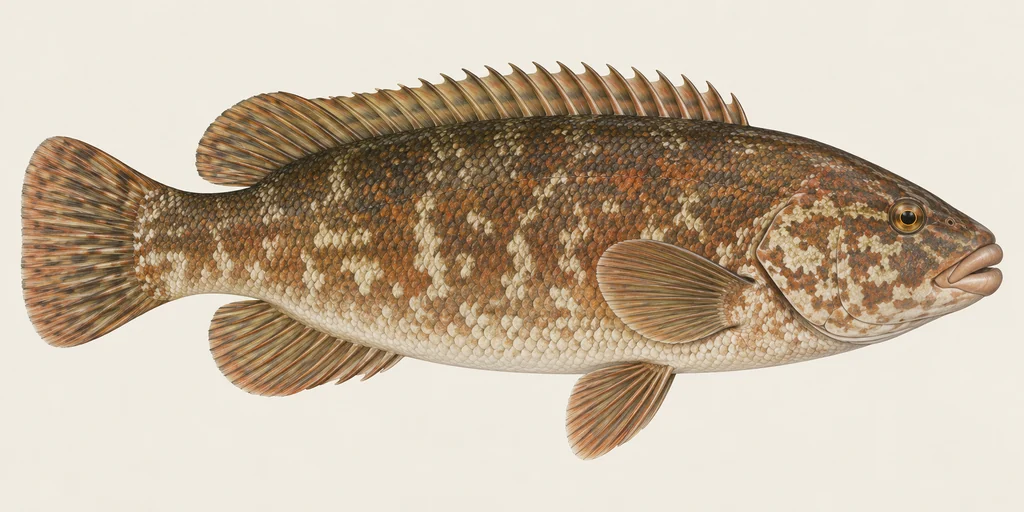
The ballan wrasse (Labrus bergylta), also called the large wrasse, is the largest wrasse on the Norwegian coast. It lives on rocks and in the kelp belt and is born female. In German waters it is very rare and is not fished for deliberately.
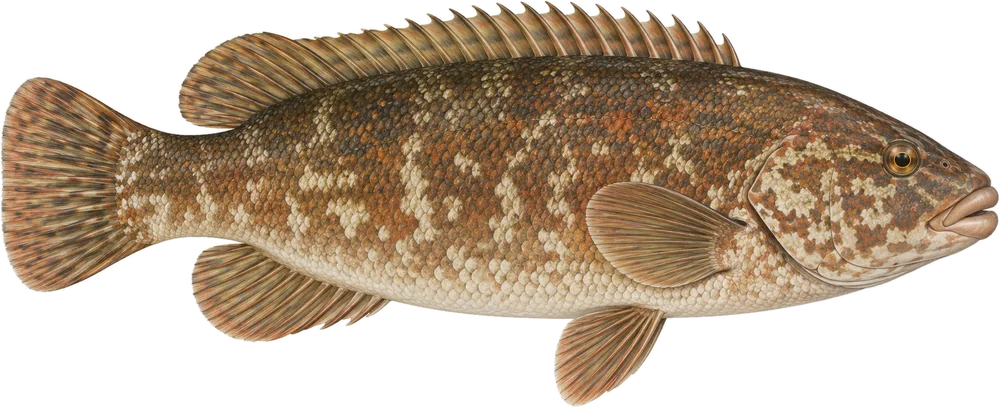
In short: Very rare in German waters; the species is not on Norway’s protection list for sea anglers (as of October 2026). Not a target fish; release a bycatch gently. What to do with a bycatch: Ballan wrasse as bycatch.
- Small mouth with thick, bulging lips
- Long dorsal fin with 19 to 21 hard rays
- Marbled colouring also on the gill cover, without parallel stripes
Catch chances through the year
- Hardly any chance
- Possible
- Good
- Peak season
- Spawning (observe the closed season)
Editorial assessment for waters in Germany, not a measured value and no guarantee. Spawning time is not the same as the legal closed season.
Species profile and sources in the catch calendarAll species compared month by monthThe rules of your federal state
How to recognise it
The body is deep and massive, the mouth small. Striking are the thick lips that give the family its name, and strong, conical teeth.
The colouring varies greatly. The base tone is usually brown or green, the back and flanks are strongly marbled, often in brown, green or reddish yellow, and the belly is paler. There is a spotted and a plain form, which occur side by side and have nothing to do with sex.
The dorsal fin is long and carries 19 to 21 hard rays (spiny, unbranched fin rays), the anal fin three. The Havforskningsinstituttet, the Norwegian institute of marine research, gives a length of up to 60 centimetres, with most fish staying clearly smaller. FishBase lists 65,9 centimetres as the largest size and 4,4 kilograms as the highest weight.
Side by side: ballan wrasse, corkwing wrasse or cuckoo wrasse?
| Feature | Ballan wrasse | Corkwing wrasse | Cuckoo wrasse |
|---|---|---|---|
| Gill cover | marbled | parallel stripes | no information in the sources |
| Distinguishing mark | no fixed spots, very variable colouring, mostly brown and green | dark kidney-shaped spot behind the eye, dark spot on the tail base | female red-orange with three black spots at the rear base of the dorsal fin, male blue |
| Hard rays of the dorsal fin | 19 to 21 | 14 to 17 | no information in the sources |
| Size according to FishBase | up to 66 cm | up to 28 cm | up to 40 cm |
Six wrasse species live on the Norwegian coast. Corkwing wrasse and rock cook look similar to small ballan wrasse. The gill cover tells them apart reliably: in the ballan wrasse it is marbled, while the other two have parallel stripes there. The corkwing wrasse also has a dark, kidney-shaped spot behind the eye and a black spot on the tail base.
The cuckoo wrasse (Labrus mixtus) is conspicuously coloured. Females are red-orange with three black spots at the rear base of the dorsal fin, males blue with dark marbling.
Where it lives
The ballan wrasse lives in the eastern Atlantic from Norway to Morocco, including Madeira, the Azores and the Canary Islands. In Norway it reaches north to the Trondheimsfjord.
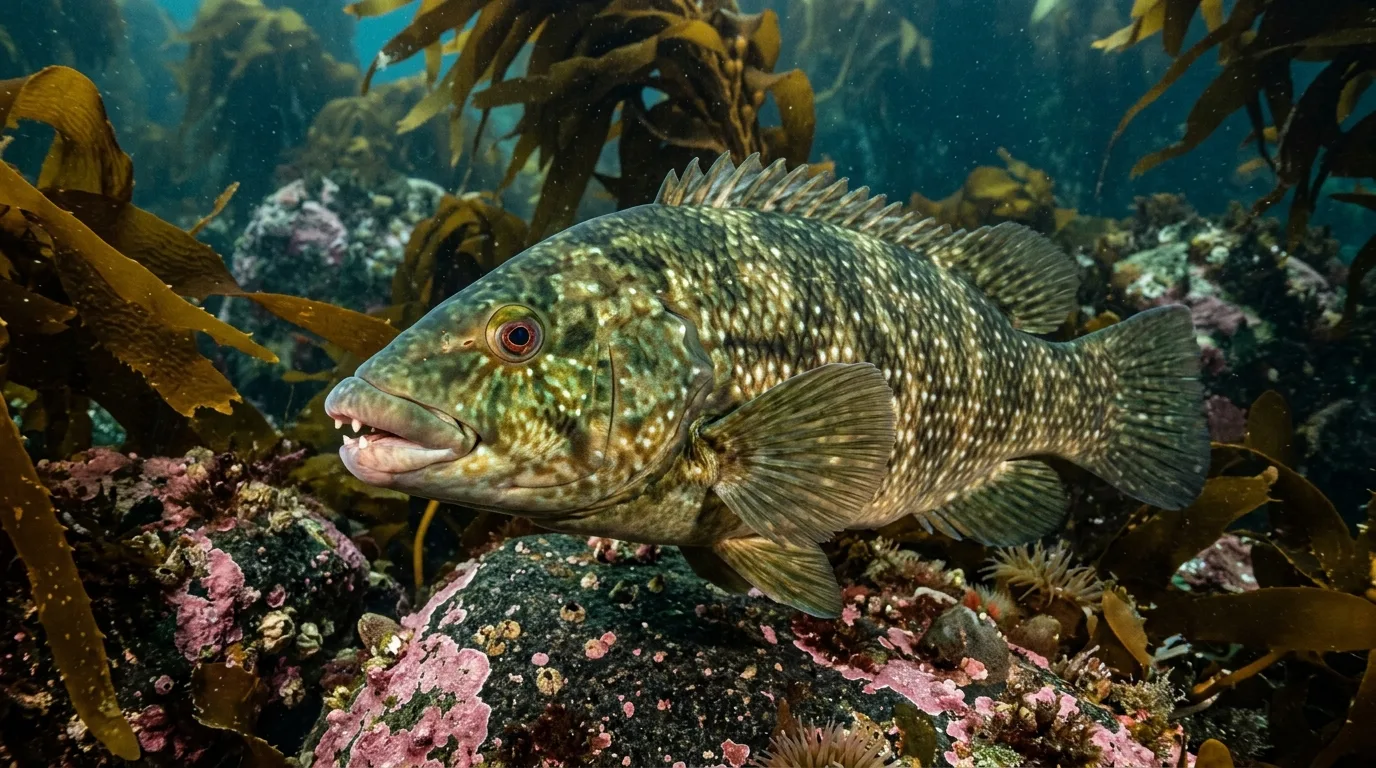
It prefers rocky coasts, reefs and kelp forests, gladly on steep rock faces exposed to the surf and on underwater skerries. It is most common from the shore down to about 50 metres, and occasionally caught down to 200 metres. Juveniles often live in the tidal zone.
In the Baltic, according to HELCOM, it occurs regularly only in the Kattegat and the Öresund and reproduces only there. Germany’s Red List classes its stock situation as very rare. On the coast of Schleswig-Holstein there are somewhat more records than in Mecklenburg-Western Pomerania because of the proximity to the Kattegat.
Holding spots in the picture
Choose the season and time of day: the picture shows where the species stands then. Spots outlined in red apply only in the chosen season. Tap a fish or a spot in the list to bring it closer. The picture is schematic and AI-generated, every water is different.
No main time Wrasses are active by day and retreat into rock crevices at night.
Active time Wrasses are active by day and retreat into rock crevices at night.
No main time Wrasses are active by day and retreat into rock crevices at night.
No main time Wrasses are active by day and retreat into rock crevices at night.
On the coast
Seagrass, gravel and stones in the shallows
Ballan wrasse (great wrasse) is found here all year round.
Stony mixed ground
Ballan wrasse (great wrasse) is found here all year round.
Drop-off
Ballan wrasse (great wrasse) is found here all year round.
Wreck, reef
Ballan wrasse (great wrasse) is found here all year round.
Deep, colder water
Ballan wrasse (great wrasse) is found here in winter only.
The ballan wrasse lives on rocky coasts, reefs and in kelp, and likes steep rock faces in the surf. It stays in a small territory all year round. In German waters it is very rare.
Spring: The spawning season falls in this period; observe the closed seasons (Schonzeiten).
Summer: This is when spawning takes place, so observe the closed seasons (Schonzeiten). In the warm months you will find them mainly among the kelp plants near the shore.
Winter: In winter they move out into deeper water.
Depth: It is most common between the shore and about 50 metres; single fish have been caught down to 200 metres.
Size comparison: AI-generated drawing, schematic.
How it lives and spawns
Wrasses are active by day and wedge themselves into rock crevices at night. The ballan wrasse stays very close to home: studies with transmitters showed small territories in which the animals stay all year. It feeds on bristle worms, mussels, snails and crustaceans.
All animals hatch as females. They mature at 16 to 18 centimetres. FishBase gives an age of 4 to 14 years for the change of sex, after which they live as males. That is why all large specimens are males. The fish grows slowly: according to the Havforskningsinstituttet, fish of 18 to 22 centimetres are two to five years old, those of 36 to 38 centimetres about 16 years.
Spawning takes place in summer. The male builds a nest of algae in a rock crevice, and one or more females lay their eggs there. The male guards the nest for one to two weeks until the larvae hatch, which then drift freely in the water.
Is there a season?
There is no fishing season for the ballan wrasse in Germany or Norway, so the calendar shows zero throughout. In summer wrasses stay in the kelp belt, in winter they move into deeper water.
A bycatch is most likely on Norwegian rocky coasts with a kelp belt.
You will find the monthly overview of all species and the water temperature check in the catch calendar.
What to do with a bycatch
As bycatch: Fishing for ballan wrasse? – why the species is not a target fish and what to do with a bycatch.
The ballan wrasse is not fished for deliberately. Because it feeds on worms and crustaceans, it can end up on natural baits meant for other fish along rocky edges.
If it takes the hook, pull it out of the rocks quickly so that it does not wedge itself in. Remove the hook in the water if possible, or with wet hands, and release it at once in the same spot.
Look at the gill cover: Marbling on the gill cover points to the ballan wrasse, parallel stripes to corkwing wrasse or rock cook.
Better to release: The ballan wrasse grows slowly and stays in a small territory all its life. A hooked fish is therefore best put straight back into the water in the same spot.
Suitable lures
Not a target fish: these baits are meant for other fish, and the species is only occasionally caught on them as bycatch. It is not fished for deliberately.
AI-generated illustrations. A click opens the lure’s page.
Very rare and slow-growing in German waters: do not target it, and release a bycatch at once and gently.
What you need to observe
Wrasses are not on the list of protected species that the Norwegian fisheries directorate keeps for sea anglers (as of October 2026). So there is no year-round fishing ban there. Minimum sizes (Mindestmaße) and further rules are given by the Fiskeridirektoratet; you will find the current list at the Fiskeridirektoratet.
Closed seasons, minimum sizes and harvest slots are set by the federal states (Bundesländer) and by the fisheries authorities of the neighbouring countries on the coast (Denmark, Norway, Poland). They vary by type of water, stretch of coast and time of year. We only give figures together with the date and source; the fisheries regulation of your federal state and your fishing permit (Erlaubnisschein) are always what is binding. You will find a list of links to the official sources in the catch calendar.
The Red List of marine fish of Germany lists the ballan wrasse as not threatened but very rare. HELCOM also classes it as not threatened for the Baltic, and the IUCN as not threatened worldwide (Least Concern). In Norway it is caught for salmon farms as a cleaner fish that eats salmon lice.
What closed season, minimum size and harvest slot mean and where to find them is explained on the page Closed season and minimum size explained.
Frequently asked questions (FAQ)
May I fish for ballan wrasse in Norway?
There is no year-round ban: wrasses are not on the protection list of the Norwegian fisheries directorate for sea anglers (as of October 2026). Because it grows slowly and stays very close to home, it is still best to release a bycatch straight away.
Why are large wrasses always males?
All animals are born female and change sex later. Anyone that grows large and old enough is therefore a male.
Is the ballan wrasse found in the North Sea and Baltic?
Yes, but in German waters it is very rare. In the Baltic it occurs regularly only in the Kattegat and the Öresund.
Sources
The rating of catch chances is an editorial assessment. The facts come from these sources, and the text is worded in our own words. The illustration is an original design by Angel Momente in the style of a natural history plate (AI-generated, see the AI notice).
- FishBase: Labrus bergylta, Ballan wrasse (Größe, Alter, Verbreitung, Fortpflanzung)
- Havforskningsinstituttet: Leppefisk (Berggylt, Grønngylt, Blåstål/Rødnebb)
- Store norske leksikon (L. A. Vøllestad, Universität Oslo): berggylt
- Rote-Liste-Zentrum: Artensteckbrief Gefleckter Lippfisch (Rote Liste Meeresfische 2025)
- HELCOM Red List: Species information sheet Labrus bergylta
- Fiskeridirektoratet: Meeresangeln in Norwegen, Regeln (Liste geschützter Arten, Lippfische nicht enthalten)
- Devon & Severn IFCA: Wrasse (Lippfischarten im Nordostatlantik, Lebendfischerei)
- Devon & Severn IFCA: A Review of Wrasse Ecology and Fisheries Interactions (Davies 2016, PDF)
- FishBase: Symphodus melops (Grüngylt, zur Unterscheidung)
- FishBase: Labrus mixtus (Kuckuckslippfisch, zur Unterscheidung)
Created with AI support from the sources listed. Figures only appear in the text if a source gives them. Last updated: 27 October 2026. Found a mistake? Write to us. Who is behind this site: About me.
More in the lexicon
- All fish species at a glance
- Catch calendar – month, water temperature and profile for 93 species
- Line calculator – breaking strain after the knot, drag guideline, backing
- Angling methods