
Knowledge – Fish
Muskellunge: Features, season, baits
The muskellunge (Esox masquinongy), called musky or muskie among anglers, is the largest member of the pike family. It lives in lakes and rivers in the east of North America. In Wisconsin, where it has been the state fish since 1955, it is regarded as the most sought-after trophy fish.
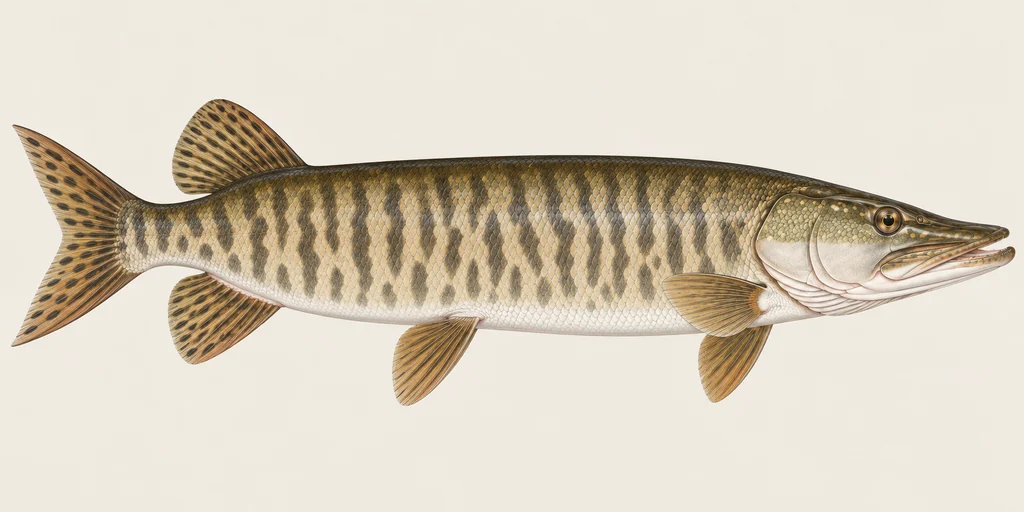
In short: According to the catch calendar the best time is June to November. Good spots on the lake: weedbed, drop-off edge and sunken tree; in the river: deep pools, calm bay and undercut bank. Proven baits: large plugs, jerkbaits, bucktail spinners, spoons and soft plastics, also live baitfish of 25 to 35 cm. Dark markings on a pale ground and cheeks scaled only on the upper half tell it from the pike. Wisconsin has its own musky season. Step by step: Fishing for muskellunge.
- Dark vertical bars or blotches on a light background
- Cheek and gill cover scaled only in the upper half
- Dorsal and anal fins set far back, deeply forked, pointed tail fin
Catch chances through the year
- Hardly any chance
- Possible
- Good
- Peak season
- Spawning (observe the closed season)
Editorial assessment for the home waters (northern Wisconsin and the Great Lakes region), not a measured value and no guarantee. The rules of the country you are visiting are binding.
How to recognise it
The body is long, muscular and cylindrical, about six times as long as it is deep. The dorsal and anal fins sit far back near the tail fin. The snout is flat like a duck’s bill, and the gape reaches halfway round the head. Large fangs stand in the lower jaw, while the palate and tongue carry short, brush-like teeth.
The back and upper flanks shimmer green-gold to light brown, the belly is creamy white. The muskellunge is the only member of the pike order with dark vertical bars or spots on a pale ground. Silvery or very large fish often show no markings at all. The tail fin is deeply forked and ends in points.
FishBase gives a usual length of around 95 centimetres and maximum values of 183 centimetres, 31,8 kilograms and 30 years. According to the Wisconsin fisheries authority (Fischereibehörde), most fish reach an age of about eight years.
The most similar is the pike, which occurs in the same area in North America. It has pale spots on a dark ground, the muskellunge dark markings on a pale ground. A look at the head is more reliable: in the muskellunge the gill cover and cheek are scaled only in the upper half, and on each side of the lower jaw there are six to nine sensory pores. According to figures from Wisconsin the pike has five to seven.
A male pike crossed with a female muskellunge produces the tiger muskellunge. It has irregular pale vertical bars on a dark ground and rounded fins. In Wisconsin it is stocked outside the natural range of the muskellunge.
Side by side
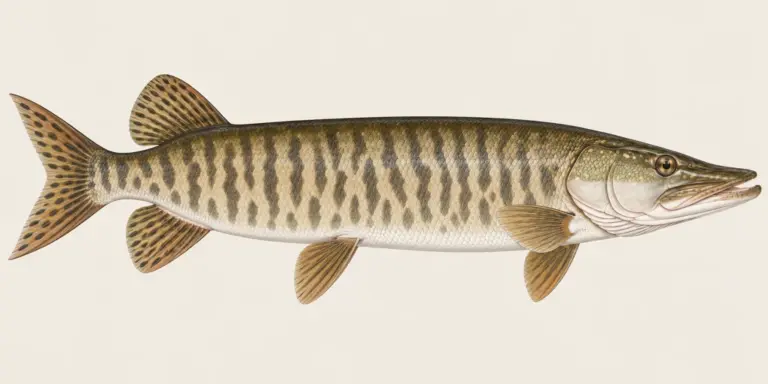

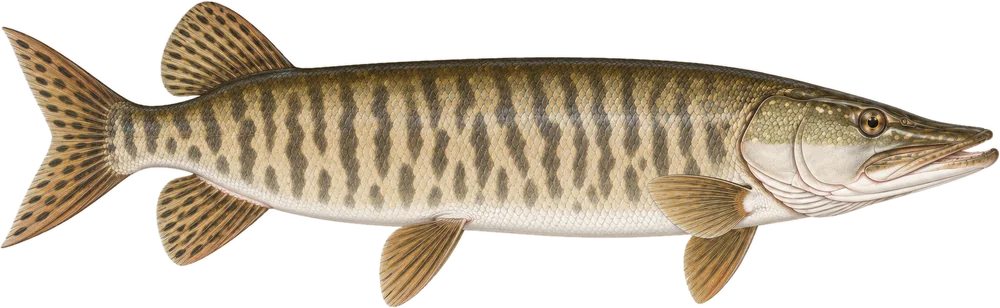
AI-generated illustrations.
Where it lives
The species originally lives in the catchment of the St Lawrence River and the Great Lakes, in the Red River, which flows to Hudson Bay, and in the Mississippi basin. It has been introduced to other parts of the USA, for example Missouri. There it does not reproduce successfully, and the stocks depend on annual stocking. In parts of Tennessee and Ohio the original stocks are protected.
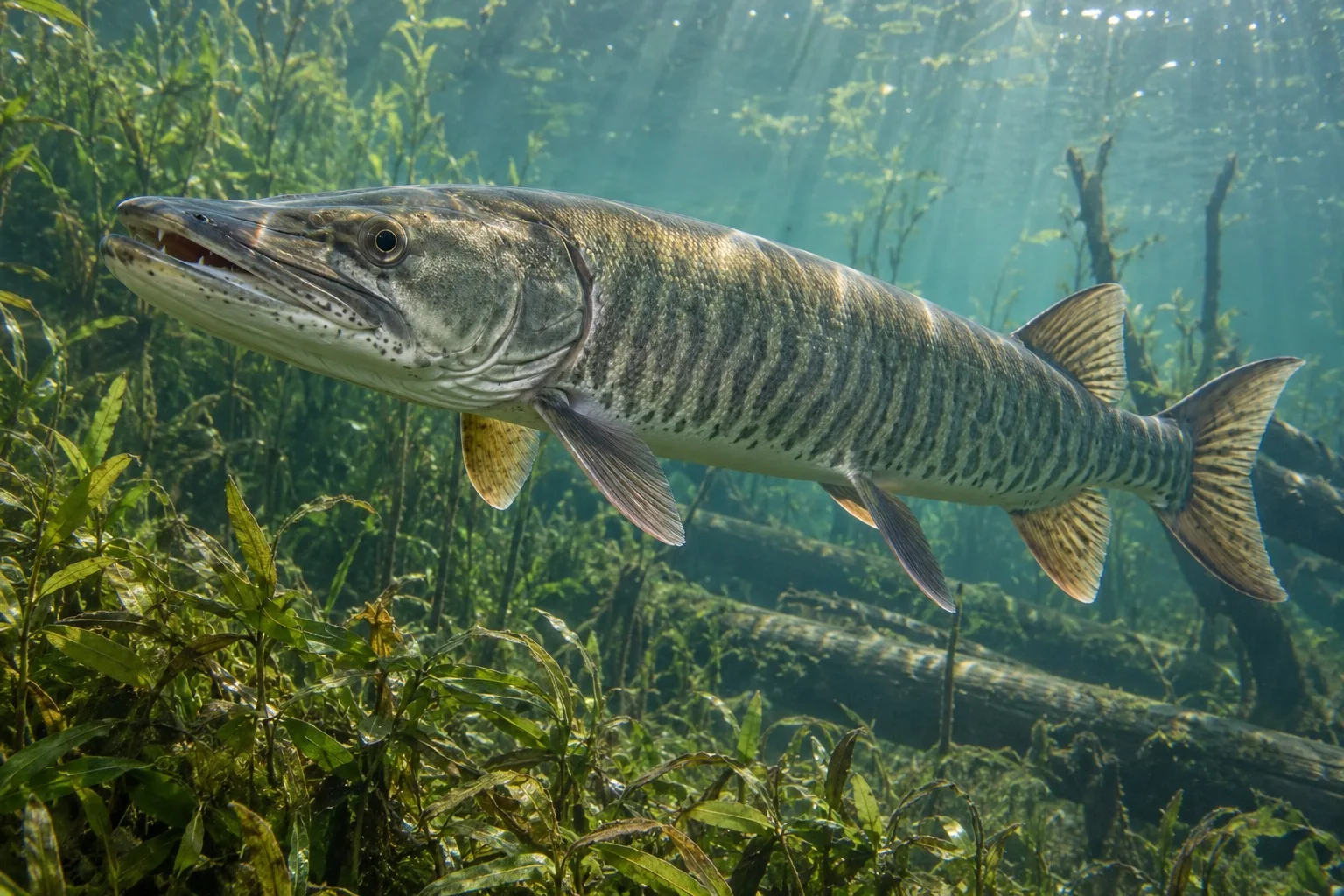
It prefers larger lakes with shallow and deep basins and extensive plant growth, as well as medium to large rivers with deep, slow-flowing pools. According to the Wisconsin DNR it is comfortable between about 1 and 26 degrees. In summer it stands deeper. The muskellunge is a loner and mostly stays in its own territory. Typical holding spots are the drop-off edges of stone and sand bars, weedbeds, small weedy bays and shaded banks under overhanging trees.
Holding spots in the picture
Choose the time of day: the picture shows where the species holds. We do not show German seasons for travel fish; the bars give the chance of a catch for each month. Tap a fish or a spot in the list to bring it closer. The picture is schematic and AI-generated, and every water is different.
Chance of a catch per month according to the catch calendar
- J
- F
- M
- A
- M
- J
- J
- A
- S
- O
- N
- D
Spawning season
In the lake
Water lilies and weed bed
The muskellunge is found here all year round.
Shelf edge
The muskellunge is found here all year round.
Sunken tree
The muskellunge is found here all year round.
Deep bottom
The muskellunge is found here all year round.
Open water
The muskellunge is found here all year round.
In a lake the muskellunge holds a fixed territory on its own. It lurks at the drop-offs of stone and sand banks, in weed beds and by tree stumps, hunting by sight. After spawning the fish sit in shallow, weedy bays and on the points next to them, deeper later in the year.
In the river
Undercut bank, overhanging branches, timber
The muskellunge is found here all year round.
Pools, deep spot
The muskellunge is found here all year round.
Calm bay with aquatic plants
The muskellunge is found here all year round.
In medium to large rivers it looks for deep pools with slow current. Add small, weedy bays and stretches of bank shaded by overhanging trees.
Depth: In summer it moves out to bigger, cooler depths and sometimes follows shoals of baitfish into open water.
Size comparison: AI-generated drawing, schematic.
How it hunts and spawns
The muskellunge lurks by stumps, stone edges or in the weeds and hunts mainly by sight. In murky water it has difficulty finding prey. It seizes the fish crosswise, turns it and swallows it head first. It eats almost any species of suitable size, especially suckers (North American bottom-dwelling fish) and perch, occasionally also muskrats, ducks, mice and frogs.
In Wisconsin spawning takes place from mid-April to the end of May, at a water temperature of 10 to 15 degrees. The pairs move over shallow bays with a muddy bottom covered in dead plants and release eggs and milt at intervals. A female lays 22 000 to 180 000 eggs, and there is no parental care. The fry grow to 18 to 33 centimetres by the end of the first summer. Males mature at four to five years, females at five to seven.
When and where the season is
In Wisconsin the muskellunge is not open all year. Since 2026 the season opens on the same day on all inland waters of the state, on 2 May in 2026, and runs until 31 December; separate dates apply to the Great Lakes, Green Bay and the border waters (as of October 2026). Because the fish spawn until the end of May, spawning is not over everywhere at the start of the season. Afterwards, according to the DNR, they stand in shallow, weedy bays, in channels and on points next to such bays.
In summer the species retreats into deeper, cooler water and sometimes follows schools of forage fish into open water. Patience is part of it: according to the Wisconsin DNR the average angler needs more than 50 hours before hooking a muskellunge he would be allowed to keep.
What to catch it with
Step by step: Fishing for muskellunge: tips on lures, rigs and tackle – season, spots, lures, tackle and rules on one page.
The classic approach is a heavy baitcasting rod, a multiplier reel and braided line rated at 50 to 80 lb, which is roughly 23 to 36 kilograms. Baits are large lures such as plugs, bucktail spinners (spinners with a tuft of hair on the hook) and spoons. Some anglers cast or troll a live sucker of 25 to 35 centimetres. At the start of the season the authority names smaller bucktails, jerkbaits (plugs worked with sharp jerks), soft plastics and surface lures.
Keep the lure moving and do not let it hang. Muskies often follow the lure right up to the boat and only strike when about 30 centimetres of line are still out. So work it all the way to the end. When you get a bite, set the hook at once and hard, because the mouth is hard and bony.
Most musky anglers in Wisconsin release their catch. The authority advises unhooking the fish next to the boat, with pliers or by cutting the hook. Keep a large landing net, long-nosed pliers, side cutters and gloves within reach in the boat.
Count the pores: On very large, silvery fish the markings can mislead. Count the pores under the lower jaw and look at the scales on the cheek, and you can reliably tell muskellunge, pike and tiger muskellunge apart.
Fingers out of the mouth: The fangs cut easily. Remove the hook with long-nosed pliers and never put your hand in the mouth.
Suitable lures
Large plugs, jerkbaits, bucktail spinners, spoons and soft plastics, also live baitfish of 25 to 35 cm.
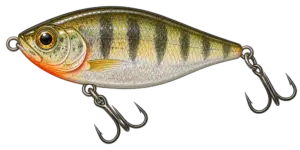
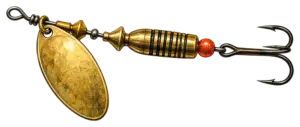
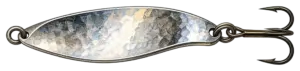
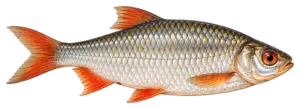
AI-generated illustrations. A click opens the lure’s page.
Work the lure all the way to the boat; muskies often follow for a long time.
Licences and rules in the country you visit
In the USA and Canada you need a fishing licence from the state or province in question. Each state sets the season, bag limits and minimum lengths for muskellunge itself. In Wisconsin, special rules for individual counties and lakes also apply. The current version issued by the local authority is binding, in Wisconsin the Department of Natural Resources.
The IUCN Red List classes the species as not threatened. If you want to eat your catch, you should know that, according to the Wisconsin DNR, larger, older muskellunge can be contaminated with PCBs, pesticides and mercury, and the authority issues consumption advice for individual waters. This is no substitute for medical advice.
Frequently asked questions (FAQ)
How do I tell a muskellunge from a pike?
Muskellunge show dark markings on a light background, pike light spots on a dark one. In addition, the cheek and gill cover of a muskellunge are scaled only on the upper part, and it has six to nine pores on each side of the lower jaw.
How big does a muskellunge get?
FishBase gives a typical length of around 95 centimetres and maximum values of 183 centimetres and 31,8 kilograms.
When is musky season?
In Wisconsin it runs on inland waters in 2026 for the first time statewide from 2 May to 31 December (as of October 2026); the Great Lakes and border waters have their own dates. Other states and provinces have their own seasons, and the relevant authority is what counts.
Sources
The rating of catch chances is an editorial assessment. The facts come from these sources, and the text is worded in our own words. The illustration is an original design by Angel Momente in the style of a natural history plate (AI-generated, see the AI notice).
- FishBase: Esox masquinongy, Muskellunge
- Missouri Department of Conservation: Muskellunge (Field Guide)
- Wisconsin Department of Natural Resources: Muskellunge (Esox masquinongy), Artporträt 2008
- Wisconsin Department of Natural Resources: Northern zone musky season 2025
- Wisconsin Department of Natural Resources: Muskellunge, Merkblatt PUBL FM-705 (rev. Juni 2012)
- Wisconsin Department of Natural Resources: Musky fishing, landesweite Binnensaison ab 2. Mai 2026
Created with AI support from the sources listed. Figures only appear in the text if a source gives them. Last updated: 27 October 2026. Found a mistake? Write to us. Who is behind this site: About me.
More in the lexicon
- All fish species at a glance
- Catch calendar – month, water temperature and profile for 93 species
- Line calculator – breaking strain after the knot, drag guideline, backing
- Angling methods