
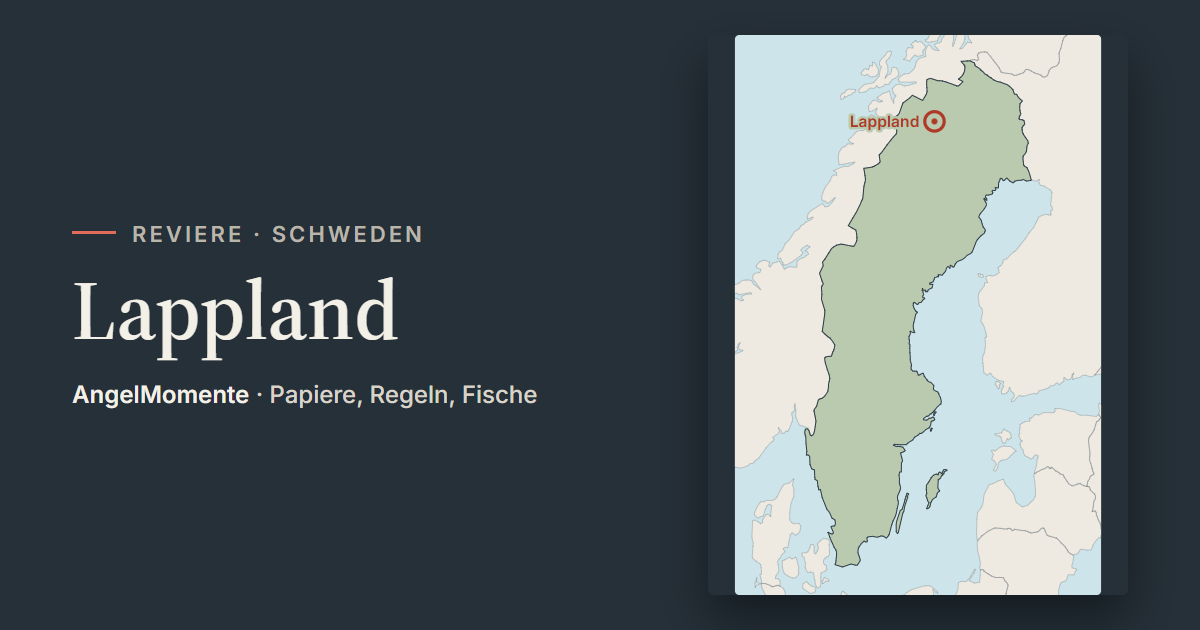
Fishing waters · Sweden
Fishing in Lapland
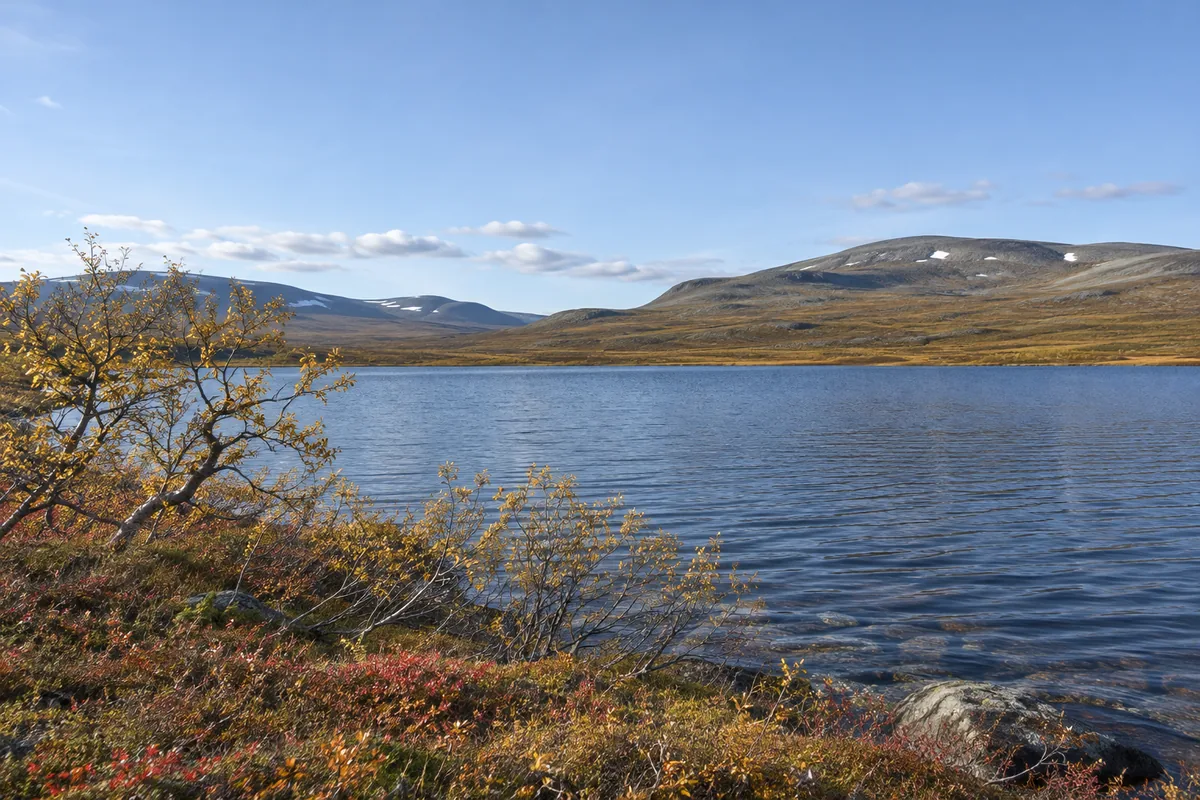
Lapland is the mountain and forest country in the north of Sweden, with thousands of lakes and the salmon rivers Torne älv and Kalix älv. The fishing licence is replaced here by the fishing permit (fiskekort): for the state fell waters the Länsstyrelse issues it, and the fishing is mainly for char, trout and grayling.
- Papers
- Fells: Länsstyrelse permit; elsewhere the rights holder’s permit
- Season
- all year; running water on the fells closed 1.9.–31.12.
As of October 2026
At a glance
- Papers
- Fells: Länsstyrelse permit; elsewhere the rights holder’s permit
- Licence and permit
- Season
- all year; running water on the fells closed 1.9.–31.12.
- Fishing seasons
- Torne border stretch: no salmon fishing from Sun 6 pm to Mon 6 pm
| Fish | Minimum size | Closed season | Catch limit | Note |
|---|---|---|---|---|
| Alpine char | – | none | – | Trolling lakes: 3 salmonids per day in total |
| Trout | 35 cm | 1.9.–31.12. | 5 per day including grayling | Kalix, Kaitum, Torne, Lainio: 1 per day, 35–45 cm; Torne border stretch protected all year |
| Grayling | 35 cm | 10.5.–10.6. | 5 per day including trout | Kiruna 15.5.–15.6., some rivers 15.4.–15.6.; Torne border stretch 1.4.–31.5. |
| Atlantic salmon | 50 cm | 1.9.–31.12. | 1 per day | Torne border stretch 2026: only 8.6.–25.8., 2 per year; Lainio: seal tag, 1 per season; females go back |
| Pike | – | none | – | baitfish only from the same lake |
| Burbot | – | none | – | Torne border stretch: also allowed during the autumn closure 15.9.–15.12. |
General rules of the Länsstyrelsen Norrbotten fell permits 2026; the trout closed season (Schonzeit) applies in running water. On the Torne border stretch the fisheries regulation applies, in Västerbotten the rules of the permits there. The leaflet that comes with the permit may be stricter. As at: October 2026. What counts are the regulation and your fishing permit (Erlaubnisschein).
Location and waters Fells in Norrbotten and Västerbotten, Torne älv
The fell area of Norrbotten above the Odlingsgräns measures 55 000 km² and is thus somewhat larger than Denmark. There are over 20 000 lakes (Länsstyrelsen Norrbotten). The state waters are managed by the Länsstyrelse, in Norrbotten divided into four fishing permits for the municipalities of Arjeplog, Gällivare, Jokkmokk and Kiruna. Further south the Länsstyrelsen Västerbotten is responsible.
In Norrbotten flow the last big salmon rivers of the Baltic region that have not been developed for hydropower. Only here does the salmon ascend into the fells. The Torne älv forms the border with Finland in its lower reaches. This border stretch also includes the Könkämä- and Muonioälven (Fiskelag, § 3).
Fish and best time Char, trout, grayling and salmon
For the fells the Länsstyrelse lists char, trout, grayling, burbot, perch and whitefish. Below the bare fells pike are added.
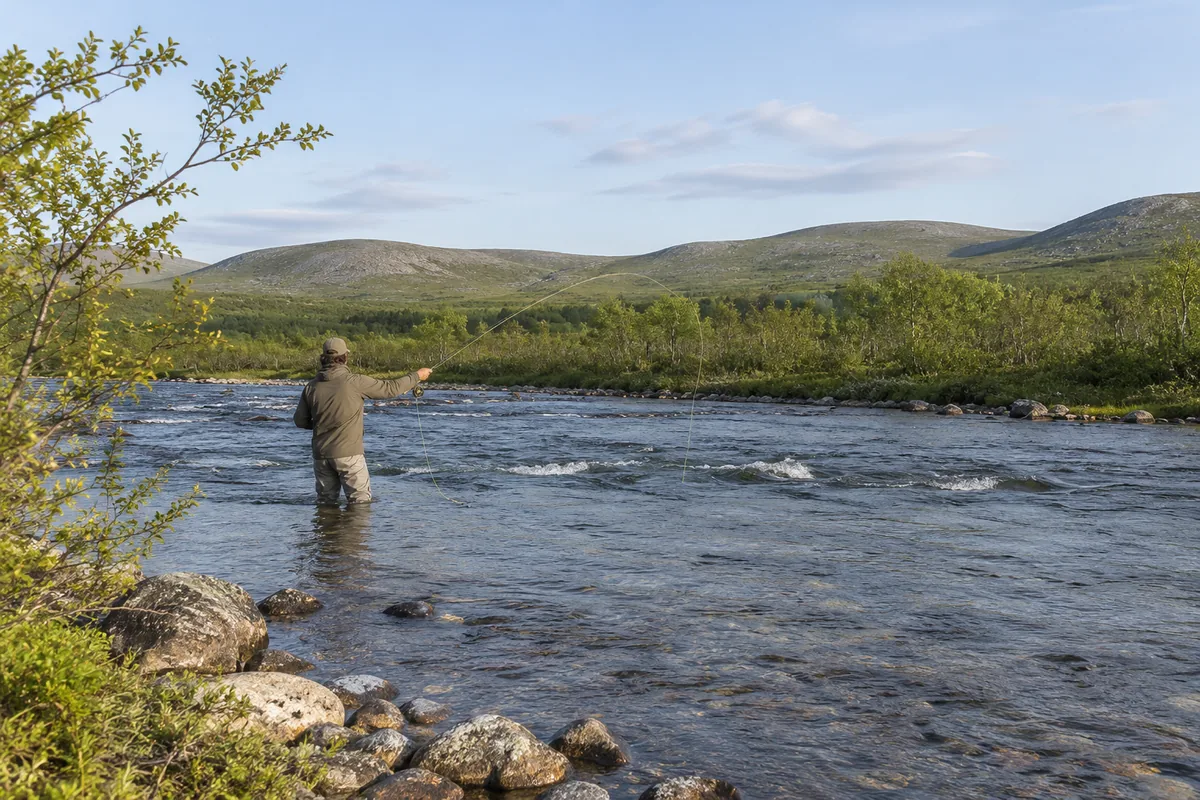
- Char, trout and grayling: They are the most sought-after species. The waters are often low in nutrients and the fish grow slowly. So keep only what you need that day.
- Salmon: It ascends the Torne, Kalix and Lainioälven. Few salmon have recently come into the Torne älv, and the forecast for 2026 was also poor (Länsstyrelsen Norrbotten).
- Winter: On the ice you catch char, in the forest country also grayling, whitefish, perch, pike and burbot. You catch baitfish in the same lake, because you must not carry live fish from one water to another.
The catch calendar shows when each species bites best.
Papers and permit Municipal permit via NatureIT
The right of public access (Jedermannsrecht) does not cover fishing (Naturvårdsverket). For the state waters above the Odlingsgräns and on the reindeer-grazing fells you buy the permit online in the system NatureIT, through which the Länsstyrelse manages the waters, or at local sales points. Take it with you, saved or printed, because reception on the fells is often poor.
- Norrbotten: The permit covers one rod with one line and at most three hooks per person. The leaflets for each municipality show maps and local rules, also in English. Some waters are open only from 1 January to 2 May and from 1 June to 31 December.
- Girjas sameby: In the area of this Sami village the Gällivare and Kiruna permits do not apply; the boundary is in the permit leaflets. Where you may fish there, ask the Länsstyrelse.
- Quota waters: They need a permit of their own. In Norrbotten you apply from 1 January to 31 March, and in April lots are drawn.
- Västerbotten: One rod per person. Children up to 16 fish free of charge when accompanied by an adult with a permit.
- Trolling: In Norrbotten on Stora Lulevatten, Tjeggelvas, Hornavan and Torneträsk, with a municipal permit only. Three rods per angler and six per boat are allowed.
- Rivers below the fells: Here the rights holders issue the permits and may tighten the rules. On the border stretch of the Torne älv there is a joint permit of the rights holders, but it applies only on parts of the stretch. More under Fishing permit and water map.
Special rules Bait ban in running water, autumn spawning break
Fells in Norrbotten: Minimum sizes and daily limits are in the box.
- In running water worm, maggot, prawn and baitfish are banned. From 1 September to 31 December fishing there is suspended because the trout spawn.
- For salmon in the Lainioälven you fish only with a gill tag with the Kiruna permit, from 8 June to 31 August. You keep no more than one salmon per season, none in August.
- Keeping the catch alive in a cage and selling it are banned.
Fells in Västerbotten: Running water is closed from 15 September to 15 October. Sizes and daily quantities for each water are in the permit sheets.
Rivers flowing into the Gulf of Bothnia: From the coast to the first migration barrier the regulation FIFS 2004:37 applies. With hand tackle you keep one salmon and one trout per day. Both are protected in Norrbotten from 1 September to 31 December, except in the Lule älv as far as Boden.
Torne älv on the border (Fischereiverordnung, Kap. 2 a, leaflet: border stretch 2026)
- Salmon 2026: from 8 June 6 pm to 15 August 11 pm. After that until 25 August only with barbless hooks, and salmon over 65 cm go back. In 2026 you keep no more than two salmon. From Sunday 6 pm to Monday 6 pm salmon fishing is suspended.
- Trout and grayling: Trout are protected all year, and in the Könkämä- and Muonioälven you must not even fish for them deliberately. Grayling have a closed season from 1 April to 31 May.
- Autumn: From 15 September to 15 December all fishing is banned, except for burbot.
Closed areas: In Sarek, Muddus and Stora Sjöfallet fishing is banned, in Padjelanta only in designated waters with a fishing permit (NFS 2013:10). In the Abisko National Park you must not fish either. The Gällivare permit does not apply in the Sjaunja nature reserve, except on the Tuvva lakes and part of the Sjaunjaälven. Other excluded waters (undantagsvatten) and larger areas with a fishing ban are marked in every permit leaflet.
On to Norway: Salmon from the Torne and Kalix älv can carry the parasite Gyrodactylus salaris. For salmon in Norway it is deadly. Dry or disinfect your tackle before every change of water.
As at: October 2026. In running water on the fells in Norrbotten you do not fish at all from 1 September to 31 December, not even for species other than trout. Many rules on the Torne älv apply only for 2026 or until May 2027. Before the season check the current leaflet of the Länsstyrelse and the leaflet that comes with your permit.
Safety
- Weather and terrain: On the fells the weather changes quickly, and mobile reception is partly weak (Sveriges nationalparker). Take a current weather forecast, a map and compass and tell someone which area you are fishing in (Fjällsäkerhetsrådet, the Fell Safety Council at the Naturvårdsverket). More at Thunderstorms and weather.
- Water: In running water wade no deeper than your knees and never get into a boat or canoe without a lifejacket. After a late snowmelt, raging streams are hard to wade. More at Bank and waders.
- Ice: Ice fishing calls for ice picks, and many also wear a flotation suit. The ice is especially treacherous early and late in winter. A ski or snowmobile track does not show that the ice holds today. Take particular care on reservoirs. From mid-May the streams rise and the ice no longer holds safely.
- Reindeer: Keep your distance and keep dogs on a lead, especially from April to June.
Related
- Fishing the river, fishing the lake and Fishing holiday in Sweden
- Arctic char, trout, grayling and salmon in the fish lexicon
- Fly fishing, Spinning and Releasing fish
Sources
- Länsstyrelsen Norrbotten: Angeln im Fjäll, Beilagen zu den Angelkarten 2026, darunter Kirunakortet 2026 und Gällivarekortet 2026, sowie Angeln an Küste und Flüssen mit den Faltblättern Grenzstrecke 2026 und Lachs und Forelle 2026
- Länsstyrelsen Västerbotten: Angeln im Fjäll; Verkauf der Fjällkarten: NatureIT
- Havs- och vattenmyndigheten: FIFS 2004:37, Fischerei im Süßwasser (Fassung 12.06.2026)
- Fiskelag (1993:787) und Verordnung (1994:1716) über die Fischerei; gemeinsames Erlaubnisgebiet Torne, Muonio und Könkämä
- Naturvårdsverket: NFS 2013:10, Vorschriften für Muddus, Padjelanta, Sarek und Stora Sjöfallet, Jagd und Fischen im Jedermannsrecht, Fjällsäkerhetsrådet: Angeln im Fjäll und Sveriges nationalparker: Sarek, Anreise Sarek, Regeln Abisko
Guide without guarantee, as at October 2026. What counts are the regulation FIFS 2004:37 of the Havs- och vattenmyndigheten, the Swedish fisheries regulation for the Torne älv, the rules of the fishing permits of the Länsstyrelser Norrbotten and Västerbotten as currently in force and the rules of the national parks.