
Knowledge – Fish
Turbot: Features, fishing spots, season and baits
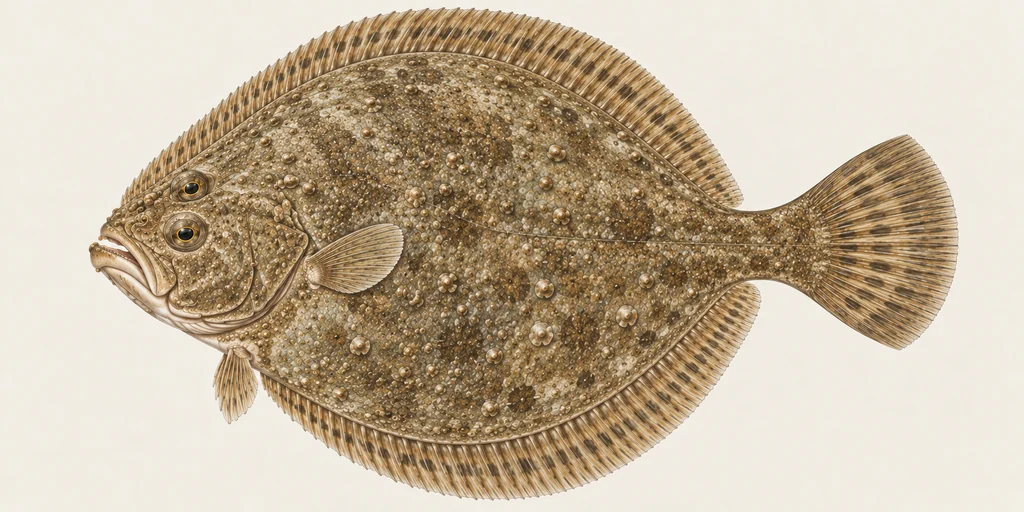
The turbot (Scophthalmus maximus) is the largest flatfish on the German coasts. It has an almost round body and, instead of scales, hard tubercles on the eyed side. As a fish hunter it rarely bites on worm; if you want to catch one, you have to fish for it deliberately with fish baits.
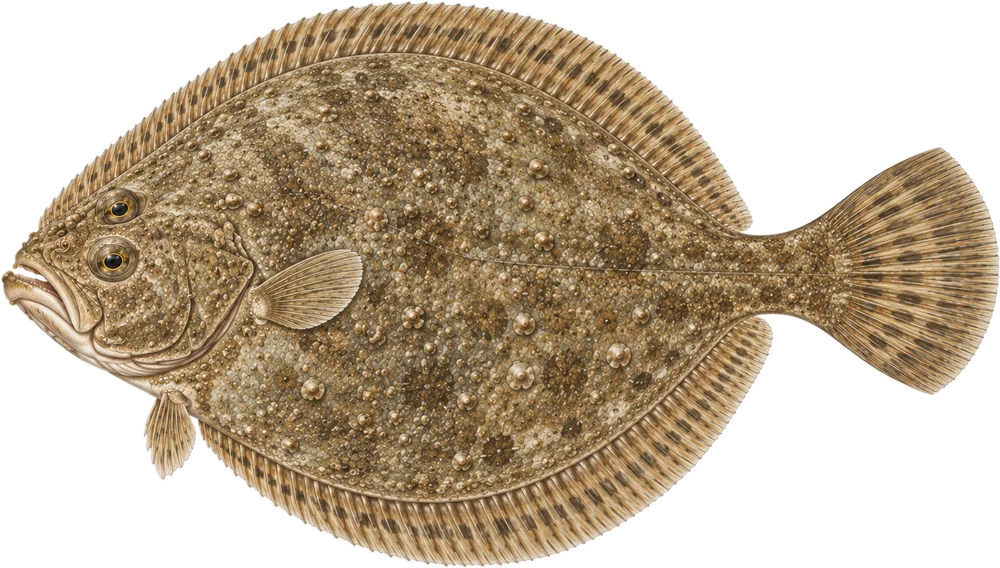
In short: The best time for turbot is September to October, especially in the evening and at night. Good spots on the coast: sandy bottom, stony mixed ground and ledges. Proven baits: sand eel and mackerel strips in motion on the bottom, behind an attractor spoon or spoon, also a pilker with fish strips. The largest flatfish on the German coasts, recognisable by its almost round body and the bony tubercles on the eyed side. In Schleswig-Holstein a 30 cm minimum size (Mindestmaß); the Baltic closed season (Schonzeit) (1.6.–31.7.) is suspended until the end of 2026 (as of October 2026). Step by step: Fishing for turbot.
- Almost circular, deep body with both eyes on the left side
- Eyed side without scales but with numerous stone-like bony tubercles
- Protruding lower jaw, dorsal fin begins in front of the upper eye
Catch chances through the year
- Hardly any chance
- Possible
- Good
- Peak season
- Spawning (observe the closed season)
Editorial assessment for waters in Germany, not a measured value and no guarantee. Spawning time is not the same as the legal closed season.
Species profile and sources in the catch calendarAll species compared month by monthThe rules of your federal state
How to recognise it
The turbot has an almost circular, deep body of a kind no other native flatfish shows. It is left-eyed: both eyes lie on the left side, and the dorsal fin begins in front of the upper eye. The lower jaw protrudes.
The eyed side has no scales. Instead it carries large, stone-like bony tubercles, which gave the species its German name. The upper side is dark and adapts its colour to the ground, and the blind side is pale.
Usual sizes are 50 to 70 centimetres, and females grow larger than males. According to FishBase and the Thünen Institute, exceptional fish reach a metre, 25 kilograms and 25 years. Blinker gives about 20 kilograms as the maximum weight and an age of up to 35 years. The turbot is among the fastest-growing flatfish and reaches about 30 centimetres within three years.
The closest relative is the brill. It is more oval, stays smaller and has a smooth, scaled eyed side without tubercles. Running a hand over the skin is enough to tell them apart.
Plaice, flounder and dab are usually right-eyed and clearly more elongated; only among flounders are there also fish with the eyes on the left.
Side by side
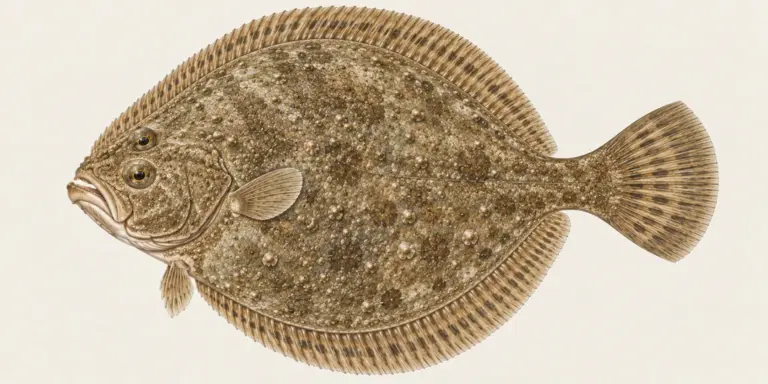
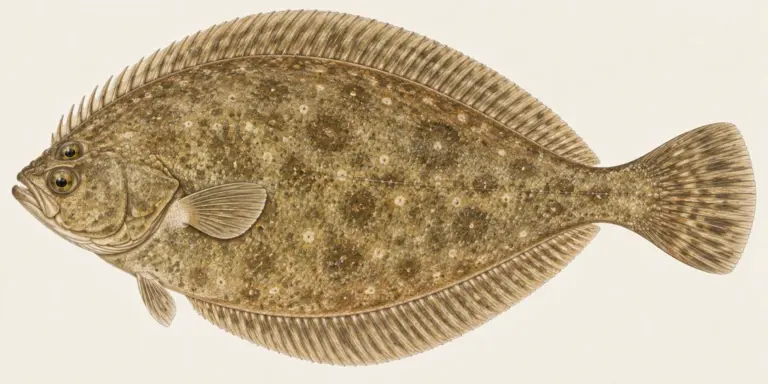
AI-generated illustrations.
Where it lies
The turbot lives on almost all European coasts from the Arctic Circle to Morocco, in the Mediterranean and in large parts of the Baltic. It lies on sand, stones or mixed ground, usually at depths of 20 to 70 metres, and also copes well in brackish water.
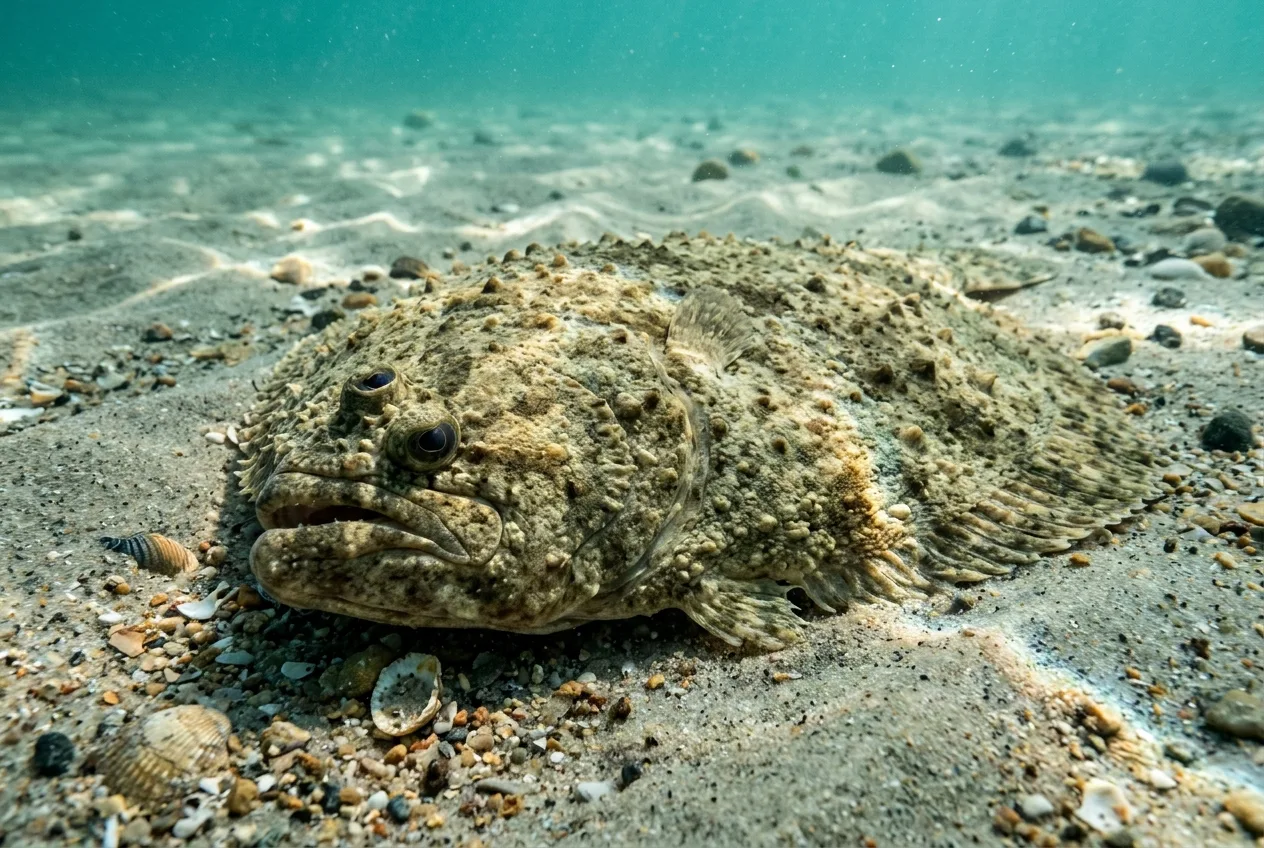
For anglers, structures count: reef edges, wrecks, channels and banks, in other words places where uniform ground suddenly changes. The turbot is faithful to its spot and leaves it only for short feeding trips. Current in straits, off headlands and on underwater slopes is an advantage, and stony ground with sand and plants is especially good.
In the Baltic the species occurs mainly in the west and south. According to the Thünen Institute there are many small fish there, while in the east the stock is declining.
Holding spots in the picture
Choose the season and time of day: the picture shows where the species stands then. Spots outlined in red apply only in the chosen season. Tap a fish or a spot in the list to bring it closer. The picture is schematic and AI-generated, every water is different.
Chance of a catch in springgood
Chance of a catch in summerpossibleSpawning, observe closed seasons
Catch chance in autumnPeak season
Catch chance in winterhardly any
- J
- F
- M
- A
- M
- J
- J
- A
- S
- O
- N
- D
Spawning season
Not the main time Turbot are fished for on purpose at dusk and at night.
Not the main time Turbot are fished for on purpose at dusk and at night.
Active time Turbot are fished for on purpose at dusk and at night.
Active time Turbot are fished for on purpose at dusk and at night.
On the coast
Surf close to the shore
Turbot are only found here in spring.
gully in front of the sandbank
Turbot are found here all year round.
Sandy bottom
Turbot are found here all year round.
Stony mixed ground
Turbot are found here all year round.
Drop-off
Turbot are found here all year round.
Wreck, reef
Turbot are found here all year round.
The turbot lies on sand, stones or mixed ground and lurks where the bottom suddenly changes: on reef edges, at wrecks, in gullies and on banks. Stony ground alternating with sand and plants is especially good. Sandy flats right beside deeper gullies it uses as a route for sandeels.
Spring: chances according to the catch calendar are possible in March and good in April and May. In spring the spawning fish move into shallower water. On Sylt they stand from April to the end of May so shallow that the baits lie just behind the edge of the surf.
Summer: chances according to the catch calendar are good in June and possible in July and August. This is when spawning takes place, so observe the closed seasons.
Autumn: catch chance according to the catch calendar is peak season in September and October, good in November.
Winter: according to the catch calendar, catch chances are possible in December, hardly any in January and February.
Depth: The turbot usually lies at 20 to 70 metres. Fish ready to spawn stay deeper, down to about 80 metres, and move into shallower water in spring.
Size comparison: AI-generated drawing, schematic.
How it hunts and spawns
The turbot is an ambush hunter and feeds mainly on fish: above all sand eels and gobies, also sprats and herring, and to a lesser extent crustaceans and mussels. Worms hardly matter for big fish.
Spawning takes place in a large part of the range between April and August, in the Atlantic mostly from May to July. According to the Norwegian Institute of Marine Research, fish ready to spawn stand deep, down to nearly 80 metres, and move into shallower water in spring. Eggs and larvae drift freely. At 2,5 centimetres the young in shallow water switch to life on the bottom, and the right eye migrates to the left side.
When it bites
There is no sharply defined season. For the North Sea and the Channel Islands, Blinker names May and the autumn months as the best time, while the warm months of July and August often fall off. May falls in the spawning season, which is why the catch calendar rates it as “good” and autumn as the main season. In spring the spawners move into shallower water.
In the Baltic turbot are usually caught by chance while pilking for cod or fishing with natural bait for plaice and flounder in medium-deep water. The North Sea and the waters around Britain offer clearly better chances.
Today’s catch index needs JavaScript. Season and spawning time are in the catch calendar.
You will find the monthly overview of all species and the water temperature check in the catch calendar.
What you catch it with
Step by step: Fishing for turbot: tips on bait, rig and tackle – season, spots, baits, tackle and rules on one page.
The best bait is the sand eel, fresh or frozen. A strip of mackerel also catches well. Movement is important: a bait hanging motionless leaves the turbot cold. Lugworm and ragworm hardly catch at all.
From a boat, a running-weight rig as for plaice and flounder works well, only stouter, with a large attractor spoon or spoon in front of the bait. For this Blinker describes hooklengths from a good metre up to three or four metres; let long hooklengths down slowly so that they do not twist. Two hooks hold the fish bait better. Medium-sized pilkers also catch, preferably with a strip of mackerel on the treble.
Surf anglers have chances on the Dutch and British North Sea coasts with fish strips in the current. More on baits under Animal natural baits and Metal lures.
Do not strike at once: A turbot is not a cod. Blinker advises waiting about half a minute after the bite and perhaps giving line before you make contact and strike.
Careful at the surface: Big turbot set their broad body against the pull. Play them especially gently near the surface and keep a large landing net ready.
Take the bycatch: A turbot rig with fish bait often also catches big plaice and flounder.
Suitable lures
Sand eel and mackerel strips in motion on the bottom, behind an attractor spoon or spoon, also a pilker with fish strips.
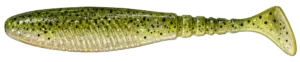
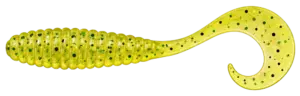

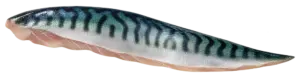
AI-generated illustrations. A click opens the lure’s page.
Rigs for these baits: natural bait rig for the sea.
Worms hardly catch; wait a moment after the bite.
What you can make of a turbot in the kitchen
The turbot is regarded as an excellent and expensively traded food fish. Its flesh is firm, white and moderately oily, and it has few bones. Because of the large head and the strong skeleton, though, there is a lot of waste when preparing it. It is usually filleted and then fried or poached. The cuts for flatfish are explained in Filleting fish, the preparation in Gutting fish.
Head and bones do not belong in the bin; they make a very good stock. The flesh at the fins is also considered especially fine. In classic cooking large specimens were steamed whole or boiled in a court-bouillon. Like all sea fish, the turbot can carry roundworm larvae, which die on deep freezing and heating.
What you need to observe
The 2025 Red List of Marine Fishes of Germany lists the turbot as not threatened; before that it was on the early-warning list. For the whole Baltic the Helsinki Commission (HELCOM) lists it on the early-warning list. According to the Thünen Institute there are no maximum catch quantities for the Baltic stock, and fishing mortality there is rated as too high. In Schleswig-Holstein a minimum size (Mindestmaß) of 30 centimetres applies to turbot. The state suspended the Baltic closed season (Schonzeit) from 1 June to 31 July until 31 December 2026 by general order (Allgemeinverfügung) (as of October 2026).
Closed seasons (Schonzeit), minimum sizes (Mindestmaß) and harvest windows are set by the federal states (Bundesland) and by the fisheries authorities (Fischereibehörde) of the neighbouring coastal countries (Denmark, Norway, Poland). They vary by type of water, stretch of coast and time of year. We only give figures with a date and a source; the fisheries regulation of your federal state and your fishing permit (Erlaubnisschein) are always what counts. In Schleswig-Holstein they are set out in the Küstenfischereiverordnung and time-limited general orders. A list of links to the official sources is in the catch calendar.
A fish of legal size that you want to keep, you stun and kill immediately in line with animal welfare rules. Protected or undersized fish you unhook, if possible, with wet hands in the water and release gently.
What closed season, minimum size and harvest slot mean and where to find them is explained on the page Closed season and minimum size explained.
What state law prescribes for closed season and minimum size for this species is in the “At a glance” box on the state page for Schleswig-Holstein. For the other states our overview does not list this species; there the state fisheries regulation is what counts.
Frequently asked questions (FAQ)
How do I tell turbot and brill apart?
The turbot is almost round and has hard bony tubercles instead of scales. The brill is more oval and smoothly scaled on the eyed side.
Which bait catches turbot?
Fish. Best a sand eel, also mackerel strips, each presented in motion. Big turbot hardly take worms.
When is the best time for turbot?
On the North Sea May and the autumn months. In high summer catches often fall off.
Sources
The rating of catch chances is an editorial assessment. The facts come from these sources, and the text is worded in our own words. The illustration is an original design by Angel Momente in the style of a natural history plate (AI-generated, see the AI notice).
- Thünen-Institut, Fischbestände online: Steinbutt (Biologie, Merkmale, Höchstwerte, IUCN)
- Thünen-Institut, Fischbestände online: Ostsee-Steinbutt (Bestand, Management)
- FishBase: Scophthalmus maximus (Größe, Alter, Tiefe, Laichzeit, Nahrung)
- Havforskningsinstituttet: Piggvar (Steinbutt; Laichwanderung, Entwicklung, Nahrung)
- Blinker: Steckbrief Steinbutt (Merkmale, Plätze, Saison, Köder, Montage)
- Blinker: Hochphase zum Angeln auf Steinbutt (Sandaal, Zweihakenmontage, Strömung)
- Rote-Liste-Zentrum: Steinbutt (Rote Liste der Meeresfische Deutschlands 2025: ungefährdet)
- Land Schleswig-Holstein: Welche Mindestmaße und Schonzeiten gelten in Schleswig-Holstein?
- Thünen-Institut, Fischbestände online: Flunder
- Land Schleswig-Holstein: Küstenfischereiverordnung (KüFVO), Anlage 1 Mindestmaße und Schonzeiten
- LLnL Schleswig-Holstein: Allgemeinverfügung zur Aussetzung von Mindestmaßen und Schonzeiten in der Ostsee (01.01.2024–31.12.2026)
- Store norske leksikon: piggvar (Steinbutt)
- Lex.dk (Den Store Danske): pighvarre (Abschnitt Udnyttelse)
- BZfE: Fisch und Meeresfrüchte, Gesundheit und Umwelt
- Blinker: Steinbutt angeln auf Sylt
- Blinker: Sandaal, der beste Köder für Wolfsbarsch und Steinbutt
- Blinker extra: Die Fische der Ostsee und wie man sie beangelt (Stand 2007)
Created with AI support from the sources listed. Figures only appear in the text if a source gives them. Last updated: 27 October 2026. Found a mistake? Write to us. Who is behind this site: About me.
More in the lexicon
- All fish species at a glance
- Catch calendar – month, water temperature and profile for 93 species
- Line calculator – breaking strain after the knot, drag guideline, backing
- Angling methods