
Knowledge – Fish
Brill: Features, difference from turbot, baits
The brill (Scophthalmus rhombus), also called Kleist on the German coast, is the smaller and slimmer relative of the turbot. It lives on sandy ground in the North Sea and western Baltic and lies in wait there for small fish. Anglers mostly catch it as rare bycatch; it is fished for deliberately mainly in England.
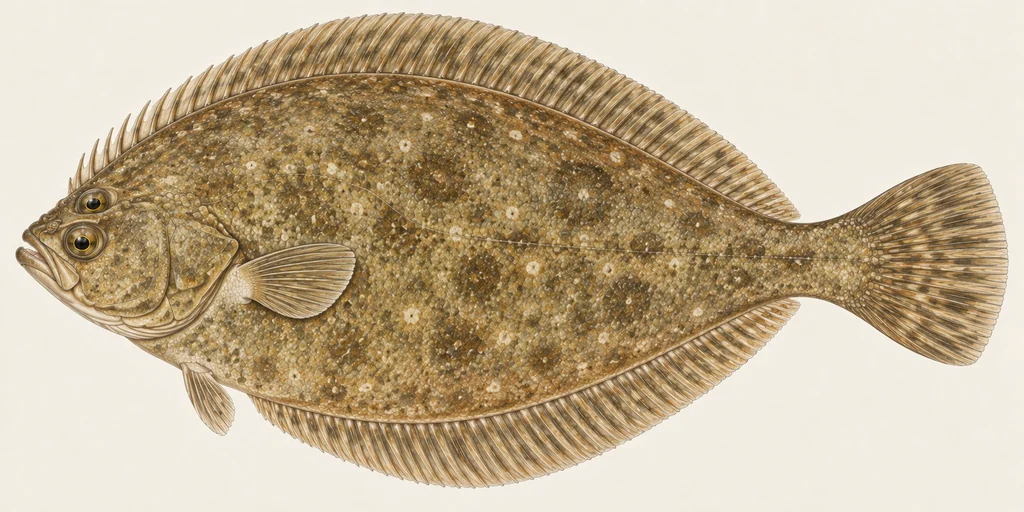
In short: The best time for brill is May to September. Good spots on the coast: sandy bottom and stony mixed ground. Proven baits: sand eel and mackerel strips on the bottom, as bycatch also a soft plastic on a jig head. Resembles the turbot but has a smooth, scaled eyed side without bony tubercles and a more oval body. In Schleswig-Holstein a 30 cm minimum size (Mindestmaß); the Baltic closed season (Schonzeit) (1.6.–31.7.) is suspended until the end of 2026 (as of October 2026). Step by step: Fishing for brill.
- Oval, slimmer body than the turbot, both eyes on the left side
- Eyed side with small, smooth scales and no bony tubercles, olive to sand-coloured with light and dark speckles
- Dorsal fin begins on the head, already in front of the eyes
Catch chances through the year
- Hardly any chance
- Possible
- Good
- Peak season
- Spawning (observe the closed season)
Editorial assessment for waters in Germany, not a measured value and no guarantee. Spawning time is not the same as the legal closed season.
Species profile and sources in the catch calendarAll species compared month by monthThe rules of your federal state
How to recognise it
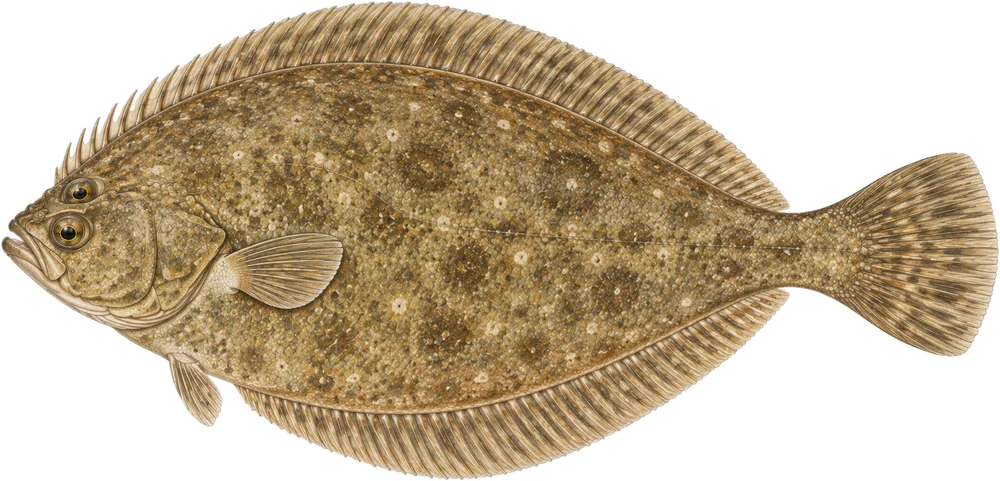
The brill is a left-eyed flatfish: both eyes lie on the left side of the body, and it lies on the bottom on its right side. Its body is oval and slimmer than that of the almost circular turbot. The dorsal fin begins on the head, already in front of the eyes.
It owes its German name to the skin. The eyed side carries small, smooth scales and no bony tubercles. Its colour adapts to the ground, often olive-green or sand-coloured with light and dark spots. On pale sand the same fish looks much lighter than on dark ground. The blind side is white.
According to FishBase the brill grows to 75 centimetres in length and 8 kilograms in weight, with around 30 centimetres usual. Blinker already counts a fish of just under 60 centimetres as a real beauty. On age the figures differ: FishBase gives six years at most, while the Norwegian Institute of Marine Research found a female of 22 years.
Brill and turbot compared
| Feature | Brill | Turbot |
|---|---|---|
| Body shape | oval, slimmer | almost circular |
| Eyed side | small smooth scales | no scales, stone-like tubercles |
| Size | up to 75 cm (FishBase) | up to 100 cm (Thünen Institute) |
| Spawning season | May to July (Norway) | April to August |
The brill is confused almost only with the turbot. Run your hand over the eyed side: the turbot has no scales there but hard, stone-like tubercles. In the brill the skin is smooth. In addition, the turbot is almost circular and the brill clearly more oval.
You tell both left-eyed species from plaice, flounder and dab by the side of the eyes. These three are usually right-eyed, brill and turbot left-eyed. In the flounder, however, the eyes are on the left in up to three out of ten fish. Then the skin helps: the flounder is rough along the lateral line and at the base of the dorsal and anal fins, the brill smooth.
Side by side
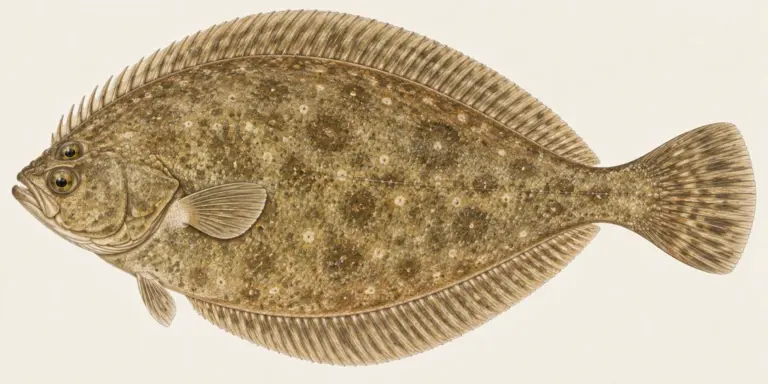
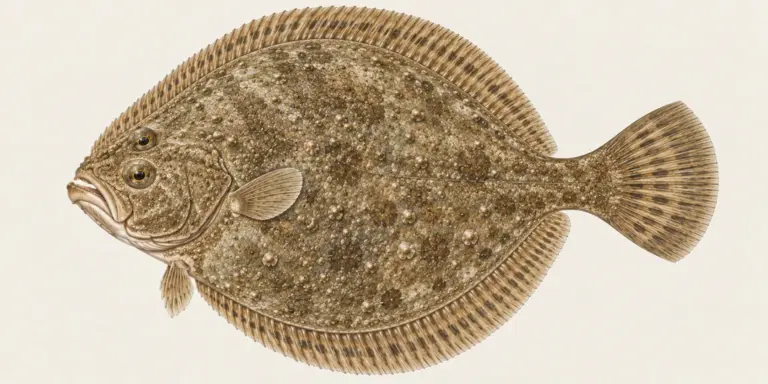
AI-generated illustrations.
Where it lies
The brill lives in the eastern Atlantic from Norway and Iceland to Morocco, in the Mediterranean and in the Black Sea. In Germany it occurs in the North Sea and the western Baltic.
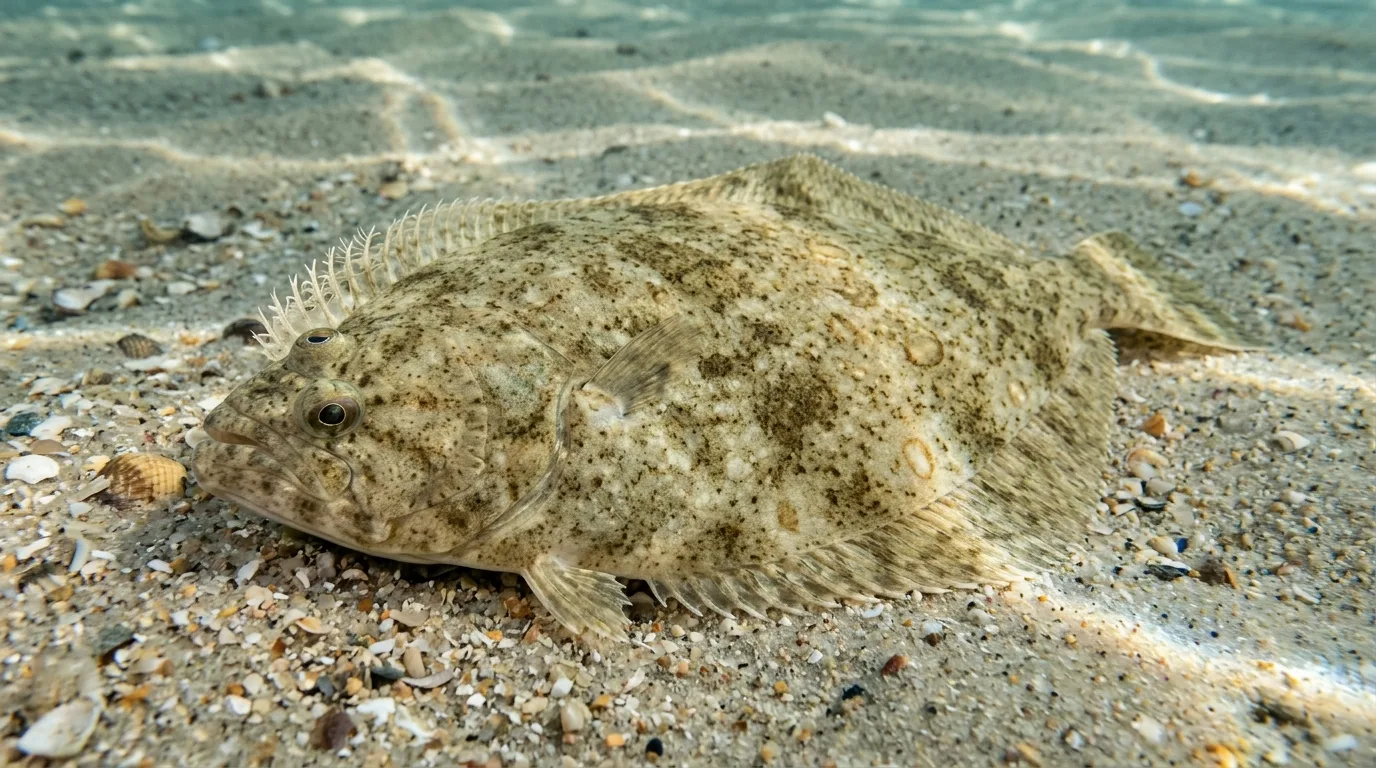
It lies on sand, mud or mixed ground. FishBase gives depths of 5 to 50 metres. Young brill stay close to the beach. From about ten centimetres they move on to sandbanks further out, where they wait for prey in the current.
Holding spots in the picture
Choose the season and time of day: the picture shows where the species stands then. Spots outlined in red apply only in the chosen season. Tap a fish or a spot in the list to bring it closer. The picture is schematic and AI-generated, every water is different.
Catch chances in springpossible
Chance of a catch in summergoodSpawning, observe the closed seasons
Catch chance in autumnpossible
Catch chance in winterhardly any
- J
- F
- M
- A
- M
- J
- J
- A
- S
- O
- N
- D
Spawning season
On the coast
Surf close to the shore
Brill is here in summer only.
Sandy bottom
Brill is here all year round.
Stony mixed ground
Brill is here all year round.
The brill lies on the bottom on sand or mixed ground and lies in wait there for small fish. Bigger ones keep further out on sandbanks, only very young ones stay close to the beach.
Spring: catch chances according to the catch calendar are possible in March and April, good in May.
Summer: chances according to the catch calendar are good. Spawning falls in this period, so observe closed seasons. On Irish and Welsh sandy beaches it takes a ground bait mainly in summer, but it has become scarcer in Ireland.
Autumn: according to the catch calendar, the chance of a catch is good in September and possible in October and November.
Winter: catch chance according to the catch calendar hardly any.
Depth: In Norwegian waters the brill usually lies at depths between 4 and 80 metres on soft ground.
Size comparison: AI-generated drawing, schematic.
How it hunts and spawns
The brill is an ambush hunter. Well camouflaged, it lies on the bottom and waits until the current carries prey in front of its mouth. Young fish eat small crustaceans, bigger brill mainly gobies, sand eels and small herring, plus larger crustaceans.
Spawning takes place in late spring and early summer, according to the Norwegian Institute of Marine Research from May to July at depths of 10 to 30 metres. The eggs drift freely in the water thanks to oil droplets they contain. The larvae first swim upright and only take on the flatfish shape at 2 to 3,5 centimetres.
When you catch it
No fixed angling season is described for the brill. To spawn, the fish stand in late spring and early summer at depths of 10 to 30 metres; the rest of the time they hunt on sandbanks and sand flats.
Many catches are chance. Blinker reports a fish 61 centimetres long that bit off Großenbrode at a depth of 12 metres while jigging for cod.
Today’s catch index needs JavaScript. Season and spawning time are in the catch calendar.
You will find the monthly overview of all species and the water temperature check in the catch calendar.
What you catch it with
Step by step: Fishing for brill: how to catch it, step by step – season, spots, baits, tackle and rules on one page.
Off the German and Dutch coasts hardly anyone fishes for brill deliberately; the fish are mostly bycatch when fishing for flatfish or cod. In England, however, boat anglers anchor on sandbanks and offer a sand eel or a strip of mackerel on the bottom.
Because larger brill eat mainly small fish, sand eel and a strip of mackerel on the bottom match their natural prey. When jigging for cod with a soft plastic on a jig head, it can also take hold. More under Animal natural baits and Soft baits. Irish angling guides also mention worm alongside fish baits, but the brill remains a rare catch there.
Check by hand: Smooth or knobbly: a pass of the hand over the eyed side tells brill and turbot apart at once. Different rules can apply to the two.
Choose a fish bait: Bigger brill eat small fish. A sand eel or a strip of mackerel on the bottom comes closest to their prey.
Suitable lures
Sand eel and mackerel strips on the bottom, as bycatch also a soft plastic on a jig head.
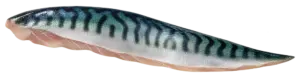
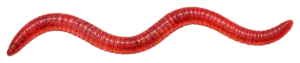
AI-generated illustrations. A click opens the lure’s page.
Rigs for these baits: natural bait rig for the sea.
Rarely fished for deliberately, mostly bycatch when fishing for flatfish or cod.
How brill tastes and what to do with it
The brill is a tasty food fish, even if it is less in demand than the turbot. Its flesh is white, moderately oily and somewhat loose, and the quality is considered fairly good. It is best suited to frying and poaching. After gutting you break it down like other flatfish; the cuts are shown in Filleting fish. Flatfish under about 35 centimetres often go into the pan whole; for that you cut off the fin fringes and the tail fin with strong scissors.
Like all sea fish, the brill can carry roundworm larvae. They die on deep freezing and heating, so well-cooked fish is safe for healthy people.
What you need to observe
The brill is listed in the 2025 Red List of Marine Fishes of Germany as not threatened, and the International Union for Conservation of Nature (IUCN) classes it as of least concern. For the North Sea the International Council for the Exploration of the Sea (ICES) rates the stock as large enough but fishing mortality as too high. In Schleswig-Holstein a minimum size (Mindestmaß) of 30 centimetres applies to brill. The state suspended the Baltic closed season (Schonzeit) from 1 June to 31 July until 31 December 2026 by general order (Allgemeinverfügung) (as of October 2026).
Closed seasons (Schonzeit), minimum sizes (Mindestmaß) and harvest windows are set by the federal states (Bundesland) and by the fisheries authorities (Fischereibehörde) of the neighbouring coastal countries (Denmark, Norway, Poland). They vary by type of water, stretch of coast and time of year. We only give figures with a date and a source; the fisheries regulation of your federal state and your fishing permit (Erlaubnisschein) are always what counts. In Schleswig-Holstein they are set out in the Küstenfischereiverordnung and time-limited general orders. A list of links to the official sources is in the catch calendar.
A fish of legal size that you want to keep, you stun and kill immediately in line with animal welfare rules. Protected or undersized fish you unhook, if possible, with wet hands in the water and release gently.
What closed season, minimum size and harvest slot mean and where to find them is explained on the page Closed season and minimum size explained.
Frequently asked questions (FAQ)
What is the difference between brill and turbot?
The brill has a smooth, finely scaled eyed side and an oval body. The turbot is almost round and carries hard bony tubercles instead of scales.
How big does a brill grow?
According to FishBase up to 75 centimetres and 8 kilograms. Fish around 30 centimetres are usual, and just under 60 centimetres already counts as a real beauty.
Which bait catches brill?
Small fish and fish strips, for example sand eel or mackerel on the bottom. In the Baltic it occasionally bites while jigging for cod too.
Sources
The rating of catch chances is an editorial assessment. The facts come from these sources, and the text is worded in our own words. The illustration is an original design by Angel Momente in the style of a natural history plate (AI-generated, see the AI notice).
- FishBase: Scophthalmus rhombus (Größe, Alter, Tiefe, Merkmale, IUCN)
- Havforskningsinstituttet: Slettvar (Glattbutt; Laichzeit, Tiefe, Alter)
- Wikipedia: Glattbutt (Merkmale, Verbreitung, Entwicklung)
- Blinker: Steckbrief Glattbutt (Aufenthalt, Nahrung, Unterschied zum Steinbutt, Angeln)
- Blinker: Glattbutt vor Großenbrode (Beifang beim Jiggen auf Dorsch)
- Rote-Liste-Zentrum: Glattbutt (Rote Liste der Meeresfische Deutschlands 2025: ungefährdet)
- Thünen-Institut, Fischbestände online: Steinbutt (zum Vergleich)
- Land Schleswig-Holstein: Welche Mindestmaße und Schonzeiten gelten in Schleswig-Holstein?
- FishBase: Platichthys flesus
- Inland Fisheries Ireland: South West Sea Angling Guide 2020 (Glattbutt, Conger: Köder und Plätze)
- Inland Fisheries Ireland: Flatfish (Glattbutt im Sommer an Stränden)
- Fishing in Wales: Brill (Glattbutt an Sandstränden, Fischköder)
- Land Schleswig-Holstein: Küstenfischereiverordnung (KüFVO), Anlage 1 Mindestmaße und Schonzeiten
- LLnL Schleswig-Holstein: Allgemeinverfügung zur Aussetzung von Mindestmaßen und Schonzeiten in der Ostsee (01.01.2024–31.12.2026)
- Store norske leksikon: slettvar (Glattbutt)
- Lex.dk (Den Store Danske): slethvarre (Abschnitt Udnyttelse)
- Blinker: Plattfisch-Trip auf der Ostsee, was wirklich mit muss
- BZfE: Fisch und Meeresfrüchte, Gesundheit und Umwelt
- LAVES Niedersachsen: Parasiten in Fischen und Fischereierzeugnissen, ein Problem?
Created with AI support from the sources listed. Figures only appear in the text if a source gives them. Last updated: 27 October 2026. Found a mistake? Write to us. Who is behind this site: About me.
More in the lexicon
- All fish species at a glance
- Catch calendar – month, water temperature and profile for 93 species
- Line calculator – breaking strain after the knot, drag guideline, backing
- Angling methods