
Knowledge – Fish
Three-spined stickleback: Features and way of life
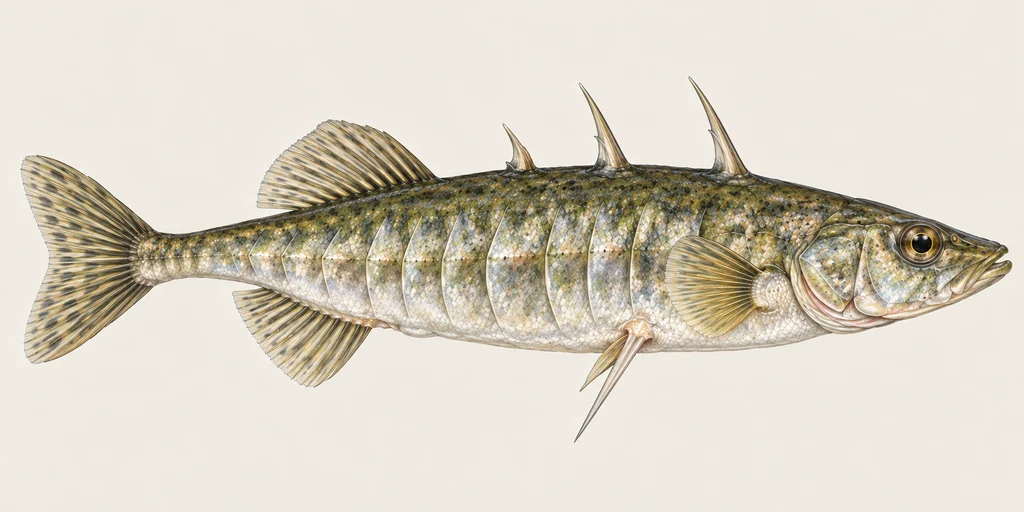
The three-spined stickleback (Gasterosteus aculeatus) is a small fish with three free dorsal spines and bony plates instead of scales. It is known for the male’s nest building and brood care. In Germany it is not threatened, is widespread and is not a target fish.
In short: Not threatened and not a target fish. Do not confuse it with the nine-spined stickleback, which is protected all year round in Bavaria.
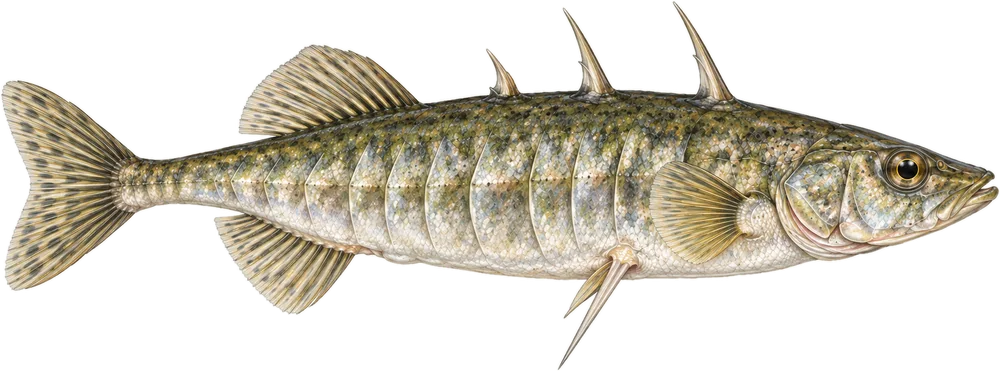
- Three separate, movable spines in front of the second dorsal fin set far back
- Pelvic fins as sharp, erectable spines
- Row of bony plates on the flanks instead of scales
Catch chances through the year
- Hardly any chance
- Possible
- Good
- Peak season
- Spawning (observe the closed season)
Editorial assessment for waters in Germany, not a measured value and no guarantee. Spawning time is not the same as the legal closed season.
Species profile and sources in the catch calendarAll species compared month by monthThe rules of your federal state
How to recognise it
The stickleback is strongly compressed from the sides, with a large head, a pointed snout and a small, slightly upturned mouth. It has no scales. Instead, the flanks carry bony plates. How many there are depends on the form: migratory fish from the sea are fully armoured, with up to 37 plates and a distinct keel on the tail stalk.
In front of the second dorsal fin, set far back, there are usually three, rarely four, separate, movable spines. The pelvic fins, too, have been turned into sharp spines that the fish can erect. That makes it an unpleasant mouthful for predatory fish.
The back and flanks are brown-grey or olive green, often with dark cross bands, and the underside is silvery. At spawning time the throat, chest and belly of the male turn bright red. The stickleback usually grows to 4 to 6 centimetres. FishBase gives 8 centimetres as the maximum in fresh water and 11 centimetres in the sea.
Side by side: three-spined or nine-spined stickleback?
| Feature | Three-spined stickleback | Nine-spined stickleback |
|---|---|---|
| Dorsal spines | 2 to 4, usually 3 | 6 to 12 |
| Bony plates | Row along the flanks, strengthened into a keel on the tail stalk | Flanks without plates, just a long keel on the very slender tail stalk |
| Male at spawning time | Throat and chest red to orange | black, especially under the chin |
| Base colour | in fresh water mostly marbled brown or greenish | pale green to olive with dark spots above, silver below |
It can be mistaken above all for the nine-spined stickleback. This one carries 6 to 12 small spines in front of the dorsal fin and no row of plates on the flanks, only a keel of plates on the tail stalk. Counting is worthwhile: in Bavaria the nine-spined stickleback is protected all year round, the three-spined is not.
It is hardly confused with young perch or roach once you look at the free spines and the missing scales.
Where it lives
The three-spined stickleback exists in two life forms. Migratory sticklebacks live on the coast and in brackish water and move into fresh water to spawn. Resident sticklebacks spend their whole life inland, in pools, ditches, oxbows and slow-flowing streams, but also in lakes and large rivers.
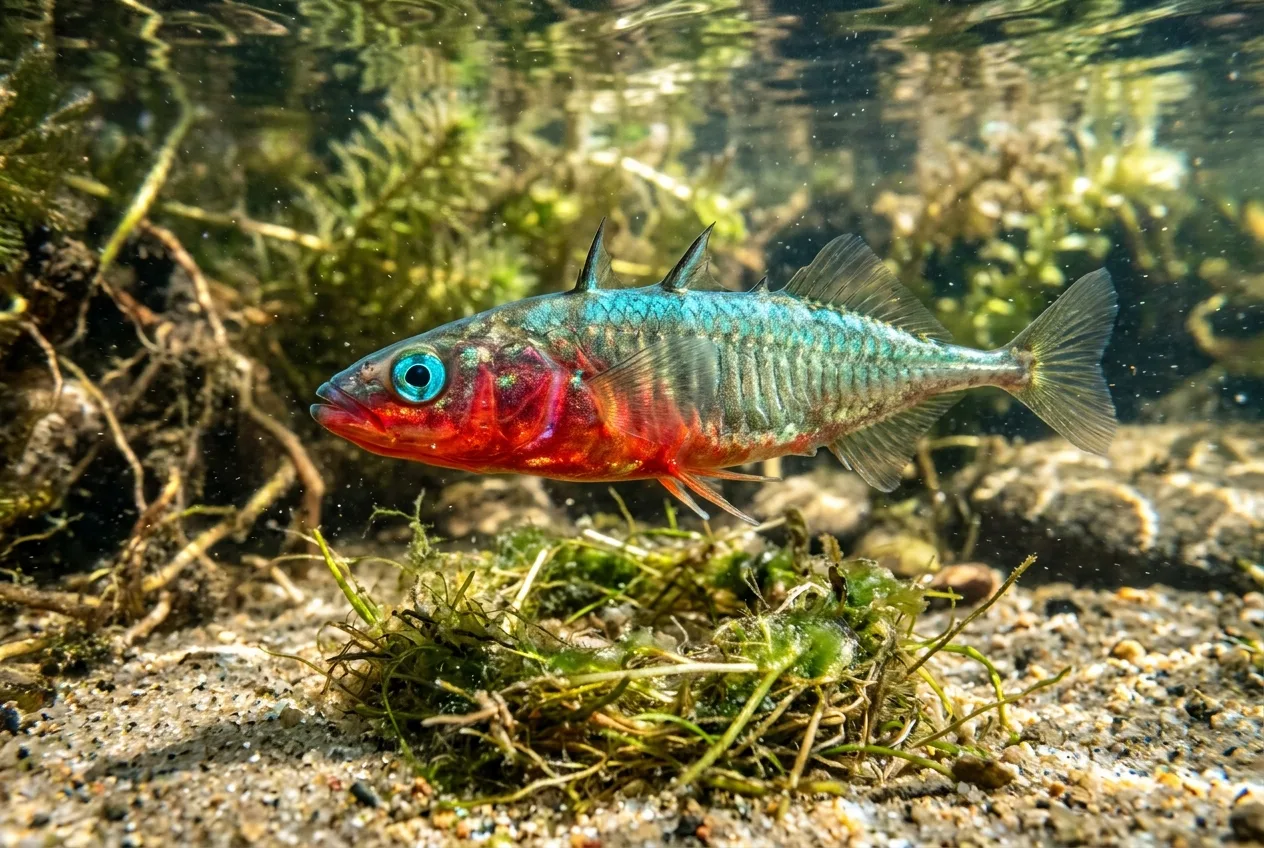
Typical places are shallow, overgrown bank zones over mud or sand. Outside the spawning season, sticklebacks roam in shoals. In summer the young fish migrate to the sea or to larger, deeper waters and form large feeding shoals there.
In the Danube catchment the stickleback was not originally native. In Lake Constance it is also considered an alien species. In a survey that Eawag published in 2016, it dominated the open water of the Obersee, where whitefish should actually dominate. It made up 28 per cent of the fish biomass in open water and stayed at similar depths to the whitefish, most densely between 12 and 35 metres.
Holding spots in the picture
Choose a season and time of day: the picture shows where the species sits then. Tap a fish or a spot in the list to bring it closer. The picture is schematic and AI-generated, every water is different.
In the lake
reed edge
The three-spined stickleback is found here all year round.
Water lilies and weed bed
The three-spined stickleback is found here all year round.
Open water
The three-spined stickleback is found here all year round.
The stickleback lives in shallow, weedy bank zones over mud or sand, in pools, ditches and oxbow lakes as well as in large lakes. Outside the spawning season it roams about in shoals. In Lake Constance the alien stickleback now also populates open water.
Spring: This is when spawning takes place, so observe the closed seasons. From March the red-coloured males build their nests on shallow, weedy banks and guard the brood.
Summer: This is when spawning takes place, so observe the closed seasons. In summer the young fish move into deeper areas and form large shoals there.
On the coast
Seagrass, gravel and stones in the shallows
The three-spined stickleback is found here all year round.
Sandy bottom
The three-spined stickleback is found here all year round.
The migratory form inhabits brackish water and the coast and always stays near the shore in the sea. They stay in shallow, weedy areas over sand or mud, the young often near drifting seaweed.
Spring: This is when spawning takes place, so observe the closed seasons. To spawn, the coastal sticklebacks migrate into fresh water.
Summer: This is when spawning takes place, so observe the closed seasons. In summer the young fish return to the sea.
Depth: In Lake Constance it lives in the open water of the Obersee, most densely at depths of 12 to 35 metres.
Size comparison: AI-generated drawing, schematic.
Nest building and brood care
Sticklebacks eat almost anything that fits into their mouth: worms, small crustaceans, aquatic insects and their larvae, insects that have fallen into the water, and small fish. They do not turn up their noses at fish spawn and their own brood either.
At spawning time the male becomes a territory defender. It builds a nest from plant parts, which it firms up with a sticky secretion from the kidneys, and drives off rivals. It lures a female ready to spawn to the nest with a zigzag dance. The male then fertilises the eggs and chases the female away. More females often follow.
The male guards the clutch and fans fresh, oxygen-rich water over the eggs. It also defends the hatched brood for a while. This brood care gives the stickleback a comparatively high breeding success.
When you can see it
It spawns from March to July. During this time the red-coloured males stand out clearly on shallow, overgrown banks, and you can often watch nest building and courtship from the bank.
In high summer the young fish leave the nursery and move into deeper water or the sea. There is no angling season, because the stickleback is not a target fish.
You will find the monthly overview of all species and the water temperature check in the catch calendar.
When a stickleback is on the hook
The stickleback is not fished for deliberately. When float fishing with maggots on shallow, weedy banks, however, one occasionally ends up on the small hook.
Handle it carefully and lay the spines flat against the body with your hand instead of grabbing against them. You remove the hook in the water or over the landing net and put the fish back in the same place where that is allowed. In the Bavarian Danube catchment it is not, see more under the rules.
Count the spines: Three strong spines and bony plates on the flank: three-spined stickleback. Many small spines and no row of plates: nine-spined stickleback, which is protected in Bavaria.
Do not disturb nests: In spring the males guard their nests in the shallows. If you wade or feed there, you easily drive them away from the clutch.
Suitable lures
Not a target fish: these baits are meant for other fish, and the species is only occasionally caught on them as bycatch. It is not fished for deliberately.
AI-generated illustrations. A click opens the lure’s page.
Not fished for deliberately; bycatch is gently released in the same place.
Status and rules
The three-spined stickleback is listed as not threatened in the German Red List of 2023. Its stock is considered moderately common and has increased markedly in both the long and the short term. Worldwide, the IUCN lists it as not threatened.
The Bavarian fisheries regulation (Fischereiverordnung) lists it for the Elbe, Rhine and Weser areas without a closed season (Schonzeit) or minimum size. For the Danube catchment it is missing from the list, so caught sticklebacks may not be released again there (§ 11 para. 8, as of October 2026). The nine-spined stickleback, by contrast, it protects all year round.
Closed seasons (Schonzeit), minimum sizes (Mindestmaße) and further rules are set by the federal states (Bundesländer). The fisheries regulation (Fischereiverordnung) of your federal state and your fishing permit (Erlaubnisschein) are always binding. You will find a list of links to the official sources in the catch calendar.
What closed season, minimum size and harvest slot mean and where to find them is explained on the page Closed season and minimum size explained.
What state law says about the closed season (Schonzeit) and minimum size (Mindestmaß) for this species is in the “At a glance” box on the state page for Bavaria. Our overview does not list this species for the other states; the state fisheries regulation applies there.
Frequently asked questions (FAQ)
Is the stickleback endangered?
No. The German Red List of 2023 lists it as not threatened, and stocks have increased.
Why does the stickleback have no scales?
It carries bony plates on its flanks instead. In migratory forms from the sea the whole side is armoured, while inland forms often have fewer plates.
Who looks after the eggs?
The male. It builds the nest, guards the eggs, fans fresh water over them and also defends the newly hatched brood.
Sources
The rating of catch chances is an editorial assessment. The facts come from these sources, and the text is worded in our own words. The illustration is an original design by Angel Momente in the style of a natural history plate (AI-generated, see the AI notice).
- Landesfischereiverband Bayern: Fischlexikon, Dreistachliger Stichling (Länge, Laichzeit, Kennzeichen, Ökotypen, Brutpflege)
- FishBase: Gasterosteus aculeatus (Größe, Alter, Knochenplatten, Lebensraum, Nahrung, Brutpflege, IUCN-Status)
- FishBase: Pungitius pungitius (Zahl der Rückenstacheln, Größe) zur Abgrenzung
- Rote-Liste-Zentrum: Dreistachliger Stichling (Rote Liste der Süßwasserfische Deutschlands 2023: ungefährdet)
- Bayerische Staatskanzlei: Verordnung zur Ausführung des Bayerischen Fischereigesetzes (AVBayFiG), Anlage
- Eawag (Projet Lac): Artenvielfalt und Zusammensetzung der Fischpopulation im Bodensee, Schlussbericht 2016
Created with AI support from the sources listed. Figures only appear in the text if a source gives them. Last updated: 8 November 2026. Found a mistake? Write to us. Who is behind this site: About me.
More in the lexicon
- All fish species at a glance
- Catch calendar – month, water temperature and profile for 93 species
- Line calculator – breaking strain after the knot, drag guideline, backing
- Angling methods