
Knowledge – Fish
Minnow: Features, habitat, species and rules
The minnow (Phoxinus phoxinus) is a small, lively shoaling fish of clear, cool streams and lakes. It usually lives where trout live and is an important forage fish for them. It is not fished for deliberately, and you had better not use it as bait fish either: two of the four minnow species in Germany are on the early-warning list.
In short: Lively shoaling fish of the trout zone and important food for trout. Several minnow species live in Germany; closed seasons are set by the federal states. What to do if you catch one by accident: Minnow as bycatch.
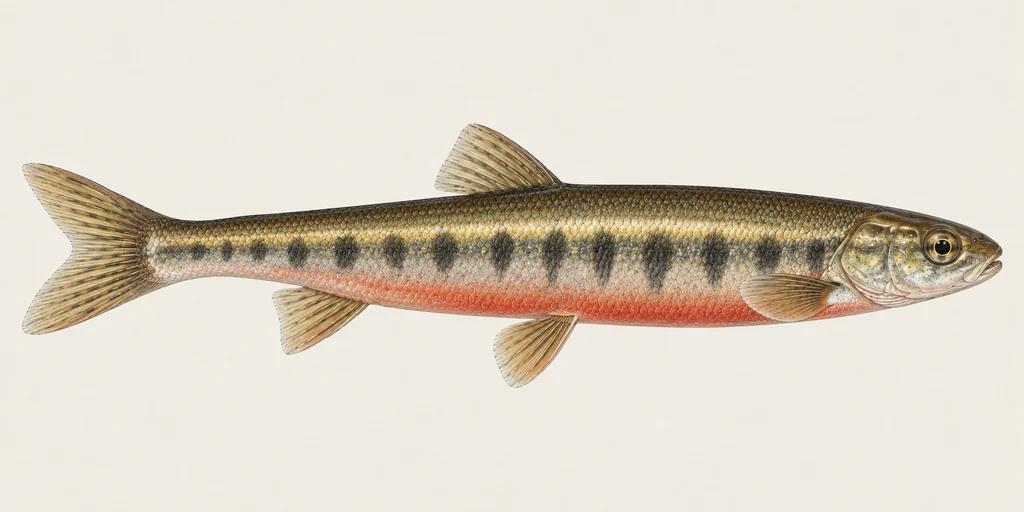
- Small, terminal mouth on an almost cylindrical body
- Row of dark transverse spots along the flank, above them a silvery-golden longitudinal band
- Red underside in the male at spawning time
Catch chances through the year
- Hardly any chance
- Possible
- Good
- Peak season
- Spawning (observe the closed season)
Editorial assessment for waters in Germany, not a measured value and no guarantee. Spawning time is not the same as the legal closed season.
Species profile and sources in the catch calendarAll species compared month by monthThe rules of your federal state
How to recognise it
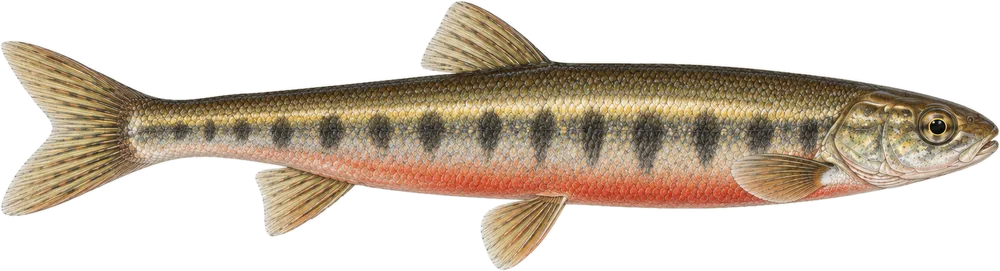
The minnow has a slender, almost round body with tiny scales and a small, terminal mouth. It is usually 6 to 10 centimetres long, and large fish reach 14 centimetres.
The back is grey-greenish with indistinct dark cross-bars reaching to the middle of the flank. Below runs a conspicuous silvery-gold longitudinal band. The flanks carry brown to black spots or stripes, and the belly is white to reddish white.
At spawning time the males become very colourful and get a red underside. Males and females then carry spawning tubercles, small hard nodules on the skin of the head and body.
The sunbleak is similarly small and silvery. It lives, however, in still and slow-flowing waters, has large scales and a steeply upturned mouth. The minnow has tiny scales, a terminal mouth and the dark spotted pattern.
Within the genus it is harder. The Red List of Germany of 2023 distinguishes four minnow species: the Rhenish minnow (Phoxinus phoxinus), the Central German minnow in the Ems, Weser and Elbe, the Danube minnow and the Baltic minnow. FishBase points out that several species are confused under the name Phoxinus phoxinus. In the field they can hardly be told apart.
Side by side
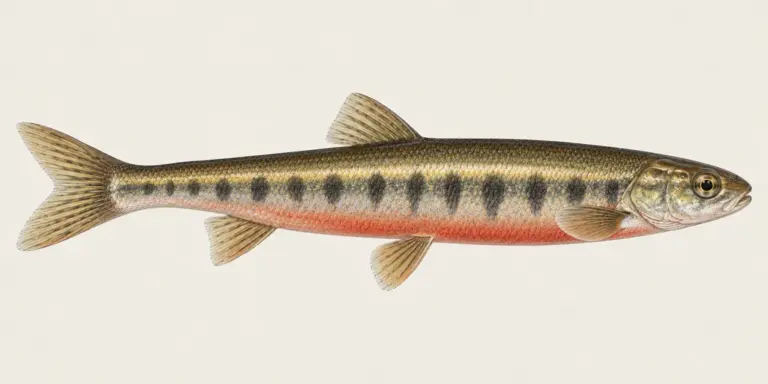
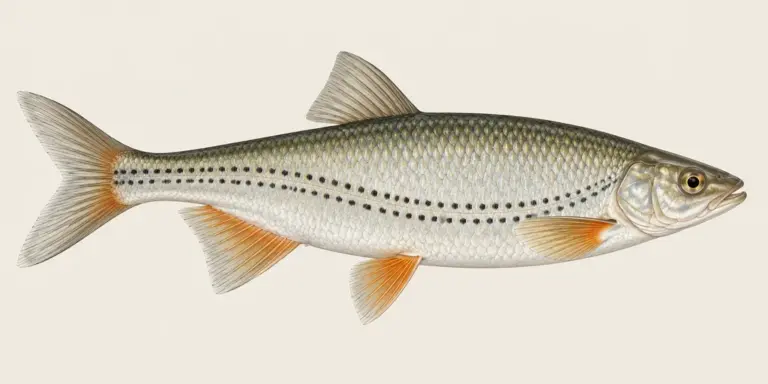
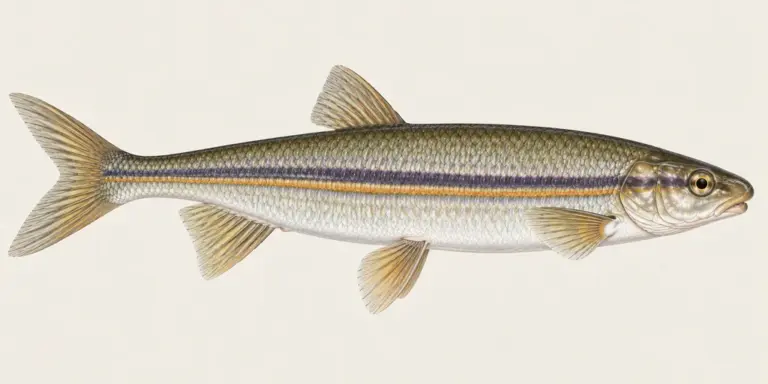
AI-generated illustrations.
Where it lives
The minnow needs clean, clear and oxygen-rich water. It lives in streams, rivers and lakes of the trout and grayling zones, in the Alps up to a height of about 2000 metres. According to FishBase it usually occurs together with trout and other salmonids.
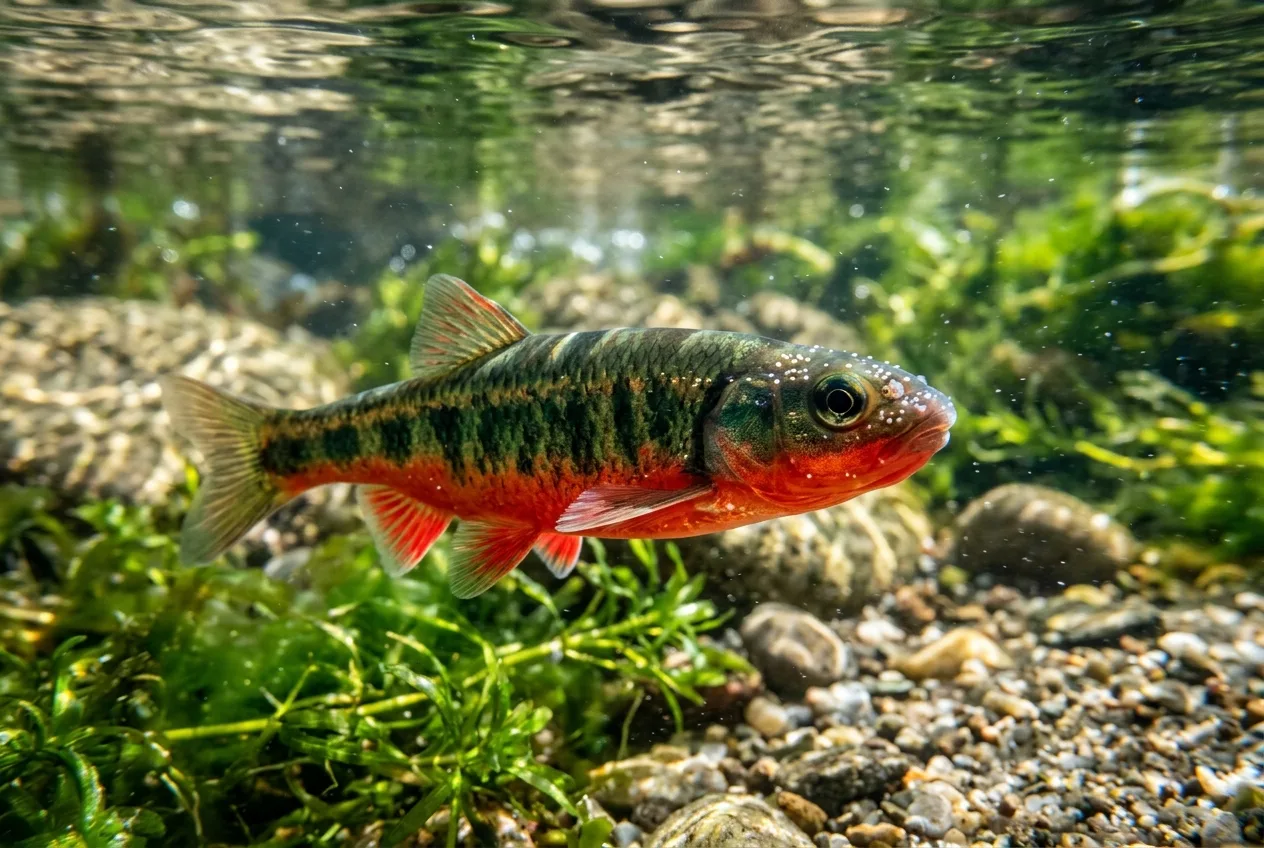
In winter it withdraws into coarse rubble or deep, only weakly flowing pools.
It is threatened by transverse structures that cut its migration routes, by silted gravel bars and by water pollution. FishBase also mentions excessive trout stocking as a local threat.
Holding spots in the picture
Choose a season and time of day: the picture shows where the species sits then. Tap a fish or a spot in the list to bring it closer. The picture is schematic and AI-generated, every water is different.
In the river
Slack water behind rocks
The minnow is found here all year round.
Gravelly shallow (riffle)
The minnow is found here all year round.
Pools, deep spot
The minnow is found here all year round.
Minnows live in shoals in clear, cool streams and rivers of the trout and grayling zones, mostly together with trout. They like to stay in the upper layers of water over shallow ground.
Spring: This is the spawning period, so observe the closed seasons (Schonzeit). From April to June large shoals move upstream to shallow gravel areas, where the eggs stick to clean gravel.
Summer: In summer the shoals stay in shallow water near the surface.
Winter: In winter they retreat to deep, calm pools or into coarse rubble.
Size comparison: AI-generated drawing, schematic.
How it feeds and spawns
Minnows are shy, lively shoaling fish that like to stay in the upper water layers. They eat insect larvae, small crustaceans and other small bottom animals, plus flying insects and algae. They are prey themselves: trout, charr and burbot eat them, and the Landesfischereiverband Bayern expressly names them as forage fish for these species.
To spawn, minnows migrate upstream in large shoals between April and June to shallow, gravelly places. According to FishBase males and females form separate shoals and arrive at the spawning ground at different times. The sticky eggs cling to clean gravel. At 18 °C the larvae hatch after four to five days, according to FishBase, and then stay hidden between the stones for a few more days.
The minnow grows slowly. FishBase gives an average maximum age of six years, and individual fish live to eleven. In research it is a well-known experimental animal for studies of fish sense organs.
When you can see it
There is no angling season in the strict sense for the minnow. It is most conspicuous in spring, when the shoals move across shallow gravel to spawn and the males wear their red breeding dress.
In Bavaria this time falls within the closed season for the species. In summer the shoals stand near the surface in shallow water, in winter they withdraw into rubble and deep pools.
You will find the monthly overview of all species and the water temperature check in the catch calendar.
What to do with a bycatch
As bycatch: Fishing for minnow? – why the species is not a target and what to do if you catch one by accident.
The minnow is not a target species. If it does take a small bait when you are fishing for trout, unhook it in the water or with wet hands and put it back.
We do not recommend the minnow as bait fish. The Danube minnow and the Baltic minnow are on the early-warning list, and in Bavaria fishing with live bait fish is banned anyway. Where dead bait fish are allowed, use common species, see Baitfish.
It is important not to move minnows from one water to another. The Rote-Liste-Zentrum reports that the Rhenish minnow is locally threatened by interbreeding with released Danube minnows, for example in the Sieg in North Rhine-Westphalia.
Do not move minnows: Never carry minnows from one water to another, not even the ones left over in the bucket. That way species mix and diseases travel.
Shoal as an indicator: Minnows need clear, oxygen-rich water and usually live where trout occur too. A shoal of minnows in the shallows shows you such stretches.
Suitable lures
We deliberately show no baits for this species.
Not fished for deliberately; using it as bait fish is regulated by state law and the water’s rules, in Bavaria a closed season applies and live bait fish are banned there.
What you need to observe
In the Red List of freshwater fish of Germany of 2023 the Rhenish minnow is classed as not threatened but rare. The Central German minnow is also not threatened, and Germany bears a high degree of responsibility for it. The Danube minnow and the Baltic minnow are on the early-warning list.
Catching and use are regulated by the federal states. In Bavaria the minnow has, under the Ausführungsverordnung zum Bayerischen Fischereigesetz, a closed season (Schonzeit) in late spring. The same regulation bans fishing with live bait fish. Other states may have other rules.
Closed seasons (Schonzeit), minimum sizes (Mindestmaß) and fishing bans are set by the federal states (Bundesland). They differ by state and water. We give figures only with a date and a source; what counts is always the fisheries regulation of your federal state and your fishing permit (Erlaubnisschein). You will find a list of links to the official sources in the Fishing calendar.
What closed season, minimum size and harvest slot mean and where to find them is explained on the page Closed season and minimum size explained.
What state law says about the closed season (Schonzeit) and minimum size (Mindestmaß) for this species is in the “At a glance” box on the state page for Bavaria. Our overview does not list this species for the other states; the state fisheries regulation applies there.
Frequently asked questions (FAQ)
How big does a minnow get?
Usually 6 to 10 centimetres. The Landesfischereiverband Bayern and FishBase give 14 centimetres as the maximum length.
May I use minnows as bait fish?
We advise against it, because two of the four species are on the early-warning list. Whether it is allowed is regulated by state law and the water’s rules. In Bavaria the minnow has a closed season (Schonzeit), and live bait fish are banned there.
Are there several minnow species in Germany?
Yes. The Red List of 2023 lists four species: the Rhenish, Central German, Danube and Baltic minnow. In the field they look very similar.
Sources
The rating of catch chances is an editorial assessment. The facts come from these sources, and the text is worded in our own words. The illustration is an original design by Angel Momente in the style of a natural history plate (AI-generated, see the AI notice).
- Landesfischereiverband Bayern: Fischlexikon – Elritze (Länge, Laichzeit, Kennzeichen, Lebensweise)
- Rote-Liste-Zentrum: Rheinische Elritze, Phoxinus phoxinus (Rote Liste 2023: ungefährdet; Hybridisierung mit Donau-Elritzen)
- Rote-Liste-Zentrum: Mitteldeutsche Elritze, Phoxinus morella (Rote Liste 2023, Verantwortung Deutschlands)
- Rote-Liste-Zentrum: Donau-Elritze, Phoxinus csikii (Rote Liste 2023: Vorwarnliste)
- Rote-Liste-Zentrum: Baltische Elritze, Phoxinus marsilii (Rote Liste 2023: Vorwarnliste)
- FishBase: Phoxinus phoxinus, Eurasian minnow (Größe, Alter, Lebensraum, Fortpflanzung)
- LAWA-Projekt O 10.20 (Leibniz-IGB, 2021): Temperaturempfindlichkeiten der Fischgemeinschaften
- Bayern.Recht: Verordnung zur Ausführung des Bayerischen Fischereigesetzes (AVBayFiG) mit Anlage Schonzeiten
- Wikipedia: Elritze
Created with AI support from the sources listed. Figures only appear in the text if a source gives them. Last updated: 27 October 2026. Found a mistake? Write to us. Who is behind this site: About me.
More in the lexicon
- All fish species at a glance
- Catch calendar – month, water temperature and profile for 93 species
- Line calculator – breaking strain after the knot, drag guideline, backing
- Angling methods