
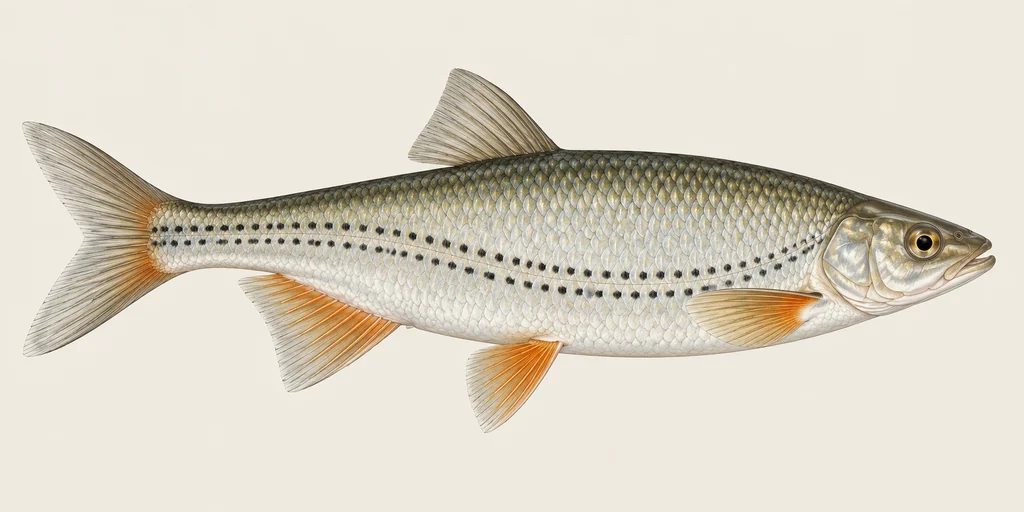
Knowledge – Fish
Riffle minnow: Features, habitat and protection
The schneider (Alburnoides bipunctatus) is a small shoaling fish of clear, fast-flowing streams and rivers. It owes its name (German for tailor) to two rows of black dots along the lateral line, which look like a double seam. In Germany it is on the early-warning list of the Red List and is not a target species.
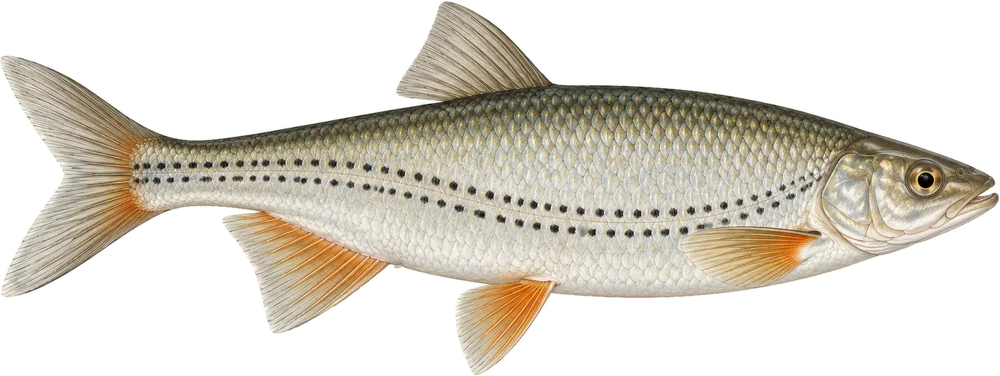
In short: It is on the early-warning list of the Red List and, in Bavaria for example, is protected all year round. You can recognise it by the lateral line, which is bordered by two rows of black dots. What to do if you catch one by accident: Schneider as bycatch.
- Lateral line bowed downwards, bordered above and below by a row of black spots
- Orange bases of the pectoral, pelvic and anal fins
- Terminal, almost horizontal mouth on a slightly deep body
Catch chances through the year
- Hardly any chance
- Possible
- Good
- Peak season
- Spawning (observe the closed season)
Editorial assessment for waters in Germany, not a measured value and no guarantee. Spawning time is not the same as the legal closed season.
Species profile and sources in the catch calendarAll species compared month by monthThe rules of your federal state
How to recognise it
The schneider is a small cyprinid with a slightly deep, laterally flattened body. The mouth is terminal and the gape runs almost horizontally. The anal fin is long and has 12 to 17 branched rays.
The distinguishing mark is the lateral line. It curves downwards and is edged above and below by a row of black dots. This pattern looks like a double seam and gave the species its German name. The back is brass-coloured to grey-green, the flanks are paler. The pectoral, pelvic and anal fins are orange at the base. During spawning a dark longitudinal band also runs along the whole lateral line.
The Landesfischereiverband Bayern gives an average of 9 to 13 centimetres and a maximum of 14 centimetres. FishBase gives a usual length of 9 centimetres and a record of 18,5 centimetres; the highest published weight is 30 grams.
At first glance the schneider looks like a small bleak. The bleak, however, has an upturned mouth with a steeply angled gape and lacks the rows of dots along the lateral line. It also prefers slow-flowing and still waters.
The vairone (Strömer) may also live in the same river. It also has orange fin bases, but its lateral line itself is orange and is not edged with dots. Young roach and dace are also quickly ruled out because they lack the double seam. Authorities point out that schneider and vairone are easily confused with each other and with other species. So look closely at the lateral line.
Side by side
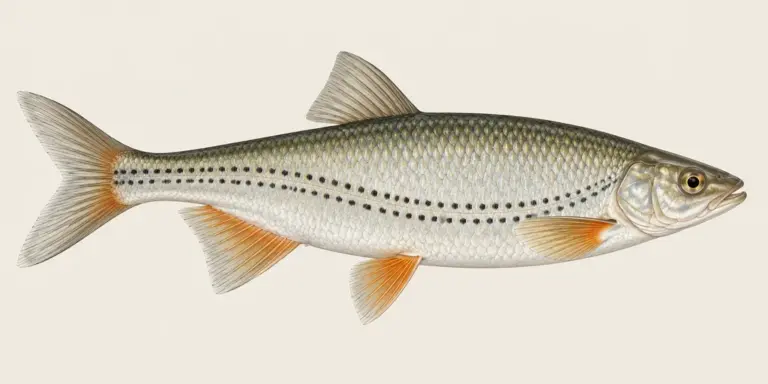
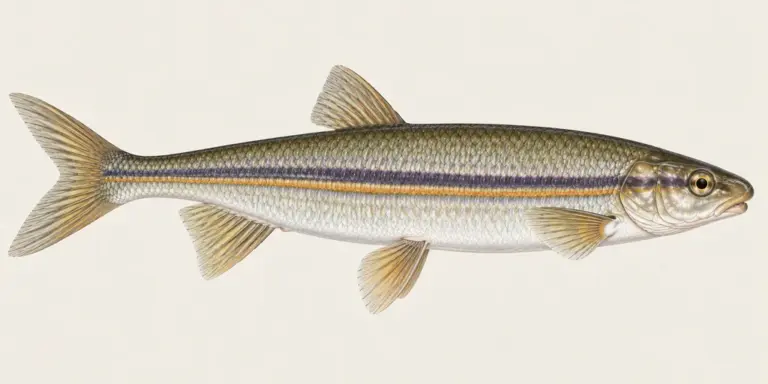
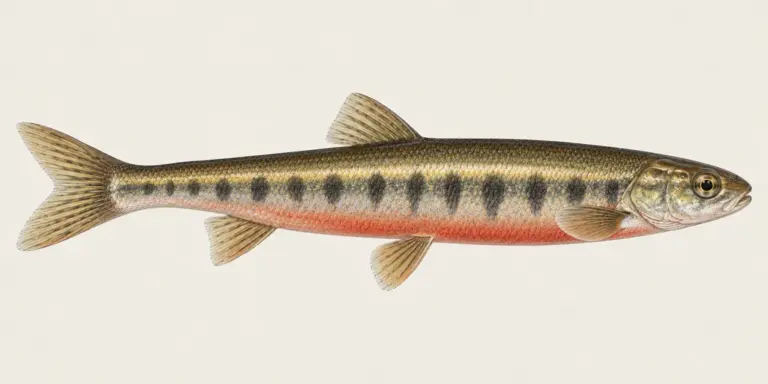
AI-generated illustrations.
Where it lives
The schneider needs clear, oxygen-rich water with a strong current. Typical habitats are streams and smaller rivers in hill country, often in the grayling and barbel zones. All age groups stay in open water, usually in shoals and often close to the bank. FishBase also mentions occurrence in more gently flowing rivers.
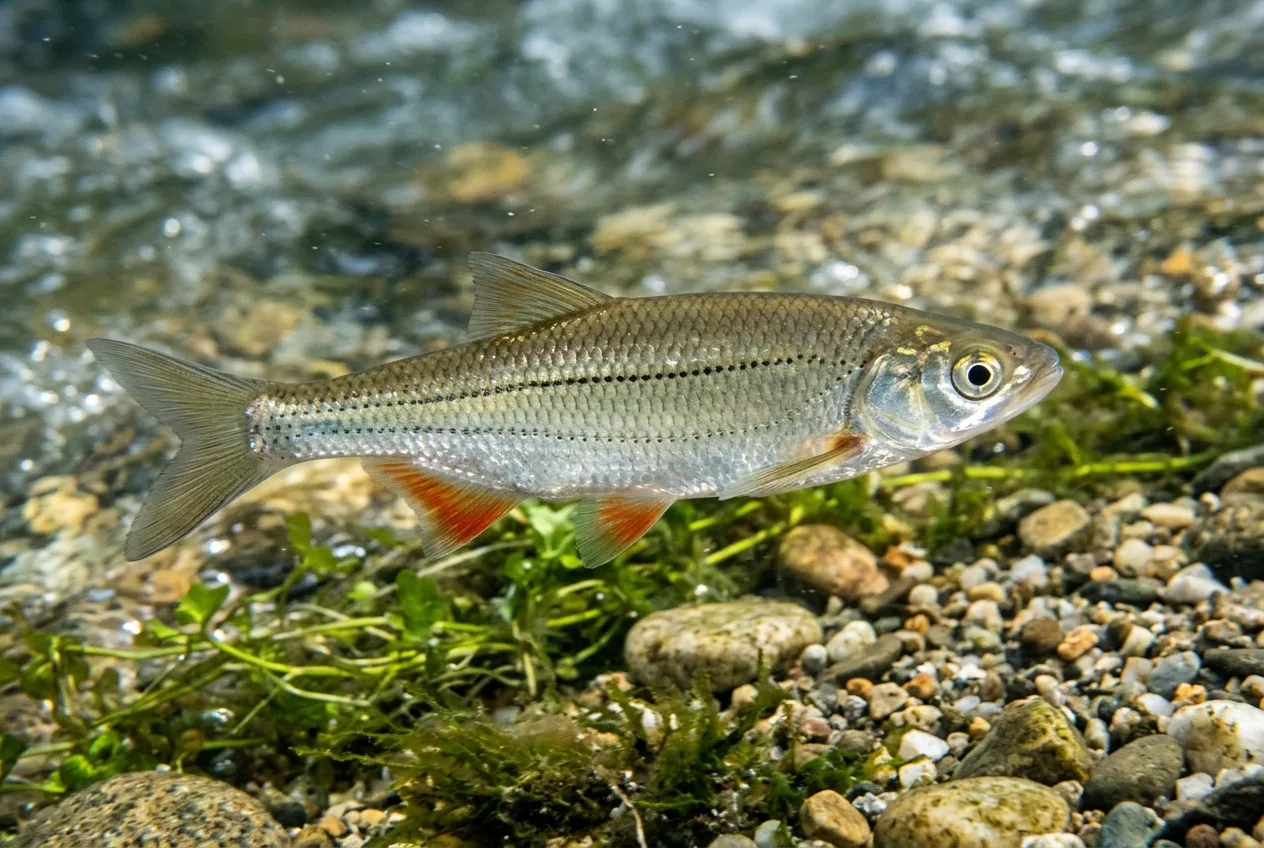
Its presence is regarded as a sign of a fairly natural river with good water quality. Weirs, impounded stretches, built-up banks and silted gravel bars cause it problems.
The species occurs from the Loire eastwards in almost all rivers flowing into the southern Baltic Sea, the North Sea, the Black Sea and the Sea of Azov. In southern Hesse the schneider has been reintroduced since 2009 under the direction of the Obere Fischereibehörde Darmstadt. In the Nidda, Kinzig and Sinn it has become established and in places makes up more than a fifth of the fish stock.
Holding spots in the picture
Choose the season and time of day: the picture shows where the species stands then. Spots outlined in red apply only in the chosen season. Tap a fish or a spot in the list to bring it closer. The picture is schematic and AI-generated, every water is different.
In the river
Gravelly shallow (riffle)
The schneider is found here only in spring.
Current seam
The schneider is found here all year round.
Free current in mid-river
The schneider is found here all year round.
The schneider swims in shoals in the open water of clear streams and small rivers with a strong current, often in the grayling and barbel zones. It likes to stay close to the bank and feeds on what the current brings down.
Spring: This is when spawning takes place, so observe the closed seasons. From April to June it spawns in small groups on shallow gravel beds washed by the current, as soon as the water is above about 12 °C.
Size comparison: AI-generated drawing, schematic.
How it lives and spawns
Schneiders stand in shoals in the current and take whatever the water brings down. The menu includes insect larvae, insects that fall into the water, small crustaceans, plankton and diatoms.
Spawning takes place, depending on the source, between April and June, as soon as the water is warmer than about 12 °C. The fish spawn in small groups on shallow, flowing gravel areas and press the eggs deep into the gravel. The sticky eggs cling firmly there. According to the canton of Fribourg a female lays 1.000 to 3.000 eggs in batches of 100 to 200.
Because the spawn is spread out like this, a population can recover quickly after renaturation or improved water quality. The reintroduction in Hesse shows this: ten years after the first stocking the species had established itself in several rivers and had moved into tributaries on its own.
Is there a season?
There is no angling season for the schneider. It is not a target species and is used neither in fishing nor in the kitchen.
It is most conspicuous in late spring, when the shoals spawn on gravel bars and the dark longitudinal band is easy to see.
You will find the monthly overview of all species and the water temperature check in the catch calendar.
What to do with a bycatch
As bycatch: Fishing for schneider? – why the species is not a target and what to do if you catch one by accident.
The schneider is not fished for. Even so, it may take a small hook when float fishing or when fly fishing for grayling.
Then unhook it in the water, avoid touching the fish if you can and release it on the same stretch of water. Where it is protected, it must not be kept.
Check the double seam: A small silvery fish from a gravelly stream with rows of dots above and below the lateral line is a schneider. Treat it like a protected species.
Quick and wet: Remove the hook with pliers in the landing net under water. Small fish are quickly injured on dry hands and on stones.
Suitable lures
We deliberately show no baits for this species.
Early-warning list, protected all year in Bavaria: do not target it, release bycatch immediately and gently.
Protection and rules
The schneider is on the early-warning list of Germany’s Red List of 2023. Its population is considered rare. In the long term it has declined sharply, in the short term it has clearly increased again. Globally the IUCN lists it as not threatened.
In Bavaria the schneider is protected all year round under the fisheries regulation (Fischereiverordnung). Fish caught during the closed season (Schonzeit) must be put back immediately and carefully into the same stretch of water.
Other federal states (Bundesland) have their own rules. What counts is always the fisheries regulation of your federal state and your fishing permit (Erlaubnisschein). You will find a list of links to the official sources in the Fishing calendar.
What closed season, minimum size and harvest slot mean and where to find them is explained on the page Closed season and minimum size explained.
What state law says about the closed season (Schonzeit) and minimum size (Mindestmaß) for this species is in the “At a glance” box on the state page for Bavaria. Our overview does not list this species for the other states; the state fisheries regulation applies there.
Frequently asked questions (FAQ)
Why is the schneider called Schneider?
Because of the two rows of black dots above and below the lateral line. They look like a double seam.
May I keep a schneider?
In Bavaria it is protected all year round and must be put back immediately. In other federal states (Bundesland) the respective fisheries regulation applies. It is not fished for deliberately.
How do I tell a schneider from a bleak?
The bleak has a steeply upturned mouth and no rows of dots along the lateral line. The schneider has a terminal mouth and the dotted double seam.
Sources
The rating of catch chances is an editorial assessment. The facts come from these sources, and the text is worded in our own words. The illustration is an original design by Angel Momente in the style of a natural history plate (AI-generated, see the AI notice).
- Landesfischereiverband Bayern: Fischlexikon, Schneider und Laube (Länge, Laichzeit, Kennzeichen, Lebensweise)
- FishBase: Alburnoides bipunctatus (Größe, Merkmale, Lebensraum, Nahrung, Fortpflanzung, IUCN-Status)
- Rote-Liste-Zentrum: Schneider (Rote Liste der Süßwasserfische Deutschlands 2023: Vorwarnliste)
- Bayerische Staatskanzlei: Verordnung zur Ausführung des Bayerischen Fischereigesetzes (AVBayFiG), Anlage und Rücksetzpflicht
- Kanton Freiburg (Schweiz), Amt für Wald und Natur: Strömer und Schneider (Laichzeit, Eizahl, Zeigerart)
- Regierungspräsidium Darmstadt, Obere Fischereibehörde: Wiederansiedlung des Schneiders in Südhessen 2021
Created with AI support from the sources listed. Figures only appear in the text if a source gives them. Last updated: 27 October 2026. Found a mistake? Write to us. Who is behind this site: About me.
More in the lexicon
- All fish species at a glance
- Catch calendar – month, water temperature and profile for 93 species
- Line calculator – breaking strain after the knot, drag guideline, backing
- Angling methods