
Knowledge · Tackle
Wormery: Keeping and breeding your own bait worms
A wormery supplies you with bait worms all year round: compost worms turn kitchen scraps into compost in it, multiply and are ready to hand on fishing days. Brandling worms and dendrobenas thrive in it, lobworms do not. Whether the wormery works depends on moisture, temperature and the amount of food.
Compost worm instead of lobworm
The wormery needs worms that naturally live in decaying material. The Bayerische Akademie für Naturschutz und Landschaftspflege (ANL) lists the compost worms Eisenia fetida and Eisenia andrei as a separate group that lives in compost, 5 to 12 cm long when fully grown. E. fetida is pale with red rings and clearly banded, E. andrei dark red to purple with barely visible bands. Anglers also keep worms of the genus Dendrobaena, sold as dendrobenas. Which species suits which fish is explained under Worms.
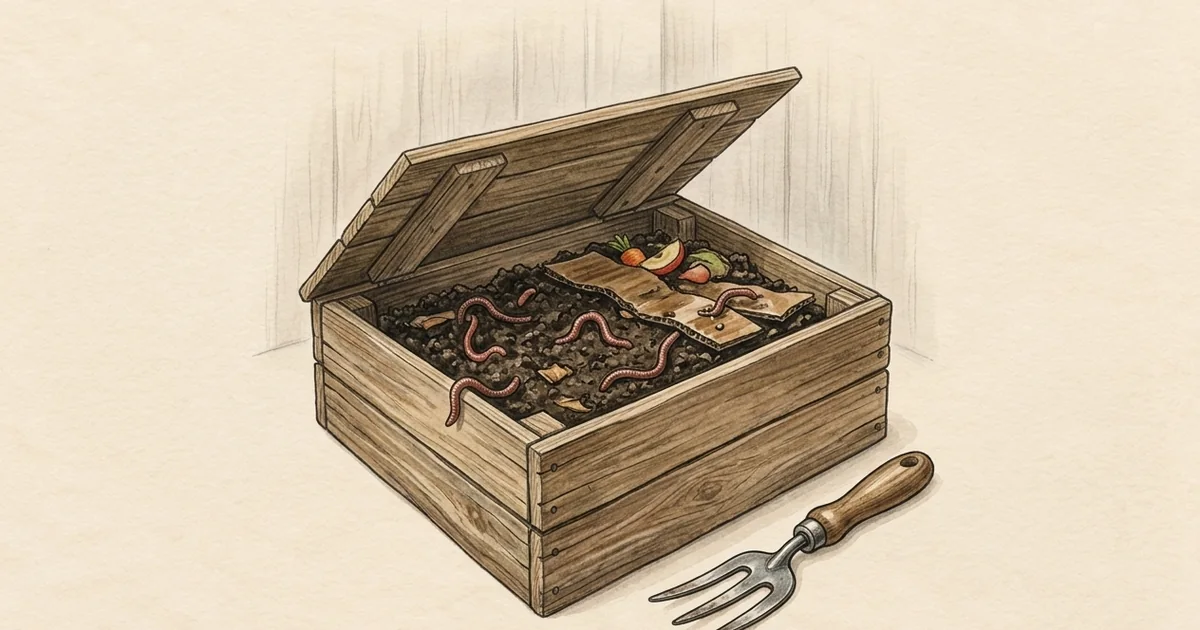
Of more than 9.000 earthworm species, according to North Carolina State University (NC State), only seven are considered suitable for vermicomposting, and most keepers worldwide use Eisenia fetida.
The lobworm (Lumbricus terrestris) lives very differently. The ANL classes it among the deep burrowers: it builds almost vertical burrows that reach more than two metres down and at night pulls plant debris into them from the surface (Fig. 2). Iowa State University advises against it in a wormery, because it depends on cooler temperatures and digs extensive tunnels. The ANL gives the temperature-dependent development time as about 16 days for the compost worm and up to 135 days for the lobworm. Anglers report that lobworms cannot be bred. Store collected lobworms cool and separately, see Maggot box and worm tub.
Building the wormery
According to NC State, a box made of untreated wood or a plastic box with a tight-fitting lid makes a suitable container. Plastic should be dark, because earthworms react strongly to light, and should be washed out thoroughly first. NC State drills the air holes at the top of the side walls, not in the lid: there, light would get in and the bedding would dry out. Iowa State University, on the other hand, considers holes in the lid possible as long as it sits loosely and no worms escape.
Six drainage holes of 1/4 inch, about 6 mm (NC State), go in the bottom, with a tray underneath for the seepage (Fig. 1). If the wormery is indoors in winter, Iowa State puts a layer of gravel in it instead of the bottom holes. Good places are a cellar, garage or balcony, with some air all round. Outdoors, the wormery always stands in the shade, because according to NC State direct sun can overheat it and kill the worms.
Worked example: size and stocking
NC State works with a rule of thumb: 1 square foot of area (about 930 cm²) per pound (about 454 g) of kitchen waste per week, at a depth of 8 to 20 inches, i.e. about 20 to 50 cm. An example with 1 kg of waste per week:
- 1 kg is just over 2,2 pounds. So the wormery needs 2,2 square feet, which is about 2.000 cm² of floor area, roughly 50 × 40 cm.
- To start with, NC State names at least one pound of worms per square foot, which is about 1.000 worms. For this wormery that would be 2,2 pounds, about 1 kg of worms.
- According to the same source, one pound of compost worms eats up to two pounds of food a week. So 1 kg of worms can manage up to 2 kg, and the kilo of waste is plenty for them.
- If you start with 200 g of worms from the tackle shop, give at most about 400 g a week, and only as much as is really eaten.
For a start like this, or a few handfuls of kitchen scraps every few days, a box the size of a large shoebox is enough, according to Iowa State.
Bedding, moisture and temperature
As bedding, NC State names shredded newspaper, paper bags, cardboard, dead leaves or coconut fibre, but no glossy paper. Tear newspaper into strips a good 1 cm wide, soak them for 5 to 10 minutes and wring them out. Loosely filled, the wormery is half full; add a handful of garden soil for the microorganisms. The worms eat the bedding too, so new bedding has to go in after one or two months at the latest (NC State).
Squeeze test: squeeze a handful of bedding firmly. If only two or three drops come out, the moisture is right; NC State gives about 80 per cent for this. Never pour water in, but moisten it with a spray bottle. If water runs out, mix in dry scraps of paper and leave the lid open for a few days.
The figures for temperature differ slightly:
| Source | Favourable range | Notes |
|---|---|---|
| NC State | 15–25 °C | Limits 0 and 35 °C |
| Iowa State University | 55–75 °F, about 13–24 °C | Frost kills the worms |
| Blinker, field report | 10–30 °C in the substrate | measured with a probe thermometer |
| ANL, earthworms in general | most active at 10–15 °C | winter in frost-free soil |
If you stay between 15 and 24 °C, you are within all three ranges for the wormery. Measure in the core. The same field report shows how quickly it can get too hot there: a wormery left to itself for too long with too many kitchen scraps, too much wet and hardly any soil reached 65 °C inside at an outside temperature of just over 30 °C, and all the worms died. If it is too warm, NC State mixes in dry bedding or puts a container of ice in the wormery.
Feeding without rotting
According to NC State, the menu includes vegetables and fruit, crushed eggshells, tea bags, coffee grounds, paper filters and chopped garden waste. Meat, bones, fish, fatty food, onions, garlic, citrus fruit, salty food and pet faeces do not belong in it, so no fish scraps or dead bait fish either. Iowa State also excludes dairy products and sprayed plant material.
Cut the food small and spread it only thinly, at most 1 inch high, i.e. a good 2,5 cm, so that it does not heat up. Then cover it with 2,5 to 5 cm of bedding, so fruit flies find nothing. Only give new food once the old has been eaten, otherwise it rots and smells.
How to spot problems:
- Smells rotten: usually too much food. Do not feed for two weeks, bury exposed food, take out anything that cannot be composted, and drill more holes if there is a lack of air (NC State).
- Wet, water standing at the bottom: mix in dry bedding, leave the lid open for a few days, use less coffee grounds and watery scraps.
- Mould: according to NC State too acidic, so less acidic food, and remove the mould. Anglers also report mould from overfeeding; in that case add nothing for a while.
- Worms gather under the lid: something is wrong in the substrate. Check moisture, temperature and food; NC State then leaves the lid open so that the worms burrow back into the bedding.
- Bedding dries out: too much ventilation. Spray it and keep the lid closed.
The sources contradict each other on turning the contents. NC State advises against it: the wormery does not need aerating like a compost heap, and roughly handled worms can die. In the field report from the table, on the other hand, a wormery that was too wet is rescued with sawdust or straw meal and turned completely. In everyday use, leave the wormery alone; turning only helps with waterlogging.
Harvesting and packing for the fishing day
For a few worms it is enough to loosen the top layer: compost worms sit together in groups and are quickly in the tub. For larger quantities, sieve:
- Take out a portion of substrate with worms and pick out coarse leftovers such as peel and cabbage leaves.
- Put the substrate in a coarse sieve over a bucket. The worms crawl through by themselves; it is faster with a gentle stream of water.
- Pour off the water and repeat the same step with a finer sieve, such as a groundbait riddle.
- Pour off the water again and collect the worms from the fine sediment.
- Put cocoons back in the wormery. NC State describes them as lemon-shaped, about the size of a match head, shiny and light brown; each one contains two to seven young worms.
- Put the worms with a little wormery substrate into an air-permeable worm tub, close the lid and keep it in the shade.
Without a sieve, the light method from NC State and Iowa State works: worms flee from light into the depths. Tip the contents onto a sheet under a bright lamp and scrape off the top layer about every five minutes until the worms are left as a ball. Or feed only on one side for a few weeks; the worms move there, and the other half can be emptied almost worm-free.
On the fishing day, compost worms do not need a fridge, but heat and blazing sun are what worms tolerate worst. So in summer the tub travels in the cool bag. Small compost worms are popular for whip fishing and bottom fishing for bream and silver bream. You harvest the worm compost after about four months (NC State) for the garden or raised bed; for flower pots, pick out worms and cocoons first, as they do not survive there.
Winter operation
Iowa State University advises bringing the wormery indoors in winter, ideally into a dark corner of the cellar, and warns that freezing kills the worms. Indoors they do not go dormant and can continue to be fed. Outdoors, NC State insulates with boards on the outer walls or straw all round.
Anglers also report wormeries that overwinter outdoors under a weather shelter. In the same field report, the thermometer in the substrate showed over 11 °C at 2 °C outside, because bacteria and worms produce heat. This is a single experience; the universities advise ruling out frost for certain.
In winter the stock grows more slowly. A worm farm quoted in Blinker gives 6 to 8 weeks to hatching from the cocoon in summer, up to 16 weeks in winter, and another eight to nine weeks from hatching to a worm ready for sale. Its test for fresh stock: the faster a worm burrows in when exposed to light, the fitter it is. So plan your winter supply in autumn.
Hygiene and nature
Hands should be washed after handling earthworms, writes the ANL, because earthworms can be intermediate hosts of many parasites. The Bundesinstitut für Öffentliche Gesundheit (BIÖG) advises washing your hands if you have touched animals, their food or waste, and at the wormery all of these come together. These notes do not replace medical advice.
Do not tip leftover worms and wormery soil out on the bank, in the woods or into the water. Fisch & Fang reported on researchers at the University of Minnesota: European earthworms released by anglers eat the leaf litter of the forests there and thus change their plant life. The scientists advise disposing of leftover bait worms with the rubbish. The soil also contains the cocoons. So take whatever is left back home with you. Why this also applies to buckets, water and tackle is explained under Not spreading species and diseases.
Common mistakes
- Putting lobworms in the wormery. They need cool, deep soil and multiply slowly. Compost worms belong in the wormery.
- Pouring water in. A wormery that is too wet and has a lot of food can heat up strongly, in the field report up to 65 °C. Damp like a wrung-out sponge is enough.
- Feeding too much at once. Whatever is left rots, smells and attracts flies. Only add more once the old food has gone.
- Putting the wormery in the sun. Direct sun can overheat it; the tub also belongs in the shade at the water.
- Letting it freeze in winter. Frost kills the worms. Bring it indoors or insulate it well.
Frequently asked questions
Can I put worms from the garden in the wormery?
Better not. According to the ANL, garden soil is also home to mineral-soil species and deep burrowers with quite different needs, and without practice it is hard to tell which species you have in front of you. NC State therefore recommends compost worms from a worm farm; according to Iowa State, some tackle shops also sell them.
Does a wormery smell?
If well looked after, it hardly smells, say NC State and Iowa State. A rotten smell comes from too much food, exposed leftovers or wet.
How long can the wormery manage without me?
Depending on the number of worms, feeding every two to three weeks is enough, according to NC State. Before two weeks‘ holiday, put out a good 1 cm of food and cover it with 5 cm of damp paper.
Related
- Worms: species, length and hooking for each target fish
- Maggot box and worm tub: keeping bait fresh until it goes on the hook
- Cool box and cool bag: transporting bait cool in summer
- Groundbait riddle: the fine sieve for harvesting
- Angling bucket: water, bait and feed at the bank
- Not spreading species and diseases: why leftovers do not belong in other waters
- Bottom fishing: the worm on the bottom for eel, bream and silver bream
- Line calculator: line and hooklength for the worm rig
Sources
- NC State Extension: Worms Can Recycle Your Garbage (AG-473-18) (Bau, Einstreu, Feuchte, Temperatur, Futter, Fehlerbilder, Ernte, Faustregeln)
- Iowa State University Extension: Vermicomposting Frequently Asked Questions (Tauwurm ungeeignet, Deckel, Temperatur, Winter)
- Bayerische Akademie für Naturschutz und Landschaftspflege (ANL): Regenwürmer, Tiere live (PDF) (Arten, Tiefgräber, Längen, Entwicklung, Hygiene)
- Blinker: Wurmzucht anlegen, so wird’s gemacht (10 bis 30 °C, 65 °C, Wenden, Sieben, Winter)
- Blinker: Zu Besuch in der Dendrobena-Zucht (Schlupf, Aufzucht, Fitness-Test)
- Blinker: Würmer züchten, in 6 Schritten zum eigenen Angelköder (Schimmel bei Überfütterung)
- Blinker: Würmer suchen und lagern (Hitze und Sonne)
- Fisch & Fang: Angel-Würmer bedrohen die Wälder Amerikas (ausgesetzte Köderwürmer)
- Bundesinstitut für Öffentliche Gesundheit: Händewaschen (Anlässe)
Text AI-assisted, drawing AI-generated. Sources opened and checked in November 2026; no graphics taken from the sources.
All information is a guide only and without guarantee. How fast compost worms multiply and how much they eat depends on temperature, moisture and food; the hygiene notes do not replace medical advice.