
Knowledge · Tackle
Carp sack and retainer: Keeping fish briefly and properly
A carp sack is a soft, dark mesh sack in which carp anglers keep a caught fish alive in shallow water near the bank, often overnight until a photo can be taken in daylight. The Humboldt-Universität zu Berlin investigated this in two studies and advises against it from a fish welfare point of view. Whether and for how long fish may be kept alive is regulated by each federal state (Bundesland) itself.
Design: a sack without rings
The Berlin researchers describe carp sacks as collapsible, dark sacks made of knotless synthetic mesh, without a rigid frame. The carp goes in after unhooking, the sack lies in shallow water at the bank, and the fish stays there for a few hours if a photo is not possible straight away. According to the study, the typical reason is the night: the fish bites in the dark, and the picture is to be taken in daylight. In the 2014 field study, one sack measured 140 by 120 centimetres and was tied to a metal pole on the bank by a sewn-in drawstring.
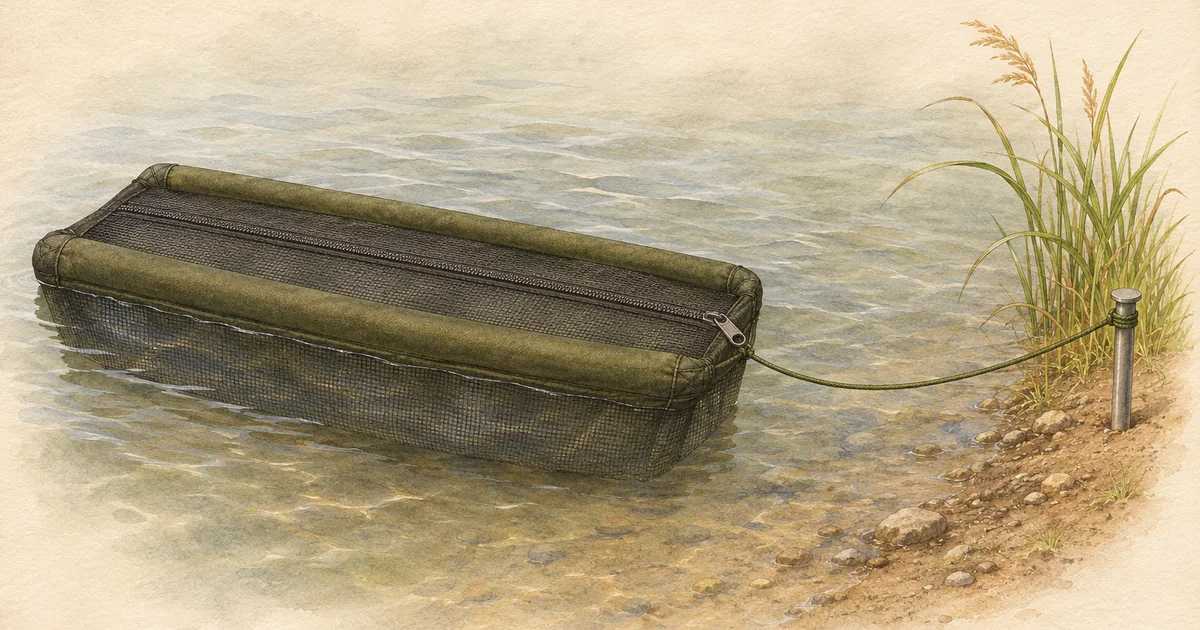
It differs from a keepnet in shape. A keepnet is a long net tube held open by rings, whereas the sack collapses without a frame. In the Berlin experiments, each carp lay alone in its own sack. There are also retainer slings, which are meant to hold a fish in the margins only briefly. No studies on this design were found in the specialist sources evaluated here. Whether it stresses the fish less than the sack therefore remains open.
What the Berlin studies show
Hours in the sack (2012)
In 2012, the Humboldt-Universität zu Berlin, together with the Leibniz-Institut für Gewässerökologie und Binnenfischerei (IGB) and Carleton University in Canada, published two experiments. In the laboratory, small farmed carp stayed in the sack for half an hour to nine hours at 12 and 22 °C. In the field, large wild carp lay in the sack in a lake in Ottawa, where the water was 18 to 23 °C.
- Recovery from the fight: lactate, the salt of lactic acid, rises in the blood through the exertion of the fight. During retention the level fell again.
- New stress: in the field, the stress hormone cortisol was higher in all retained fish than in freshly caught comparison fish, and it rose with the time spent in the sack.
- Tissue damage: after nine hours there were more enzymes in the blood that normally stay inside the cells. The researchers interpret this as a sign of damaged tissue.
- Behaviour: fish that had spent nine hours in the sack rested longer during the first half hour after release, but returned to normal behaviour within a few hours.
- Survival: no fish died over two months. However, there were no predators in the lake that could have been a danger to a large carp.
The researchers draw two conclusions from this. If you only look at the survival of the population, the sack is of little importance. But if you want to rule out any avoidable stress for the individual fish, you should do without the sack and photograph and release the carp straight after capture, provided releasing it is permitted.
Sack first, then photo (2014)
Two years later came an experiment on air exposure. The carp were kept out of the water for ten minutes to simulate a photo session, either straight after capture or after nine hours in the sack. Straight after capture, air exposure raised lactate by 24 percent in the laboratory; in the field it did not change any of the blood values measured. If air exposure came only after retention, lactate rose by 358 percent in the laboratory and by 89 percent in the field compared with fish that were only retained. Fish exposed to air moved around less afterwards; after twelve hours the difference had disappeared. None died within two months, and overall the researchers consider carp very resistant to air exposure.
According to this study, retention and air exposure act together, and the stresses reinforce each other. The researchers‘ recommendation: take the photo while the fish is freshly caught, lift it out of the water only briefly or keep the gills under water, and then release it immediately. If the water is colder or warmer than in the experiment, the time in the air should be even shorter.
Oxygen and warmth at the bank
In the laboratory tank, the water in the sack hardly changed. Oxygen fell slightly in the first half hour and then stayed the same, ammonia remained stable, and there was no significant difference from the surrounding water. At a real water it can look different. The 2012 study refers to the margins of nutrient-rich lakes, where oxygen fluctuates strongly over the day in summer and can run short at night. According to the study, carp sacks usually lie in shallow water at the bank, so on nutrient-rich lakes exactly in this zone.
The researchers know of carp that did not survive a night in the sack only from isolated reports. They attribute such cases to lack of oxygen in warm conditions or poor water at the fishing spot rather than to the sack itself, in other words to a sack in the wrong place at the wrong time. Why warm water holds less oxygen is explained in Water temperature and oxygen. What the fight already does to a fish in hot weather is under Fight, heat and depth.
What states and associations regulate
Fishing law is state law. The word carp sack does not appear in the regulations checked here; they speak generally of keeping fish alive and of nets, containers and other devices. Some examples, paraphrased and shortened:
- Brandenburg, § 11 Fischereiordnung: keeping fish alive (Hältern) means storing live fish for a limited time without feeding. Fish caught with a hand line may be kept at most until the end of the fishing day; trout, char, grayling, whitefish and salmon may not be kept at all. Under paragraph 4, fish that have been kept alive may not be returned to the water.
- Bavaria, § 20 AVBayFiG: keeping fish alive in the water where they were caught should be as short as possible. Anyone who keeps fish in a keepnet may not return them to that water.
- Saxony, § 16 Fischereiverordnung: when keeping fish alive, only devices that rule out avoidable harm to the fish’s health may be used. The fish need enough oxygen, and the duration is limited to what is necessary.
- Schleswig-Holstein, state leaflet (February 2026): fishing where releasing the fish is planned from the outset is prohibited and an administrative offence. According to the leaflet, keeping fish in a keepnet is only permitted to keep the catch fresh as food. Only uninjured fish may be kept, at most until the end of the fishing day; if the fish shows clear signs of stress, keeping it ends immediately, and fish that have been kept do not go back into the water.
The Bayerisches Landesamt für Gesundheit und Lebensmittelsicherheit (LGL) also writes that courts have consistently judged trophy fishing to be a criminal offence: catching specimen fish, measuring, weighing or photographing them and then releasing them again. This page does not contain an interpretation for individual cases.
On top of this come the rules of clubs and associations for their own waters. The Landesanglerverband Brandenburg requires that a fish that is to go back is put into the water straight after unhooking. Its water rules (2019 edition) provide for keeping fish alive only for fish that are to be taken, and they call it unacceptable to fish deliberately for specimen fish just to measure and weigh them and then release them. The Anglerverband Niedersachsen bans keeping live fish altogether on the Mittellandkanal (as of 2026). What applies at your water is in the fishing permit and the water rules.
Read first, then buy: whether a carp sack may be used at your water at all, and whether a fish that has been kept may go back afterwards, is settled by state law, the water rules and the fishing permit (Erlaubnisschein). If in doubt, ask the fisheries authority (Fischereibehörde) or the club. Other states such as Lower Saxony and Saarland are listed with references under Keeping fish and keepnets.
Instead of a sack: the photo straight after capture
Both Berlin studies come to the same advice: take the photo while the fish is freshly caught. For that, everything must be ready before the bite comes. Blinker lists disgorger, tape measure, scales, weigh sling, unhooking mat and camera, because a fish out of the water risks lack of oxygen and a drying mucous membrane. How a photo works even at night with a tripod and self-timer is under Catch photo, the right light under Head torch.
| If … | then … |
|---|---|
| the carp is to go back and the mat and camera are ready | unhook, photograph briefly, release immediately |
| the bite comes at night | photograph straight away with a lamp and self-timer, do not keep it until morning |
| the fish is to be taken home | stun, kill and chill instead of keeping it alive |
| the water rules or state law prohibit keeping fish alive | do not use a sack, not even briefly |
| the water is warm and the bank shallow and nutrient-rich | do not keep the fish, keep the time in the air short |
| the fish is injured or shows stress | do not keep it; in Schleswig-Holstein only uninjured fish |
For a fish you want to eat, Schleswig-Holstein refers to the cool box after the fish has been killed humanely. The steps are under Stunning and killing fish, the equipment under Cool box.
If keeping fish alive is allowed: checklist
If state law and fishing permit allow keeping fish alive and there is a genuine reason for it, these points from studies and regulations help:
- Rules checked: state law, water rules and fishing permit read, including whether the fish may go back after being kept.
- Only uninjured fish, as Schleswig-Holstein prescribes for keeping fish alive.
- One fish per sack, as in the Berlin experiments.
- A spot with enough oxygen, not the shallow, warm margin of a nutrient-rich lake on a summer night. Saxony expressly requires sufficient oxygen.
- The sack is secured at the bank, in the field study to a pole. Holders for this are described under Banksticks.
- As short as possible: Bavaria requires the shortest possible time, Brandenburg sets the end of the fishing day as the limit.
- If the fish shows clear signs of stress, keeping it ends immediately, according to the rule in Schleswig-Holstein.
- No long photo session after keeping: have the mat and camera ready beforehand and lift the fish only briefly.
Common mistakes
- Putting the sack in shallow, warm margins overnight. That is exactly where oxygen can run short at night.
- Taking photos in the air for a long time after hours in the sack. In the Berlin experiment, retention and air exposure reinforced each other.
- Releasing a fish that has been kept where the law forbids it. Brandenburg and Schleswig-Holstein expressly prohibit this, Bavaria for the keepnet.
- Reading the good survival rate as a free pass. The fact that no carp died in the studies does not mean it feels nothing: stress hormone, signs of tissue damage and changed behaviour were measurable.
- Buying the sack before reading the water rules. The Anglerverband Niedersachsen bans keeping fish alive altogether on the Mittellandkanal.
Frequently asked questions
Is a carp sack gentler than a keepnet?
That has not been studied. The Berlin researchers wrote in 2012 that sacks differ in shape and construction from keepnets, and that whether findings on keepnets could be transferred to sacks had been unknown until then. The studies used here contain no direct comparison.
How long may a carp stay in the sack?
None of the regulations checked here gives a number of hours for the sack. Bavaria requires the shortest possible time when keeping fish alive; Brandenburg and Schleswig-Holstein draw the line at the end of the fishing day at the latest. In the 2012 study, cortisol rose with the time in the sack, which argues for every minute less.
Does a carp survive a night in the sack?
In both Berlin studies, no fish died within two months of release. However, the lake in the field study had no predators for large carp, and the researchers know of isolated reports of deaths overnight, which they attribute rather to lack of oxygen in warm conditions or poor water. The fish is stressed in any case.
Do I need a sack for night catches?
No. The Berlin studies recommend photographing the fish straight after capture and then releasing it immediately. How to do this at night too, with a head torch, tripod and self-timer, is under Catch photo.
Related
- Keeping fish and keepnets: state law with references and requirements for the net
- Catch photo: tripod, self-timer and working quickly with the fish
- Unhooking mat: lay the fish down softly and unhook it before the photo
- Weigh sling: weighing the carp briefly and with support
- Releasing a fish: when it is compulsory and what state law says
- Carp angling: rig, groundbait, playing and landing
- Line calculator: breaking strain and drag setting for a quick fight
Sources
- Humboldt-Universität zu Berlin, IGB und Carleton University: Physiological and behavioural consequences of capture and retention in carp sacks on common carp, Fisheries Research 2012 (PDF) (Bauform, Versuchsaufbau, Cortisol, Enzyme, Verhalten, Überleben, Wasserwerte, Sauerstoff am Ufer, Empfehlung)
- Humboldt-Universität zu Berlin und IGB: Consequences of air exposure on caught-and-released common carp, 2014 (Zusammenfassung) und Volltext (PDF) (zehn Minuten Luft, Laktat +358 % und +89 %, Verhalten, Foto direkt nach dem Fang, Kiemen unter Wasser)
- Land Brandenburg: Fischereiordnung, § 11 (Begriff Hältern, Fangtag, Arten, kein Zurücksetzen)
- Freistaat Bayern: Verordnung zur Ausführung des Bayerischen Fischereigesetzes, § 20 (geringstmögliche Dauer, Setzkescher, Zurücksetzen)
- Freistaat Sachsen: Sächsische Fischereiverordnung, § 16, gültig ab 1. Juni 2022 (Vorrichtungen, Sauerstoff, Dauer)
- Landwirtschaftsministerium Schleswig-Holstein: Merkblatt zum Urlauberfischereischein, Stand Februar 2026 (PDF) (geplantes Zurücksetzen, unverletzte Fische, Stress, Rückgabeverbot, Kühlbox)
- Bayerisches Landesamt für Gesundheit und Lebensmittelsicherheit: Tierschutzaspekte in der Angelfischerei, Stand 2018 (Trophäenfischen und Gerichte)
- Landesanglerverband Brandenburg: Gewässerordnung, Ausgabe 2019 (Zurücksetzen gleich nach dem Lösen des Hakens) und Anglerverband Niedersachsen: Gewässerordnung Mittellandkanal, Stand 2026 (PDF) (Hälterungsverbot)
- Blinker: Fische landen, Kescher, Lip-Grip und Co. (Zubehör griffbereit, Folgen der Luftzeit)
Text AI-assisted, drawing AI-generated. Sources opened and checked in November 2026; no graphics taken from the sources.
All information is a guide only, without guarantee and no substitute for legal advice. Whether you may keep a carp alive and release it afterwards is determined by the fishing law of your federal state, the water rules and your fishing permit in their current versions.