
Knowledge · Tackle
Tubes and creature baits: Soft lures for the bottom and cover
Tubes and creature baits are soft plastic lures for the bottom that usually do not imitate a swimming small fish but crayfish, amphibians or other bottom-dwelling animals. The tube is a hollow tube with a ring of tentacles, while a creature bait has claws, arms or feelers. Both are fished slowly along the bottom, and with a concealed hook also where wood and weed would snag an exposed hook.
The tube: a hollow body with a skirt
The tube is a soft plastic sleeve, hollow inside and closed with a rounded nose at the front. At the back it ends in a ring of tentacles, the skirt. It looks like a small squid, and according to Blinker it also resembles a crayfish fleeing backwards. Blinker wrote in 2013 that it had long been popular in the USA for smallmouth bass, but was hardly known in Germany.
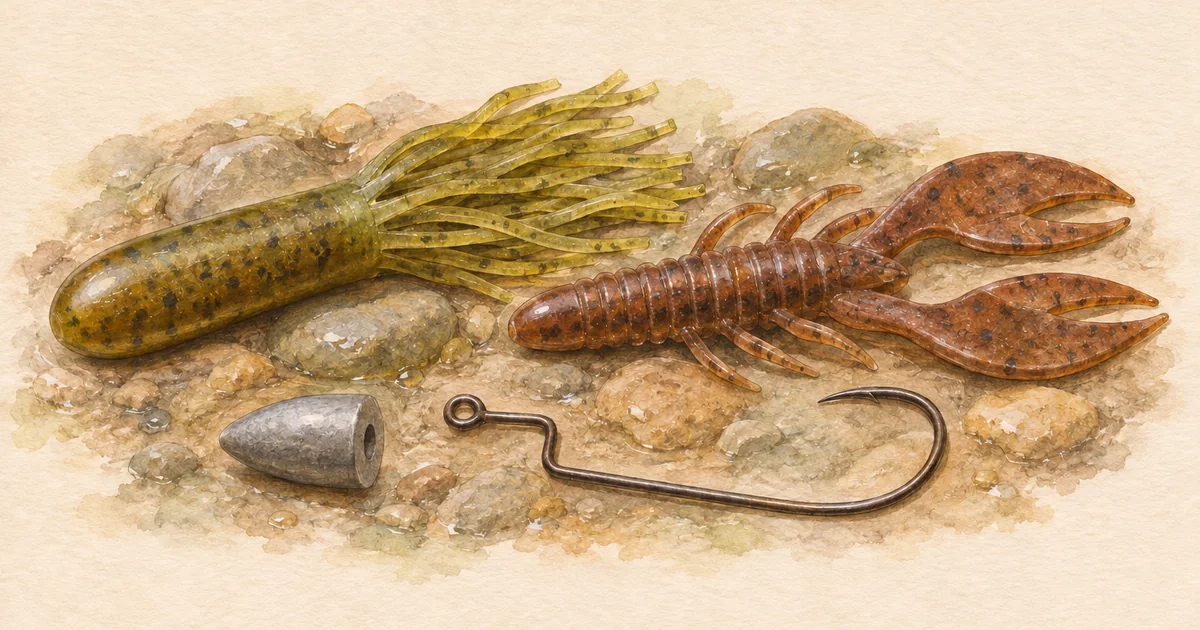
The tube gets its action from the head inside it. The head is cone-shaped and its eye sits far back, which leaves a long soft nose at the front. When you twitch it, the tube shoots steeply up off the bottom. As it sinks, it spirals off in changing directions, while an ordinary jig head always follows the same path. Every touchdown kicks up sand. According to Blinker, the skirt adds little to this action; above all it makes the bait look more edible.
The same Blinker article from 2013 gave these guide values: tubes up to 6 cm for trout, 5 to 10 cm for perch, around 12 cm for zander and pike, and 20 cm and over for big pike. The New York State environmental agency recommends tubes of 2½ to 5 inches, so around 6 to 13 cm, for smallmouth bass in Lake Erie. Depending on depth, they go on lead heads of ¼ to ½ ounce, about 7 to 14 g. For around 10,7 m of water (35 feet) it considers 3/8 ounce suitable, a little over 10 g. The Unit converter converts other values.
Five ways to present a tube
- Internal head: the cone-shaped head sits inside the tube. This is true tube fishing with the spiralling action.
- Jig head on the outside: the hook of a normal jig head is pushed through from the outside. The tube then runs like a pintail with no action of its own and only flares its skirt when it touches down on the bottom.
- Offset hook on a Texas or Carolina rig: because the tube is hollow, the hook fits inside it. For weedy spots. For fringed tubes with a thick soft plastic head, a Blinker article from 2023 names offset hooks with a particularly long shank between eye and Z-bend.
- Lightly weighted offset hook: Blinker suggests working the tube like a soft jerkbait just below the surface, in shallow water and over dense weed.
- Drop shot: the New York agency also lists the tube for the drop-shot rig; the hook then sits through the nose.
Threading a tube onto the internal head
- Fold the tube back slightly at the rear, between the skirt strands.
- Push the cone head in from behind until it rests against the inside of the nose.
- Fold the plastic back and push the head’s eye from the inside out through the wall.
- Arrange the skirt and position the hook so that the point comes out freely between the strands.
- Check from the side that the tube sits straight. Blinker considers this crucial: if a tube hangs bent like a banana, thread it on again.
Creature baits: crayfish, amphibian and insect
Blinker groups under creature baits the soft plastic lures that imitate crayfish and other bottom-dwelling animals such as amphibians and salamanders. As add-ons for jigs with silicone skirts, the magazine also names insect imitations. What they have in common is that claws, legs or feelers sit on the body instead of a paddle tail. The best-known of them, the soft plastic crayfish, has its own page with sizes and retrieve.
How a creature bait lies on the bottom is determined above all by the head. A Blinker article from 2025 on jig heads sorts the shapes like this:
- Round head: soft plastic crayfish sit badly on it, because the round head tips over to the side on the bottom.
- Stand-up jig: the flat underside holds the lure almost upright. A soft plastic crayfish is threaded on tail first for this. If you pause briefly, it rears up with its claws raised, like a crayfish defending itself.
- Ned jig: the mushroom-shaped head also stands the lure upright; most Ned baits are creature baits made of buoyant TPE, a thermoplastic material.
- Shaky head: it sets the lure at an angle, so that, according to a Blinker article from 2024, claws or legs point upwards as on the living animal.
On the skirted jig, a lead head with a skirt of silicone strands, a creature bait serves as a trailer, that is, an add-on. It gives the lure action and bulk and slows the sink: with chunky, large crayfish imitations, the jig stays longer in the fish’s field of vision, according to Blinker. On the Carolina rig, a Blinker article from 2022 suggests creature baits and soft plastic worms when the lure is meant to sink for a long time. A shorter leader shows the bites more clearly there but lets the lure fall faster.
Offset and worm hooks: snag protection with consequences
On an offset hook the point disappears into the plastic, so the bait comes through weed and wood without constantly snagging. The Indiana fisheries authority sums up the principle briefly: if the hook is run through the bait, it catches less in plants. How to rig it and which size suits which bait length is covered under Texas rig, shapes and size numbers under Fishing hooks.
Besides the classic offset hook, Rute & Rolle mentions the wide-gap hook with an especially wide bend, as well as offset hooks with a moulded lead head or with a weight on the shank. They give the bait weight without a lead on the line. A bait that is meant to drift stays completely unweighted, according to the Indiana information. According to a Blinker article from 2023, a lead plug on the shank also lets you present soft plastic crayfish and tubes close to the bottom.
Snag protection comes at a price: on the strike the point first has to get through the plastic. For creature baits, Blinker says this means choosing slim, soft shapes with a round cross-section; deep-bodied, hard plastics get in the hook’s way. According to Blinker, the tube suits the offset hook well because of its hollow body. Which baits can be slit and why you wait briefly before striking is explained under Texas rig.
Which rig for which spot
Whether a bait comes through depends above all on what lies and grows on the bottom. The table sorts the rigs accordingly and by what the fish want at the moment. The reasons come from the sources named.
| If | then this rig | because |
|---|---|---|
| dense weed, water lilies, branches | Texas rig, slim bait, with a heavy weight a stopper behind it | hidden point, comes through weed and brush (Blinker) |
| Perch want a slowly sinking lure | Carolina rig | long sink phase (Blinker) |
| bottom without weed or wood | tube on an internal head or creature bait on a stand-up jig head | lure stands upright, hook is exposed (Blinker) |
| fish just above the bottom | Drop-shot rig, tube hooked through the nose | the bait stays close above the bottom (New York agency) |
| weed up to just below the surface | tube on a lightly weighted offset hook | it runs like a soft jerkbait over the weed (Blinker) |
According to a Blinker article on the Texas rig, the bites there usually come while the lure is sinking. How heavy the weight may be depending on depth is explained under Texas rig.
Target fish: perch, zander, pike and smallmouth bass
Of the native predators, the Blinker article from 2013 names zander, perch and pike for tubes. With perch, according to the magazine, the resemblance to a crayfish fleeing backwards helps. Which other lures suit when is sorted out on Perch lures, Zander lures and Pike lures.
According to Blinker, pike cause a particularly high number of missed takes on an offset hook, because of the shape of their mouth, the strength of their jaws and the way they seize prey. In weed, one Blinker author ties a 1 mm fluorocarbon or a wire trace in front of the bait. Which thickness counts as bite-proof for pike is covered under Pike trace; the Line calculator shows what the main line still holds after the knot.
In the USA anglers fish both types of bait for largemouth bass and smallmouth bass, among others. Both species come from North America and have been introduced to many countries as sport fish. According to FishBase, adult largemouth bass eat fish, crayfish and frogs, adult smallmouth bass eat crayfish, fish and aquatic and terrestrial insects. This fits the information from two US authorities. The Ohio natural resources agency recommends creature baits, lizards and tubes for largemouth bass in spring, pumped slowly like a walking crayfish, at points, brush and tree stumps. For smallmouth bass in Lake Erie, the New York agency counts tubes among the strongest artificial lures. Among the most productive colours it names shades of brown that imitate crayfish and the round goby. Which licence and which rules apply abroad is set by the country or state; the New York agency, for example, refers to its own special regulations for the Great Lakes.
Attractant on the soft plastic
According to Blinker, attractant sticks a little better to soft plastic than to painted crankbaits, because the surface is more porous. Even so, on artificial lures it lasts more like 30 to 60 minutes than hours, so the magazine advises reapplying it roughly every 10 to 20 casts. Some soft plastics are sold in a resealable bag with attractant; put them back into it after a few casts. Salt and scents attack hooks more. For salted or flavoured lures, according to Blinker, a tin-plated hook can give better protection than the usual black nickel plating.
According to another Blinker article, the scent lasts longer in a foam collar that sits on the soft lure. Which substances exist, how gels and sprays differ and what they do in the water is explained on the Attractants page.
Law: whether attractant on artificial lures is allowed on your water is governed by state law, the water rules and your fishing permit (Erlaubnisschein). The sources evaluated here contain no general rule on this; if in doubt, ask the club. Just as important is whether artificial lures may be fished at all at that time. In the 2024 water rules (Gewässerordnung) of the Landesverband Sächsischer Angler, artificial lures generally count as predator baits; that is a rule of the association for its own waters. What a predator closed season means is covered under Closed season and minimum size explained, and where to find the rules for your water under Fishing permit and water map.
Common mistakes
- Expecting the spiralling action from a jig head pushed through from outside. Only the cone head inside produces the zigzag as it sinks. Hooked from the outside, according to Blinker, the tube runs like a soft plastic shad with no action of its own.
- Threading the tube on crooked. It should sit straight on the internal head; otherwise thread it on again.
- Putting the soft plastic crayfish on a round head. It tips over onto its side on the bottom. On a stand-up or Ned jig it stands upright, according to Blinker.
- Choosing a deep-bodied, hard bait for the offset hook. The point struggles to get through the plastic on the strike; according to Blinker, slim and soft shapes are the better choice.
- Applying attractant once and forgetting it. Blinker advises renewing it every 10 to 20 casts, because the scent trail gets weaker with every cast.
Frequently asked questions
What is the difference between a tube and a soft plastic shad?
The tube is hollow inside and has a ring of tentacles instead of a paddle tail. Its action comes from the cone-shaped head inside: as it sinks, it darts off unpredictably to the side. A soft plastic shad on a jig head, by contrast, always falls in much the same way.
Which hook suits creature baits in weed?
An offset or wide-gap hook with its point buried in the plastic. The bait should be slim and soft so that the point comes free on the strike. Guide values for hook size by bait length are given under Texas rig.
When do I use a jig head instead of an offset hook?
On a bottom without weed or wood, where nothing can snag. There the point does not first have to go through the soft plastic on the strike. For creature baits, Blinker names the stand-up or Ned jig, because it holds the lure upright. Use the offset hook where obstacles would catch an exposed hook.
Am I allowed to use soft lures with attractant?
That is governed by state law and the water rules of your club or association, which you can read in your fishing permit (Erlaubnisschein). Also check beforehand whether artificial lures are allowed there at that time, for example because of a predator closed season. If in doubt, ask the club.
Related
- Soft plastic crayfish: retrieve, choice of colour and storage of the best-known creature bait
- Texas rig: rigging the offset hook, weight and hook size by depth and bait
- Carolina rig: weight set at a distance, long sink over weed
- Jig heads: head shapes and weights for exposed hooks
- Fishing hooks: offset hooks, size numbers and hook shapes
- Soft baits: all soft plastics at a glance
- Attractants: flavours and dips and what they do in the water
- Line calculator: breaking strain of main line and hooklength after the knot
Sources
- Blinker: Pro-Tipp: Raubfische lieben Tubes (2013; Aufbau, Innenkopf, Lauf, Montagearten, Aufziehen, Größen, Zielfische)
- Blinker: Jigköpfe, Formenvielfalt verständlich erklärt (2025; Rundkopf, Stand-up-Jig und Ned-Jig für Creature Baits, TPE-Köder), Blinker: Shaky Heads (2024; Creature Baits wie Krebse und Lurche, Scheren nach oben) und Blinker: Skirted Jig (2025; Creature Bait als Trailer, Absinken)
- Blinker: Barschangeln im Herbst (2022; Carolina-Montage mit Creature Baits, Vorfachlänge), Blinker: Texas-Rig, die Erfolgsmontage mit dem Klick (2016, aktualisiert 2025; Kraut und Unterholz, Stopper bei schwerem Blei, Bisse beim Absinken) und Blinker: Offset-Haken, hängerfrei Spinnfischen im Kraut (2023; langer Schenkel für Tuben, Bleiplombe, Hakenbeschichtung)
- Rute & Rolle: Barsch: Da ist der Wurm drin (2026; Offset- und Widegap-Haken, beschwerte Offsethaken)
- Blinker: Offset mit Gummifisch: Fehlbisse minimieren (Köderform und Gummihärte, Fehlattacken des Hechts) und Blinker: Hechtangeln im Kraut (runder Querschnitt, Vorfach im Kraut)
- Blinker: Flavours auf Kunstködern: Wie lange halten sie? (Haltbarkeit auf Gummi, Würfe bis zum Nachlegen, Beutel) und Blinker: Kunstköder aromatisieren (Schaumstoffkragen)
- New York State Department of Environmental Conservation: Smallmouth Bass Fishing on Lake Erie (Tubes für Schwarzbarsch, Größen und Kopfgewichte, Dropshot, Farben)
- Ohio Department of Natural Resources: Fishing Tips (Creature Baits, Echsen und Tubes für Forellenbarsch im Frühjahr) und Indiana Department of Natural Resources: Fishing Equipment Tips (Haken durch den Köder gegen Pflanzen, ohne Gewicht treibend)
- FishBase: Micropterus salmoides und FishBase: Micropterus dolomieu (Herkunft, Einbürgerung, Nahrung von Forellenbarsch und Schwarzbarsch)
- Landesverband Sächsischer Angler: Gewässerordnung 2024 (PDF) (Kunstköder als Raubfischköder, Regel des Verbands)
Text AI-assisted, drawings AI-generated. Sources opened and checked in November 2026, no graphics taken from the sources.
All information is for guidance only and without guarantee. Which rig snags and which one catches depends on the bottom, the vegetation and the target fish; what is allowed is set by your water rules.