
Knowledge · Tackle
Ice auger: Drilling holes without weakening the ice
An ice auger cuts a round hole in the ice sheet with sharp blades, while a spiral pushes the cuttings upwards. This is quieter than hacking and works without blows that can drive cracks into the ice. How big the hole should be depends on the target fish and, at some waters, on the water rules.
Designs from hand auger to power auger
The hand auger is the basic form: a handle at the top, a crank below it, a long drill shaft and, at the bottom end, the flight, a steel spiral. The blades sit at its lower end. You press down on the top of the auger and turn the crank, which also works with two people, as described in the MinnAqua guide from the Minnesota Department of Natural Resources. The blades shave off the ice, and the flight carries the chips out of the hole. The environmental agency of the US state of New York (DEC) calls hand augers easy to use and the best compromise for average ice conditions.
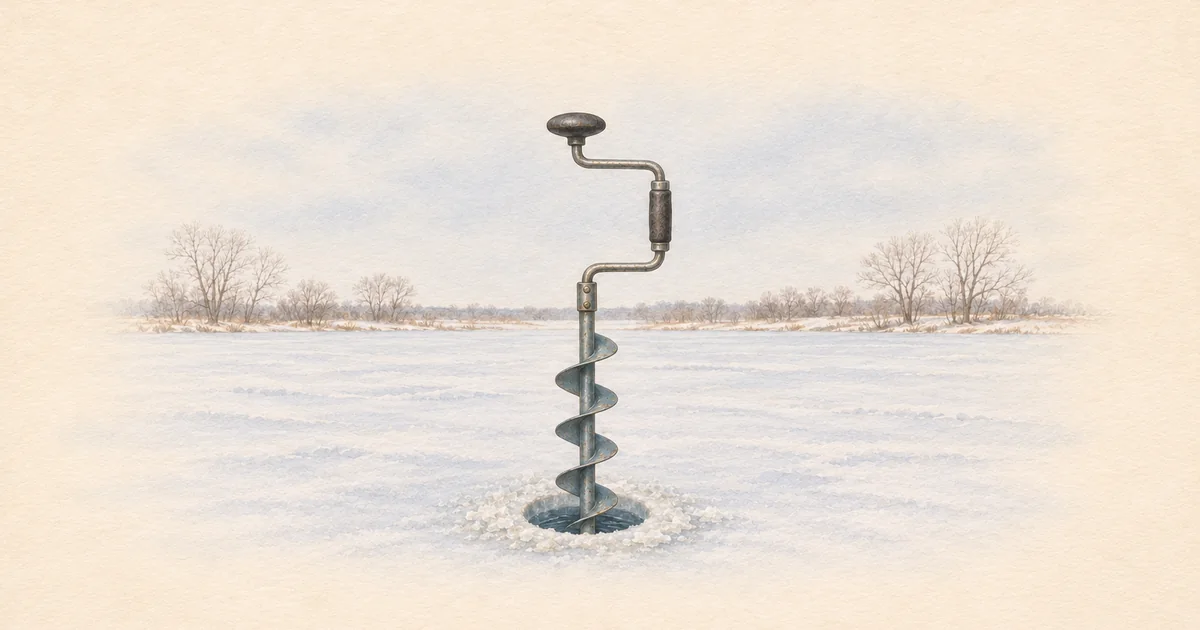
According to the DEC, some hand augers can be attached to a cordless drill with an adapter, which then does the cranking. Power augers are the fastest but heavier and harder to carry; at some waters in New York their use may be restricted. Whether anything applies to your water is set out in the water rules and the fishing permit. Batteries and power banks covers what matters when charging and storing batteries.
Ice chisel and axe as extras
According to MinnAqua, the ice chisel is a chisel with a long handle and a sharp blade. The DEC calls it often the cheapest way to make a hole. It copes reasonably well with ice up to about one foot, around 30 centimetres, and is good for testing the ice thickness. Blinker names an axe as a stopgap for anyone without an auger; anyone who goes onto the ice more often should get an auger. Rute & Rolle gives the reason: hacking is very loud, can drive fish away from shallow water for a long time and can crack the ice. For the same reason, the Anglerverband Niedersachsen advises clubs that open an ice sheet to prevent oxygen depletion to use a chainsaw or ice auger rather than a hammer and axe.
Protecting the blades
The blades determine how easily the auger goes through the ice. The Swedish anglers’ association Sportfiskarna advises looking for good cutting edges when buying and a diameter that suits your target fish. MinnAqua stresses that the blade is sharp. So if your auger has a protective cap, put it on the blades when carrying the auger and in the car. None of the specialist sources checked here describes how to resharpen or replace the blades. For that, follow the instructions supplied with the auger.
Diameter: as large as necessary
The diameter of the auger determines the size of the hole, and the fish has to fit through it, writes Rute & Rolle. If you are after larger fish, choose a wider blade. According to Blinker, 150 millimetres has proven itself, because a pike that unexpectedly takes while you are perch fishing will fit through a hole that size. The DEC names augers of 4 to 6 inches, around 10 to 15 centimetres, for perch and other small fish: they are light and quick through the ice. For trout, char and pike, anglers there use larger augers, because landing big fish through the hole is tricky.
| If you … | Diameter, guide value | Source |
|---|---|---|
| fish for perch and other small fish | 10 to 15 cm | DEC New York |
| catch perch but expect pike | 15 cm | Spoon |
| are targeting pike or large trout | larger than 15 cm | DEC, Rute & Rolle |
| fish a water with a hole size limit | 20 cm at most on the underside | water regulations |
The last row is no coincidence. The Landesanglerverband Brandenburg and the Landesanglerverband Sachsen-Anhalt limit ice holes on their association waters in their water rules to a maximum of 20 centimetres in diameter or side length, measured on the underside of the ice sheet. An auger of more than 200 millimetres is therefore ruled out there.
Worked example: how much ice a hole costs
A drill hole is a cylinder. Its volume is the area of the circle times the ice thickness, and the area of the circle grows with the square of the diameter. With 20 centimetres of ice, that gives:
- 10 cm diameter: 3,14 × 5 cm × 5 cm × 20 cm = about 1,6 litres of ice
- 15 cm diameter: 3,14 × 7,5 cm × 7,5 cm × 20 cm = about 3,5 litres of ice
- 20 cm diameter: 3,14 × 10 cm × 10 cm × 20 cm = about 6,3 litres of ice
So going from 15 to 20 centimetres increases the work by a factor of 1,8, and doubling the diameter makes it four times as much. The DEC arrives at the same ratio: an 8-inch hole costs almost twice as much ice as a 6-inch hole. It advises against buying an auger much larger than you need. With thicker ice, all the values grow in the same proportion.
Step by step from the bank to the marked hole
- Check clearance and rules. According to the Deutscher Feuerwehrverband, the local authorities are responsible for clearing an ice surface for use, and the DLRG advises asking the responsible authority. Whether you may fish there is set out in the water rules and the fishing permit.
- Not alone, ice picks around your neck. The DLRG ice rules advise never going onto the ice alone. Blinker advises wearing the plugged-together spikes around your neck while fishing. More under Ice claws and ice prod.
- The first hole from the bank. The Pennsylvania Fish and Boat Commission recommends drilling or chiselling the first test hole from a jetty or from the bank before you head out.
- Keep measuring as you go. The further out you go, the more often you check the thickness with an auger or ice chisel, advises the Ontario Ministry of Natural Resources. Blinker suggests a test hole every few metres: there can be 20 centimetres of ice at the bank and only 3 in the middle. The DLRG guide values, 15 centimetres for lakes and 20 for flowing water, and what they do not promise, are under Walking on ice.
- Drill, keeping your distance from your neighbour. Rute & Rolle advises keeping your distance from your fishing partner when the ice is thinner, so that the load is not concentrated on a small area. According to the Deutscher Wetterdienst, standing loads are more dangerous than moving ones.
- Keep the hole clear. In frost, according to Blinker, ice crystals form on the edge within just a few minutes, and the sharp edges can cut the line. Remove slush and snow with a sieve or skimming ladle.
- Mark it when you leave. Mark the hole with twigs or sticks, as the Fischereiamt Berlin describes; some water rules require marking (section below). Afterwards, the protective cap goes back on the blades.
Old holes, spacing and marking
An old hole can remain a weak spot, even after it has frozen over again. The ministry in Ontario lists old ice holes among the places where the ice can be weaker than its surroundings, along with ice over currents, springs and pressure cracks. The authority in Pennsylvania warns that fresh snow can hide thin ice and existing holes. A snow-covered hole is then easy to miss.
That is where the rules on marking come from. The Fischereiamt Berlin asks anglers to mark the ice hole with twigs or sticks when they leave so that everyone can see the danger spot, and writes that Berlin’s Eisflächenverordnung (ice surface ordinance) also requires this. In the coastal waters of Mecklenburg-Western Pomerania, ice holes must be clearly marked under § 20 Abs. 5 of the Küstenfischereiverordnung (working copy from the state office LALLF). The water rules of the Landesanglerverbände of Brandenburg and Saxony-Anhalt require clear marking after fishing on their association waters.
None of the sources checked gives a fixed minimum distance in metres between two holes. All that is documented is what matters: spread the load, do not stand close together in a group around one hole, and check the thickness again at every new spot.
Law: going onto the ice and ice fishing
There are two separate questions. According to the Feuerwehrverband, the local authorities are responsible for clearing an ice surface for use. In Bavaria, municipalities can prohibit walking on ice surfaces by ordinance (Art. 27 LStVG). Whether you may fish there is governed by state law and the water rules. The water rules of the Landesanglerverband Brandenburg (2019 edition) allow ice fishing on the association waters at your own risk, provided no official decision or board resolution prohibits it. The water rules of the Landesanglerverband Sachsen-Anhalt generally prohibit it on flowing waters.
As of November 2026: The examples come from Bavaria, Berlin, Brandenburg, Mecklenburg-Western Pomerania and Saxony-Anhalt and apply only there. What applies at your water is set out in the fishing permit and the water rules (Fishing permit and water map). Mandatory equipment covers whether a state requires equipment at the water.
More equipment on the ice
- Ice scoop: a perforated ladle or a small sieve. MinnAqua describes the ladle with small holes that lifts pieces of ice out of the hole, Fisch & Fang names the skimming ladle for leftover ice, Blinker the sieve for broken ice and snow.
- Spikes under your shoes: Blinker recommends them for a secure footing, and the DEC advises traction cleats on your boots to prevent falls. For soles and uppers, see Fishing shoes and boots.
- Ice picks and rope: The authority in Pennsylvania advises wearing ice picks around your neck and carrying a rope you can throw to someone who has gone through the ice.
- Something to stand and sit on: Blinker suggests a foam board that keeps out the cold from below, even when you kneel. Warm clothing is covered in Thermal suit and flotation suit.
- Ice shelter: Whether you may put up a tent on the ice is set out in the water rules (Gewässerordnung) and your fishing permit (Erlaubnisschein). The water rules of the Landesanglerverband Brandenburg deal with weather shelters such as angling tents and brolly tents in the same section as ice fishing, including: room for no more than two people, no waterproof groundsheet, no more than twelve hours without a break in the same spot. Whether this applies explicitly to the ice, they do not say. Background under Night fishing and weather shelter.
Common mistakes
- Auger too big: More diameter means quadratically more ice (worked example above), and some water rules (Gewässerordnung) set the limit at 20 centimetres.
- Test-drilling only near the bank: Further out the ice can be much thinner. Blinker gives the example of 20 centimetres at the bank and 3 in the middle.
- Chopping instead of drilling: Axes and hatchets are loud, may scare off fish in shallow water and, according to Rute & Rolle, can crack the ice.
- Leaving the hole open: Under fresh snow it becomes a trap for others. Mark it before you leave.
- Ice picks in the rucksack: In an emergency they have to be within immediate reach. Blinker and the authority in Pennsylvania advise wearing them around your neck.
Frequently asked questions
Which diameter suits a beginner?
Blinker gives 150 millimetres as a proven size that a pike will also fit through. If you are only after perch and other small fish, the DEC says 10 to 15 centimetres will do, and drilling is easier.
Can I use a cordless drill?
According to the DEC, some hand augers can be connected to a cordless drill with an adapter. Whether that works for your auger is stated in its instructions. You still need the auger; the drill only replaces the crank.
How thick must the ice be before I drill?
The DLRG gives 15 centimetres for lakes and 20 for flowing water. Thickness alone is no guarantee, because it varies across the same sheet of ice. That is why you keep drilling test holes as you walk out.
Do I have to mark my ice hole?
In the coastal waters of Mecklenburg-Western Pomerania it is required by the Küstenfischereiverordnung, and on the club waters in Brandenburg and Saxony-Anhalt by the water rules (Gewässerordnung) of the Landesanglerverband. For Berlin, the Fischereiamt refers to the Eisflächenverordnung. For other waters, check the water rules. Branches or sticks at the hole protect others even where nothing is prescribed.
Related
- Ice fishing: bait, presentation and target fish at the hole
- Stepping onto ice: guide values for ice thickness and help if someone falls through
- Ice rod and ice reel: the short tackle for the drilled hole
- Ice lures: Zocker, balance jig and mormyshka
- Ice claws, ice picks and throw line: self-rescue if the ice breaks
- Line calculator: check the breaking strain of the thin line for the ice reel
- Unit converter: convert feet and other units from sources into centimetres
Sources
- New York State Department of Environmental Conservation: How to Ice Fish (Bauformen, Eisstange, Durchmesser nach Zielfisch, Eismenge, Akku-Adapter, Grödel)
- Pennsylvania Fish and Boat Commission: Ice Fishing (Probeloch vom Steg, verschneite Löcher, Eispicker und Seil)
- Ontario Ministry of Natural Resources: Ice fishing (Dicke unterwegs prüfen, alte Löcher als Schwachstellen)
- Minnesota Department of Natural Resources: MinnAqua, Making Ice Fishing Jiggle Sticks (Aufbau und Bedienung des Handbohrers, scharfe Klinge, Eisstange als Meißel, Eisschöpfer)
- Sportfiskarna: Isfiske (Schneiden und Durchmesser beim Kauf)
- Blinker: Eisangeln: Heiße Tipps, Sicherheit beim Eisangeln, Eisangeln auf Hecht (150 Millimeter, Axt als Notlösung, Sieb, Spikes, Unterlage, Probebohrungen, Eispicker, zufrierendes Loch)
- Rute & Rolle: Einstieg ins Eisangeln (Bohren statt Hacken, Durchmesser, Abstand zum Partner)
- Fisch & Fang: Auf zum Eisangeln (Schaumkelle für Eisreste)
- Anglerverband Niedersachsen: Faktencheck Eiszeit (Lärm von Hammer und Axt, Eisbohrer als leiseres Werkzeug)
- Gewässerordnungen: Landesanglerverband Brandenburg, Landesanglerverband Sachsen-Anhalt (Eisangeln, Lochgröße, Kennzeichnung, Wetterschutz)
- Fischereiamt Berlin: Die Angelkarte und ihre Auflagen (Eisloch mit Zweigen oder Stöcken markieren)
- LALLF Mecklenburg-Vorpommern: Küstenfischereiverordnung, Arbeitskopie (§ 20 Abs. 5, Kennzeichnung der Eislöcher)
- Freistaat Bayern: Landesstraf- und Verordnungsgesetz, Art. 27 (Betretungsverbote der Gemeinden)
- Deutscher Feuerwehrverband: Dünnes Eis birgt große Gefahr (Freigabe durch örtliche Behörden)
- DLRG: Eisregeln (15 und 20 Zentimeter, nie allein, beim Amt nachfragen)
- Deutscher Wetterdienst: Sicher auf dem Eis?! (stehende und bewegte Lasten)
Text AI-assisted, drawing AI-generated. Sources opened and checked in November 2026; no graphics taken from the sources.
All figures are guide values without guarantee. Whether a sheet of ice will hold and whether you may drill and fish there is decided by the authorities, state law and the local water rules (Gewässerordnung); this text does not replace official approval or legal advice.