
Knowledge · Tackle
Ice lures: Zocker, balance jig and mormyshka
If you go ice fishing with a zocker, a mormyshka or a balance jig, you fish vertically below the rod tip and move the lure sparingly. The three lures hang differently in the water, move differently and carry their hooks in different places. That determines which fish you target and how cleanly it is hooked.
Three lures, three positions in the water
At the ice hole there is no casting. The lure hangs on the line directly below the rod tip, and the way it hangs there determines how it moves. How to search the hole layer by layer is explained under Ice fishing, and the short tackle for it under Ice rod and ice reel.
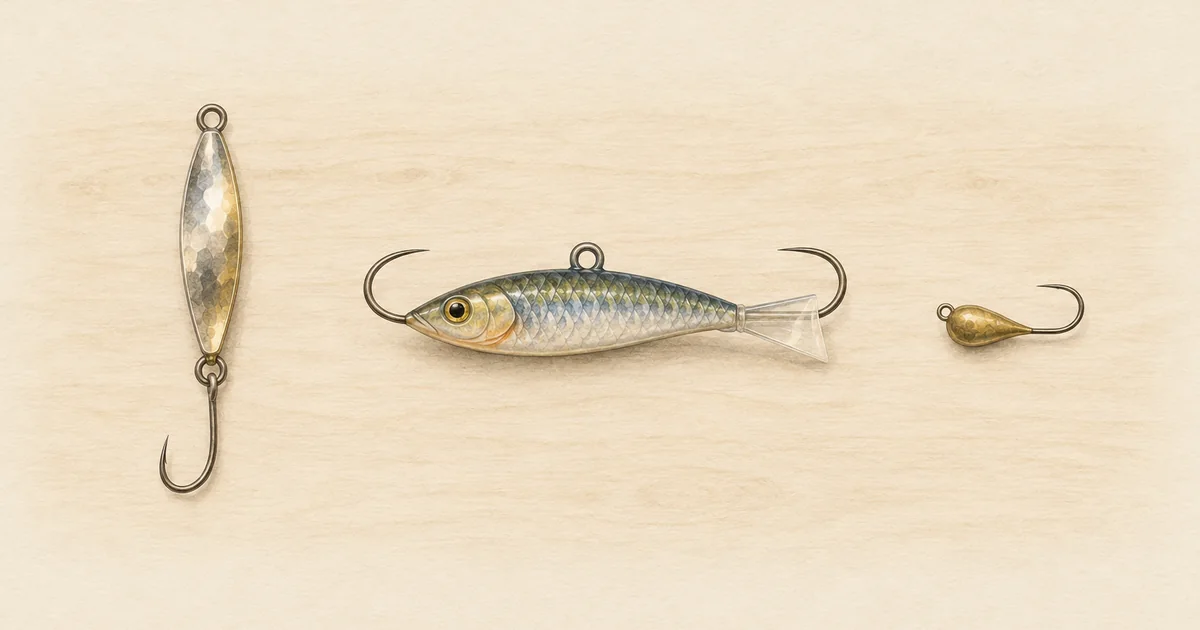
Zocker
A zocker is a small pirk. Rute & Rolle describes the lightest pirks as lures of a few grams for perch, trout and char, which in fresh water are usually called zockers. The eye sits at the head end, so the lure hangs vertically. At the end there is usually a treble, a hook made up of three hooks. The lure is old, too: a look back in Fisch & Fang at ice fishing before the First World War describes the zocker of the time as a simple lead pirk with the treble cast into it. Design and swivel are explained on the Pirk page.
Balance jig
Blinker classes the balance jig as a lure type of its own. Its eye sits on its back, so at rest it hangs horizontally in the water and looks like a small fish. You can recognise it by the broad, wing-like fin at the tail. It carries two single hooks moulded firmly into the head and tail, plus a treble on its belly. Because the eye is on top, it is only suitable for vertical fishing and is never cast. That is why Blinker also calls it a horizontal zocker.
Mormyshka
According to Blinker, the mormyshka comes from Russia and Belarus. In its simplest form it is a tiny long-shanked hook with a split shot pinched onto it. Most have a small hole in the lead drop: the line runs through it and is knotted to the hook shank. It is often baited with maggots, writes Fisch & Fang.
Small soft plastics
For trout at the ice hole, Rute & Rolle names mini twisters and small soft plastic shads on a jig head as first choice alongside small zockers; soft plastics are also an option for perch. In the magazine’s search example, a small twister hangs on a two-gram jig head. Fisch & Fang also mentions small jigs baited with maggots.
Working the lure in the ice hole
The rule for all ice lures: keep movement small. Rute & Rolle warns that too much lure action can prevent bites and advises tapping the zocker lightly from the wrist rather than jerking it half a metre upwards.
Zocker: lift and let it sink
When pirking, according to Rute & Rolle, most bites come while the lure flutters back down to the bottom after the lift. So keep the line slightly taut during this phase and watch for every knock. A Blinker article on perch fishing under jetties and boats, i.e. without ice, recommends short up-and-down movements for small zockers and balance jigs. Every now and then the lure should hit the bottom: the cloud of mud and sand it stirs up makes perch curious.
Balance jig: arc to the side, then pause
- Lower. Bring the lure down to the depth you want to search and wait until it hangs still and horizontal beneath the rod tip.
- Hold. According to Blinker, your hand on the rod or a rocking boat already transmits enough impulses for it to move slightly to the side. In cold water that can be enough.
- Twitch briefly. If you lift the rod tip a little, the broad fin steers it sideways and a little upwards. With a twitch it darts to the side. The training material from the Landesfischereiverband Baden-Württemberg describes how it swings out unpredictably in changing directions when lifted.
- Pause. Wait until it hangs still and horizontal beneath the tip again before you give the next impulse.
- Keep it small. According to Blinker, a hard jerk sends the lure up to 1 or 1,5 metres diagonally upwards and to the side, which is too much in winter.
Mormyshka: quiver instead of twitch
Lower the mormyshka to the bottom and then hold the rod completely still. According to Blinker, the slight trembling of your hand or even your pulse is enough to make the lure twitch delicately. The short mormyshka rods cannot take a fight: after the bite you put the rod aside and bring the fish out by hand on the line. Another Blinker article, which shows the mormyshka used for spin fishing, observes that coarse fish bite above all when it is worked very slowly and when there is a maggot rather than a worm on the hook.
Weight, size and depth
The specialist sources checked give hardly any fixed weight tables for ice lures. These guide values can be backed up:
- Zocker: the lightest pirks, only a few grams according to Rute & Rolle.
- Small soft plastics: in the Rute & Rolle search example, a 2-gram jig head in about five metres of water.
- Mormyshka: very light and, according to Blinker, intended for depths of 5 metres at most, usually for shallower water. Another Blinker article, focused on spin fishing, uses heavier models in the cold season that get down to the fish more quickly.
- Balance jig: heavy enough to stir up sediment when it touches the bottom; according to Blinker it can be worked in midwater as well as over the bottom.
More weight is not an advantage in itself. For the pirk, Rute & Rolle describes the trade-off: heavy models sink faster but have a less attractive action on the drop. According to Blinker, you can make a simple mormyshka yourself in seconds: a fine-wire hook in size 10 to 14, depending on the bait, with a split shot pinched on above it at the knot. If you want to avoid lead, you will find alternatives under Lead-free weights. The line calculator shows how much breaking strain a fine line still has.
Which lure for which fish
| Baits and lures | Position and retrieve | Target fish according to the angling press |
|---|---|---|
| Zocker | vertical; lift from the wrist, let it sink | Perch, trout, char |
| Balance jig | horizontal; hold, twitch briefly, pause | Perch, also zander and rainbow trout |
| Mormyshka with maggot | lower to the bottom, hold still, let it quiver | Perch, roach and other silver fish, trout at put-and-take trout lakes |
| Mini twister, small soft plastic shad | small hops just above the bottom | Trout, perch |
According to Rute & Rolle, pike and zander also take artificial lures under the ice, and the magazine also names a dead baitfish on or just above the bottom for both (more under Ice fishing). Whether you may target a species in winter at all depends on the closed seasons in your federal state (Bundesland). One example: the Sächsische Fischereiverordnung protects pike from 1 February to 30 April and zander from 1 February to 31 May (annex to the regulation, accessed on 7 November 2026). Other states set other dates. Closed season and minimum size explains what closed season (Schonzeit) and minimum size (Mindestmaß) mean.
Hooks, law and fish welfare
With two fixed single hooks and a treble, a fish on a balance jig is hooked at the slightest touch. That has a downside: if you twitch too vigorously, according to Blinker the lure easily foul-hooks perch on the outside, usually on the lower jaw. Blinker’s advice is to twitch more gently.
What counts as snagging, and is therefore prohibited, is governed by each state’s fisheries law. In § 4 of its Fischereiordnung, Brandenburg prohibits, among other things, “artificial lures with fixed multiple hooks” and “fishing methods and devices for snagging fish” (BbgFischO, accessed 7 November 2026). In the Bavarian exam questions, snagging tackle is one of the prohibited means of fishing, and accordingly a rod and line may not be used for snagging. In § 38 Abs. 1 of its Fischereigesetz, Baden-Württemberg prohibits, among other things, snagging “including Zocken, Schlenzen and the like” (FischG BW, accessed 7 November 2026). § 3 Abs. 1 of the state fisheries regulation (Landesfischereiverordnung) allows no more than three hooks per rod and contains the sentence “The use of the zocker is prohibited.” (LFischVO, version valid from 4 February 2022). The paragraph does not explain what the regulation means by zocker or whether a small metal lure at the ice hole falls under it. The fisheries authority (Fischereibehörde) can answer that.
As exam material, the Bavarian questions rate artificial lures with single hooks as gentler on fish than those with trebles; a hook without a barb is called a barbless hook (Schonhaken) there. Single hook instead of treble shows how to convert a lure. Never leave a caught fish lying on the ice. The Fischereiamt Berlin makes clear that fish must be killed properly when ice fishing too, and that letting them suffocate on the ice breaches animal welfare law; Stunning and killing fish describes the procedure. If an undersized fish or one caught in the closed season has swallowed the hook deeply, Brandenburg requires in § 3 BbgFischO that you cut the line level with the tip of its head before the fish goes back into the water.
Note, as of November 2026: The legal examples come from Baden-Württemberg, Berlin, Brandenburg and Saxony and apply only there; the Bavarian questions are exam material. What applies at your water is set out in the state fisheries regulation, the water rules (Gewässerordnung) and the fishing permit (Erlaubnisschein). Mandatory equipment covers which tackle the states require, and Walking on ice whether the ice will hold you.
Common mistakes
- Too much movement. A zocker jerked half a metre upwards is more likely to prevent bites. A tap from the wrist is enough.
- Jerking the balance jig hard. It then darts far to the side, and the fixed hooks are more likely to catch the fish on the outside.
- Casting the balance jig. With its eye on its back, it only works vertically beneath the rod tip.
- Fishing the mormyshka too deep. Blinker describes it as a lure for depths of five metres at most, usually for shallower water.
- Reading the rules only once you are on the ice. Check beforehand with the water rules and the fisheries authority whether jigging (Zocken), trebles or three hooks on one lure are permitted.
Frequently asked questions
What is the difference between a zocker and a balance jig?
The position of the eye. On the zocker it sits at the head end, so it hangs vertically and works as it rises and sinks. On the balance jig it sits on the back, so it lies horizontally and veers to the side when twitched.
Can I use balance jigs without ice too?
Yes, anywhere you fish vertically beneath the rod tip. Blinker mentions vertical fishing from a boat, from jetties and from sheet piling. It cannot be cast.
Which ice lure suits roach?
The mormyshka with a maggot, worked very slowly and just above the bottom. Maggots on a fine float, described under ice fishing, are also proven. Zockers and balance jigs are aimed more at perch.
Is the zocker allowed everywhere?
Each state decides for itself. Baden-Württemberg lists jigging (Zocken) in its Fischereigesetz and the zocker in its state fisheries regulation among the prohibitions, without defining the term there. Ask the fisheries authority or your club before using one for the first time.
Related
- Ice fishing: search patterns, target fish and rules at the ice hole
- Ice rod and ice reel: the short tackle for the lures on this page
- Ice auger: drilling holes without weakening the ice
- Metal lures: pirks, spoons and spinners at a glance
- Maggots and larvae: hooking maggots and pinkies properly
- Perch: winter holding spots, closed season and minimum size
- Fish-friendly tackle: studies on trebles, single hooks and barbs
- Line calculator: working out the breaking strain of fine lines
Sources
- Blinker: Was sind Balance Jigs? Und wie werden sie geführt? (2026) (Bauform, Lage im Wasser, Bewegung beim Zupfen, Haken von außen, Zielfische, Einsatz vom Boot)
- Blinker: Angeln mit der Mormyschka (2025) (Herkunft, Aufbau, Zittern, Drill mit der Hand, Tiefe bis 5 Meter) und Blinker: Mormyschka, bewährter Köder in modernen Zeiten (2019) (schwerere Modelle im Winter, Selbstbau, Weißfische mit Made)
- Blinker: Barschangeln, 10 Tipps für deinen Erfolg (2025) (Zocker und Balance-Jig führen, Sediment aufwirbeln)
- Rute & Rolle: Einstieg ins Eisangeln (2017) (wenig Köderbewegung, kleine Zocker und Gummiköder, Jigkopf mit 2 Gramm, Zielfische, toter Köderfisch für Hecht und Zander) und Rute & Rolle: Der Pilker (2017) (Zocker als kleinste Pilker, Bisse beim Absinken, Gewicht und Spiel)
- Fisch & Fang: Auf zum Eisangeln (2024) (Mormyschka und Jigs mit Maden) und Fisch & Fang: Eisangeln anno dazumal (2023) (historischer Zocker aus Blei mit eingegossenem Drilling)
- Landesfischereiverband Baden-Württemberg: Gerätekunde zur Fischerprüfung, Stand März 2022 (PDF) (Bewegung des Balance-Jigs beim Anheben)
- Land Baden-Württemberg: Fischereigesetz (FischG), § 38 (Verbot des Reißens einschließlich Zocken) und Land Baden-Württemberg: Landesfischereiverordnung (LFischVO), § 3 (höchstens drei Angelhaken, Verbot des Zockers)
- Bayerische Landesanstalt für Landwirtschaft: Prüfungsfragen zur Fischerprüfung 2023/2024 (PDF) (Reißangeln, Einzelhaken an Kunstködern, Schonhaken)
- Land Brandenburg: Fischereiordnung (BbgFischO) (§ 3 Zurücksetzen bei tief geschlucktem Haken, § 4 verbotene Fanggeräte), Freistaat Sachsen: Sächsische Fischereiverordnung (Schonzeiten von Hecht und Zander) und Fischereiamt Berlin: Die Angelkarte und ihre Auflagen (Schlachten beim Eisangeln, Tierschutz)
Text AI-assisted, drawing AI-generated. Sources opened and checked in November 2026; no graphics taken from the sources.
All information is a guide only, without guarantee. Which lures, hooks and fishing methods are permitted at the ice hole is governed by state law and the water rules; this text does not replace legal advice.