
Knowledge · Tackle
Ice rod and ice reel: Short tackle for the hole in the ice
An ice rod is a greatly shortened rod with which you present the lure vertically through a hole in the ice. Because nobody casts, other things count than on the bank: wide rings, which ice building up in them does not immediately clog, a fine tip that shows the bite, and a reel that mainly stores line.
Short, because nobody casts
At the ice hole you sit directly above the fish, and the lure simply sinks downwards. That is how MinnAqua, the angling education programme of the Minnesota Department of Natural Resources, explains the short design: there is no casting in ice fishing. The angling magazines give slightly different figures for how short. Blinker gives 50 to 90 centimetres for Scandinavian ice rods, Rute & Rolle 60 to 100 centimetres. As a guide value, then, an ice rod is between half a metre and a metre long.
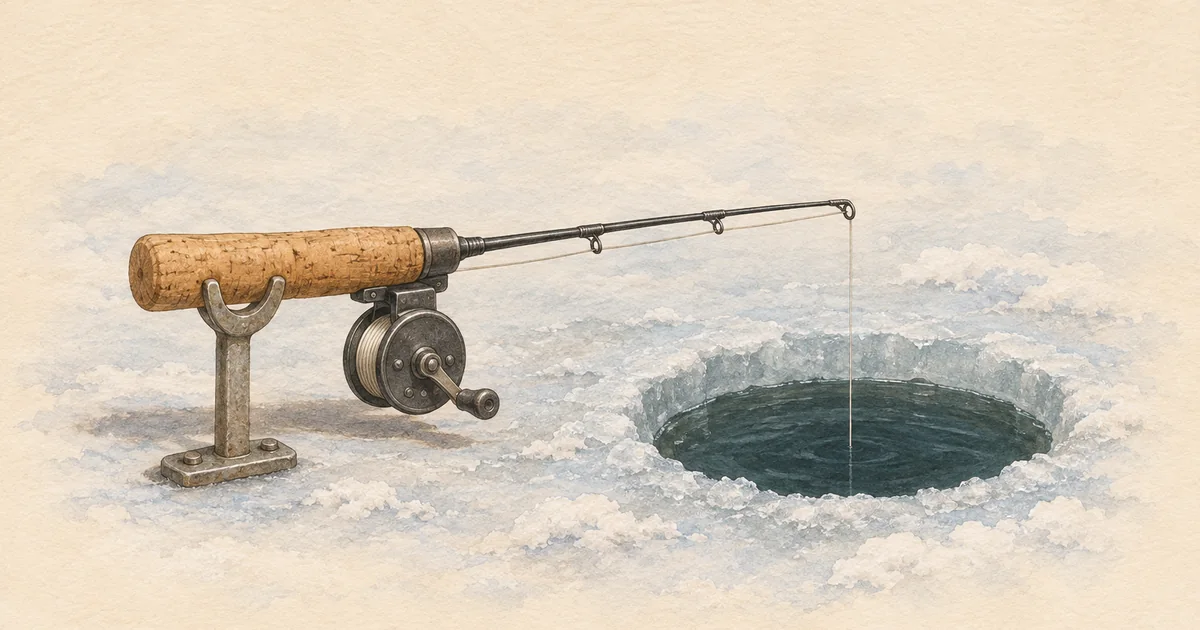
The second feature is the rings. MinnAqua describes them as wide so that there is still room when ice builds up in them. Blinker warns that snow blocks the rings, reel and line or lets them freeze up as soon as the rod lies in the snow.
You do not need special tackle for your first attempt. As a substitute, Blinker names short spinning rods of 1,60 to at most 2,10 metres with a casting weight of 20 to 30 grams. Rute & Rolle suggests short glass-fibre children’s rods because they are forgiving and hardly ever break (more under Children’s rod). One Blinker author uses collapsed telescopic rods for pike fishing: an elastic band holds the rings in place, and only the glass-fibre tip sticks out.
Three designs from 20 centimetres to just over 2 metres
Mormyshka rod
The finest form is barely longer than a hand. For the mormyshka, a tiny hook with a lead drop on the shank, Blinker describes little rods of around 20 centimetres with line just 0,10 to 0,14 millimetres thick. You cannot play a fish on them: after the bite you put the little rod down and bring the fish out by hand on the line. MinnAqua shows an even simpler version, the jiggle stick. This is a small stick without a reel, with the line wound around two pegs.
Ice rod with reel
The usual ice rod carries a small reel and wide rings. Among anglers it is also called a Pimpel, as Fisch & Fang puts it. Sportfiskarna, the Swedish anglers’ association, names balance rods with a sensitive tip and small spring indicators that show the bite, alongside the simple Pimpelspö.
Short spinning or ledger rod
Pike and zander call for more backbone. For predators, Sportfiskarna advises stronger rods, a wire trace, a treble and a large ice auger; for silver fish, on the other hand, thinner lines and more sensitive rods. According to Blinker, a light spinning rod of 1,60 to 2,00 metres is enough for roach too, because you fish with a sliding float anyway owing to the depth.
The tip shows the bite
On the fine ice rod, the tip itself is the bite indicator. You know the principle from the quivertip on the bank: the line is under slight tension and a bite makes the tip jerk. That is how the tackle guide for the angling exam (Fischerprüfung) from the Fischereiverein Löningen describes it. On the mormyshka rod, according to Blinker, the line runs through a ring that sits on a small coil spring or a soft plastic arm. According to Blinker, this little spring amplifies the trembling of your hand so that the lure twitches.
That determines how you hold it: rod still in your hand, eyes on the spring. According to Blinker, the mormyshka often needs no more movement than that; even your pulse can be enough. According to Rute & Rolle, you only tap a zocker from the wrist rather than jerking it half a metre upwards. Too much movement can prevent bites.
When ledgering for pike with a dead baitfish, a float does the indicating. One Blinker author uses ordinary pike floats with a red tip, which he can still make out even with binoculars. Without a float, he clips the main line under an elastic band on the handle. When a fish bites, the predator pulls it out and feels hardly any resistance. Floats explains how to shot a float correctly.
Reel: line store rather than casting machine
According to MinnAqua, reels on ice rods are simple or absent altogether, because without casting they only hold line. The programme distinguishes two types. The simple ice reel has no drag; the line runs off freely. The short combo with a fixed-spool reel, on the other hand, has a drag that you set so that not every movement costs line. The tackle guide for the angling exam basically divides reels by their spool: on fly and multiplier reels it rotates, and its axis is at right angles to the rod. On the fixed-spool reel the spool stays still, and its axis runs along the rod.
For roach, Blinker names a small fixed-spool reel. When ledgering for pike, a bite must be able to take line: the Blinker author laid his rod down on the reel so that the line ran freely off the spool. Setting the reel drag explains how tight the drag is otherwise set, and the baitrunner reel how a reel releases line without opening the bail arm.
Line in frost
Braided line soaks up water and therefore freezes at sub-zero temperatures, Blinker writes. The pike author in the same issue describes how water collects between the fibres and freezes on the rings and reel. He sticks with monofilament line, which stays more supple in frost. According to Blinker, fluorocarbon, unlike nylon, absorbs hardly any water. On the ice it appears in the sources as leader material: the pike author fishes a thick 0,90-millimetre fluorocarbon leader under a monofilament main line. Sportfiskarna recommends a wire trace for predators (see Pike leader).
For perch, Sportfiskarna names nylon line of 0,16 to 0,22 millimetres. MinnAqua considers light monofilament of 4 to 8 lb breaking strain sufficient for most trips, that is about 1,8 to 3,6 kilograms. For pike and zander it should be the stronger one. The line calculator works out how much breaking strain is left after the knot.
The US authorities among the sources give lines in pounds of breaking strain, not by diameter. 1 lb is about 454 grams, so 4 lb is just over 1,8 kilograms. The figure does not tell you the matching diameter. So compare the breaking strain on the spool; the unit converter does the conversions.
Which rod for which fish
| Target fish | Rod | Line | Baits and lures |
|---|---|---|---|
| Perch | light, simple ice rod | Mono 0,16–0,22 mm | Zocker, balance jig, mormyshka, worm |
| Perch and silver fish in shallow water | Mormyshka rod of around 20 cm | 0,10–0,14 mm | Mormyshka with maggot, down to about 5 m |
| Roach | Ice rod or spinning rod up to 2 m with sliding float | 0,16–0,18 mm, hooklength 0,08–0,12 mm | Maggot, pinkie, on the bottom or 1–2 cm above it |
| Pike | short spinning rod 1,60–2,10 m or telescopic rod | Mono, plus a bite-proof leader | dead baitfish under a float |
The figures are guide values from Sportfiskarna, Blinker and Rute & Rolle. For roach, Blinker also names hooks in sizes 18 to 22 and wagglers taking up to 2 grams. The Pennsylvania fisheries authority puts 4 lb for the North American yellow perch and 15 lb for pike, about 6,8 kilograms. Ice lures shows which lures catch under the ice and when.
Check the closed seasons before your day on the ice. They can fall right in the middle of the ice season: Saxony protects pike from 1 February to 30 April (Sächsische Fischereiverordnung, version valid from 1 June 2022). What applies at your water is set out in state law and the fishing permit (Erlaubnisschein); background under Closed season and minimum size.
Rod rests, tip-ups and what state law says
Blinker recommends a small tripod as a rod rest so that the rod does not lie in the snow. A device from North America goes further: the tip-up is a frame over the hole with a line spool. When a fish bites, a little flag springs up. MinnAqua describes it for larger fish such as pike and zander and stresses that it leaves your hands free. Sportfiskarna also knows spring indicators and traps that show the bite when ledgering on the ice.
Whether you may use such a device is up to your federal state. Brandenburg is one example: under § 7 Abs. 1 of its Fischereiordnung (BbgFischO, as amended on 24 August 2026), a rod must be part of a rod and line (Handangel). Under Abs. 3, an angler there may fish with no more than two rods at the same time and must supervise rods that have been set out constantly and directly. The water rules of the Landesanglerverband Brandenburg (2019 edition) additionally ban devices on its waters that set the hook automatically. Neither text says explicitly whether a particular tip-up is permitted under these rules. So ask the fisheries authority or the fishery manager before using one for the first time. What applies at your water is set out in the fishing permit (Erlaubnisschein).
This is how you set up an ice rod at the hole:
- Scoop the hole clear: remove ice chips with a perforated ladle. According to MinnAqua, they otherwise freeze onto the line and mask the bite.
- Place the stand next to the hole and lay the rod on it, not in the snow.
- Plumb the depth: under the ice, according to Blinker, roach sit right on the bottom, and the bait belongs on the bottom or 1 to 2 centimetres above it. A plummet helps with this.
- When ledgering, set the reel so that a fish can take line.
- With little mormyshka rods and when ledgering for pike, bring the fish up through the hole by hand on the line after the bite, as Blinker describes.
- Deal with your catch immediately. The Fischereiamt Berlin makes clear that fish must be killed properly when ice fishing too; letting them suffocate on the ice breaches animal welfare law. Stunning and killing fish shows the procedure.
The rod does not decide whether the ice will hold. Guide values are under Walking on ice, self-rescue under Ice claws.
Common mistakes
- Leaving braid on the reel. It soaks up water and ices up on the rings and spool. Blinker advises carrying at least one spare spool with mono in winter.
- Laying the rod in the snow. Snow blocks the rings, reel and line, or they freeze up.
- Going after pike with the fine ice rod. Blinker considers short ice rods suitable only for smaller fish. Pike call for a stronger rod and a bite-proof leader.
- Working the lure too frantically. Cold fish hardly follow. Small twitches from the wrist are enough.
- Leaving the fish lying on the ice. It is stunned and killed straight away. According to the Fischereiamt Berlin, a fish you return is released immediately, without being kept in the meantime.
Frequently asked questions
How long should an ice rod be?
As a guide value, 50 to 100 centimetres; Blinker and Rute & Rolle are within this range. Little rods for the mormyshka are only around 20 centimetres long. For pike you would rather use a short spinning rod of up to 2,10 metres.
Can you go ice fishing without a special rod?
Yes. A short spinning rod, a glass-fibre children’s rod or a collapsed telescopic rod will also do. What matters is that the rod does not lie in the snow and the line does not ice up.
Which line belongs on the ice reel?
Monofilament, because braid soaks up water and freezes onto the rings and reel in frost. For perch, Sportfiskarna names 0,16 to 0,22 millimetres; for the mormyshka, Blinker names 0,10 to 0,14 millimetres. Fluorocarbon only appears in the sources as leader material.
Does an ice rod need a reel at all?
Not always. On the little mormyshka rod and the jiggle stick, the line is wound on and the fish is landed by hand. For deeper spots and larger fish a small reel is more convenient.
Related
- Ice fishing: search patterns, target fish and who regulates fishing from the ice
- Ice lures: zocker, balance jig and mormyshka in detail
- Ice auger: the hole that a larger fish will fit through too
- Ice claws, ice prod and throw line: self-rescue after falling through
- Thermal suit: protection from the cold for long hours at the hole
- Fishing lines compared: monofilament, braid and fluorocarbon side by side
- Line calculator: working out the breaking strain after the knot
Sources
- Minnesota Department of Natural Resources, MinnAqua: Making Ice Fishing Jiggle Sticks (kurze Ruten ohne Wurf, weite Ringe, einfache Rollen mit und ohne Bremse, Schnur 4 bis 8 lb, Jiggle-Stick, Tip-up, Kelle gegen Eissplitter)
- Blinker: Eisangeln, Tipps für mehr Erfolg (Länge der Eisruten, nur für kleinere Fische, Spinnrute als Ersatz, Dreibein gegen Schnee)
- Blinker: Angeln mit der Mormyschka (Rütchen um 20 cm, Federspitze, Schnur 0,10 bis 0,14 mm, Handdrill, Tiefe bis 5 m)
- Blinker: Eisangeln auf Hecht (Teleskoprute, Pose mit roter Spitze, Gummiband, Ablage auf der Rolle, Mono statt Geflecht, Fluorocarbon-Vorfach, Landung per Hand)
- Blinker: Futter-Tipps zum Eisangeln auf Rotaugen (Spinnrute mit Laufpose, kleine Stationärrolle, Schnur, Vorfach, Haken, Pose, Maden und Pinkies am Grund)
- Blinker: 10 Tipps zum Angeln im Winter (Geflecht gefriert, Ersatzspule mit Monofil, kalte Fische folgen kaum)
- Blinker: Fluorocarbon, die unsichtbare Leine (Fluorocarbon nimmt kein Wasser auf)
- Rute & Rolle: Einstieg ins Eisangeln (Länge der Eisruten, Kinderruten aus Glasfaser, Zocker aus dem Handgelenk, Köder für Barsch)
- Fisch & Fang: Auf zum Eisangeln (Pimpel als Begriff)
- Sportfiskarna, schwedischer Angelverband: Isfiske (Bauformen, empfindliche Spitzen und Wippen, Ansitz mit Bissanzeigern, Gerät für Raub- und Weißfisch, Schnur und Köder für Barsch)
- Pennsylvania Fish and Boat Commission: Ice Fishing Tackle & Techniques (Schnurstärke für Gelbbarsch und Hecht)
- Fischereiverein Löningen: Gerätekunde zur Fischerprüfung (Grundtypen der Rolle, Rutenspitze als Bissanzeiger)
- Land Brandenburg: Fischereiordnung (BbgFischO), § 7 (Stand: Änderung vom 24.08.2026; Rute als Bestandteil der Handangel, höchstens zwei Handangeln, Aufsicht)
- Landesanglerverband Brandenburg: Gewässerordnung, Ausgabe 2019 (Verbot von Geräten, die den Anhieb selbsttätig setzen)
- Fischereiamt Berlin: Die Angelkarte und ihre Auflagen (Fische beim Eisangeln fachgerecht schlachten, Zurücksetzen ohne Zwischenhälterung)
- Freistaat Sachsen: Sächsische Fischereiverordnung (Schonzeit des Hechts)
Text AI-assisted, drawing AI-generated. Sources opened and checked in November 2026; no graphics taken from the sources.
All information is a guide only, without guarantee. Whether a piece of tackle is permitted at your water and whether the ice will hold is decided by state law, the water rules and the authorities; this text does not replace legal advice.