
Knowledge · Fish biology
Age and growth of fish
A fish’s age is recorded in its scales and ear stones (otoliths), because each year leaves a ring there. How fast it grows depends on water temperature, food and stock density. That is why two fish of the same length can be of very different ages, and why a minimum size (Mindestmaß) targets sexual maturity and not years of life.
Annual rings on the scale
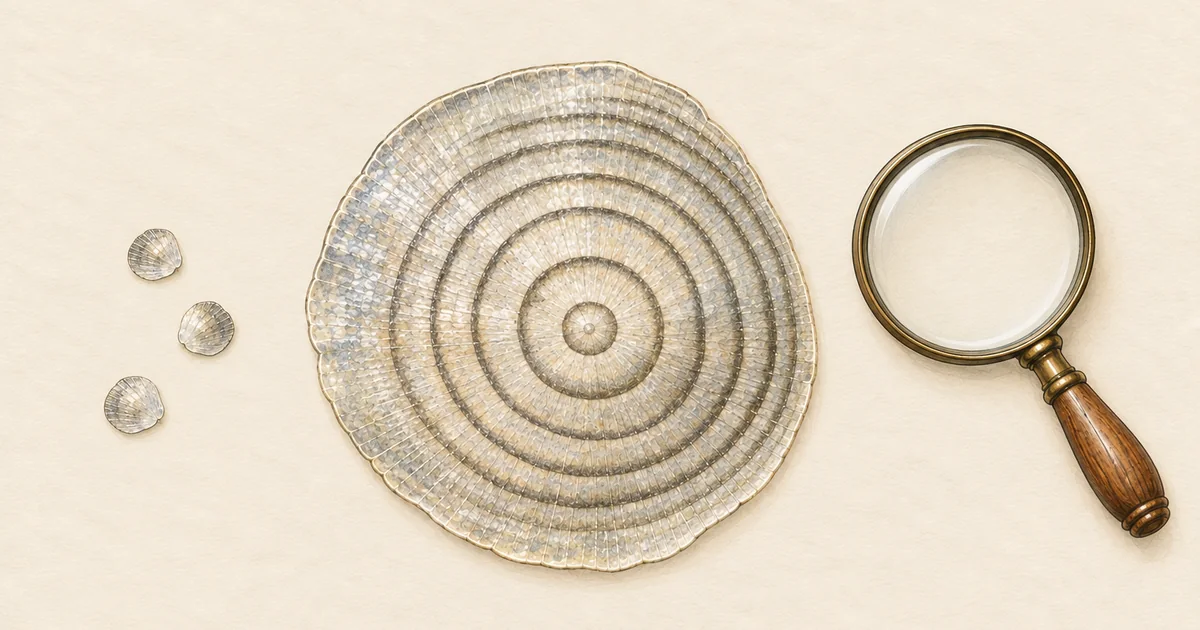
A fish lays down its scales in youth. After that their number stays the same and they grow with it (Blinker). In summer fish and scale grow fast, in winter slowly. On the scale this shows as a pattern of light summer phases and dark winter phases. This is how the Leibniz-Institut für Gewässerökologie und Binnenfischerei (IGB) describes it in its 2023 report „Boddenhecht“.
Fig. 1 shows the principle: wide, light summer zones alternate with narrow, dark winter rings. They are counted like on a sawn-through tree (Landesfischereiverband Bayern), from the centre to the edge. The distance between two rings reveals how much the fish grew in that year. Fisheries biologists use this to calculate back how long it was at each ring.
The picture is not always clear-cut. Spawning also slows growth and, according to Blinker, leaves traces in the rings. In the pike, according to the IGB, even the switch from plankton to fish food in the first year of life can produce a pattern that looks like an annual ring and is not one. If a fish loses a scale, it forms a replacement scale. It only forms after the loss and cannot show the years before.
Ear stones, gill covers and fin rays
Annual rings do not form only on scales. The IGB names as further calcified hard parts the ear stones (otoliths), the gill covers, the shoulder girdle and the fin rays. The wels catfish has no scales, so in its case only these parts are an option.
Ear stones sit in the inner ear. The Thünen-Institut reads the age of sea fish such as cod from them. As in a tree, at least in theory a ring is laid down every year. There the stones are sawn into thin slices and read under magnification.
Which structure reflects age correctly was tested by the IGB on pike from the Bodden, the inner coastal waters of Mecklenburg-Western Pomerania. The ear stones gave accurate results. The scales systematically underestimated the age of animals over six years old, because with age the growth increment decreases and the rings crowd together at the edge. On the other hand, a scale can be taken from a living fish. For the ear stones it has to be killed.
Otoliths are not free of error either. The Thünen-Institut knows „false“ rings, above all from the Baltic Sea with its strongly varying salinity.
Who reads the rings and why
Age determination is the work of fisheries biology. At the Thünen-Institut age readers read the ear stones, because anyone who wants to calculate a stock needs the number of one-, two- and three-year-old fish. For stock management (Hege), the care of a stock through catch rules, stocking and habitats, growth matters. From age and length it follows how fast the fish of a water grow. According to the IGB, a reading error shifts the estimated growth rate and with it the recommendations for management.
Growth throughout life
Unlike humans, most fish keep growing in length throughout their lives, the IGB writes in its 2017 practical guide for angling waters. Young fish gain length fastest because all surplus energy goes into the body. With sexual maturity the pace drops, because now reproduction also costs energy. In old fish the increment is usually very small, and with scarce food it can fail to appear.
The FishBase database gives the highest reported age for many species. These are records of individual animals, not an average. The third column gives the scales: cycloid scales have a smooth rear edge, ctenoid scales a toothed one.
| Species | Highest reported age | Scales |
|---|---|---|
| Pike | 30 years | Cycloid scales |
| Perch | 22 years | Ctenoid scales |
| Zander | 17 years | Ctenoid scales |
| Carp | 38 years | Cycloid scales |
| Roach | 14 years | Cycloid scales |
| Wels catfish | 80 years | none |
What the pace depends on
- Water temperature: Fish are cold-blooded (see Water temperature and oxygen). According to the IGB, warmer water speeds up the metabolism and, with enough food, growth too. This only applies within a temperature window that depends on the species and life stage. For Swedish pike the report gives the most favourable growth temperature as about 19 °C for adult animals and 22 to 23 °C for young pike.
- Food: The fish encyclopaedia of the Landesfischereiverband Bayern gives as an example the stone trout: brown trout from food-poor mountain streams that grow slowly and reach only 15 to 20 centimetres.
- Stock density: The more fish of the same species share the food, the less is left for each and the annual increment falls (IGB).
In the extreme case a stock becomes stunted: the fish are so dense that they stay small. The Landesfischereiverband Bayern describes this for perch, roach and bream. With overpopulation and scarce food, stunted forms arise, in perch even when predatory fish are lacking.
Equally long yet of different ages
How far length and age can diverge is shown by the pike of the Bodden. According to the IGB growth curves, the females there measure on average 40 centimetres after their first year and reach one metre on average at nine years. In comparison stocks from inland waters of Europe and North America, pike were on average only 20 to 25 centimetres long on their first birthday.
The animals also differed greatly among themselves: five-year-old pike from the Bodden and their tributaries were between 50 and 90 centimetres long. Then there is sex. In pike and zander, the females (the roe-bearers) grow considerably larger than the males, according to the IGB.
That growth can change in the same lake is shown by the Lake Constance whitefish (Blaufelchen) of Lake Constance. According to the growth model of the SeeWandel research project, a three-year-old fish weighed about 250 grams at around 30 centimetres in 1935. In 1974, in the nutrient-rich lake, it was 450 grams at around 35 centimetres. When the lake was nutrient-poor again, the values were back at the old level, and with the spread of sticklebacks from 2012 the weight fell to 200 grams.
What the minimum size has to do with it
A minimum size (Mindestmaß) is meant to ensure that a fish can spawn at least once before it is taken. This is how the IGB and a leaflet provided by the fisheries authority (Fischereibehörde) of Mecklenburg-Western Pomerania explain it. The yardstick is thus the length at sexual maturity, not age. How much this length varies is shown by FishBase for the pike: in the studies collected there it ranges from 25 to 63 centimetres.
Because growth depends on the water, a size limit does not fit equally well everywhere. In the Bodden pike grow so fast that, according to an IGB calculation from 2023, only two thirds of the animals could spawn once before they exceeded the minimum size then in force. The institute advised raising it.
Some waters also protect the large fish, through a maximum size or a harvest slot, that is minimum and maximum size together. Behind this is the number of eggs. In female pike of the Bodden it rises exponentially with length, according to the IGB. Large, very fertile animals serve the stock as an egg reservoir. A minimum size alone, by contrast, strongly rejuvenates the stock, because the large fish are taken. They are not quickly replaced, since it takes years for a metre-long pike to grow up. With the amendment of its Küstenfischereiverordnung of 11 September 2026, Mecklenburg-Western Pomerania raised the minimum size for pike and set a maximum size for anglers. The values are given under Fishing in Bodden, Förde and fjord.
Note, as of October 2026: Which minimum size applies and whether there is a maximum size or harvest slot is regulated by your federal state (Bundesland). Water rules and fishing permit (Erlaubnisschein) can be stricter. The official sources of all states are given under Closed seasons and minimum sizes explained. How an undersized fish is returned gently to the water is shown by Releasing fish.
Frequently asked questions
Can you read the age from a scale yourself?
On the enlarged scale of a fish that has been taken the rings can be seen, interpreting them is harder. According to the IGB the result also depends on the reader, and in old fish the estimate is often too low.
How old is a pike of one metre?
That depends on the water. In the Bodden female pike reach one metre on average at nine years according to the IGB, and pike grow particularly fast there. A conversion of length into years that holds everywhere does not exist.
Why do perch stay small in some lakes?
One possible reason is stunting: too many perch on too little food. A minimum size then does not help, according to the IGB, because it protects the many small ones. Thinning out the stock is advised. The water manager decides on that.
Related
- Closed seasons and minimum sizes explained: terms and official sources of the 16 states
- Releasing fish: gentle handling of undersized fish
- Pike, perch, carp and wels catfish: portraits with size, age and spawning season
- Fishing calendar: spawning seasons through the year
- Identifying fish: first establish the species, then apply the measure
- Reproduction and spawning season: when and where the species spawn
Sources
- Leibniz-Institut für Gewässerökologie und Binnenfischerei (IGB): Boddenhecht, Bericht 33, 2023 (PDF, 115 MB; Jahresringe, Schuppen und Gehörsteine, Wachstum der Boddenhechte, Mindestmaß)
- IGB: Nachhaltiges Management von Angelgewässern, Bericht 30, 2017 (PDF; Wachstum, Verbuttung, Mindest- und Höchstmaß)
- Thünen-Institut: Altersbestimmung und Wachstum, Die Demographie der Fische, Otolithen machen den Unterschied (Gehörsteine, falsche Ringe, Bestandsberechnung)
- Landesfischereiverband Bayern: Allgemeine Fischkunde, Fischlexikon (Jahresringe, Schuppenarten, Verbuttung, Steinforelle)
- Aqua & Gas 7+8/2023, Projekt SeeWandel: Felchen im Bodensee (PDF; dreijährige Blaufelchen seit 1935)
- FishBase: Pike, Perch, Zander, Carp, Roach, Wels catfish (höchstes berichtetes Alter; Hecht: Länge bei erster Laichreife)
- Fischereischutzverein Mecklenburg-Vorpommern, bereitgestellt vom Landesamt LALLF: Faltblatt „Angeln in Mecklenburg-Vorpommern“, 2017 (PDF; Zweck des Mindestmaßes)
- Mecklenburg-Vorpommern: Fünfte Verordnung zur Änderung der Küstenfischereiverordnung vom 11. September 2026 (PDF; Mindest- und Höchstmaß für den Hecht)
- Blinker: Fischschuppen, die zweite Haut der Wasserbewohner (Schuppenzahl, Jahresringe, Laichzeit)
Text AI-assisted, drawing AI-generated. Sources opened and checked in October 2026; no graphics taken from the sources.
All figures are guidelines without guarantee. Which sizes apply at your water is determined by the law of your federal state (Bundesland), the water rules and the fishing permit (Erlaubnisschein).