
Knowledge · Tackle
Smoker oven and smoking cabinet
A smoker oven has a fire area at the bottom, a cooking chamber for the fish in the middle and a flue at the top. Whether it is a smoking barrel or a smoking cabinet, how well it works depends on air intake, flue damper, thermometer and wood. Here you will find designs, ways of heating, the technique for cold smoking and what applies to smoke, fire safety and neighbours.
Construction: fire below, fish in the middle, flue at the top
A simple design is the smoking barrel, a drum with embers at the bottom and a flue in the lid, drawn under Smoking fish. A smoking cabinet follows the same principle but is taller, has a door and often a drawer at the bottom for the fire or burner (Fig. 1). According to the magazine Blinker, all ovens cook by the same pattern, whatever the design and heat source. You choose the shape by the fish: long eels and garfish hang better in a tall oven, many trout fit lying down in a shallow one. What a large cabinet holds is shown by a self-test by Rute & Rolle: a 1.50-metre-tall oven easily took 30 trout.
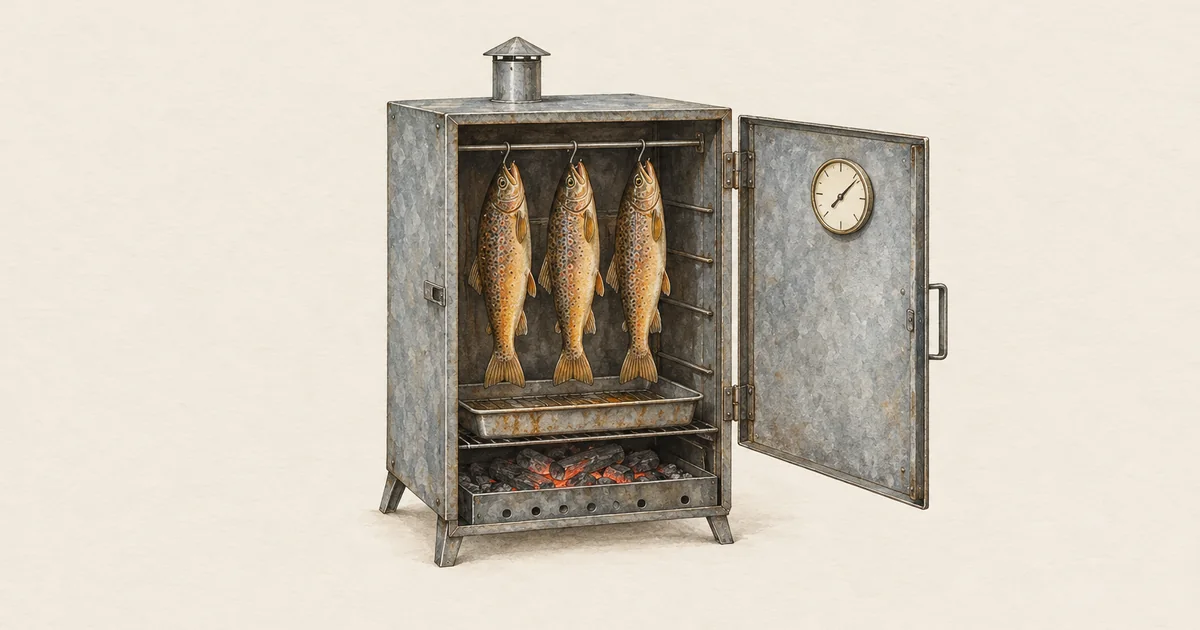
- Fire chamber: Wood burns in it, or a gas burner supplies the heat.
- Smoking-dust tray: Smoking dust is fine wood shavings. The tray stands on the fire or over the burner, where the dust smoulders and smokes.
- Drip tray: It catches fat and juices before they fall into the embers. Why that matters is explained further down under PAHs (PAK).
- Cooking chamber: Rods with smoking hooks or racks for fish lying flat.
- Air intake and flue: If you close both, the fire gets hardly any oxygen and only smoulders. That is how you control the smoking phase after cooking.
- Thermometer: It measures the air in the cooking chamber, not the fish.
Wood fire or gas burner
Rute & Rolle tried both and cooks at 90 to 100 degrees. The wood fire drove the oven thermometer to the stop; it only went better with pure embers. With a burner drawer for gas the temperature rose slowly. The table is based on this one test, the last row on the Berlin fire brigade.
| Feature | Wood fire | Gas burner |
|---|---|---|
| Home | wait for embers, a good 30 minutes in the test | immediately, open the regulator only slightly |
| Temperature | shoots up easily, up to 120 °C in the test | rises slowly, just under 100 °C in the test |
| Supervision | constant, adjust door and drawer | also necessary, as with any fire |
| Risk | sparks and drifting embers | leaking connections, hose in the heat |
Cold smoking: smoke without heat
In hot smoking the fish is first cooked and then smoked in the same oven. The Federal Centre for Nutrition (BZfE) gives over 60 degrees for this and no more than 30 degrees for cold smoking. Blinker draws the same line: it must never get warmer than 30 degrees in cold smoke, otherwise the fish protein coagulates. If protein leaks out of the fillet, it was too warm. So the smoke has to reach the fish cool. There are two ways to do that:
- External smoke generator: The smoking dust smoulders in its own metal housing next to the oven. On the way to the fish the smoke cools. Large smokehouses work on this principle, and a hot-smoking oven can be converted with it.
- Cold-smoking maze: a winding metal channel full of smoking dust that stands in the drawer. A piece of ember in the starting corner lets the dust burn down slowly, for seven to ten hours according to Blinker. The air opening of the drawer stays open; if it gets too warm, you open the flue lid.
Heat does not kill germs here, so keeping quality depends on salt (Max Rubner Institute). According to BfR, bacteria can multiply between 10 and 60 degrees. Cold smoke of up to 30 degrees falls into this range as soon as it is warmer than 10 degrees. Salting and clean working are explained under Smoking fish, the cold chain beforehand under Storage and hygiene.
Wood and smoking dust
The BZfE names beech and alder as common woods for smoked fish. Hard deciduous woods are usual, classically beech, plus fruitwood; softwood and resinous wood are advised against. The Bavarian State Office for Health and Food Safety (LGL) writes that resin-rich softwoods heavily soot the smoked food and can markedly raise PAH (PAK) levels. For wood embers when barbecuing, the LGL advises resin-free, dry, seasoned wood.
Varnished, painted or wood-preservative-treated wood never goes into the oven. According to the Federal Environment Agency (UBA) it can release highly toxic dioxins and furans when burned. Paper, cardboard and plastic also do not belong in the fire, says the UBA. Old boards, fence slats or pallets of unknown origin are therefore left out.
Smoking dust and chips
The heat comes from wood or gas, the smoke from the smoking dust. According to Blinker, the smoke forms when dust or sawdust lies on the embers and smothers the fire. For flavour, the magazine says, the dust matters more than the firewood, and spices such as juniper can be mixed in. The LGL uses the name Kienholz for the resin-rich softwood with which meat is smoked black in Lower Bavaria and the Upper Palatinate. The resin in the wood can form soot particles containing PAHs during smoking, so Kienholz stays out when you smoke fish.
Damp smoking dust smoulders poorly. A Blinker article on the tabletop smoker describes what happens with too many fillets in a small smoker: their water drips onto the chips, which then barely smoulder, and there is no smoke. So store the dust dry and only put in as much fish as there is room for. How to use dust and burner in the tabletop smoker is explained on its page.
In smokers with a separate smoke generator, the number of glowing points controls the amount of smoke. In a Blinker article about African catfish, one lit point gives a little smoke for 12 to 14 hours, two points more smoke for about 6 hours, and four points a lot of smoke for roughly 3 hours. These figures apply to that one appliance. But they show the principle: with more glowing points the smoke gets denser and the dust burns out sooner.
Smoke and PAHs: what the oven influences
Polycyclic aromatic hydrocarbons, PAHs (PAK) for short, form according to BfR during incomplete combustion, and the smoke carries them onto the food. According to the BfR, some of these substances are mutagenic and carcinogenic, and intake should be kept as low as possible. The LGL therefore counts smoked products among the foods monitored especially closely for PAHs.
In direct smoking the smoke forms in the smoking chamber itself, as with the dust tray over the fire. In the indirect method it is generated separately. According to the LGL, the direct method is more likely to put PAHs on the smoked food. You can still counteract this:
- Keep an eye on temperature and smoking time (LGL). The longer food hangs in smoke, the more PAHs are deposited (BfR).
- Leave a gap between smoking dust and fish (LGL).
- No fat in the embers: if it drips in, more PAHs form (BfR). The drip tray belongs under the fish.
- Deciduous wood instead of resinous softwood (LGL).
Health: The figures on PAHs and carbon monoxide come from BfR and LGL. What the BfR advises pregnant women about smoked fish is explained under Smoking fish. This text does not replace medical advice.
Site, fire safety and neighbours
An oven with embers belongs outdoors. According to the BfR, glowing charcoal releases so much carbon monoxide that barbecuing indoors and in garages is life-threatening, even with windows and doors wide open. The Berlin fire brigade gives rules for the barbecue that also fit here:
- A firm stand with distance from anything that can burn. For campfires the UBA advises a fireproof surface.
- Watch the wind so that neither sparks nor embers blow away. In drought and forest-fire risk the UBA advises doing without campfires.
- Keep children away, never leave a burning oven unattended.
- Keep a fire blanket, a bucket of sand or a powder extinguisher ready. The fire brigade advises against water at a barbecue because the steam can scald.
- Never light embers and wood with petrol or methylated spirit.
- With a gas burner: tight connections, hose away from the heat.
- Dispose of ash only when it is completely cold, according to the UBA in general waste and not on the compost.
According to the UBA, smoke and smell repeatedly lead to trouble with neighbours. For campfires the agency advises keeping away from windows, doors and ventilation openings. Whether and when they are allowed is set by the municipality. Whether that also applies to your oven is answered by the public order or environment office. What neighbour law says about smoke is covered under Smoking fish.
Accessories: hooks, brine bucket and thermometers
Smoking hooks, rack and fillet holders
After the salt bath and drying, according to Blinker you hang the fish on suitable smoking hooks or lay them on a rack. For African catfish, the Blinker article explicitly uses sturdy hooks. An older Blinker article on gurnards cuts off the head, twists a curved smoking hook around the spine and hangs the fish so that the tail points downwards. That way the juices stay in the fish and it dries out less. The fish in Fig. 1 and 2 also hang tail down.
Fillets shrink in the smoker. For cold-smoked fillets, Blinker shows a holder made from a small board: a double cord runs through two holes at the head end of the fillet and holds it to the board. Smoking hooks work for this too. With whole trout, Rute & Rolle props the belly flaps open with toothpicks so that they do not curl up. How the fillets are made is shown in Filleting fish.
Brine bucket
The gutted fish soaks in the brine, a salt solution, before smoking. Smoking fish compares salt quantities and times. For the container, Blinker recommends plastic, which salt water cannot harm. Uncoated aluminium is a poor choice: according to the BfR, the metal from foil and uncoated trays can pass into salty foods, and salted herring should not be stored for long in uncoated aluminium pots.
How big the bucket can be is often decided by the fridge. The BfR advises setting the fridge to no more than 7 degrees, preferably below 5 (BfR leaflet), and putting raw fish on the bottom shelf near the back wall (BfR). A fridge thermometer shows whether that holds; the BfR advises checking the temperature in different places. For eel in brine, Blinker gives a cool place at around ten degrees, which is above the BfR value.
You measure the amount of water against the fish, as Fisch & Fang describes:
- Put the gutted fish in the bucket and pour in cold water until they are well covered.
- Pour off the water and measure the litres, using litre bottles if necessary.
- Weigh out the salt. Fisch & Fang gives 50 to 55 grams per litre. For 6 litres of water that is 300 to 330 grams.
- Dissolve the salt completely in the water, put the fish back and keep the bucket cold.
Without scales, the packet helps: a 500-gram packet of salt dissolved in a full ten-litre bucket gives 50 grams per litre (Fisch & Fang). Blinker calculates differently for eel, with about one litre of water per kilo of fish and 80 grams of salt per litre. Three kilos of eel therefore need around three litres of water and 240 grams of salt.
Oven thermometer and core thermometer
The gauge on the smoker measures the air in the chamber. Only a probe or meat thermometer in the flesh shows how hot the fish is inside. The BfR advises checking with a meat thermometer, if in doubt, that at least 70 degrees has been reached for two minutes at every point. So the tip belongs where the fish is thickest (Fig. 2).
If the smoker has no gauge, you can retrofit one. In the Blinker article on the tabletop smoker, a 4-millimetre hole in the side wall lets the probe of a meat thermometer reach into the chamber. Check the measuring range when buying. In the wood-fire trial by Rute & Rolle, the needle hit its stop at 120 degrees and no longer showed how much hotter it got. For cold smoking, the lower end of the scale matters: it must be easy to read around 30 degrees, because according to Blinker it must not get any warmer than that.
Common mistakes
- Starting with a big wood fire. In the Rute & Rolle self-test the thermometer quickly hit the stop. First let the fire burn down to embers.
- Filling the new oven with fish straight away. Heat it up empty once before the first smoking, outdoors and following the manufacturer’s instructions, so that residues of paint and solvents from manufacture burn off.
- Heating with softwood or old construction timber. Resin brings soot and PAHs, treated wood brings dioxins (LGL, UBA).
- Forgetting the thermometer when cold smoking. Above 30 degrees the protein coagulates. Open the flue before it gets that far.
Frequently asked questions
Can I also cold smoke in a hot-smoking oven?
Yes, with an external smoke generator or a cold-smoking maze in the drawer. What matters is that the cooking chamber stays below 30 degrees. If the reading rises, you open the flue.
What does the thermometer in the door show?
The air temperature in the cooking chamber. It does not tell you whether the fish is cooked inside. For that, the BfR gives at least 70 degrees for two minutes throughout, measured with a meat thermometer.
Why does the fish turn black instead of golden?
Two possible reasons: resin-rich wood, which according to the LGL produces a heavily sooted, black surface, and fish that goes into the smoke wet. Eels smoked wet turn black on the outside. With the soot, the PAH levels can also rise.
What does the law say about a smoker oven in the garden?
Annex 1 No. 7.5 of the 4. BImSchV lists installations for smoking meat or fish products and in No. 7.5.2 exempts, among others, installations in restaurants and smokehouses with less than 1 tonne of meat or fish products per week. Beyond that, municipal rules on open fires, building law or neighbour law may apply; whether and which of them concern your oven is answered by the public order or environment office. The text is not legal advice.
What do I make the brine in?
In a plastic container that fits in the fridge. Avoid uncoated aluminium, because according to the BfR aluminium can pass into salty foods. You measure the amount of water against the fish, as described above under brine bucket.
Related
- Smoking fish: salting, cooking and smoking step by step, plus listeria and keeping quality
- Tabletop smoker: a small oven for a few trout
- Storage and hygiene: cold chain from the water to the oven
- Gutting a fish: how the fish goes into the brine clean
- Cool box and cool bag: getting the catch home cool
- Rainbow trout: species profile and catching it
- Line calculator: calculating line strength and spool capacity
Sources
- BfR: Ausgewählte Fragen und Antworten zum Grillen (PAK, Fett in der Glut, Kohlenmonoxid)
- BfR: Verbrauchertipps: Schutz vor Lebensmittelinfektionen im Privathaushalt (PDF) (10 bis 60 °C, 70 °C Kerntemperatur)
- BfR: Lebensmittelinfektionen im Privathaushalt: Quellen erkennen, Risiken vermeiden (Fleischthermometer, 70 Grad)
- BfR: Verbrauchertipps: Schutz vor Lebensmittelinfektionen mit Listerien (PDF) (Kühlschrank höchstens 7 Grad)
- BfR: Korrektes Kühlen von Lebensmitteln im Privathaushalt (Fach für rohen Fisch, Temperatur prüfen)
- BfR: Fragen und Antworten zu Aluminium in Lebensmitteln und verbrauchernahen Produkten (Aluminium und salzige Lebensmittel)
- LGL Bayern: Polycyclische aromatische Kohlenwasserstoffe (PAK) (Überwachung von Geräuchertem)
- LGL Bayern: Untersuchungsschwerpunkt Gegrillte und geräucherte Lebensmittel 2019 (direktes Räuchern, Abstand, Nadelholz, Kienholz und Harz)
- LGL Bayern: FAQ zur Belastung von Grillgut mit PAK (harzfreies, trockenes Holz)
- Umweltbundesamt: Lagerfeuer können für Mensch und Umwelt schädlich sein (behandeltes Holz, Asche, Nachbarn)
- BZfE: Fisch und Meeresfrüchte: Vom Fang in den Handel (Temperaturen, Buche und Erle)
- Max Rubner-Institut: Salzreduktion in Fischprodukten (Keime ohne Hitze)
- Berliner Feuerwehr: Grillen (Standplatz, Löschmittel, Gas)
- Verordnung über genehmigungsbedürftige Anlagen (4. BImSchV), Anhang 1 (Nr. 7.5, Genehmigung)
- Blinker: Fisch räuchern: In 4 Schritten zum Räucherprofi (Ofenform, Luft, Holz, Kalträuchern, Haken und Filethalter, Räuchermehl)
- Blinker: Räucheraal (feucht geräucherte Aale werden schwarz, Kunststoffwanne und Lake für Aal) und Blinker: Gift im Räucherofen? (neuen Ofen leer anheizen)
- Rute & Rolle: Räucher-Special: Holz oder Gas? (Holz oder Gas, Ofengröße, Thermometer am Anschlag)
- Rute & Rolle: Räucherforelle aus dem Kugelgrill (Bauchlappen spreizen)
- Blinker: Afrowels räuchern: Lasst Euch Zeit! (stabile Haken, Glutstellen und Rauchmenge)
- Blinker: Knurrhähne: stachelige Gesellen, aber gut für die Räuchertonne (Haken um die Wirbelsäule)
- Blinker: Fit für den Forellensee: Stremellachs wie vom Profi (nasse Späne, Bratenthermometer)
- Fisch & Fang: Nass-Salzen vor dem Räuchern ist sicherer (Lake am Fisch abmessen)
Text AI-assisted, drawing AI-generated. Sources opened and checked in October and November 2026, no graphics taken from the sources.
All figures are guide values without guarantee. For open fires the rules of your municipality apply; the text does not replace medical or legal advice.