
Destinations · Poland
Fishing in the Gulf of Gdańsk and on Hel
The inner Gulf of Gdańsk with Puck Bay behind the Hel Peninsula counts in Poland as inner sea. In the shallow bay live pike and perch alongside herring, garfish and sea trout. Instead of a fishing licence and fishing permit you only need the receipt for the state fee for sea angling.
- Papers
- ID and proof of payment of the state fee for sea angling
As of October 2026
At a glance
- Papers
- ID and proof of payment of the state fee for sea angling
| Fish | Minimum size | Closed season | Catch limit | Note |
|---|---|---|---|---|
| Pike | 50 cm | 1.1.–15.5. | 2 per day including zander | Closed season in the inner Gulf of Gdańsk with Puck Bay |
| Perch | 20 cm | none | 15 a day | |
| Zander | 50 cm | 10.4.–31.5. | 2 per day including pike | east of 19°21′ E: 20.4.–10.6. |
| Sea trout | 50 cm | 15.9.–15.11. | 2 per day | Closed season in the strip up to 4 nautical miles off the coast |
| Atlantic salmon | 60 cm | 15.9.–15.11. | 1 per day | only with the adipose fin clipped, then stop salmon fishing (EU 2026) |
| Herring | 16 cm | none | 6 kg per day | |
| Garfish | 60 cm | none | 10 per day | |
| Flounder | 23 cm | none | 7 kg including other species | |
| Cod | – | Fishing ban 2026 | – | Return bycatch immediately; protected all year round in Poland |
| Eel | – | protected all year round | – |
Regulation on recreational sea angling (Dz. U. 2023 item 2816), for cod and salmon additionally EU Regulation 2025/2454. Upstream of the river mouths inland law applies. As of October 2026. The regulation and your fishing permit (Erlaubnisschein) take precedence.
Location and waters Puck Bay, Hel Peninsula and Gulf of Gdańsk
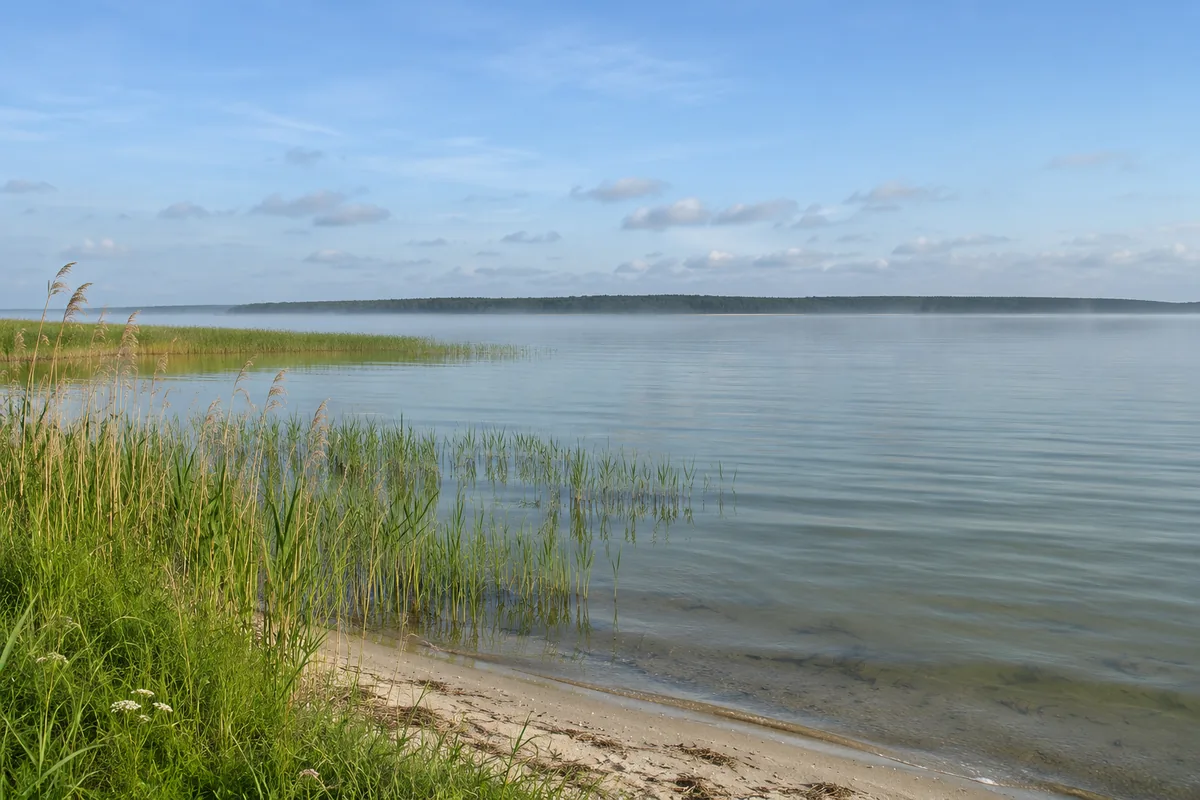
The narrow Hel Peninsula separates Puck Bay (Zatoka Pucka) from the open Baltic Sea. The part of the Gulf of Gdańsk behind the baseline of the territorial sea is internal marine water (Maritime Areas Act, Article 4). Puck Bay belongs to it too (MIR-PIB), so sea law applies everywhere when you fish.
11.352 ha of the inner bay belong to the Nadmorski Park Krajobrazowy coastal landscape park (NPK). In addition there are the Natura 2000 sites Zatoka Pucka and Zatoka Pucka i Półwysep Helski. Baltic water is on average five times less saline than the ocean.
Fish and best time Pike, perch, garfish, herring and sea trout
- Pike, perch and zander: The freshwater predators live here alongside marine fish, but have become scarcer. Drained shorelines cost the pike its spawning sites (MIR-PIB). From 2020 to 2022 more than 300.000 young pike were stocked. The perch stock fluctuates strongly here (MIR-PIB).
- Garfish: It spawns mainly in Puck Bay. In the catch reports it appears mostly in May and June, then again in August and September on its way back to the North Sea (MIR-PIB).
- Herring: In the reports of the angling boats it came mostly from March and April. That is when the spring herring moves into the Vistula Lagoon to spawn.
- Sea trout and Atlantic salmon: The sea trout of the Reda, which flows into the bay, are supported by state stocking (MIR-PIB). Salmon are trolled for from boats mainly in ICES area 26, which includes the Gulf of Gdańsk. You report tagged fish to the MIR-PIB.
The catch calendar shows the months for other species.
Papers and permit Fee to the GIRM and boat trip report
- Fee: You transfer it to the Chief Inspectorate of Sea Fisheries (GIRM). The validity period starts on the day of payment, and no paper permit is issued (GIRM). At the water you show ID and proof of payment (Sea Fisheries Act, Article 90).
- Responsible body: The former district inspectorate OIRM Gdynia no longer exists; the only authority is the GIRM (Article 100). It has a branch office in Gdynia and offices in Hel and Władysławowo.
- Reporting a boat trip: In Puck Bay and the Gulf of Gdańsk you email the boat name, start time and area to the GIRM at least two hours before you start (Article 96a). If you have herring, sprat, cod or eel on board, you enter them in a catch report before entering the harbour.
- RecFishing: You record species covered by EU catch rules in the free app (GIRM).
Special rules Pike closed season, cod ban and salmon limit 2026
- Pike and perch in brackish water: In the inner waters of the bay, pike is protected from 1 January to 15 May. For perch the sea regulation sets no closed season, only the minimum size.
- Cod: In 2026, fishing for cod in the Baltic Sea is banned, and bycatch goes straight back (Regulation (EU) 2025/2454, Article 10). Poland protects cod and eel at sea all year round anyway.
- Salmon: In 2026 you may keep only one salmon with a clipped adipose fin per day. After that your salmon fishing ends, and every fish you keep is landed whole (Article 11). Salmon and sea trout are protected in the strip of four nautical miles off the coast from 15 September to 15 November.
- Closed areas: Where commercial fishing is banned, you must not fish either. You keep 100 m from the edge. In the bay this affects, from 20 April to 20 June, the area off the mouth of the Płutnica. If the ministry announces stocking, fishing there is also suspended.
- Harbours and piers: You do not fish from sea marks and bridges. In the harbours of the Gdynia Maritime Office, for example Hel, Jastarnia and Władysławowo, you fish only at least 150 m from the fairway, roadstead and anchorage (harbour regulations, § 99).
- Boat: Fairways and anchorages are taboo, and you keep 100 m from nets and charted wrecks. Fishing within 500 m of the wrecks of the Wilhelm Gustloff and the Goya is banned (Gdynia Maritime Office).
- Nature reserves: The coastal landscape park contains several reserves (rezerwat przyrody), for example Beka and Mechelińskie Łąki (NPK). Fishing there is allowed only at designated spots (Nature Conservation Act, Article 15).
- Seals: All seal species, including the harbour seal, are strictly protected in Poland. Keep your distance and do not disturb the animals, not even for a photo. If a seal looks ill, you call the marine station of the University of Gdańsk in Hel (Fokarium Hel).
As of October 2026. Sizes, closed seasons, daily limits, distances and tackle are governed by the Regulation on recreational sea angling of 27 December 2023; the closed areas are listed in the annex to the commercial fisheries regulation. The EU catch rules for cod and salmon apply only for 2026. Before fishing from a pier, ask at the harbour master’s office (Bosmanat).
Safety
The bay is shallow and a playground for windsurfers and kitesurfers, from spring to autumn and in winter on the ice. On the ice you often do not know how thick it is, and it breaks more easily at inflows and outflows. In a storm, returning water can form a strong current, and the weather changes quickly. Remains of sunken chemical warfare agents may lie on the beach, so do not touch anything unknown (NPK hazard analysis 2026). More under Walking on ice and Thunderstorms and weather.
Related
- Fishing in the Bodden and fjords and Fishing in harbours and from piers
- Fishing in Poland, Polish Baltic coast and Vistula Lagoon
- Pike, perch, garfish, herring and sea trout in the fish encyclopedia
- Spinning and returning fish
Sources
- Verordnung über das Freizeitangeln im Meer (Dz. U. 2023 Pos. 2816), Seefischereigesetz (Dz. U. 2025 Pos. 590), Gesetz über die Meeresgebiete und Verordnung zur Berufsfischerei, Anhang 1 (Dz. U. 2022 Pos. 1556)
- Verordnung (EU) 2025/2454, Artikel 10 und 11, und Naturschutzgesetz (Dz. U. 2026 Pos. 13)
- Główny Inspektorat Rybołówstwa Morskiego: Freizeitfischerei, RecFishing, Außenstelle Gdynia, Büros (abgerufen 04.10.2026)
- Urząd Morski w Gdyni: Hafenvorschriften (einheitlicher Text vom 19.12.2025) und Verbot an den Kriegsgräber-Wracks
- Morski Instytut Rybacki – PIB: Zustand der Putziger Wiek, Wiadomości Rybackie 11-12/2018, 11-12/2023, 1-2/2024, 9-10/2025, Portal Nasz Bałtyk
- Nadmorski Park Krajobrazowy: Natura 2000, Rechtsakte und Reservate, Safety at the water; Verordnung zum Gebiet PLH220032; Stacja Morska UG, Fokarium Hel
Guide without guarantee, as of October 2026. The Polish rules on recreational sea angling, the harbour regulations of the Gdynia Maritime Office, nature conservation law and EU law for the Baltic Sea, each in its current version, take precedence.