
Knowledge – Fish
Sprat: Features, difference from herring, bait fish
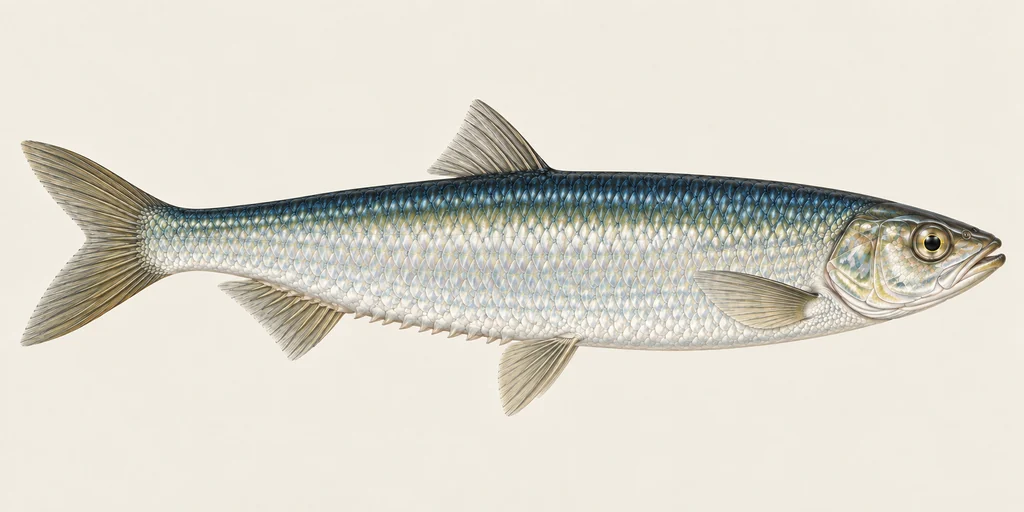
The sprat (Sprattus sprattus), also called Sprott, Brisling or Breitling in German, is a small shoaling fish of the herring family. In the North Sea and Baltic it is very common and a staple food of many predatory fish. Anglers hardly ever target it, but know it as a baitfish and as Kieler Sprotte (Kiel sprats) from the smokehouse.
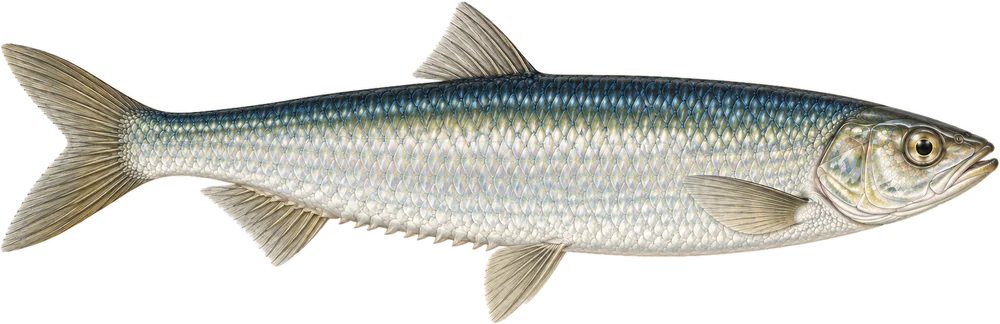
In short: Small shoaling fish, easily confused with young herring. Hardly ever fished for deliberately, but a well-known baitfish. What to do with a bycatch: Sprat as bycatch.
- Pelvic fins sit in front of or below the start of the dorsal fin
- Sharp keel of bent scales between the pelvic and anal fins
- Blue to blue-grey back, silvery sides without dark spots, slightly protruding lower jaw
Catch chances through the year
- Hardly any chance
- Possible
- Good
- Peak season
- Spawning (observe the closed season)
Editorial assessment for waters in Germany, not a measured value and no guarantee. Spawning time is not the same as the legal closed season.
Species profile and sources in the catch calendarAll species compared month by monthThe rules of your federal state
How to recognise it
The sprat is a slender fish, flattened from the sides, with a blue to blue-grey back and silvery sides and belly. The lower jaw projects slightly, and there are no dark spots on the flanks.
On the belly it has a strong keel of scales. These keeled scales between the pelvic and anal fins are sharply bent and have points directed backwards. If you run a finger over the belly from back to front, you catch on them.
Around 12 centimetres is usual. The Thünen-Institut gives 16 centimetres as the maximum length, the Norwegian institute of marine research 19,5 centimetres and 54 grams. Sprats live six years at most, usually only four to five. In the Baltic they live longer than elsewhere.
The sprat is most often confused with young herring. Three features help: in the sprat the pelvic fin starts in front of or directly below the start of the dorsal fin, in the herring further back. The sprat looks stockier and has smaller eyes. Then there are the sharp keeled scales on the belly.
Side by side
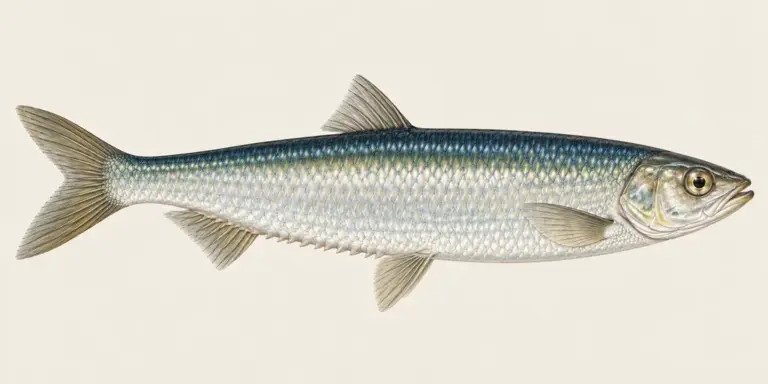
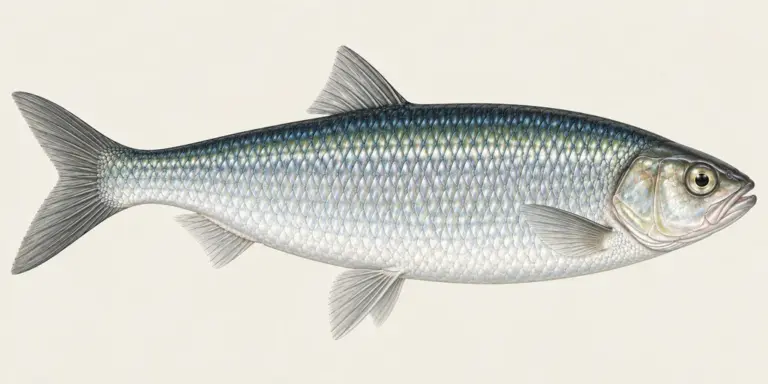
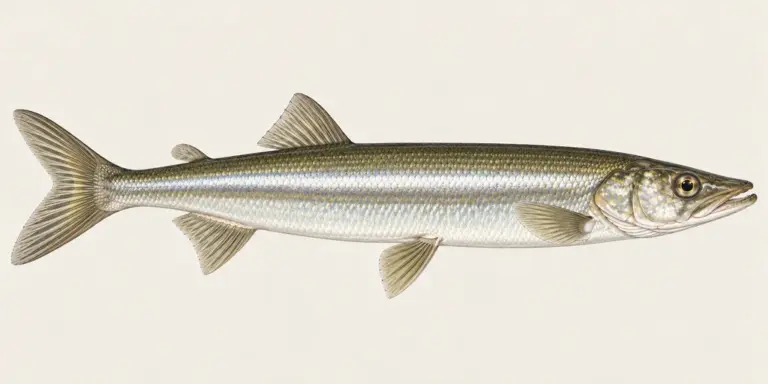
AI-generated illustrations.
Where it lives
The sprat lives in the north-east Atlantic from Norway to Morocco, in the North Sea and Baltic, in the Mediterranean, in the Adriatic and in the Black Sea. Important areas are the Baltic, the Skagerrak, the Kattegat and the North Sea.
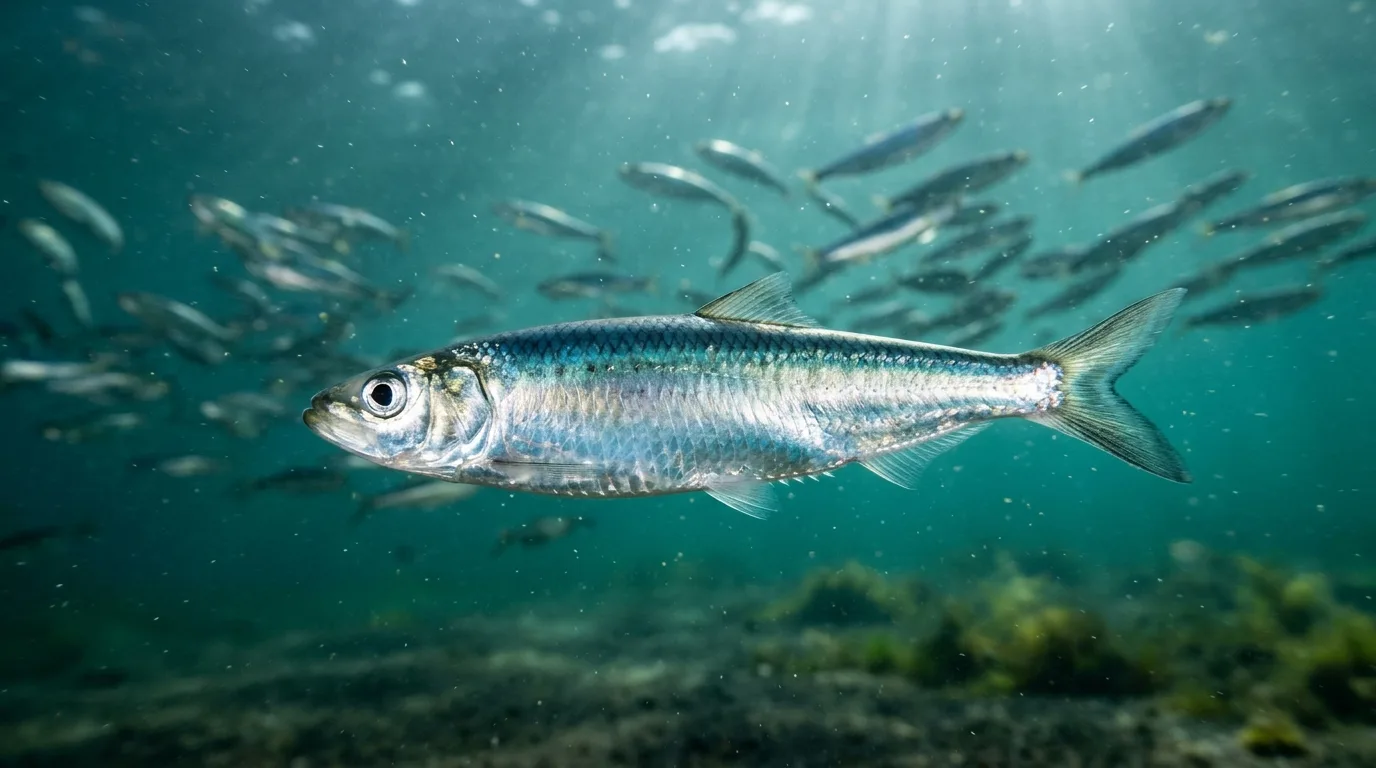
It lives in open water, especially in fjords and near-coastal waters, mostly between 10 and 150 metres. It tolerates low salinity well, and juveniles also move into river mouths. That is why it has also settled the brackish water of the Baltic.
Holding spots in the picture
Choose a season and time of day: the picture shows where the species sits then. Tap a fish or a spot in the list to bring it closer. The picture is schematic and AI-generated, every water is different.
On the coast
Open water, mid-water
Sprat is found here all year round.
Just below the surface
Sprat is found here all year round.
The sprat travels in shoals through open water near the coast and in fjords. It copes well with low salinity, which is why it also lives in the brackish water of the Baltic Sea.
Depth: It usually lives between 10 and 150 metres. By day the shoals stay near the bottom; at night they spread out and rise.
Size comparison: AI-generated drawing, schematic.
How it lives and spawns
Sprats travel in shoals. During the day the shoals stay near the bottom, at night they break up and rise to the surface. They feed on animal plankton, above all small crustaceans, and are themselves food for many predatory fish and seabirds. They migrate noticeably between winter feeding grounds and summer spawning grounds.
Individual sprats spawn almost all year round, most in spring and summer, peaking in May and June. The fish spawn at 10 to 20 metres depth, on the coast or up to 100 kilometres out. The free-floating eggs and the larvae drift towards the coast. Sprats mature at about ten centimetres.
When it is on the coast
There is no fishing season for the sprat; it is not a target fish.
Sprat shoals are still interesting for predator anglers because they attract predators. In Norwegian fjords large shoals of coley follow the herring and sprats, and mackerel eat sprat fry, among other things. If you are looking for coley, watch out for shoals of baitfish.
You will find the monthly overview of all species and the water temperature check in the catch calendar.
The sprat as bait fish
As bycatch: Fishing for sprat? – why the species is not a target fish and what to do when one turns up on your hook.
Hardly anyone targets sprat. It is better known as a bait fish, usually bought deep-frozen. Fresh sprats are hard to get hold of, but on the coast they are considered a very good bait on a float rig.
In fresh water many pike anglers use sprats because they are cheap and imitate small cyprinids such as bleak well. The flesh is soft: they can only be cast while frozen and barely survive hard casts. Blinker recommends hooking them through the lip under a float; they are no good for active retrieves. Sprats also catch zander as long as the water is warm. More under Animal natural baits.
Baiting up frozen: Take sprats out of the cool box only just before you cast. Half-thawed ones easily tear off when cast.
Check the belly: Young herring or sprat? Run a finger along the belly from the rear. If it catches on sharp keeled scutes, it is a sprat.
Suitable lures
We deliberately show no baits for this species.
Small shoaling fish that is hardly ever targeted; known mainly as a bought bait fish.
What you can do with sprats in the kitchen
Like herring, sprat is an oily fish. A large share of the catch ends up as fishmeal, though, and only a smaller part on the plate. It is sold fresh, frozen, smoked or tinned, and you can also cook it in a pan or under the grill. For hot smoking it traditionally stays whole: ungutted, with head and tail. How smoking works is explained in Smoking fish.
Like all sea fish, sprat can contain roundworm larvae. The larvae die from heat or freezing, and thoroughly cooked fish poses no danger in this respect.
What you need to observe
In the 2025 Red List of Marine Fishes of Germany, sprat is listed as not threatened and very common, with a clear short-term increase. The International Union for Conservation of Nature (IUCN) classes it as of least concern.
Closed seasons (Schonzeit), minimum sizes (Mindestmaß) and harvest windows are set by the federal states (Bundesland) and by the fisheries authorities (Fischereibehörde) of the neighbouring coastal countries (Denmark, Norway, Poland). They vary by type of water, stretch of coast and time of year. We only give figures with a date and a source; the fisheries regulation of your federal state and your fishing permit (Erlaubnisschein) are always what counts. In Schleswig-Holstein they are set out in the Küstenfischereiverordnung and time-limited general orders. A list of links to the official sources is in the catch calendar.
A fish you may keep and want to keep, you stun and kill immediately in line with animal welfare rules.
What closed season, minimum size and harvest slot mean and where to find them is explained on the page Closed season and minimum size explained.
Frequently asked questions (FAQ)
What is the difference between sprat and herring?
The sprat stays smaller, looks stockier and has smaller eyes. Its pelvic fin sits in front of or below the start of the dorsal fin, and the belly carries sharp keeled scutes.
Are Kieler Sprotten a separate species of fish?
No. In Germany that is the name for smoked sprats. In the shops the species also turns up in tins as so-called anchovies.
Are sprats suitable as bait fish?
Yes: frozen for pike and zander under a float or on the bottom, fresh on the coast on a float rig. They are too soft for fast retrieves.
Sources
The rating of catch chances is an editorial assessment. The facts come from these sources, and the text is worded in our own words. The illustration is an original design by Angel Momente in the style of a natural history plate (AI-generated, see the AI notice).
- Thünen-Institut, Fischbestände online: Sprotte (Biologie, Merkmale, Verbreitung, Höchstwerte)
- FishBase: Sprattus sprattus (Größe, Tiefe, Merkmale, Laichen, Wanderungen)
- Havforskningsinstituttet: Brisling (Sprotte; Größe, Alter, Laichzeit, Nahrung)
- Rote-Liste-Zentrum: Sprotte (Rote Liste der Meeresfische Deutschlands 2025: ungefährdet)
- Blinker: Fängige Köderfische zum Angeln auf Hecht (Sprotten)
- Blinker: Von Aal bis Meerforelle, Köder für das Molenangeln (Sprotten)
- Blinker: Zanderangeln mit Köderfisch (Sprotten bei warmem Wasser)
- Land Schleswig-Holstein: Welche Mindestmaße und Schonzeiten gelten in Schleswig-Holstein?
- Blinker: Norwegen, Angeln im Fjord (Köhler folgen Hering und Sprotte)
- Blinker: Die 7 besten Naturköder zum Meeresangeln (Makrele frisst Sprottbrut)
- Deutsche Lebensmittelbuch-Kommission (veröffentlicht vom BMLEH): Leitsätze für Fisch und Fischerzeugnisse
- Bundeszentrum für Ernährung (BZfE): Fisch und Meeresfrüchte, Gesundheit und Umwelt
- LAVES Niedersachsen: Parasiten in Fischen und Fischereierzeugnissen – ein Problem?
Created with AI support from the sources listed. Figures only appear in the text if a source gives them. Last updated: 27 October 2026. Found a mistake? Write to us. Who is behind this site: About me.
More in the lexicon
- All fish species at a glance
- Catch calendar – month, water temperature and profile for 93 species
- Line calculator – breaking strain after the knot, drag guideline, backing
- Angling methods