
Fishing waters · Norway
Fishing in Central Norway, on Hitra and Frøya
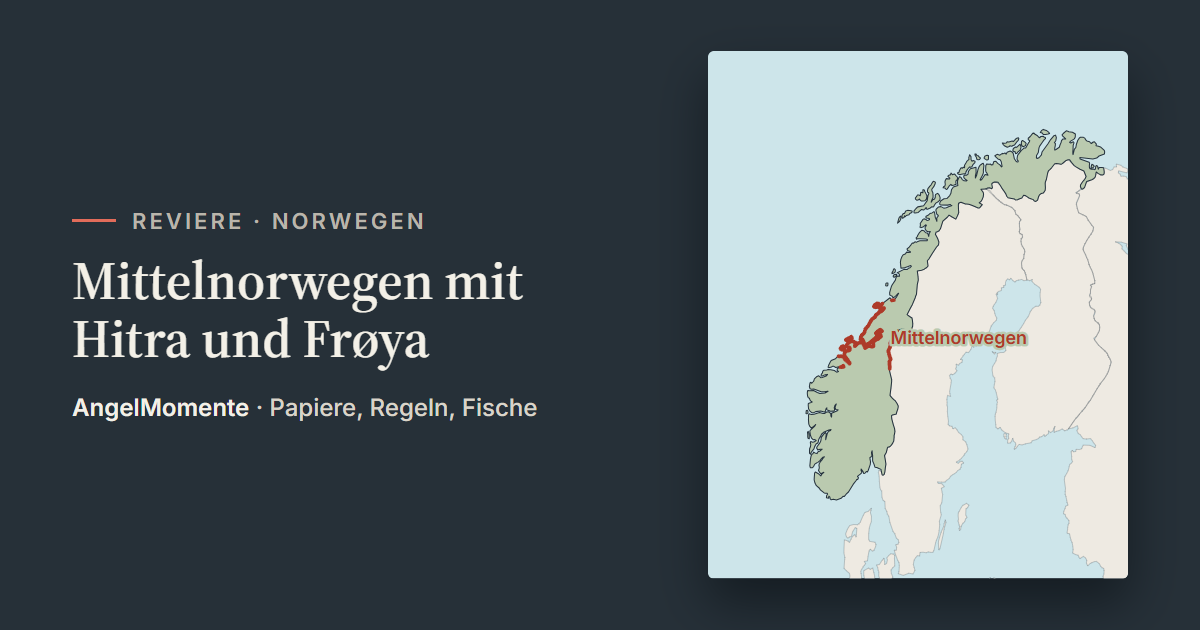
Central Norway begins at the 62° N line at Stad and extends to the border with Nordland. It includes the coast of Møre og Romsdal north of Stad, the Trondheimsfjord and the islands of Hitra and Frøya. The whole area lies north of 62° N, so the larger minimum sizes (Mindestmaß) for cod and haddock apply here.
- Papers
- None at sea; on a salmon river a fishing permit, from 18 a fishing levy (Fischereiabgabe)
As of October 2026
At a glance
- Papers
- None at sea; on a salmon river a fishing permit, from 18 a fishing levy (Fischereiabgabe)
| Fish | Minimum size | Closed season | Note |
|---|---|---|---|
| Cod | 55 cm | none | further than 4 nautical miles from the baseline: 44 cm |
| Coley | – | none | no minimum size as long as you do not sell |
| Haddock | 40 cm | none | |
| Halibut | 84 cm | 20.12.–20.4. | over 2 m always release; Sklinnabank closed all year |
| Redfish | 32 cm | 1.9.–31.5. | 1.6.–31.8. only with a hand line (jukse); further than 12 nautical miles: 30 cm |
| Atlantic wolffish (sea wolf) | – | none | |
| Tusk | – | none | |
| Mackerel | – | none | no minimum size as long as you do not sell |
| Sea trout (at sea) | 35 cm | 1.3.–31.5. | Trøndelag; Møre og Romsdal 1.3.–30.4. (not Smøla); Sunndalsfjord and others inside the E39 all year |
| Plaice | 29 cm | none | inner Borgenfjord: closed 1.2.–30.6. |
Sea north of 62° N: catch regulation (høstingsforskriften), sea trout according to Fiskeridirektoratet and the regulation on salmonids at sea. In the river the salmon regulation and the rights holder’s permit apply. Correct as of October 2026. What counts is the regulation and your fishing permit (Erlaubnisschein).
Location and waters Trondheimsfjord, Hitra, Frøya and Møre og Romsdal
North of Stad the coast belongs to Møre og Romsdal, up to Smøla. Beyond that comes Trøndelag with its islands from Heim and Hitra in the south to Leka in the north (Store norske leksikon).
The Trondheimsfjord is 130 km long, and its deepest point, at 617 m, is at Agdenes near the entrance (SNL: Trondheimsfjorden). Hitra lies south-west of the mouth. At 571,5 km² it is the largest island in Norway south of Northern Norway. Frøya lies further out in the open sea and measures 151,4 km² (SNL: Frøya).
Fish and best time Cod, coley and halibut
- Cod: The coastal cod between Stad and the Helgeland coast is managed as a separate unit (Havforskningsinstituttet: Küstendorsch).
- Coley: lives along the coast from Stad to the Kola Peninsula and spawns, among other places, on the banks off Møre og Romsdal. The Haltenbank off northern Trøndelag is known for rich catches of coley.
- Halibut: Fish from the coast of Trøndelag and Nordland contained clearly fewer pollutants than halibut from the closed area far out at sea (Havforskningsinstituttet, 2019).
- Redfish: The Haltenbank is one of its main spawning grounds.
- Tusk and ling: For the tusk the coast of southern and central Norway is a main spawning ground. The ling lives on the banks and in the fjords.
- Mackerel: after spawning moves to the Norwegian Sea and the coastal areas to feed.
- Wolffish (Atlantic wolffish): occurs along the whole coast and spawns in fjords and bays at depths of 50 to 150 m.
Halibut and redfish have fixed fishing times, shown in the box above. Good times for the other species are shown in the catch calendar.
Papers and permit At sea no levy, on rivers a fishing permit (fiskekort)
- Sea: With a rod or hand line you pay no state fishing levy (Fischereiabgabe) (Miljødirektoratet). As a guest from abroad you fish only with gear that you hold in your hand (Fiskeridirektoratet).
- River and lake: Your fishing licence there is the fishing permit (fiskekort), which you buy from the holder of the fishing rights (Norwegian environment agency). In a salmon river you also pay the state fishing levy from the age of 18 (Lachs- und Binnenfischereigesetz, § 30).
- Salmon rivers: The Orkla, Gaula, Nidelva, Stjørdalselva, Verdalselva and Byaelva flow into the Trondheimsfjord, all national salmon rivers. Fishing times and quotas can change during the season: since 1 August 2026 the Gaula, Orkla and Verdalselva have been closed until the end of the year (Sonderverordnung 2026). More under Salmon rivers in Norway.
- Export: You may take sea fish with you only if you fished through a registered tourist fishing business. The business issues every guest aged 12 or over with their own export document; there are no collective documents for groups. In 2026 the limit is 15 kg, at most twice per calendar year (Fiskeridirektoratet). Salmon, trout, char and freshwater fish are not covered (Norwegian Customs).
Special rules Minimum sizes north of 62° N, halibut and release
- Minimum size and release: The values in the box apply north of 62° N (Fangverordnung § 47). You carefully put an undersized fish back with wet hands. If it is dead or cannot survive, you may eat it (Fiskeridirektoratet). For herring from the Trondheimsfjord, 23 cm applies instead of 25 cm.
- Halibut: Fish over 2 m always go straight back, alive or dead. During the closed season you put back every live halibut. On the Sklinnabank far off the coast an area is closed all year (Fiskeridirektoratet: Heilbutt).
- Redfish: North of Stad you may catch it only from 1 June to 31 August, and only with a hand line (jukse) (Fiskeridirektoratet). Whether your rod counts as a jukse, ask Fiskeridirektoratet if in doubt.
- Sea trout and salmon at sea: In Trøndelag fishing for both is banned from 1 March to 31 May, in Møre og Romsdal except Smøla from 1 March to 30 April. In the Sunndalsfjord, Tingvollfjord, Bergsøyfjord and Batnfjord inside the E39 you may not fish for sea trout at any time of year. Off the mouths of salmon rivers all fishing is banned within 100 m, including for sea fish. From the shore it is allowed as long as the river is open (Verordnung über Lachsfische im Meer, §§ 2 und 3).
- Plaice: In the inner Borgenfjord it is protected from 1 February to 30 June (Verordnung Borgenfjord).
- Fish farms: Fish are also farmed on Frøya. When fishing you keep 100 m away from the installations, and 20 m when passing (Aquakulturverordnung § 18).
- Froan: In the Froan nature reserve off Frøya you may not go ashore from 1 April to 10 August (Schutzverordnung).
- Catch reporting: Registered tourist fishing businesses report their guests’ catches of cod, halibut, coley, redfish and Atlantic wolffish every day, including fish that were released (Meldeverordnung). So tell your business what you caught.
- Disinfecting gear: Before you move from one river or lake to the next, you dry or disinfect your fishing tackle and everything that was wet. Violations are punishable (Mattilsynet).
Correct as of October 2026. From 1 January 2027 the export limit falls to 10 kg. The special regulation for the Gaula, Orkla and Verdalselva applies until 31 December 2026; before the next season, check the fishing times in the salmon regulation. What counts are the regulations as currently in force.
Safety
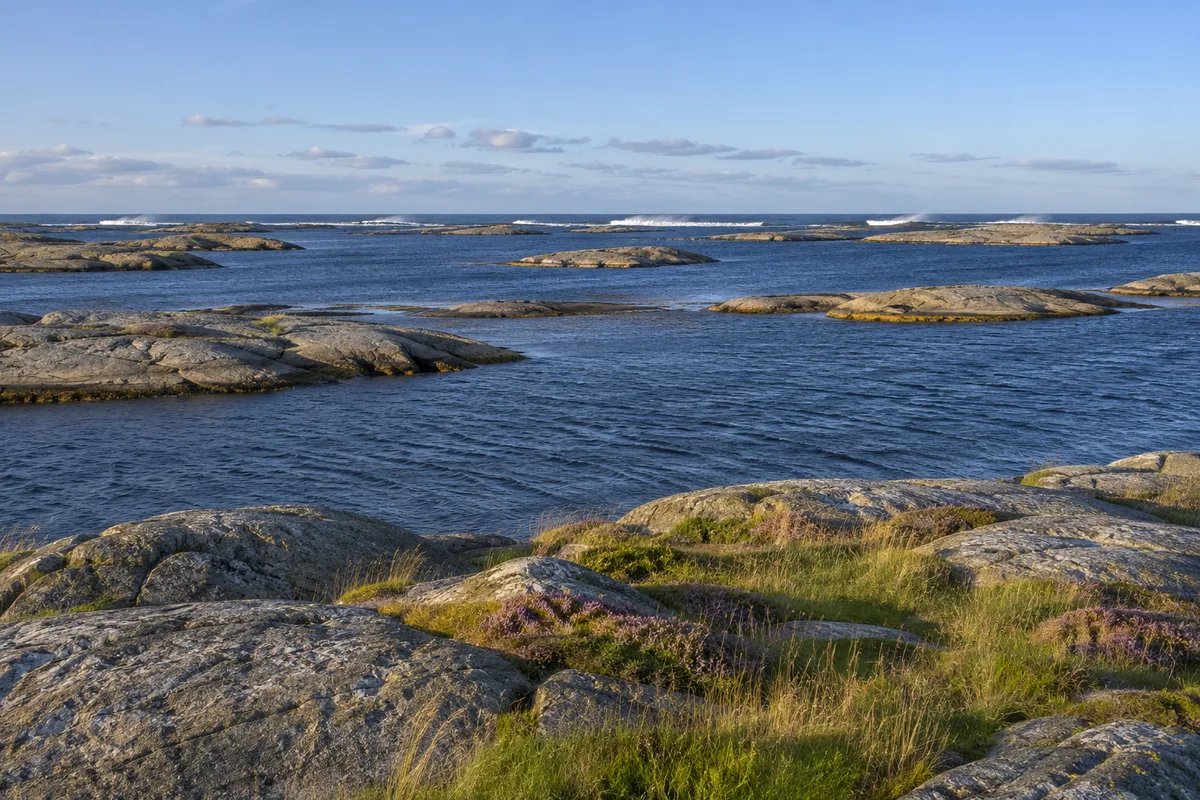
Frøya lies out in the open sea. Its north-west coast is heavily indented and has foul waters, that is, rocks and shoals. The Froan island group is regarded as a weather-beaten coastal area (SNL: Froan). The weather at sea can change quickly (Fiskeridirektoratet).
In boats under 8 m everyone wears a life jacket while the boat is under way. The maritime authority advises keeping it on when fishing from a stationary boat as well (Sjøfartsdirektoratet). More under Boat and life jacket and Thunderstorms and weather.
Related
- Fishing from a cutter and a boat and Fishing in bodden and fjords
- Angling in Norway: papers, export and rules for the whole country
- Salmon rivers in Norway, plus the neighbouring regions Western Norway and Northern Norway
- Cod, coley, halibut, salmon and sea trout in the fish encyclopedia
- Sea fishing and Closed season and minimum size explained
Sources
- Lovdata: Fangverordnung (høstingsforskriften), Mindestmaße und Schonzeiten (zuletzt geändert 14.09.2026)
- Lovdata: Verordnung über das Angeln auf Lachsfische im Meer (Fassung ab 01.01.2026), in Flüssen und Sondermaßnahmen 2026 (gültig bis 31.12.2026)
- Fiskeridirektoratet: Geschützte Arten, Heilbutt, Mindestmaße, Zurücksetzen, Ausfuhr, Register der Touristenfischereibetriebe und Regeln für Gäste
- Havforskningsinstituttet: Küstendorsch, Köhler, Rotbarsch, Lumb, Leng, Makrele und Spined loach
- Miljødirektoratet: Fischereiabgabe, Abgabe bezahlen und Angeln in Flüssen und Seen
- Norwegischer Zoll: Fischausfuhr (aktualisiert 03.06.2026) und Mattilsynet: Gerät desinfizieren
- Lovdata: Touristenfischereibetriebe, Fangmeldung, Aquakulturverordnung, Scholle im Borgenfjord und Schutzgebiet Froan
- Store norske leksikon: Møre og Romsdal, Leka, Hitra, Frøya und Haltenbanken
- Sjøfartsdirektoratet: Schwimmweste im Boot
Guide without guarantee, correct as of October 2026. What counts are the Norwegian regulations as currently in force, the guidelines of Fiskeridirektoratet and the rights holder’s fishing permit.