
Fishing waters · Norway
Fishing in Western Norway and the fjords
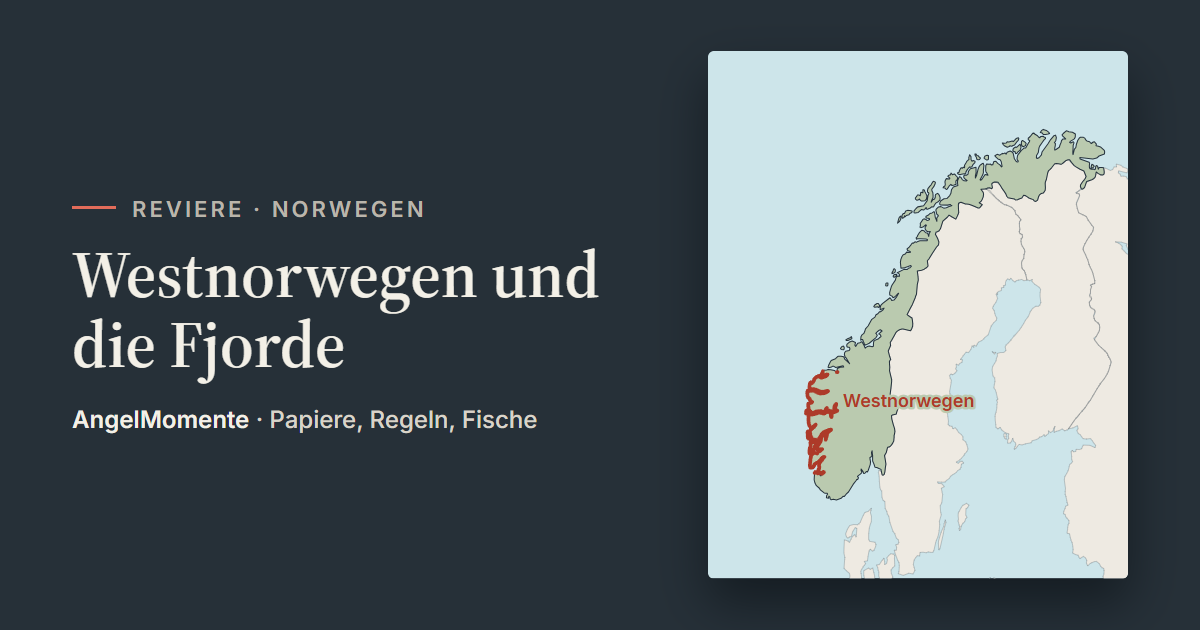
Western Norway stretches from Rogaland to Møre og Romsdal. Long, deep fjords cut far inland here, with islands and skerries in front of them. The 62° N line, at which several fishing rules change, runs right through the middle of the region.
- Papers
- Sea: no levy; salmon river: fishing permit, from 18 plus levy
- Season
- Sea all year; salmon and sea trout at sea with closures in some areas
As of October 2026
At a glance
- Papers
- Sea: no levy; salmon river: fishing permit, from 18 plus levy
- Licence and permit
- Season
- Sea all year; salmon and sea trout at sea with closures in some areas
| Fish | Minimum size | Closed season | Note |
|---|---|---|---|
| Cod | 40 cm | none | north of Stad 55 cm up to 4 nautical miles, 44 cm further out |
| Haddock | 32 cm | none | north of Stad 40 cm |
| Coley | – | none | minimum size only when selling |
| Mackerel | – | none | minimum size only when selling |
| Tusk | – | none | consumption warning for parts of the Sognefjord and Hardangerfjord |
| Pollack | – | none | |
| Halibut | 84 cm | protected all year round | south of Stad; north of it 20.12.–20.4., over 2 m release |
| Redfish | 32 cm | none | north of Stad only 1.6.–31.8. with a juksa |
| Sea trout | 35 cm | 1.3.–30.4. | only Ryfylke, inner Hardangerfjord, Møre og Romsdal; at sea |
| Lobster | 90 mm carapace | protected all year round | catch only for residents of Norway |
Catch regulation (høstingsforskriften): basic values south of 62° N (Stad), deviations north of it in the note. Salmonids at sea under the regulation on salmonids at sea, lobster under the lobster regulation. Correct as of October 2026. What counts is the regulation and your fishing permit (Erlaubnisschein).
Location and waters Hardangerfjord, Sognefjord, Nordfjord and Storfjord
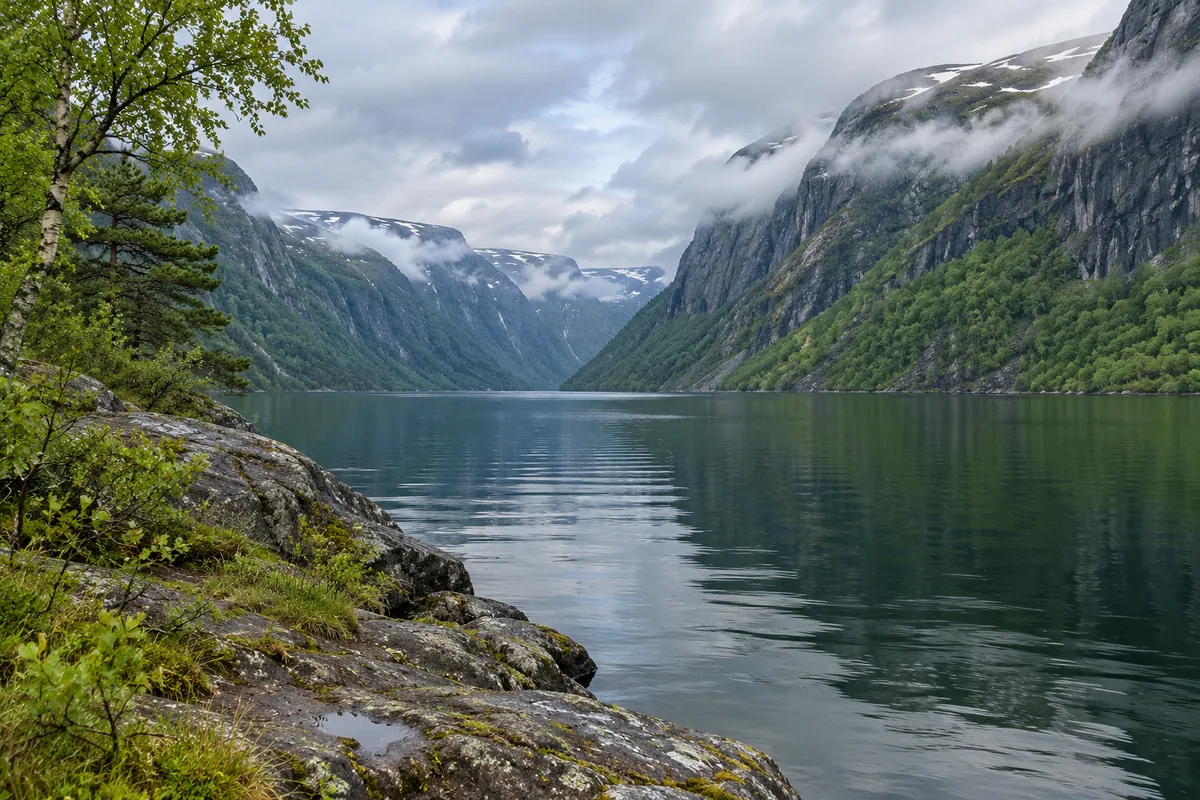
The great fjords of the region are the Hardangerfjord, Sognefjord and Nordfjord in Vestland and the Storfjord in Møre og Romsdal. At 205 km the Sognefjord is the longest and, at about 1300 m, the deepest fjord in Norway. The Hardangerfjord is 855 m deep, the Nordfjord 565 m (Havforskningsinstituttet: Brislingtokt 2025).
At the mouth of the Hardangerfjord, Sognefjord and Nordfjord there is a sill between 100 and 200 m deep, at the Sognefjord 170 m. Behind it come deeper basins whose water exchanges only slowly with the sea. On top lies a layer of brackish water from the rivers, usually 5 to 10 m thick. A belt of islands, islets and skerries shelters many stretches of coast and fjord from waves and wind from the open sea (Havforskningsinstituttet: Kyst og fjord).
The fisheries authority sets the 62° N line at the level of the Stad peninsula. Rogaland and the fjords up to the Nordfjord lie south of it, Møre og Romsdal with the Storfjord lies north. The box “At a glance” shows which minimum sizes (Mindestmaß) and closed seasons (Schonzeit) apply on either side.
Fish and best time Cod, coley, mackerel, ling and tusk
- Cod: The coastal cod between Stad and Lindesnes is regarded as a separate stock. It feeds in the fjords and along the coast and spawns in fjord and coastal basins (Havforskningsinstituttet: Kysttorsk).
- Coley and mackerel: Both ended up in the institute’s net in February 2022 on a trip through the fjords between Karmøy and Stad (Toktbericht Vestlandsfjorde).
- Ling and tusk: Both live in the Sognefjord and Hardangerfjord. The tusk has more mercury there than is permitted, the ling clearly less (Havforskningsinstituttet).
- Sea trout and salmon: In spring 2026 young salmon in the Hardangerfjord and Sognefjord carried many sea lice, as did sea trout from Ryfylke to Sotra (Havforskningsinstituttet).
The catch calendar shows when each species bites.
Papers and permit At sea no levy, on a salmon river a fishing permit
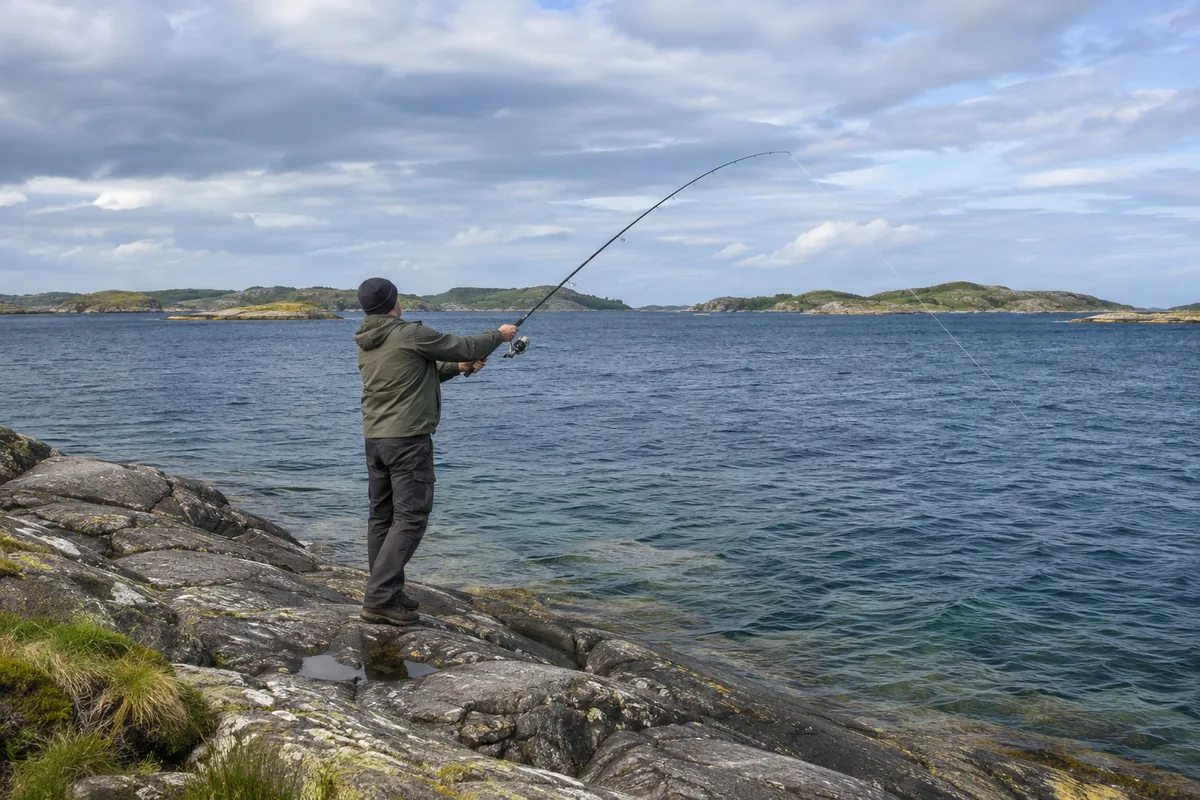
At sea there is no state levy for fishing with a rod or hand line, and as a guest you use only hand-held gear (Fiskeridirektoratet, German version). This also applies to salmon and sea trout at sea. With a rod and hand line you may in principle catch them all year from the shore and from a boat, except in the closed areas below (Verordnung über Lachsfische im Meer).
For a salmon river you need the local fishing licence, the fishing permit (fiskekort) from the landowner or the local administration. From the age of 18 you also pay the state fishing levy (Fischereiabgabe) online to the environment agency and take the receipt with you to the water (Miljødirektoratet).
Every salmon river has its own fishing times. If necessary the environment agency shortens them at short notice, in 2026 for example on three rivers in Møre og Romsdal (Sonderverordnung 2026). Ask the seller of the permit for the current situation. What applies to export and gear disinfection is under Angling in Norway.
Special rules Closure for salmon and sea trout, river mouths
- Closed period for salmonids: From 1 March to 30 April fishing for salmon and sea trout at sea is banned in parts of the Ryfylke fjords, in the inner Hardangerfjord and in the whole of Møre og Romsdal except Smøla. In the Sunndals-, Tingvoll-, Bergsøy- and Batnfjord inside the E39, sea trout are off limits all year (§ 2 der Verordnung).
- River mouths: In the first 100 m off the mouth of a salmon river all fishing is banned. The exception is a rod from the shore during the river’s fishing season. In Vestland, signed protection zones follow. There you may catch sea fish with a rod from the shore or from a stationary boat all year (Verordnung des Statsforvalteren in Vestland).
- Fish farms: Salmon has been farmed in the Hardangerfjord since the 1970s. When fishing you keep at least 100 m away from every installation, and 20 m when passing (Aquakulturverordnung).
- Halibut: South of Stad fishing is banned all year, and live fish go straight back. North of it halibut has a closed season from 20 December to 20 April, and fish over 2 m always go back (Fiskeridirektoratet).
- Redfish: North of Stad it is protected. Only from 1 June to 31 August may you catch it with a pilker or hand line (juksa) (Fiskeridirektoratet).
- Lobster: Only Norwegian citizens and people resident in Norway may catch it (Hummerverordnung, § 1). In the lobster protection areas up to Austevoll only hand line, rod, pilker and trolling line are allowed; in the Sognefjord this applies on the shore down to a depth of 50 m (Fiskeridirektoratet: Hummer-Schutzgebiete).
- Eating: Mattilsynet advises against eating tusk from parts of the Sognefjord. For parts of the Hardangerfjord and Sørfjord the warning covers tusk and ling (Mattilsynet: Warnungen).
Correct as of October 2026. The special regulation for salmon rivers applies until 31 December 2026. The boundaries of the protection zones and lobster protection areas are set out in the regulations and on the signs on site. What counts are the regulations.
Safety
In boats under 8 m you wear a life jacket while the boat is under way. The maritime authority advises keeping it on when fishing from a stationary boat as well. About 61 % of those killed in accidents involving leisure boats were not wearing a life jacket (Sjøfartsdirektoratet). Anyone born in 1980 or later needs a boating licence for boats over 8 m or with more than 25 hp, and at the helm the limit is 0,8 per mille (Fiskeridirektoratet). Keep an eye on the weather; on the coast it often changes quickly. More under Boat and life jacket.
Related
- Angling in Norway: papers, export and rules for the whole country
- Salmon rivers in Norway and Inland lakes and the fjell
- Fishing in bodden and fjords
- Cod, coley, ling, sea trout and gurnard in the fish encyclopedia
- Closed season and minimum size explained
Sources
- Havforskningsinstituttet: Kyst og fjord (03.07.2026), Brislingtokt 2025, Kysttorsk und Lachsläuse 2026
- Fiskeridirektoratet: Heilbutt, geschützte Arten, Mindestmaße und Regeln für Gäste
- Lovdata: Lachsfische im Meer (Fassung ab 01.01.2026), Vestland-Verordnung, Mindestmaße (14.09.2026), Hummerverordnung
- Miljødirektoratet: Fischereiabgabe und Angelkarte, Abgabe bezahlen
- Mattilsynet: Warnungen zum Verzehr
- Sjøfartsdirektoratet: Schwimmweste
Guide without guarantee, correct as of October 2026. What counts are the Norwegian regulations as currently in force, the local rules of the Statsforvalteren and the conditions of your fishing permit.