
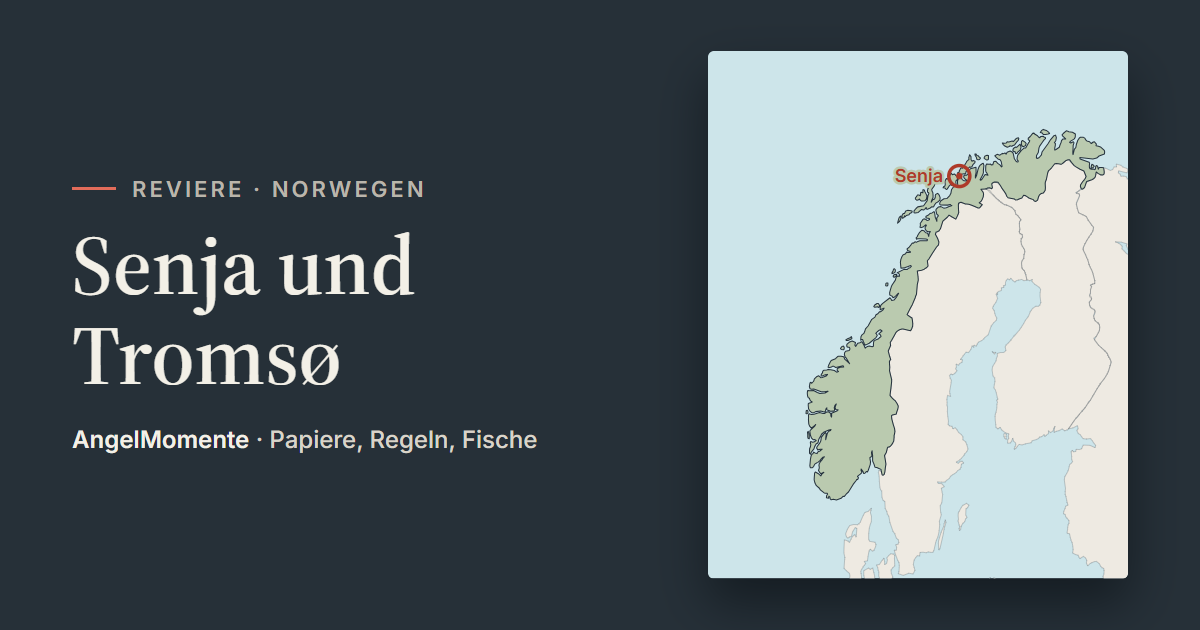
Fishing waters · Norway
Fishing on Senja and around Tromsø
Senja and the islands around Tromsø lie on the open coast of Troms. Cod, coley, haddock and halibut are among the common bottom fish here, and Troms is popular with visiting anglers. The rules and minimum sizes north of 62° N apply.
- Papers
- At sea no papers, hand-held tackle only; in rivers a fishing permit
As of October 2026
At a glance
- Papers
- At sea no papers, hand-held tackle only; in rivers a fishing permit
| Fish | Minimum size | Closed season | Note |
|---|---|---|---|
| Cod | 55 cm | none | 44 cm further than 4 nm from the baseline |
| Haddock | 40 cm | none | |
| Coley | – | none | |
| Halibut | 84 cm | 20.12.–20.4. | over 2 m always release |
| Redfish | 32 cm | 1.9.–31.5. | hand-held rod only (jukse) 1.6.–31.8.; 30 cm further than 12 nm |
| Atlantic wolffish | – | none | |
| Tusk | – | none | |
| Sea trout | 30 cm | none | closed 100 m off the mouths of salmon rivers |
Catch regulation (høstingsforskriften) and rules of the Fiskeridirektoratet for the sea north of 62° N; sea trout according to the regulation on salmonids at sea. In the rivers their own rules apply. Correct as of October 2026. What counts are the regulation and your fishing permit (Erlaubnisschein).
Location and waters Senja, Malangen, Tromsøya and Kvaløya
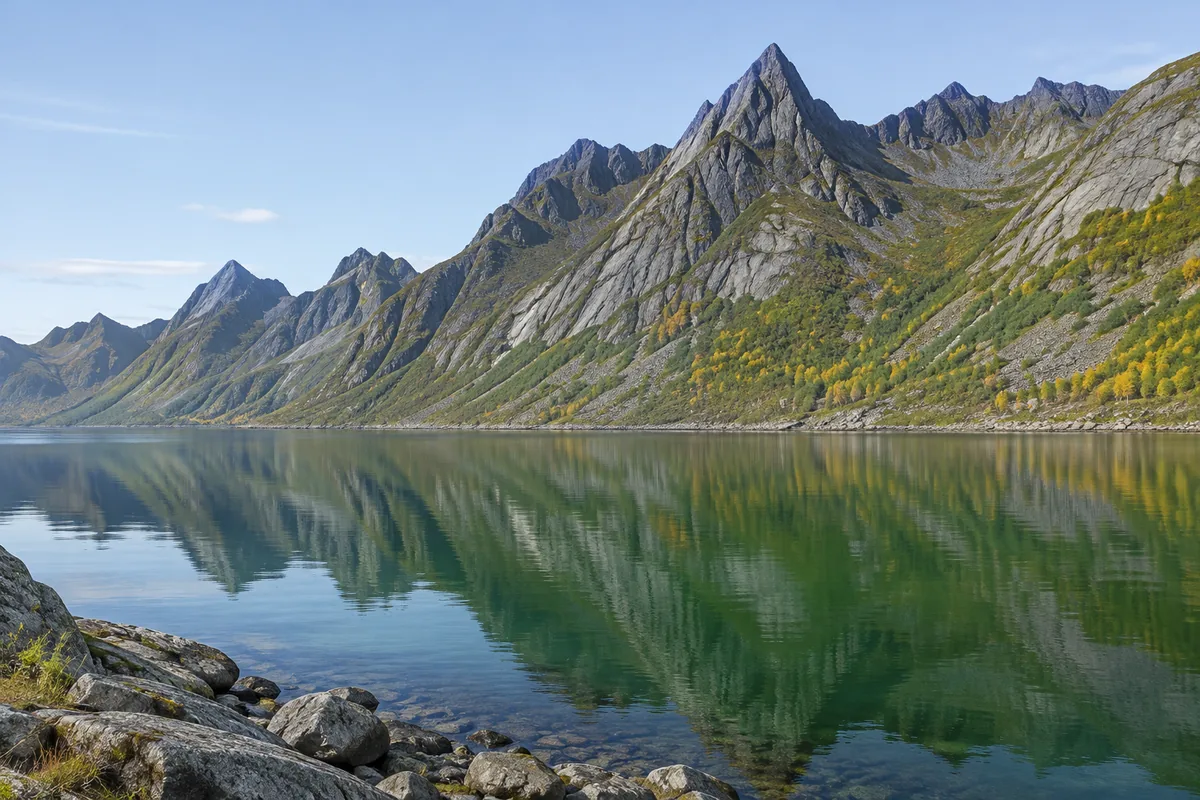
Senja is, not counting Svalbard, the second largest island of Norway and belongs to the municipality of Senja in Troms. In the north and north-west it lies open to the sea. In the north-east lies the Malangen, in the south-west the open Andfjord. The north and west of the island are marked by sharp peaks and deep fjords, and the villages there are mostly fishing villages (Store norske leksikon: Senja).
The municipality of Tromsø includes Tromsøya, Kvaløya, the south of Ringvassøya and Rebbenesøya and many small islands. Fishermen from Tromsø landed around 200 000 t in 2024, mainly cod and coley (SNL: Tromsø). The whole region lies north of Stad, so the rules for the sea north of 62° N apply (Fiskeridirektoratet).
Fish and the best time Cod, coley, haddock, ling and halibut
A report by the Havforskningsinstitutt describes the fish life of the coast from Kvaløya to Loppa north of Senja. Common bottom fish there are cod, coley, haddock, tusk, ling and halibut. In the outer areas skrei, haddock, coley and halibut spawn, in the fjords coastal cod, halibut, redfish and coley. Residents and visiting anglers take a considerable amount of fish on the coast of Troms (HI-Bericht 2025-27).
- Cod: About three quarters of the coastal cod live north of 67° N, partly in the same areas as the skrei (HI: Küstendorsch).
- Halibut: usually stays in its area, standing deep in winter and shallower in summer. Anglers can noticeably fish down the stock (HI: Heilbutt). So stick strictly to the minimum size (Mindestmaß) and closed season (Schonzeit).
- Wolffish: The Atlantic wolffish (gråsteinbit) lives along the whole coast as far as the Barents Sea and spawns in fjords and bays at depths of 50 to 150 m (HI: Seewolf).
- Coley: lives along the whole coast from Stad to the Kola peninsula and spawns in winter, most strongly in February (HI: Köhler).
When the species bite well is shown by the catch calendar.
Papers and permit No licence at sea, catch reporting at the angling operator
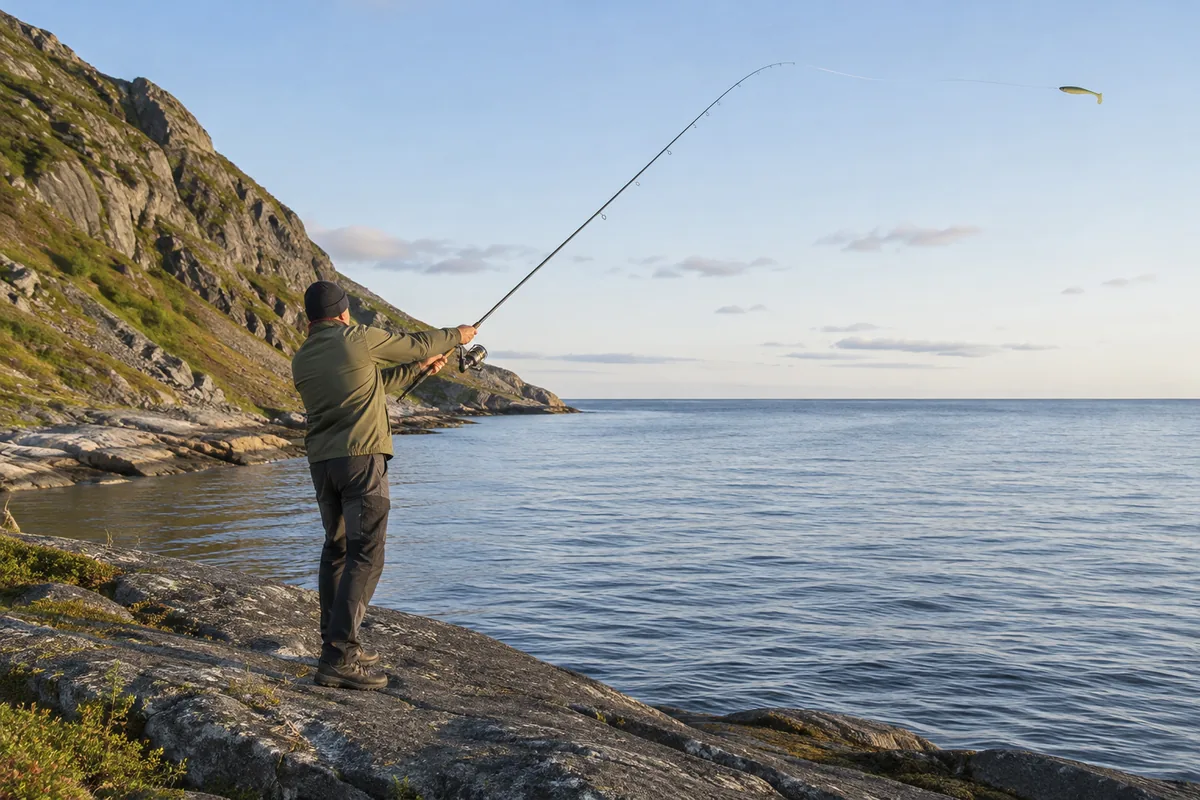
- Sea: You need no fishing licence, and with a rod or handline you pay no fishing levy (Miljødirektoratet). As a visitor from abroad you fish only with gear you hold in your hand and sell nothing from your catch (Fiskeridirektoratet).
- Angling operator: Registered angling operators (turistfiskebedrifter) report their guests‘ catches daily to the Fiskeridirektoratet (Verordnung über Angelbetriebe, § 3). Whether yours is one of them is shown in the authority’s register.
- Salmon rivers: In a river you buy the fishing permit (fiskekort) from the rights holder (Miljødirektoratet), and from 18 the state fishing levy (Fischereiabgabe) is added (Lachs- und Binnenfischereigesetz, § 30). The Miljødirektoratet sets the fishing time and quotas for each river. In 2026 two rivers in Troms were reopened after treatment against the parasite Gyrodactylus salaris, from 1 July to 31 August (Miljødirektoratet). Everything else is under Salmon rivers in Norway.
Special rules Halibut, redfish, lumpsucker and river mouths
- Halibut: In the closed season you release every viable fish, fish over 2 m always, because of their high content of pollutants (Fiskeridirektoratet: Heilbutt).
- Redfish and lumpsucker: You may catch redfish only from 1 June to 31 August with a hand-held rod (jukse). For lumpsucker (rognkjeks) recreational fishing is banned entirely in Troms (Fiskeridirektoratet: geschützte Arten).
- River mouths: On the 100 m off the mouth of a salmon river all fishing is banned, including marine fish. You may fish there only from the bank, as long as the river is open (Verordnung über Lachsfische im Meer, § 3).
- Nets and seines: If you enter an area with gear set out, you must find out where it lies. You never steer or moor your boat so that you damage gear or spoil other people’s catch. You compensate for any damage, including the lost catch (Fiskeridirektoratet: allgemeine Regeln).
- Herring fishing in winter: Usually from November to January larger vessels fish for herring with purse seines in northern Troms, since 2018 mainly near Kvænangen and Skjervøy (HI-Bericht 2025-27). With hooks you stay at least 100 m from seines that are set out, holding pens and fish farm cages. If you are in the fishermen’s way while they shoot the net, you make room when called (Fangverordnung, §§ 70 und 71).
- Fish farming: When fishing you stay 100 m away from farms, 20 m with a boat (Aquakulturverordnung, § 18).
- Export: Only those who fished through a registered operator and are at least 12 years old may take fish out of the country. In 2026 it is 15 kg, twice in the calendar year, from 1 January 2027 only 10 kg (Fiskeridirektoratet: Ausfuhr). This rule does not apply to salmon, trout and char (Ausfuhrverordnung).
Correct as of October 2026. For cod within 4 nautical miles of the baseline the larger size of 55 cm applies, further out 44 cm (Fangverordnung, § 47). Where the baseline runs, your angling operator will tell you. If in doubt, stick to 55 cm. Fishing times and quotas of the salmon rivers change every year, and what counts is the regulation in force.
Safety
In boats under 8 m you wear a lifejacket or flotation suit while under way. The maritime authority advises keeping it on even when fishing from a boat that is lying still (Sjøfartsdirektoratet). Many accidents involving visitors with hired boats are due to their not knowing the boat and the coast (Sjøfartsdirektoratet: Sicherheit für Angeltouristen). Ask the owner to show you the dangerous spots, the fish farms and the commercial fishing in the area.
The weather at sea changes quickly (Fiskeridirektoratet). So plan trips to the open north and north-west side of Senja with a margin. Warnings from the Meteorological Institute are on Yr (Meteorologisk institutt). You reach the coast radio station on 120. More under Boat and lifejacket and Thunderstorms and weather.
Related
- Northern Norway, Lofoten and Vesterålen and fishing holiday in Norway
- Salmon rivers in Norway
- Fishing from cutters and boats, fishing in lagoons and fjords and jigging with a pilker
- In the fish encyclopaedia: cod, coley, halibut and Atlantic wolffish
- Closed season and minimum size explained and Returning fish
Sources
- Lovdata: Fangverordnung (høstingsforskriften) mit Kapitel 10 (zuletzt geändert 14.09.2026), Lachsfische im Meer, Aquakulturverordnung, Angelbetriebe, Ausfuhrverordnung und Lachs- und Binnenfischereigesetz
- Fiskeridirektoratet: allgemeine Regeln, Heilbutt, geschützte Arten, Mindestmaße, Regeln für Gäste (Deutsch), Touristenfischerei und Ausfuhr
- Havforskningsinstituttet: Bericht 2025-27, Troms von Kvaløya bis Loppa (2025), Küstendorsch nördlich 62° N, Heilbutt, Seewolf und Köhler
- Miljødirektoratet: Fischereiabgabe, Angeln in Flüssen und Seen und Lachsfischerei 2026
- Sjøfartsdirektoratet: Schwimmweste im Boot, Sicherheit für Angeltouristen und Safe at sea in Norway (PDF, Juni 2025); Meteorologisk institutt: Gefahrenwarnungen
- Store norske leksikon: Senja und Tromsø
A guide without guarantee, correct as of October 2026. What counts are the Norwegian regulations in their current version and, for rivers, the rules of the rights holder and your fishing permit.