
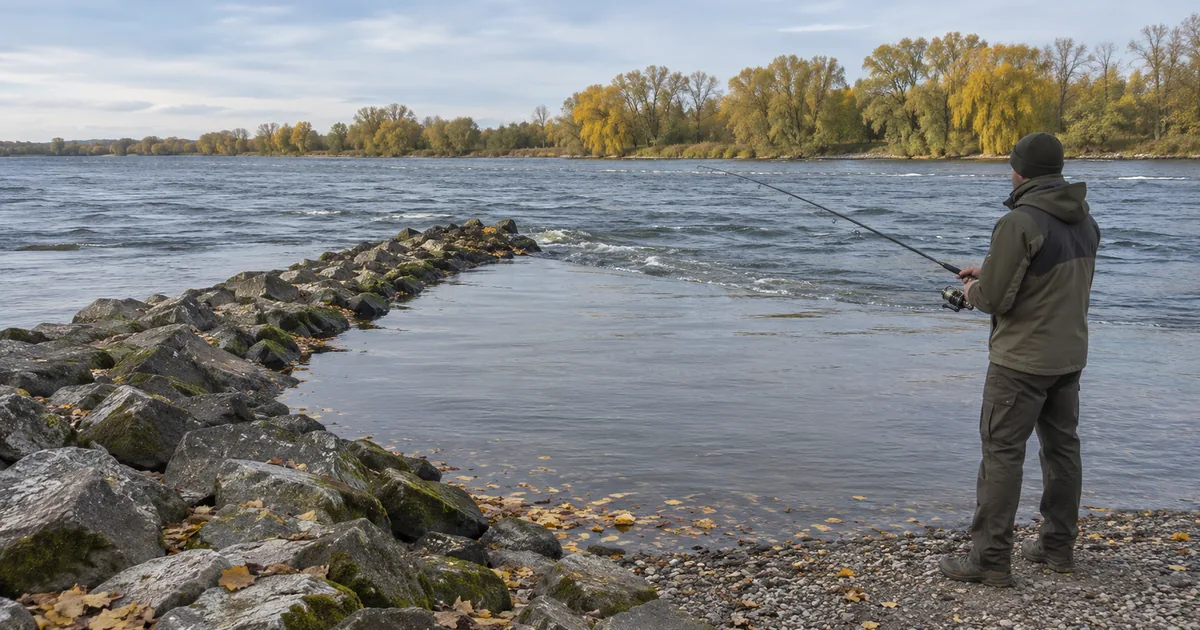
At a glance
- Holding spot
- Bank at the root; don’t walk on federal groynes
- Head and edge
- only reachable from the root on short groynes
- Rock armouring
- over the last few metres, wind evenly just above the stones
- Snag
- let the line drift downstream, then jerk from behind
- Gauge
- submerged: stay on the firm bank; low water: not out to the edge
Reading a groyne from root to head
A groyne is a dam that juts out from the bank across the river. The Bundesanstalt für Wasserbau (BAW) distinguishes its root at the bank, the crest, the head at the tip and the toe. It is usually built from tipped stones, often paved, and points slightly upstream. Between two groynes lies the groyne field.
The groyne pushes the flow into the middle of the river, where the main current runs. According to the BAW, between the heads lies a shear zone in which vortices turning on a vertical axis travel downstream. I call this line the edge. In the field a large vortex turns back, the eddy, and because the water flows much more slowly there, material settles on the bottom.
At the head the vortices often dig deep holes in the riverbed, the groyne-head scour holes. As a rule this gives fish a current channel, a scour hole and a shallow zone in the slack water, as the Regierungspräsidium Tübingen describes. What matters for where I stand: the head and the edge both lie about one groyne length from the bank.
Casting from the bank at the root
On federal waterways, § 2 of the Wasserstraßen-Betriebsanlagenverordnung (WaStrBAV) prohibits using federally owned groynes for purposes other than intended, and names walking on them as the first example. Anyone who walks on them anyway commits an administrative offence under § 7. Pedestrians, on the other hand, may walk on the federal bank, at their own risk. Only the Waterways and Shipping Office (Wasserstraßen- und Schifffahrtsamt) can allow an exception, for individuals by official notice or for everyone by a sign (§§ 3 and 6). So I stand on the bank next to the root and read the signs there first (status of the regulation: amendment of 2 September 2019, checked on 4 November 2026).
From there I first cast parallel along both flanks, then fan out into the field, where there are fewer snags on the flatter gravel. Whether the head and the edge come into play depends on the length of the groyne. On long river groynes both lie further out than a cast can reach.
The first cast along the flank tells me which it is. If the current pulls the line noticeably downstream just before the lure touches down, the lure was at the head. If it sinks calmly into the field, my cast ends short of it. Then I leave out the head and the edge and fish the flank and the field thoroughly.
Even where I am allowed to walk on a groyne, I don’t go out to the head. There, strong current and the scour hole meet large, often sharp-edged stones which, according to the DLRG, are slimy and very slippery when wet.
From my own experience
- Before I go to a new stretch, I measure on the aerial view of an online map how far the groynes reach into the river, so I already know at home on which of them I can cast to the head at all.
- I land a fish at the riprap from above with a long landing-net handle and don’t climb down onto the wet lower stones to do it.
- To get from one groyne field to the next, I walk along the service road or the top of the bank, not over the groyne itself.
Finding zander, perch and chub in their spots in October
In October all three are in their main season according to the catch calendar; their closed seasons (Schonzeiten) are set by your federal state (Bundesland). I look for zander in scoured-out holes. The deepest lies at the head, and on a short groyne I cast to it with a heavier jig head, because the water pressure is greatest there. On the side facing the current the lure sinks to the bottom faster than on the sheltered side, so less lead is enough there.
On a long groyne I am left with the steps where the rock fill of the flank meets the bottom, and the hollows in the field. During the day I tend to cast into deeper water, towards evening more towards the bank.
I look for perch in the sandier parts of the field. They lie in wait there in hollows or roam in groups of similar-sized fish, so I fish one field and then move to the next one downstream. In autumn chub like to sit on the edge, which on long groynes is often out of reach. On short ones I don’t pull the lure against the current there, but let it run close to the bottom with the flow.
| Where | What happens there | From the root | How I cast |
|---|---|---|---|
| Flank, riprap | stones with gaps, bites and snags | always within reach | parallel to the groyne, finally just above the stones |
| Back eddy in the field | water circles back, material settles | always within reach | light jig head, hollows and sandy patches |
| Drop-off | vortices travel downstream | only on short groynes | against the current, let it drift back with contact |
| Scour hole at the head | strongest current, hole on both sides | only on short groynes | heavier jig head, let it sink into the hole |
| Main current | fast, deep water of the navigation channel | hardly | by day, at most its margin |
Keeping contact with the lure at the riprap
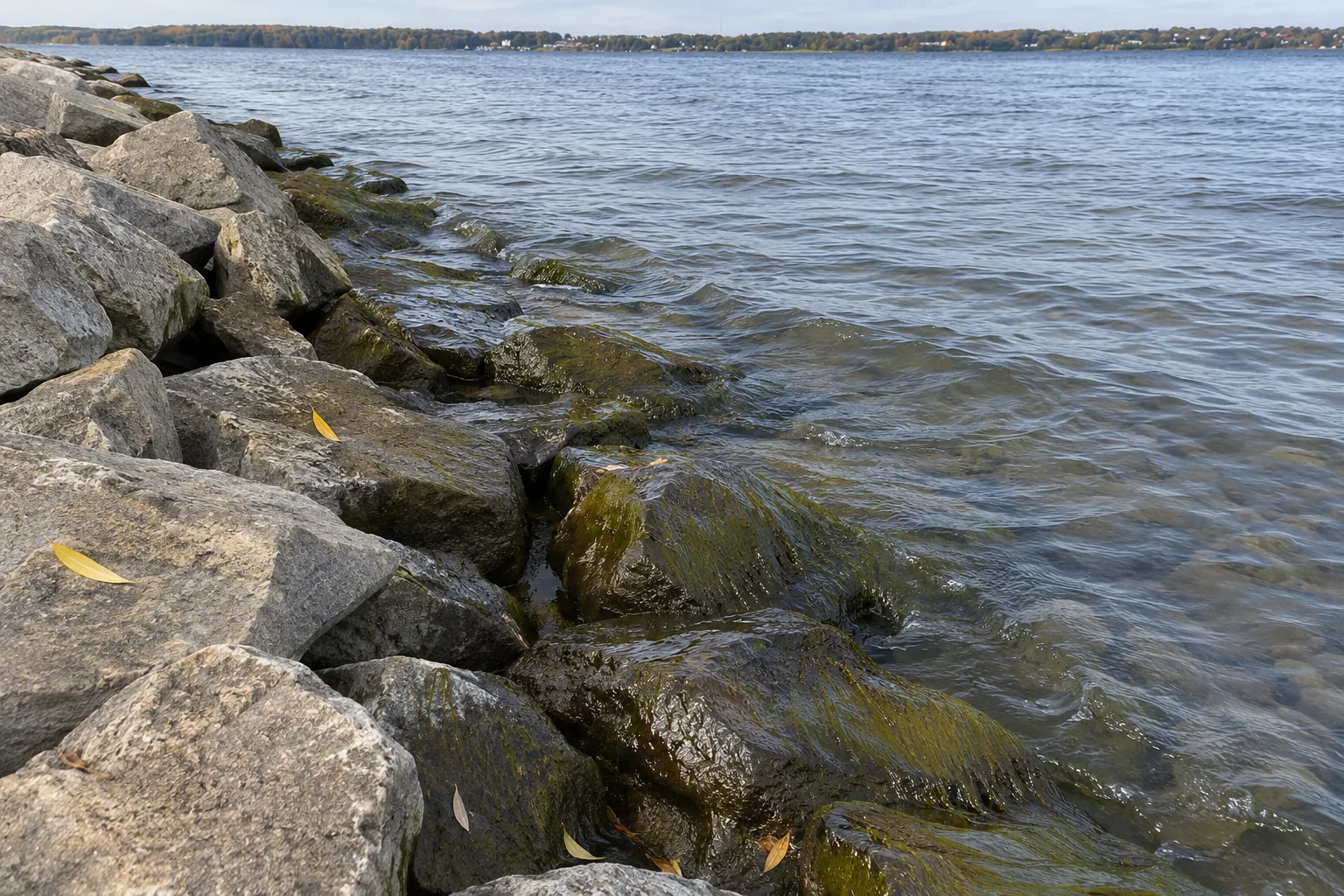
The flanks of the groyne and the reinforced bank are riprap. When the lure comes out of deep water to the riprap, anglers report lots of bites and just as many snags, so I fish out every cast right up to my feet.
When I cast against the current, the water pushes the soft plastic towards me. I keep winding slowly even while it sinks, so the line stays tight and I feel the touchdown, a bite or a snag starting early on.
Where the stones begin, I stop hopping the lure, raise the rod tip and bring it in evenly just above the stones. A long rod guides it better over the stones at your feet; length and stiffness are covered in Zander rod.
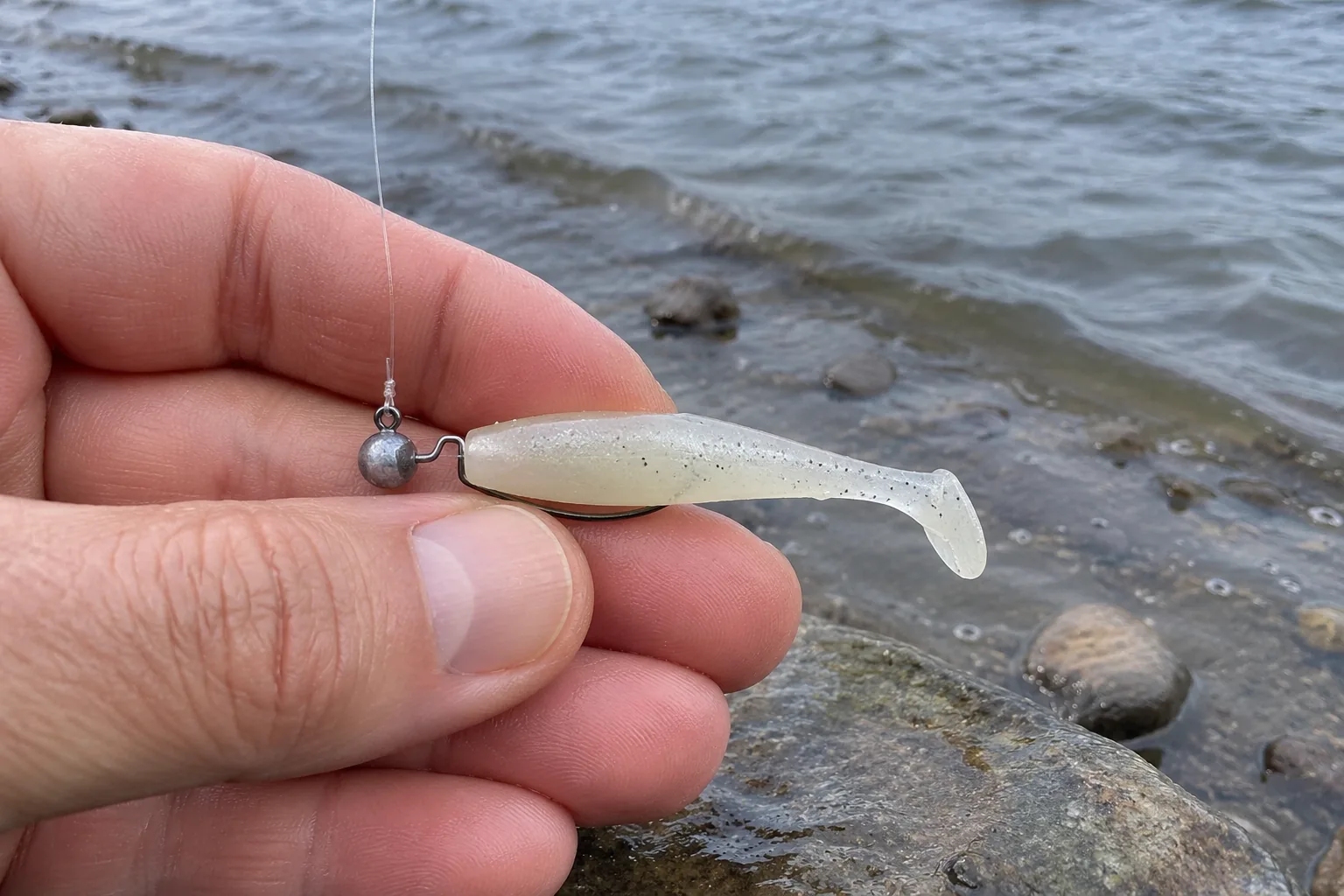
The heavier the jig head, the more easily it slips between the stones, so I fish as light as the current allows. On rough ground the hook point sits in the plastic, on an offset hook as with the Texas rig. In front of the braid I add one to two metres of fluorocarbon against abrasion on the stones.
 AI-generated
 AI-generated
Freeing a snag from behind
If the lure is stuck, I don’t keep pulling, otherwise it only wedges itself deeper between the stones. In strong current I open the bail arm and let line drift off until it forms a wide bow downstream behind the snag. Then I close the bail arm and give a hard jerk. The pull now comes from behind, from the opposite direction to the retrieve.
In the calm field I use the flick method. The rod tip points at the snag, the taut line lies over my index finger, I open the bail arm and let the line snap off my finger. The short jolt can free the lure from where it is wedged.
If neither works, I put the rod down, because trying it with the rod can cost you the rod, all the more so with braid. Then I pull the line slowly by hand until it gives, never wrapped around a bare finger.
Allowing for water levels and ships
At higher water levels, groynes can be completely submerged and barely visible from above, the DLRG warns. They are then of little use for fishing, because according to the BAW, when groynes are clearly overtopped the water in the field flows at a similar speed to the main current. If the crest of the groyne is submerged, I stay on the firm bank.
Low water tempts you the other way. You can then get very close to the navigation channel across the groyne field, and between the groynes, according to the DLRG, the depth increases sharply over a very short distance. The suction of passing ships is also stronger there when the water level is low. So I don’t walk out over exposed sand to the edge, even if it would then be within casting range.
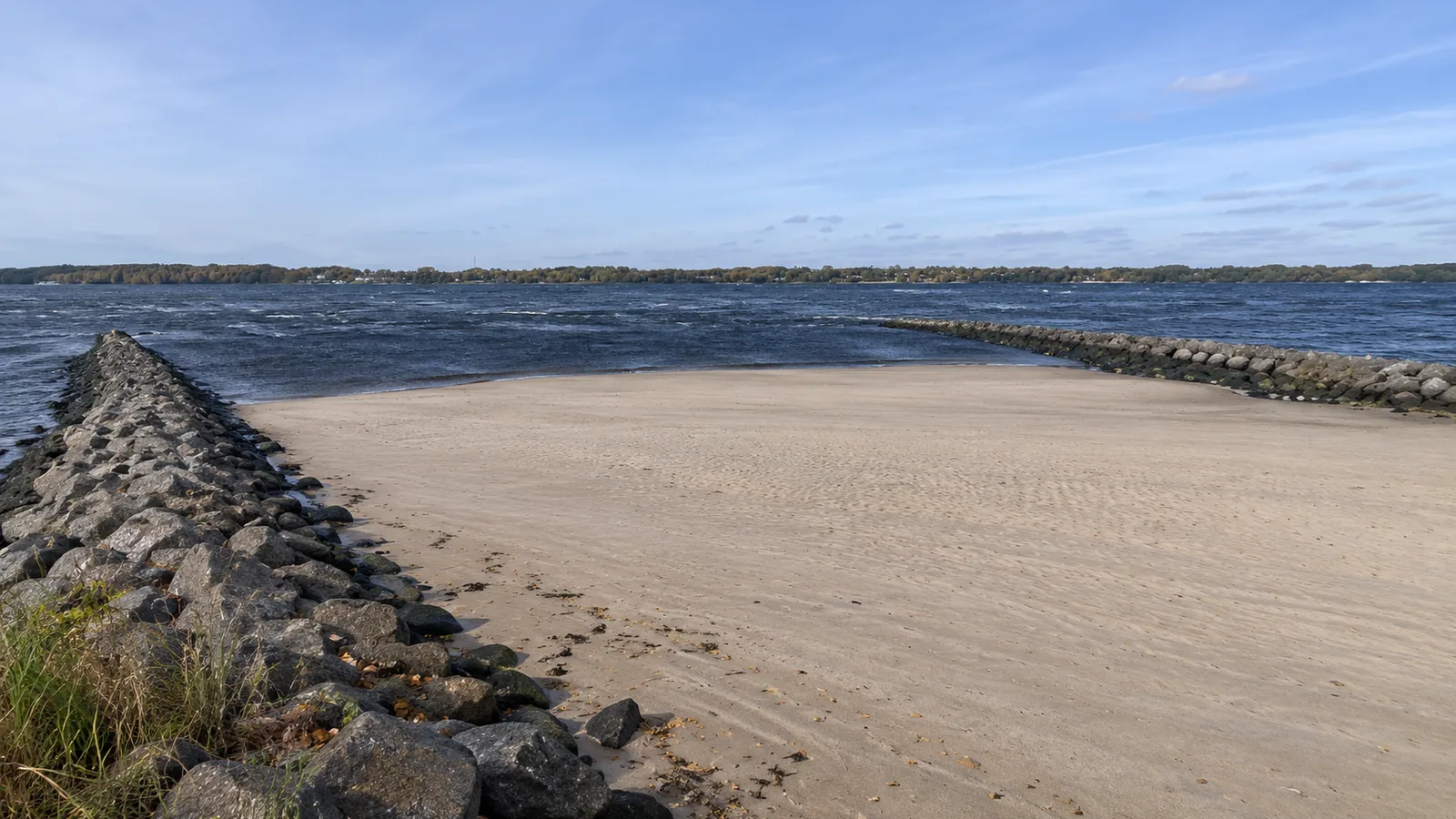
A passing ship first draws the water down at the bank and then sends it back, so my bag and landing net never lie on the lower stones.
A fall from a groyne does not end in calm water. According to the DLRG, strong cross-currents and return currents form at their heads and between the groynes, carrying even experienced swimmers away from the bank. So I keep my distance from the waterline and move off the lower stones when ships pass.
Frequently asked questions
Am I allowed to walk on a groyne?
Federally owned groynes on federal waterways only with an exception from the Waterways and Shipping Office (Wasserstraßen- und Schifffahrtsamt), which can also be given by a sign. The bank next to them is open to pedestrians, at their own risk. On the Hamburg river stretches of the Elbe the regulation does not apply under § 1; what applies there is covered in Fishing in Hamburg. On other waters, state law, the owner and the fishing permit (Erlaubnisschein) decide.
How do I reach the scour hole at the groyne head from the bank?
Only if the groyne is shorter than your cast, because the head lies one groyne length from the bank. Then I cast to it from the root with a heavier jig head. On long groynes I leave it out and fish the flank, the field and the steps in the rock fill.
Is a groyne worth fishing in high water?
Only as long as the water still flows around it. Once it is submerged, the water in the field flows almost as fast as in the main current, and the stones are barely visible.
Related
- Zander: where it sits in the river by day and at night
- Fishing for zander: lures and retrieve for river and lake
- Perch: profile of the shoaling predator
- Fishing for perch: choosing lures and the approach at the water
- Chub: where it sits through the year
- Fishing for chub: baits for current and cover
- Fishing on a river: groyne field, scour hole and rules on federal waterways
- Read the current: back eddies, scour holes and edges on any river
Sources
- Bundesanstalt für Wasserbau: Buhnen (Informationsgrafik) (Teile, Scherzone, Feldwirbel, Kolke, überströmte Buhnen)
- Regierungspräsidium Tübingen: Fischökologisch funktionsfähige Strukturen, 2. Auflage 2022 (Rinne, Kolk, Flachzone im Strömungsschatten)
- WaStrBAV § 1, § 2, § 3, § 6 und § 7, Fassung vom 2. September 2019 (Geltungsbereich, Betreten, Ausnahmen, Ordnungswidrigkeit)
- DLRG: Gefahren in fließenden Gewässern (Strömungen, überspülte Buhnen)
- DLRG Ortsgruppe Burscheid: Gefahren an Fließgewässern, 9. Auflage 2017 (Tiefe und Schiffssog zwischen den Buhnen bei Niedrigwasser, glatte, scharfkantige Steine)
- Fisch & Fang: Zander-Spots im Fluss (Kopf, Standplatz, Würfe, Gewicht, Bisse an der Packung)
- Fisch & Fang: Buhnen voller Barsche (Barsche im Feld, lange Rute)
- Blinker: Steckbrief Zander (Fangplätze, Fluorocarbon)
- Blinker: Döbelangeln im Herbst (Döbel an der Kante)
- Blinker: Hängerlösen (Abtreiben, Schnipp-Methode)
- Blinker: Die 7 häufigsten Fehler an der Angelrute (Hänger nicht über die Rute lösen)
- Rute & Rolle: Zander an der Steinpackung (leicht fischen, konstant kurbeln)
- Rute & Rolle: Carolina Rig vs. Texas Rig (verdeckte Hakenspitze)
Text AI-assisted, title image, drawing and all images in the text AI-generated. Sources opened and checked in November 2026; no graphic was taken from the sources.
All information is a guide only and without guarantee. How a groyne directs the water depends on its design, the water level and the river. Whether you may walk on a groyne and fish there is governed by the regulation for the waterway, the fishing permit (Erlaubnisschein) and state law.